

Market Commentary July 2026
.png)

Key Takeaways
• Global stock markets posted very strong returns in the second quarter. Solid corporate earnings reports helped fuel a strong rally in April, despite the ongoing conflict in the Middle East. Towards quarter-end, a ceasefire between Iran and the U.S. helped pull oil prices back down. That helped cool inflation fears and reduced any lingering concerns about the economic outlook.
• U.S. equities were among the global leaders in Q2. The S&P 500 index advanced 15%. That was driven by strong corporate profits and continued enthusiasm for artificial intelligence (“AI”). The Canadian equity market trailed other global markets, despite a solid 7% gain. The financial sector had very strong performance, but that was offset by negative returns for the resource sectors due to falling commodity prices.
• The Canadian bond market delivered a 2% return in Q2. The ceasefire pushed interest rates lower and revived risk appetite in the corporate bond market. Credit spreads recovered from their weakness in March. Corporate bonds had a solid quarter, even as the market absorbed a record $68 billion in issuance. That included landmark deals from hyperscalers Alphabet and Amazon, for which there was strong investor demand.
• Central banks kept their policy rates on hold on both sides of the border. The Bank of Canada kept its rate at 2.25%, pointing to a softer economy and an uncertain backdrop. The U.S. Federal Reserve also held steady but signaled a sharper focus on inflation under new leadership.
Economic and Market Update
Economic Summary: In the U.S., economic activity remained resilient during the second quarter despite heightened geopolitical uncertainty and elevated energy prices. Consumer spending and business investment continued to support growth, particularly in artificial intelligence and digital infrastructure. Inflation pressures increased during the quarter, due mainly to the higher energy prices caused by the on-going conflict in the Middle East. The labour market remained stable, although underlying trends weakened. The Federal Reserve maintained a cautious stance and left interest rates unchanged at its meetings in April and June. The June meeting was the debut meeting for new Federal Reserve Chairman Kevin Warsh. He emphasized his commitment to addressing inflation and stated that the Fed would “chart a new course.” That new course includes scaling back the use of forward guidance on the likely path of its future policy changes.
In Canada, the economy grew modestly during the quarter following earlier weakness. Labour market conditions were generally stable, although signs of meaningful improvement were limited.
Inflation pressures edged higher, largely reflecting elevated energy prices. The U.S. decision not to renew the USMCA in its current form at the 2026 review added to trade policy uncertainty. Concerns about future tariff measures and potential changes to the agreement continued to weigh on business confidence and investment. The Bank of Canada maintained its policy rate at 2.25% at both of its meetings in Q2, citing soft economic conditions and elevated uncertainty.
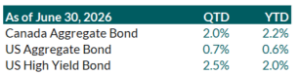
The Canada Aggregate Bond Index returned 2.0% in the second quarter. The market grew more confident that the war in Iran was approaching a conclusion, putting downward pressure on interest rates. That said, while interest rates ultimately fell during the quarter, there was volatility during the period. Interest rates peaked in May amidst uncertainty about the on-again, off-again negotiations between Iran and the U.S. With the ceasefire seeming to hold, by quarter-end interest rates had begun to reflect less inflation risk from energy prices.
This view of lower inflation has been reflected in the market’s expectation for the Bank of Canada’s benchmark interest rate. At the end of the first quarter, markets were pricing in a 70% chance of two 25 basis point increases by the end of 2026. At the end of Q2, that had fallen to a 50% chance of just one 25 bps increase.
In addition, the ceasefire has underpinned the risk-on tone to the corporate bond market. Credit spreads (i.e. the extra yield on corporate bonds versus government bonds to compensate for their extra risk) partially reversed the risk-off move in March and moved back towards levels we saw near the beginning of the year. Spreads could not fully regain lost ground due to the record volume of corporate bond issuance during the quarter. There were 101 bonds issued in Q2 totalling a record $68 billion, up an incredible 84% year-over-year. Driving that increase were two monster issues from U.S.-based hyperscalers. Alphabet, the parent company of Google, set a Canadian record by tapping the market for $8.5 billion in a single day in May. That record stood for almost an entire month before Amazon tapped the market for an incredible $14 billion in June. While that level of supply did move spreads wider as investors digested the deals, the fact that they were done in such size provided strong evidence of investors’ continued enthusiasm to support the primary issuance market.
Stock Markets:
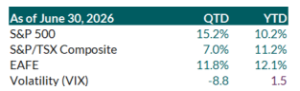
Global equity markets delivered strong returns in the second quarter. The rally was kick-started in April by solid corporate Q1 earnings reports. U.S. corporations posted strong profitability, fueling the recovery of the U.S. equity market from its sell-off in March. The S&P 500 index advanced 15%, driven by continued enthusiasm for artificial intelligence, with semiconductor stocks posting the strongest gains. Canadian equities gained 7%. The top-performing sector was financials, which benefited from resilient earnings and strong capital market activity. In contrast, the materials sector lagged as softer commodity and gold prices weighed on mining equities. The energy sector also underperformed amid lower crude oil prices. Meanwhile, international equities also advanced, with Europe, Australasia, and Far East Index (EAFE) gaining approximately 12%. It was also supported by resilient corporate earnings and improving economic sentiment.
U.S. Equities: U.S. equities staged a strong recovery in Q2, driven by better-than-expected earnings from semiconductor and AI infrastructure companies. Market leadership remained concentrated in a narrow group of AI beneficiaries. However, the industrials sector also delivered a solid quarter, reflecting healthy manufacturing activity and ongoing capital investment trends.
The AI infrastructure buildout continued to accelerate during the quarter. Memory chips emerged as a key bottleneck in the supply chain, as strong demand pushed prices higher. Industry estimates now suggest annual capital expenditures are approaching US$750 billion, up from US$400 billion last year. As investment requirements continued to rise, several large technology companies accessed debt and equity markets to help fund these capital-intensive projects. An example of this trend was SpaceX, which completed a record-setting IPO on June 12, raising US$75 billion at an offering price of US$135 per share. Following a strong market debut, the company’s market capitalization surpassed US$2 trillion, placing it within striking distance of the largest S&P 500 constituents by market capitalization. Its scale prompted many index providers, including Nasdaq, to fast-track the stock’s inclusion into their indices. The stock will be included in the Nasdaq-100 index on July 7, under revised entry rules designed for mega-cap listings. Nasdaq has changed its rule so that the biggest new companies could join its main index within 15 trading days, rather than waiting the usual three months. However, SpaceX remains ineligible for the S&P 500 is unlikely to qualify before mid-2027, as the index provider continues to require a demonstrated profitability track record.
Towards the end of the quarter, however, performance within AI-related equities became increasingly volatile following an extended period of outperformance. Semiconductor stocks came under pressure beginning in early June despite largely positive earnings releases. Strong results from companies such as Broadcom and Micron failed to extend the sector’s rally, reflecting a market that had already priced in exceptionally optimistic growth expectations. With valuations stretched and investor positioning crowded, even solid earnings were insufficient to drive further gains. As a result, investors increasingly rotated toward sectors less exposed to AI earnings risk, with financials and healthcare among the beneficiaries where valuations were more with compelling and earnings expectations appeared less demanding.
Canadian Equities: In Canada, the financial sector was the main driver of the S&P/TSX Composite’s gains. Bank stocks rallied as the major banks delivered broad-based earnings beats supported by strong capital markets activity. Higher equity underwriting and advisory revenues reflected improving deal volumes, while dividend increases and expanded buyback programs signaled confidence on the earnings outlook. A favourable reduction in domestic capital requirements announced in the quarter by Canada’s financial regulator was also supportive.
However, gains from the financial sector were partially offset by weakness in resources. Energy stocks gave back earlier gains as crude prices retreated from near-cycle highs following de-escalation in the Middle East. Materials lagged as several industrial and precious metal prices consolidated after a strong start to the year. That led to profit-taking across mining stocks. Against this backdrop, the TSX’s heavier exposure in financials and resources relative to high-growth technology proved both a source of stability and a relative performance constraint. The index was insulated from volatility within parts of the U.S. AI-driven trade but captured less of the technology-led gains that continued to drive U.S. large-cap outperformance in Q2.
Bottom line: Overall, the second quarter demonstrated the resilience of financial markets amid geopolitical developments, shifting policy expectations, and ongoing trade uncertainty. While investors remained attentive to inflation and monetary policy developments, market sentiment recovered in April and remained strong throughout the quarter. Economic growth remained generally constructive, corporate earnings were broadly supportive, and sustained investment in AI and digital infrastructure continued to provide an important tailwind for risk assets.
Downloadable Copy
| Mark Warywoda, CFA VP, Public Investments |
Ian Whiteside, CFA, MBA AVP, Public Investments |
Johanna Shaw, CFA Director, Public Investments |
Jin Li Director, Equity Investments |
||
| Wanyi Chen, CFA, FRM Sr. Quantitative Analyst |
Andrew Vermeer, CFA Senior Analyst, Credit |
Elizabeth Ayodele Analyst, Credit |
Edward Ng Cheng Hin Analyst, Credit |
Kate (Huyen) Vinh Analyst, Equity |
Francie Chen Analyst, Rates |
ADVISOR USE ONLY
Except for statements of historical fact, all statements in this document are forward-looking statements. These forward-looking statements represent the portfolio manager’s current best judgment as to what may occur in the future. However, forward-looking statements are subject to many risks, uncertainties, and assumptions, and are based on the portfolio manager’s present opinions and views. For this reason, the actual outcome of the events or results predicted may be materially different from what is expressed. Furthermore, the portfolio manager’s views, opinions, or assumptions may subsequently change based on previously unknown information, or for other reasons. Equitable assumes no obligation to update any forward-looking information contained in this document. The reader is cautioned to consider these and other factors carefully and to not to place undue reliance on forward-looking statements. Investments may increase or decrease in value and are invested at the risk of the investor. Investment values change frequently, and past performance does not guarantee future results. Professional advice should be sought before an investor embarks on any investment strategy.