

Site Search
552 results for open portal PROBLEMGO.COM how to get VIP treatment in prison with money Randers
- [pdf] myFlex Options Overview
- [pdf] Another reason to invest with Equitable
- [pdf] Personalized Brochure - Benefits of segregated funds in a Tax-free Savings Account
-
Market Commentary January 2026
.png "EAMG-(1).png")
Key Takeaways
Full year 2025:
• Government policy was very impactful for markets in 2025. U.S. trade policy unsettled markets in the first half of the year, as the U.S. implemented significant tariffs and engaged in tough negotiations with major trading partners. However, by mid-year, fiscal policy provided positive support for markets, particularly with the passing in the U.S. of the One Big Beautiful Bill Act in July.
• Artificial Intelligence (“AI”) continued to attract investment, particularly in the United States. This investment provided strong support for equity market performance.
• Global equity markets delivered strong performance, most notably Canadian equities, which returned an impressive 31.7%.
• Positive risk appetite supported solid corporate bond performance, which outpaced government bonds.
Fourth Quarter:
• U.S. equities advanced at a slower pace in the fourth quarter after a strong surge in the prior two quarters. Canadian equities outperformed U.S. equities, fueled by a powerful rally in the Materials, Consumer Discretionary, and Financials sectors.
• Canadian bond markets posted slightly negative returns during the quarter as higher interest rates weighed on performance. Strong corporate bond performance partially offset weakness in government bonds.
• Both the Bank of Canada and the U.S. Federal Reserve lowered policy interest rates during the quarter, with Canada dropping its benchmark rate by 25 basis points and the U.S. dropping its policy rate by 50 basis points. Both central banks signalled a cautious approach for further easing.
Economic and Market UpdateEconomic Summary: The U.S. economy continued to expand at a moderate pace, supported by strong consumer spending and AI investment. However, job growth slowed and the unemployment rate has edged higher. Inflation remains higher than the 2% target, despite easing trends. While some U.S. trading partners have made trade agreements, uncertainty remains regarding reciprocal tariffs, with a case before the U.S. Supreme Court as to their legality. The Federal Reserve lowered its policy interest rate twice during the quarter, first in October and again in December, to reach a target rate of 3.50% to 3.75%. Chair Powell cited downside risks to employment as a key factor behind the rate cut decisions and emphasized that officials are “well positioned” to wait and assess how the economy evolves.
In Canada, U.S. tariffs on steel, aluminum, autos, and lumber have weighed heavily on these sectors. While most goods continue to enter the U.S. tariff-free due to the Canada-United States-Mexico Agreement (“CUSMA”), broader uncertainty around U.S. trade policy is dampening business investment. Third quarter GDP growth exceeded market expectations, but growth tracked weaker in the fourth quarter amid the trade disputes. The labour market showed signs of improvement in the fourth quarter after earlier weakness. Headline inflation has hovered near the 2% target, while core inflation remained persistent. The Bank of Canada lowered its policy interest rate by 25 basis points to 2.25% in October and made no changes in December. Going into 2026, trade uncertainty remains with the CUSMA up for renegotiation. The Bank of Canada reiterated its readiness to respond if new shocks or accumulating evidence materially alter the outlook.
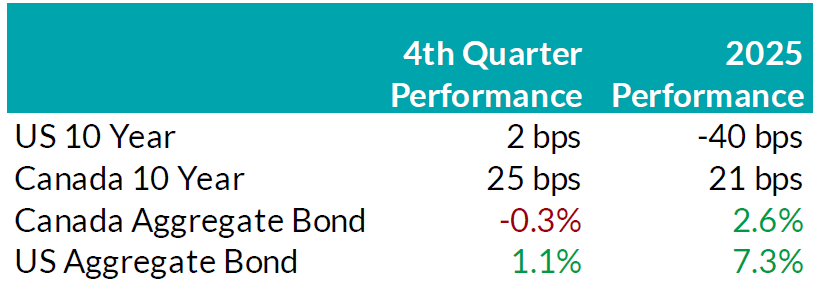 Bond Markets: During the quarter, the FTSE Canada Universe Bond Index returned -0.3% as interest rates on Canadian bonds rose (bond prices fall as interest rates go up). The increase reflected reduced expectations for interest rate cuts by the Bank of Canada and a higher risk premium demanded by investors for long-term debt. Although interest rates increased, credit spreads (i.e. the extra yield on corporate bonds versus government bonds to compensate for their extra risk) continued to move lower. These lower credit spreads resulted in positive overall returns for corporate bonds in the quarter, despite the overall bond market recording a loss. Tightening credit spreads reflected the continued risk-on tone to the market. Despite some volatility, lower-rated BBB bonds generally performed better than higher-quality A-rated bonds. Credit spreads have now rallied back to the tightest spreads since the 2008 financial crisis, nearing the tightest spreads in history. Despite expensive levels, investors remain buyers of corporate bonds, evidenced not just by falling credit spreads, but also by investors’ enthusiasm to support the primary issuance market. Corporate bond supply continues to set new records, with an impressive $37.5 billion in new issuance in the fourth quarter helping 2025 to exceed the prior year’s issuance. All told, 2025 saw an impressive $160 billion in new issuance via 358 new bonds, versus 2024’s prior record of $139 billion from 301 new bonds.
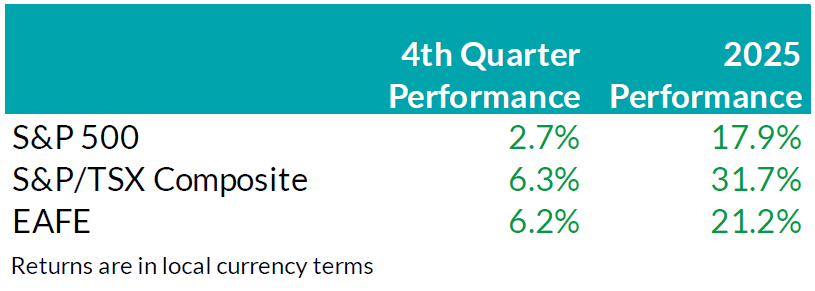 Stock Markets: The fourth quarter marked a pivotal shift in the global equity market rally of 2025. After three quarters of a highly concentrated, tech-led rally in the U.S., cyclical and valueoriented sectors outperformed in Q4. The S&P 500 advanced at a slower 2.7% in the fourth quarter, reflecting a market that is recalibrating after an extended period of concentrated gains. Canadian equities outperformed U.S. equities as the S&P/TSX Composite returned 6.3% in the quarter, finishing the year with an impressive 31.7% return. That was its strongest annual gain since 2009. The strong returns in Canadian equities were fueled by a powerful rally in the Materials sector, supported by soaring gold and base metal prices, and reinforced by the resilience of the Consumer Discretionary and Financials sectors. Internationally, developed markets in Europe and Asia gained 6.2% for the quarter, bringing their annual return to 21.2%. This move signals a healthy rebalancing as global investors rotated into attractivelyvalued international equities to hedge against elevated U.S. valuations. Capital is now flowing toward regions and sectors offering stronger earnings visibility and defensive characteristics rather than purely speculative growth.
U.S. Equities: U.S. equities entered the fourth quarter at elevated valuations. Despite fundamentally strong earnings growth, stock prices struggled to move higher because investor expectations were for even stronger growth. Technology remained the primary driver of earnings, but the sector faced intense pressure to prove its value. Specifically, investors questioned the pace at which companies could convert AI investments into actual revenue. Investors also worried that growth remained concentrated among too few companies rather than more broadly across the economy. Sector-wise, Communication Services emerged as the top performer for the full year due to significant margin expansion. This was driven by a wave of media-related merger activity and the successful use of AI to make digital advertising more efficient. Industrials also advanced as new tax incentives for domestic manufacturing boosted factory orders. Nevertheless, the market remains concentrated with the top ten stocks representing nearly 40% of the S&P 500 Index. This level of concentration makes the market vulnerable to sudden price swings. As inflation moderated and the Federal Reserve cut rates in December, investors shifted toward more defensive sectors and international equities. This rotation signals a preference for companies with stable cash flows over speculative growth.
Canadian Equities: The Canadian market was a global standout during the quarter, supported by lower borrowing costs, a stable Financials sector, and rally in the prices of metals (including gold, but also base metals like nickel and copper). The Materials sector led the way as a weaker U.S. dollar and geopolitical tensions pushed gold to a record of US$4,550 per ounce in late December. For major mining companies, these prices generated record cash flow allowing them to raise dividends and buy back shares. The Bank of Canada interest rate cut supported both the Consumer Discretionary and Financials sectors, reducing borrowing costs, and helping banks maintain stable net interest margins. The Big Six Canadian Banks delivered strong earnings results in Q4. These were driven by a surge in capital markets activity and better-than-expected provisions for credit losses, as the economy remained resilient. Trading at 17 times forward earnings, the Canadian market appears attractively valued, prompting investors to shift away from U.S. volatility toward more tangible assets and reliable dividends.
Bottom line: The final quarter of 2025 saw a notable shift in investor positioning. As recession fears receded, attention turned to navigating a period of moderate economic expansion. In Canada, capital flowed into profitable, cash flow-generating companies in the Financials and Material sectors. Momentum in U.S. equities slowed as investors reduced risk amid caution around AI developments. Although major indices remain highly valued, opportunities persist in sectors and regions with stable cash flows and pricing power.
Downloadable Copy
Mark Warywoda, CFA
VP, Public InvestmentsIan Whiteside, CFA, MBA
AVP, Public InvestmentsJohanna Shaw, CFA
Director, Public InvestmentsJin Li
Director, Equity Investments
Wanyi Chen, CFA, FRM
Sr. Quantitative Analyst
Andrew Vermeer, CFA
Senior Analyst, Credit
Elizabeth Ayodele
Analyst, Credit
Edward Ng Cheng Hin
Analyst, Credit
Kate (Huyen) Vinh
Analyst, Equity
Francie Chen
Analyst, Rates
ADVISOR USE ONLY
Any statements contained herein that are not based on historical fact are forward-looking statements. Any forward-looking statements represent the portfolio manager’s best judgment as of the present date as to what may occur in the future. However, forward-looking statements are subject to many risks, uncertainties, and assumptions, and are based on the portfolio manager’s present opinions and views. For this reason, the actual outcome of the events or results predicted may differ materially from what is expressed. Furthermore, the portfolio manager’s views, opinions or assumptions may subsequently change based on previously unknown information, or for other reasons. Equitable® assumes no obligation to update any forward-looking information contained herein. The reader is cautioned to consider these and other factors carefully and not to place undue reliance on forward-looking statements. Investments may increase or decrease in value and are invested at the risk of the investor. Investment values change frequently, and past performance does not guarantee future results. Professional advice should be sought before an investor embarks on any investment strategy. - [pdf] Guide to MGA contracting
-
EAMG Market Commentary July 2024
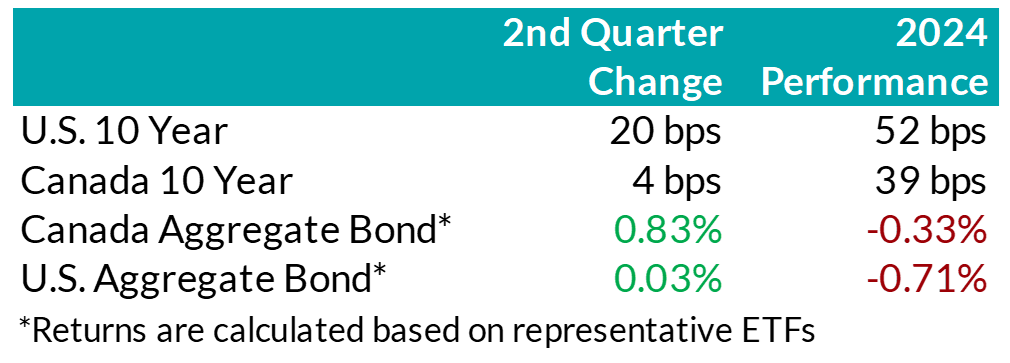.png "Picture1-(3).png") Rates & Credit – In Q2 2024, U.S. inflation and economic growth data was mixed, leading to moderately higher interest rates in the U.S. Meanwhile, in Canada, long-end interest rates were little changed during the quarter, but short-term interest rates fell. That was due to the weaker economic outlook, as well as the Bank of Canada’s decision to reduce its overnight interest rate in June, with anticipation of further monetary policy easing to come. Canadian corporate bonds returned 1.1%, outperforming the 0.8% return of government bonds as well as the 0.9% return for the overall FTSE Canada Universe Bond index. Shorter-dated bonds outperformed longer-dated bonds. Within corporate bonds, lower-rated BBBs outperformed higher-rated A bonds, while industries that have shorter-dated debt (e.g. real estate and financials) outperformed those that tend to have longer-dated debt (e.g. communications and infrastructure).
Rates & Credit – In Q2 2024, U.S. inflation and economic growth data was mixed, leading to moderately higher interest rates in the U.S. Meanwhile, in Canada, long-end interest rates were little changed during the quarter, but short-term interest rates fell. That was due to the weaker economic outlook, as well as the Bank of Canada’s decision to reduce its overnight interest rate in June, with anticipation of further monetary policy easing to come. Canadian corporate bonds returned 1.1%, outperforming the 0.8% return of government bonds as well as the 0.9% return for the overall FTSE Canada Universe Bond index. Shorter-dated bonds outperformed longer-dated bonds. Within corporate bonds, lower-rated BBBs outperformed higher-rated A bonds, while industries that have shorter-dated debt (e.g. real estate and financials) outperformed those that tend to have longer-dated debt (e.g. communications and infrastructure).
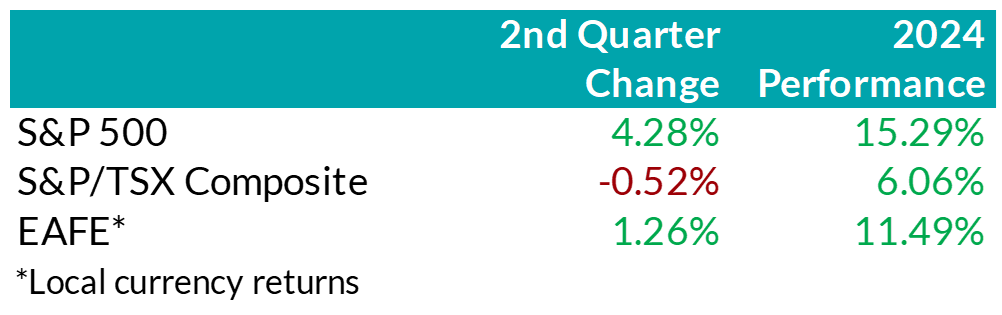.png "Picture2-(2).png") Equity Overview – Against the backdrop of volatile inflation data and a lack of indication from the Federal Reserve that it was prepared to start cutting interest rates yet, U.S. equity markets decoupled from other regions. Crowding into AI-focused, mega-cap names accelerated in Q2. More specifically, investors defaulted toward the Magnificent 7 to navigate the current period, overlooking broadening earnings breadth and less expensive valuations from the remaining S&P 493. Outside the U.S., equity returns were generally mundane in dollar terms. That said, emerging markets proved to be a bright spot for investors seeking value, as the rebound in heavily discounted Chinese equities helped push frontier markets higher.
Equity Overview – Against the backdrop of volatile inflation data and a lack of indication from the Federal Reserve that it was prepared to start cutting interest rates yet, U.S. equity markets decoupled from other regions. Crowding into AI-focused, mega-cap names accelerated in Q2. More specifically, investors defaulted toward the Magnificent 7 to navigate the current period, overlooking broadening earnings breadth and less expensive valuations from the remaining S&P 493. Outside the U.S., equity returns were generally mundane in dollar terms. That said, emerging markets proved to be a bright spot for investors seeking value, as the rebound in heavily discounted Chinese equities helped push frontier markets higher.
U.S. Fundamentals – Corporate earnings continued to surpass expectations last quarter with stable operating margins helping businesses report better-than-expected bottom line results. Investors remain focused on the ability of companies to sustain debt levels ahead of renewing debt obligations, rewarding businesses with a strong ability to generate stable cash flows. Moreover, while prior quarters have witnessed earnings growth that was largely driven by highly profitable mega-cap technology stocks, U.S. markets are witnessing a broadening trend in earnings strength, with previously stunted segments of the market recovering. Our work shows that members of the Russell 1000 index, excluding the Magnificent 7, posted a median earnings growth of about 6% last quarter, with nearly 60% of companies increasing earnings versus the year prior. Furthermore, we observed an increase in the number of major companies that expect improving financial performance to approximately 27%, suggesting that the recovery in earnings breadth may persist.
U.S. Quant Factors – As mentioned, concentration in the equity market drove a surge in valuations as investors continued to chase specific mega-cap technology stocks. In fact, within the Russell 1000 growth factor – which screens for companies whose earnings are expected to grow at an above-average rate relative to the market – the Magnificent 7 totaled nearly 55% of the entire index by quarter-end. In addition, the Nasdaq 100 – which is generally viewed as a technology-biased index – saw the weight of the Magnificent 7 rise to almost 43% of the entire index by the end of the quarter. Furthermore, the equal-weighted S&P 500 underperformed the cap-weighted index by nearly 7% last quarter, bringing the year-to-date divergence to about 10%. With concentration accelerating, the cap-weighted index outperformance has soared past Covid-era levels, a period that saw investors rapidly crowd into profitable technology names due to panic and economic uncertainty. We remain cautious of a severely crowded market that trades near all-time highs as strong performance from 5-7 names distorts the overall stature of market conditions.
Canadian Fundamentals – Although Canadian companies exceeded bleak forecasts, earnings continue to contract on a year-over-year basis. Furthermore, earnings revisions have grinded lower with easing monetary conditions unable to offset concerns of a slowing economic environment. We note the sharp contrast versus the U.S. as the bifurcation of earnings performance widens. The CRB Raw Industrials Index, a measure of price changes of basic commodities, broke out of recent ranges as metals rallied higher despite a stronger U.S. dollar and elevated interest rates. The mining industry benefited from a sustained elevation in prices, helping the materials sector outperform over the quarter. Returns from the heavily-weighted Canadian banks were constrained last quarter with company-specific drivers – including regulatory challenges from TD, and underwhelming U.S. results from BMO – limiting performance. More broadly, the banks continue to build prudent credit provisions to mitigate uncertain economic forecasts and remain well capitalized.
Canadian Quant Factors – With investors remaining attentive to businesses’ ability to create value relative to financing costs, we see value in high quality, dividend-paying companies with strong earnings sustainability and a healthy degree of leverage. Based on our work, investors of the Canadian banks appear well compensated, with the current premium between value creation and current yield remaining compressed. In our opinion, the market has modest expectations regarding prospects for value generation from the banks and, therefore, we believe the industry stands to benefit if the premium reverts closer to historical norms. We also continue to see sources of quality dividend opportunities within certain areas of the energy sector. More specifically, we believe companies that have taken steps to improve their balance sheets through deleveraging efforts, and with improved operating leverage, offer attractive prospects given their stable and high-yielding composition.
Views From the Frontline
Rates – During the first half of the second quarter, interest rates in both Canada and the U.S. increased, continuing the upward momentum from Q1. Higher-than-expected inflation data in the U.S. along with mixed economic growth data caused investors to push out expectations for when the U.S. Federal Reserve would start lowering its interest rate. This trend shifted in the second half of Q2, as positive economic momentum slowed in the U.S. economy and inflation data began to soften. Interest rates in Canada declined more rapidly than in the U.S. due to more benign inflation, a weaker job market, and economic growth remaining below population growth. This economic weakening provided the confidence required for the Bank of Canada to cut rates by 25 basis points in June to 4.75%. The Bank also signaled that if inflation continues to ease and the Bank’s confidence grows that inflation would continue to trend toward its 2% inflation target, it is reasonable to expect further cuts. The second quarter marked a pivotal point for the global policy easing cycle. Sweden, Canada, and the European Central Bank all began lowering their policy rates, and Switzerland made a second rate cut, following one in Q1. The market continues to speculate on the timing of the U.S. Federal Reserve’s first rate cut. Interest rate cut expectations are largely unchanged in Canada since last quarter, with a total of three rate cuts expected throughout 2024. Expectations for the rate cuts by the U.S. Federal Reserve declined slightly, however, to two cuts in 2024.
Credit – The risk premium for corporate bonds (versus government bonds) was largely flat over the quarter, with spreads approaching the tight post-pandemic levels experienced in 2021. Corporate bond supply continues to be very robust, with $41bn in new issuance. Year-to-date, corporate issuance has set a new record, with an impressive $80bn in issuance. On balance, we do not think the current risk premium adequately compensates for downside risk, particularly in longer-dated corporate bonds, and have a bias towards shorter-dated credit where we view the risk / reward trade-off as being more favourable.
Equity – On the backdrop of a heavily concentrated U.S. market rally, we remain cautious of the distortion to market returns from high-flying technology stocks. As a result, we continue to favour a combination of the Dow Jones Industrial Average and the S&P 500 for our broad U.S. market exposure. The Dow provides a more diversified exposure to 30 prominent large-cap companies and less concentration in technology relative to the S&P. Broadening earnings strength presents an opportunity for previously out-of-favour names to “catch-up”. In our view, companies outside the Magnificent 7 that have demonstrated robust earnings growth, strong cash flow generation, along with decreased debt loads, are well-positioned to benefit from internal market rotations. As such, we gain exposure to these companies through the quality factor – companies with higher return-on-equity, strong operating performance, and healthy leverage levels – and the dividend growth factor – businesses with a lengthy and established history of increasing dividends.
In Canada, we remain attentive to how efficiently corporations are generating profits relative to financing costs. Looking forward, we continue to monitor the ability of businesses to generate profits given a decline in capital spending. More specifically, we are focused on businesses’ ability to grow and sustain dividends amid the lag between easing monetary conditions and consumption. Due to this, we observe value in higher yielding companies that are higher on the spectrum of quality. Geographically, we maintain our overweight U.S. exposure, underpinned by encouraging U.S. inflation data trends, broadening corporate earnings growth, and normalizing consumption. In addition, sluggish Chinese data and the lack of positive earnings revisions from EAFE tilt the risk-adjusted return profile in favour of the U.S. Lastly, as a Canadian investor, fluctuations in the Loonie’s relative value versus other major currencies continues to present tactical trading opportunities within our investment mandate.
Downloadable Copy
Mark Warywoda, CFA
VP, Public Portfolio ManagementIan Whiteside, CFA, MBA
AVP, Public Portfolio ManagementJohanna Shaw, CFA
Director, Portfolio ManagementJin Li
Director, Equity Portfolio Management
Tyler Farrow, CFA
Senior Analyst, Equity
Andrew Vermeer
Senior Analyst, Credit
Elizabeth Ayodele
Analyst, Credit
Francie Chen
Analyst, Rates
ADVISOR USE ONLY
Any statements contained herein that are not based on historical fact are forward-looking statements. Any forward-looking statements represent the portfolio manager’s best judgment as of the present date as to what may occur in the future. However, forward-looking statements are subject to many risks, uncertainties, and assumptions, and are based on the portfolio manager’s present opinions and views. For this reason, the actual outcome of the events or results predicted may differ materially from what is expressed. Furthermore, the portfolio manager’s views, opinions or assumptions may subsequently change based on previously unknown information, or for other reasons. Equitable® assumes no obligation to update any forward-looking information contained herein. The reader is cautioned to consider these and other factors carefully and not to place undue reliance on forward-looking statements. Investments may increase or decrease in value and are invested at the risk of the investor. Investment values change frequently, and past performance does not guarantee future results. Professional advice should be sought before an investor embarks on any investment strategy.
- [pdf] B2B Loan Application Tips
- [pdf] Modify a Household - Equitable GIF
- [pdf] Create A Household - Equitable GIF
- [pdf] Shareholder Borrowing Checklist