

Site Search
741 results for click for site PROBLEMGO.com Buying fake court stamps darknet launch site we commence right away
-
Passkey: The fastest, safest way to log in to Client Access
We’ve upgraded the Client Access® portal to make access easier and more secure.
What’s new?
• Passkey: The easiest way to log in
Passkey is now available across all Equitable portals. With passkey, clients can log in quickly and securely using biometrics like face or fingerprint recognition, eliminating the need for passwords.
• Extra protection for email/password users
For clients who continue to use their email and password, extra security may be required. Clients may be prompted to enter a one-time passcode sent to their email, ensuring only authorized access.
What you need to know:
• Clients sign in to Client Access the same way you do on EquiNet, making it easier to support your clients.
• “Forgot email” is available to help clients recover the email they need to log in.
• Passkey setup is easy and safe. Just follow the prompts when you login. Watch the video to learn how to create a passkey. -
Curious about large case pricing? Our experts are here to help
Ask our Experts Episode 2
At Equitable, we’re committed to the large case market. Our dedicated team of experts is here to support you from application through to policy placement.
Ask our Experts is a mini docuseries features key members of our large case team. They talk about their work, their perspectives, and their role in the large case experience.
Watch Ask our Experts Episode 2 featuring Kevin Till, AVP of Individual Life Pricing.
Kevin chats with us about:
• What he finds interesting about large case pricing.
• How quickly Equitable can turn around a large case quote.
• The difference between a mutual and a stock insurance company.
• Equitable’s reinsurance strategy.
Learn more:
Visit our large case markets webpage to learn more about our team of dedicated experts.
Don’t miss the favourites! Watch our most viewed Ask our Experts episodes here:
Do you have a large case opportunity? Talk to your wholesaler to learn more.
3/2/2026 - Franklin Templeton
- Exchanges
- [pdf] CLHIA MGA Compliance Survey
-
Insights from a pandemic: Long-term COVID-19 drug risks
For the remainder of 2020 and beyond, COVID-19 will continue to add to the existing pressures driving up drug costs. Examples of contributing factors include:
- Claims for acute drugs will likely increase as elective surgeries resume and plan members address non-emergency health issues that were left unattended during COVID-19.
- Plan members whose employers are facing financial strain due to COVID-19 may stock up on their prescriptions in anticipation of losing their job and/or their benefits.
- An ongoing increase in the prevalence and severity of mental health issues and chronic conditions. In May and June, we saw a dramatic increase in the number of claimants for depression, ulcers, blood pressure and diabetes, and depression was associated with 1 in 5 claimants.
All trends thus far suggest we can expect about a 10% increase in average paid amounts per certificate in 2020 compared with 2019. But the impact won’t be the same for all groups. There will be significant variations, particularly for smaller groups, and some may see much larger cost increases.
Unknown COVID-19-related risks
Another risk exposure may come from the costs associated with drugs used to treat or prevent COVID-19. There are currently numerous vaccines in development, and more than 300 clinical trials are underway for both new and existing drugs to determine their effectiveness in treating the virus.
The cost of any vaccine or whether government or private plans will pay for it is unknown. Regardless, there will likely be other drugs indicated for the treatment or prevention of COVID-19 that private plans will be expected to cover. The cost of this impact for private payers is unknown, but potentially high.
Another unknown is what will happen with dispensing fees. While most provinces have lifted their 30-day prescription refill limits, it remains to be seen whether pharmacies will resume dispensing 60- and 90-day refills at pre-COVID levels for private plans. If not, this would mean the dispensing fees will continue to drive up drug costs.
Advisor opportunity
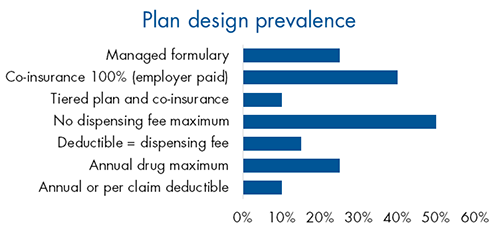
Despite the increase in drug plan risk in recent years, little has changed in plan design trends. Very few plan sponsors have adopted managed plans or other plan design options that could help manage risk.
This presents an opportunity for advisors to educate their clients about the risks their drug plan may be exposed to and the options available to manage that risk.
A practical starting point for those conversations is our Drug Plan Design Tool. With two simple questions, it can help confirm your client’s objectives and identify some best-fit solutions for their plan. Ask your Group Account Executive or myFlex Sales Manager for a copy of the tool.
-
Update: Employment Insurance (EI) Sickness Benefit Extension
As it proposed in its 2022 Budget, the federal government has confirmed it is extending the Employment Insurance (EI) Sickness Benefits period from 15 weeks to 26 weeks later this year. The official implementation date and details have not yet been confirmed by the government and we will share further details once they are available. In the meantime, here’s what you need to know.
We will not require or implement any changes to our disability plan designs based on this extension. However, plan sponsors may wish to amend their short-term disability (STD) and long-term disability (LTD) plans and policies to align with the new 26-week EI period.Impact to short-term disability (STD) benefits integrated with EI
Plan sponsors with EI-integrated STD may wish to adjust their benefits to line up with the new 26-week extension.
Impact to plans with no STD benefits
For plan sponsors who do not offer STD, they have the option of adjusting their LTD plans to the new 26-week elimination period if members claim EI prior to LTD. This adjustment would help to avoid the plan member receiving disability and EI payments at the same time and potentially being required to return funds due to overpayment.Considerations for plan sponsors
Plan sponsors who amend their STD or LTD policies to align with the new 26-week EI period should note that there may be inadvertent delays to their employees’ return to work. While collecting EI, injured or ill employees do not benefit from our early intervention services or rigorous claims management practices that could help them get back to work sooner. So, by delaying the availability of STD or LTD coverage, the advantages that these programs are intended to provide could also be delayed.Impact to Premium Reduction Program (PRP)
The Premium Reduction Program (PRP) allows employers with eligible short-term disability plans to pay lower EI premiums. The eligibility criteria have not changed at this time. The government plans to review the PRP in 2024.Questions
If you have questions about these changes or what they mean for your clients’ disability plans, please contact your Group Account Executive or myFlex Sales Manager.
-
Supporting plan members affected by the British Columbia and Northwest Territories wildfires
Wildfires across Canada are disrupting the lives of many Canadians. During this difficult time, Equitable Life is providing additional support to help affected clients and plan members.
Prescription refills
Plan members who have been evacuated and/or lost their medication due to the wildfires will be able to make early refills until September 17, 2023, through TELUS Health, our pharmacy benefit manager.
Replacement of medical or dental equipment and appliances
Plan members who need to replace eligible medical or dental equipment or appliances due to the wildfires should first call 1.800.265.4556 to confirm coverage.
Disability or other benefit cheques
Plan members receiving disability benefits or other benefit reimbursements via cheques can visit www.equitable.ca/go/digital for instructions on how to sign up for direct deposit. It just takes a few minutes. Plan members can also call us at 1.800.265.4556 if they need help, a replacement cheque or assistance arranging a different mailing address.
Mental health support
Unpredictable, large-scale natural disasters can cause people to experience intense reactions, putting a lot of pressure on their mental health. Having coping mechanisms to deal with the current crisis can be a huge help. Any Equitable Life plan member who needs mental health support can visit Homeweb.ca/equitable to access online resources or contact Homewood at 1.888.707.2115.
For plan sponsors who have purchased Homewood Health’s Employee and Family Assistance Program (EFAP), their plan members also have access to confidential counselling services. The EFAP provides plan members with 24/7 access to confidential counselling through a national network of mental health professionals. Whether it’s face-to-face, by phone, email, chat or video, plan members will receive the most appropriate, most timely support for the issue they’re dealing with.
Plan Administrator support
We realize that the fires are having a profound impact on regular business operations in B.C. and N.W.T. If you have clients that are unable to carry out day-to-day plan administration, they can call us at 1.800.265.4556. They can also contact their Customer Relationship Specialist for support.
This is a challenging time for advisors, plan sponsors and plan members. We will continue to monitor the situation and provide additional updates as appropriate.Questions?
If you need more information, contact your Group Account Executive or myFlex Sales Manager.
-
Digital tools for your clients and their plan members
In this issue:
- Digital tools for your clients and their plan members*
- QDIPC updates terms and conditions for 2024*
Digital tools for your clients and their plan members*
Do your clients know how to use all the available digital tools in their Equitable® benefits plans? With useful features for both plan administrators and their members, it’s even easier for your clients to access their plans online.Tools for plan administrators
- Our online plan member enrolment tool lets groups and administrators add new plan members online without completing paper forms
- The EquitableHealth.ca plan administrator portal makes it easy for plan administrators to manage their plan anytime and anywhere. Helpful features include:
- A premium calculator to calculate monthly costs for plan members
- A simple process for updating plan member information
- Digital welcome kits provide personalized information directly to plan members through email
- Easy, automated payment options help plan administrators avoid missed payments by offering pre-authorized debit or electronic funds transfer
Tools for plan members
- Our plan member portal at EquitableHealth.ca provides secure, 24/7 access to claims history and coverage details. It also lets members submit claims, and includes health and wellness resources
- Electronic notifications and claims payments give plan members claim updates via email and deposit payments directly into their bank account
- The Equitable EZClaim® mobile app lets plan members submit claims quickly and securely on-the-go from their mobile device
- Digital benefits cards give plan members the convenience to access their benefits cards easily from a mobile device
Help with digital benefits tools
We’ve created a brochure and video guide to help plan members use digital tools for a smoother, more convenient benefits experience.
Plan members can contact us at 1.800.265.4556 and select the option for Web Support if they need further assistance.
QDIPC updates terms and conditions for 2024*
Every year, the Quebec Drug Insurance Pooling Corporation (QDIPC) reviews the terms and conditions for the high-cost pooling system in the province.
Based on its latest review, QDIPC is revising its pooling levels and fees for 2024 to reflect trends in the volume of claims submitted to the pool, particularly catastrophic claims. These updates take effect January 1, 2024. You can view the updates here.
We will apply the new pooling levels and fees to future renewal calculations that involve Quebec plan members.
If you have any questions, please contact your Group Account Executive or myFlex Account Executive.
-
Market Commentary April 2025
Key Takeaways for Q1
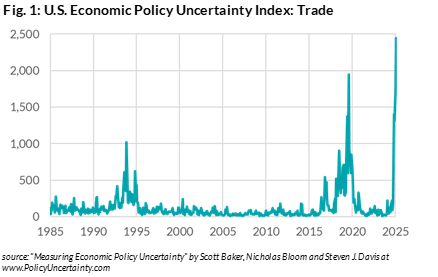
- Economic policy became more uncertain with fluctuating tariff announcements from the U.S. and its trading partners.
- Global stocks markets experienced heightened volatility year-to-date, reflecting the negative repercussions of tariffs for highly integrated global economies.
- Within U.S. markets, investors rotated out of growth stocks into value and defensive areas of the market.
- Bond markets performed well during the quarter as interest rates moved lower.
- Most central banks continued to ease monetary policy by reducing their target interest rates. The U.S. Federal Reserve was a notable exception, electing to wait for greater clarity before lowering rates further.
Economic and Market UpdateEconomic Summary: In the U.S., the latest GDP data confirmed solid economic growth in 2024. However, as President Trump pushes forward his economic agenda, uncertainty surrounding fiscal policy and global trade have dampened market sentiment. Inflation pressures persisted, with the rate of inflation remaining above the central bank’s 2% objective. The labour market in the U.S. remained resilient, with unemployment rate staying low compared to historical norms. The Federal Reserve shifted to a more cautious approach, holding the policy rate steady through Q1 at the range 4.25% - 4.5%. The central bank raised its inflation forecast, lowered growth projections, and warned that “uncertainty around the economic outlook has increased.” U.S. bond yields were lower for most maturity dates during the first quarter, as the market priced in more growth concerns and anticipated more rate cuts from the Federal Reserve.
In Canada, recent GDP data showed stronger-than-expected growth. The inflation rate remained close to the 2% target but rose more than expected in February, and the labour market showed signs of improvement. U.S. tariffs continued to be a significant concern, and it is prompting businesses and consumers to become more cautious and slow their spending. The Bank of Canada warned that the economic impact of the tariffs could be “severe” and expected weaker growth in the coming quarters. For those reasons the Bank of Canada continued its easing cycle, cutting rates by 25 basis points at each of the January and March meetings, bringing the policy rate to 2.75%. Bond yields in Canada were also lower, with short-term interest rates decreasing faster than long-term interest rates as the Bank of Canada’s rate cuts outpaced market expectations.
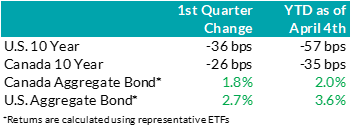
Bond Markets: During Q1 2025, the FTSE Canada Universe Bond Index returned 2.0% as interest rates declined across all tenors. Although interest rates fell, this was partially offset by higher credit spreads (i.e. the extra yield on corporate bonds versus government bonds to compensate for their extra risk). Consequently, while corporate bonds still generated a positive return on the quarter, they underperformed government bonds. Widening credit spreads reflected the risk-off tone to the market, with on-off-on-off-on(?) tariffs contributing to the uncertainty. Lower-rated BBB bonds generally performed worse than higher-quality A-rated bonds. While credit spreads are higher than they were in December and January, they are still expensive compared to longer term averages. Corporate bond issuance remained robust up until the last week of March, as investor demand kept deals well supported. Overall, the market took in $40 billion in new issuance, the second highest on record, spread over 82 bonds. While corporate bonds are more attractive than in January 2025, we believe the more likely path is towards higher credit spreads as U.S. tariffs impact global growth. We have maintained our conservative view with a bias towards shorter-dated credit but remain ready to invest in longer dated corporate bonds as valuations become more attractive.
Stock Markets – Overview:
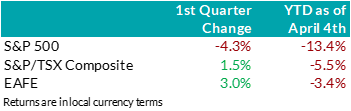
Uncertainty surrounding the scope and severity of new tariffs led investors to reassess global economic growth prospects and weighed on risk sentiment. As a result, the S&P 500 declined 4.3% over the quarter, underperforming Canadian and international markets. Within the U.S., investors rotated out of previously favoured growth stocks with loftier valuations – including members of the Magnificent 7 – into less volatile and value-cyclical companies. Meanwhile, Canadian equities returned 1.5% in Q1 despite ongoing trade negotiations and uncertain economic growth forecasts. Surging commodity prices helped the materials and energy sectors outperform, offsetting weakness in the technology and industrials sectors. Elsewhere, major developed markets from Europe and Asia (EAFE) were supported over the quarter by the introduction of a new German fiscal stimulus package and signs of improving Chinese economic growth. Following the quarter end, President Trump announced global tariffs on April 2nd, prompting some trading partners to hit back with retaliatory tariffs. The S&P 500 lost a record $5.2 trillion over two trading sessions and re-entered correction territory, with other global equity markets moving in tandem.
U.S. Equities: While the impact of tariffs has made investors more apprehensive, we have yet to witness a deterioration in financial performance. In fact, U.S. earnings continued to exceed forecasts last quarter, with approximately 70% of companies beating expectations. Furthermore, our bottom-up analysis shows that the skew of corporate earnings surprises continues to tilt positive. That said, we note that companies are providing more cautious guidance amid the increased economic uncertainty and that these earnings largely reflect conditions in 2024, not 2025. Notably, consumer stocks like Walmart have lowered growth forecasts for 2025, citing concerns surrounding consumer confidence and macroeconomic conditions. In addition to clouding the outlook, geopolitical shocks like sweeping tariffs may risk changing how companies choose to operate, including the structure of supply chains and sources of revenue. At this stage, it is still unclear how long these trade tensions will last, as that depends on how other countries choose to respond. If the tariffs are rolled back quickly, many companies may be able to absorb the temporary extra costs without serious damage to profits, and the broader economy could avoid lasting harm. But if the tariffs remain in place for a long time, the consequences could be much more serious; companies might have to change how they operate, restructure supply chains, and raise prices to deal with long-term pressure on profits.
Canadian Equities: Against the backdrop of worrisome trade developments, the Bank of Canada continued to ease monetary policy. While lower rates have helped Canadian companies report better-than-expected profit growth, consensus earnings expectations for 2025 have been revised 2% lower since the beginning of the year, reflecting the expectations for tariff headwinds. Falling bond yields made high quality, high dividend paying companies more attractive, helping this group outperform. Furthermore, the price of raw industrials – a basket of commodities – surged higher over the quarter and as a result, commodity-oriented companies benefitted. More specifically, the materials sector performed strongly with gold prices reaching new all-time highs throughout the quarter. However, if trade frictions continue to escalate and weaker growth projections materialize into a real economic slowdown, the Canadian market, given its cyclical nature and heavy reliance on commodity-driven businesses, remains particularly vulnerable to external headwinds. Moreover, given Canada’s weaker fundamental backdrop, we caution that the recent outperformance of Canadian equities relative to the U.S. may prove short-lived, particularly if trade tension persists.
Bottom line:
Heightened uncertainty surrounding global trade policies, coupled with deteriorating economic growth projections, continued to weigh on investor sentiment. Bond prices benefited from the flight to less-risky assets, with lower interest rates in anticipation of weaker economic conditions. In equity markets, the introduction of broad-based tariffs increased market volatility and drove major indices sharply lower year-to-date. Looking forward, we remain cautious of the recent outperformance of Canadian and international markets relative to the U.S. While tariffs began as a U.S. policy move, the ripple effects extend far beyond American borders, reflecting the systemic fragility that underpins global trade. If trade barriers persist, businesses may be forced to make structural shifts in their operations and review their current business models. Until markets achieve greater clarity on global trade policies, we continue to prioritize exposure to diversified large-cap stocks in the U.S., over defensive or growth-heavy positions. Within Canada, we continue to favour high quality, high dividend paying names with less sensitivity to downgrades in global growth.
Downloadable Copy
ADVISOR USE ONLYMark Warywoda, CFA
VP, Public Portfolio ManagementIan Whiteside, CFA, MBA
AVP, Public Portfolio ManagementJohanna Shaw, CFA
Director, Portfolio ManagementJin Li
Director, Equity Portfolio Management
Tyler Farrow, CFA
Senior Analyst, Equity
Andrew Vermeer
Senior Analyst, Credit
Elizabeth Ayodele
Analyst, Credit
Francie Chen
Analyst, Rates
 Any statements contained herein that are not based on historical fact are forward-looking statements. Any forward-looking statements represent the portfolio manager’s best judgment as of the present date as to what may occur in the future. However, forward-looking statements are subject to many risks, uncertainties, and assumptions, and are based on the portfolio manager’s present opinions and views. For this reason, the actual outcome of the events or results predicted may differ materially from what is expressed. Furthermore, the portfolio manager’s views, opinions or assumptions may subsequently change based on previously unknown information, or for other reasons. Equitable® assumes no obligation to update any forward-looking information contained herein. The reader is cautioned to consider these and other factors carefully and not to place undue reliance on forward-looking statements. Investments may increase or decrease in value and are invested at the risk of the investor. Investment values change frequently, and past performance does not guarantee future results. Professional advice should be sought before an investor embarks on any investment strategy.