

Site Search
312 results for enter portal now PROBLEMGO.COM hire cops to arrest someone
- [pdf] EZtransact FAQ
-
Equitable Life of Canada ends 2020 in a position of financial strength
Equitable Life of Canada is pleased to report that our strategic approach continued to serve us well in 2020, despite operating in a global pandemic.
Equitable Life, one of Canada’s largest mutual life insurance companies, closed out 2020 with strong earnings and solid growth.
The Company reported earnings of $153 million, equating to a return on policyholders’ equity of 16%. This result was driven by strong sales, investment performance, positive impacts from favourable expense ratios and reserve assumption changes.
“There is no doubt the global pandemic has had, and continues to have, a profound impact on the lives of Canadians and created challenges for all of us in 2020 that we could never have envisioned,” said Ron Beettam, Equitable Life’s President and Chief Executive Officer. “Thanks to the resiliency and commitment of our entire team, we effectively responded to unfavourable impacts caused by the pandemic, including market volatility, and continued to achieve a high growth rate on most key measures, ending 2020 in a position of financial strength.”
Equitable Life reported premiums and deposits of $1.7 billion in 2020, contributing to $6.0 billion of assets under administration. This growth was supported by very strong sales during the pandemic, as more Canadians turned to insurance to protect the financial security of their families. Dividends to participating policyholders increased by 24% over the prior year.
The Individual Insurance business reported 2020 sales of $149 million, reflecting the third consecutive year of double-digit sales growth. Savings & Retirement reported sales of $401 million, driven by sales of segregated funds. Group Benefits delivered sales of $46 million, despite competitive industry pricing strategies and the impact the pandemic had on businesses.
Equitable Life finished the year with an impressive LICAT ratio of 166%, well above the regulatory target and one of the highest in the industry. This capital result demonstrates that we are well-positioned to continue meeting our commitments to our policyholders. In addition, DBRS Limited (DBRS Morningstar) upgraded our Financial Strength rating to A (high) with Stable Trends in September.
“While we don’t yet know what future impacts the global pandemic could have on our business, we know we can face the future with confidence,” said Beettam. “I am very proud of all that we have accomplished together, especially throughout this unpredictable year, and I know the Company is very well positioned to meet the challenges ahead and will continue building on those achievements by focusing on organic and profitable growth across all lines of business, with a continued emphasis on meeting the needs of our policyholders and distribution partners.”
2020 Financial Highlights
- Net income of $153 million, for a return on policyholders' equity of 16%
- Capital strength, as measured by the LICAT ratio, ended the year at 166%
- Participating policyholders' equity surpassed $1 billion
- Premiums and deposits increased by 6.8% to $1.7 billion
- Sales of $149 million in Individual Insurance, $401 million in Savings and Retirement, and $46 million in Group Benefits
- Assets under administration grew 17.6% to $6 billion
- Benefits and payments to policyholders of $820 million
- Dividends to participating policyholders increased by 24% to $61 million
About Equitable Life of Canada
Canadians have turned to Equitable Life since 1920 to protect what matters most. We work with independent advisors across Canada to offer individual insurance, savings & retirement, and group benefits solutions to meet your needs.
Equitable Life is not your typical financial services company. We have the knowledge, experience and ability to find solutions that work for you. We’re friendly, caring and interested in helping. As a mutual company, we are not driven by shareholder pressures for quarterly results. This allows us to focus on management strategies that foster prudent long-term growth, continuity and stability. We are dedicated to meeting our commitments to customers – now and in the future.
-
Equitable Life Group Benefits Bulletin - September 2022
Homewood Health launches Sentio, an upgraded iCBT platform
Equitable Life’s mental health partner, Homewood Health, has launched Sentio, an upgraded platform for Internet-based cognitive behavioural therapy (iCBT). This self-directed platform is now available to all Equitable Life clients, and it replaces Homewood’s previous iCBT platform, i-Volve.
Sentio Self-Directed iCBT is a comprehensive digital cognitive behavioural therapy platform. Developed by Homewood’s mental health experts, it is an action-oriented solution for plan members, giving them practical resources and activities to help with their depression, anxiety and overall mental health challenges.
Available as a standalone app, on mobile, tablet and desktop, Sentio contains over 20 unique treatment goals for issues like stress management, improving sleep, managing depressive thoughts, and coping with panic. Users can work through treatment goals in any order, at their own pace. It also includes tools and resources to help plan members build skills and change their thought patterns.Sentio iCBT benefits
Sentio integrates seamlessly with Homewood Pathfinder so that users can easily locate and take advantage of the iCBT activities available. Sentio also includes a number of unique features:- More interactive features and activities to help plan members build valuable mental health skills
- Integrated symptom measurement and progress tracking
- Interactive multimedia learning and cognitive exercises to enhance learning
- Progress, learnings, and exercises that have been accessed are available to be re-accessed for 12 months
Please contact your Group Account Executive or myFlex Sales Manager if you have any questions.
Streamlining disability claims with Opifiny
Equitable Life is partnering with Opifiny to provide a quicker and more seamless disability claims experience.
Opifiny is an online platform that streamlines the disability claims process for consulting physicians, benefits plan sponsors, and disability plan members. Equitable Life will be using Opifiny for ongoing disability claims management, modernizing the process of gathering medical assessments and information.
Disability claims frequently involve several instances of correspondence between Equitable Life and the plan member’s medical team. By using the secure platform, health care professionals can access, respond to and process medical insurance requests easily from any device. They can typically complete administrative tasks associated with disability claims in a quarter of the time. The platform is secure and protects the privacy of their patients’ confidential information.
By digitizing and modernizing the claims management process for doctors, Equitable Life will have faster access to higher quality claims information. For some claims, using Opifiny may enable Equitable Life to help plan members safely return to work sooner.
Reminder: Obtaining plan member signatures on all administration forms
Please remind your clients that plan members must sign all administration forms, including enrolment forms, benefits change forms, and beneficiary designation forms. Once completed, a plan administrator can keep the form or send it to us. We are not able to accept a beneficiary designation that has not been signed by the plan member. Having appropriately signed forms helps to ensure that any life insurance claims are paid to the intended recipients.
For your clients’ convenience, forms can be signed electronically using one of our approved vendors, which include DocuSign, BambooHR, Adobe Sign, and many more.
If you have questions about providing signed forms, please contact your Group Account Executive or myFlex Sales Manager.
Correction: Coverage for full-time students and dependents with disabilities
In our August edition of eNews, we provided incorrect information about benefits coverage options for over-age dependents. We indicated that over-age dependents who are full-time students may continue to be eligible under the plan member’s benefits plan if they are studying in their home province. However, attending a post-secondary institution in their home province is not a requirement for continued eligibility. Dependents who are full-time students may continue to be eligible for coverage regardless of where in Canada they are attending post-secondary education.
If your clients have any questions about extending coverage for over-age dependents that are full-time students, please notify them of this error.
We apologize for any inconvenience or confusion this may have caused.
-
Equitable Life Group Benefits Bulletin - November 2022
The importance of timely plan member eligibility updates*
Effective Dec. 1, 2022, we are implementing a revised process for managing plan member and dependent health and dental claims that have been incurred and paid after coverage has been terminated. This new process is consistent with industry practices.
If health or dental claims have been incurred and paid after a plan member’s termination date but before we received notice of the termination, we will align the plan member’s or dependent’s termination date with the service date of the last paid claim, retaining premiums up until that date.
If no claims have been incurred and paid after the termination date, Equitable Life will process the termination as requested and refund any excess premium, subject to a maximum premium refund credit of three months.
Currently, we process the termination as requested and attempt to recover any claim overpayments directly from the plan member. We then refund any excess premiums that have been paid, subject to the maximum refund credit amount.
To avoid claims being incurred and paid after a plan member’s termination date, it is important for your clients to update plan member and dependent eligibility dates on or before the effective date of the change.
If you have any questions about the process your clients should follow for updating plan member eligibility, please contact your Group Account Executive or myFlex Sales Manager.QuickAssess®: Absence and accommodation request review services*
It can be difficult to navigate chronic or complex cases of absenteeism or accommodation requests. That’s where QuickAssess® can help.
QuickAssess is an optional, fee-per-use service that can provide your clients with an unbiased, timely assessment of complex plan member absences and workplace accommodation requests. Our disability experts can provide recommendations to help your clients manage:- Workplace absences
- Chronic or patterned absenteeism
- Requests to modify workplaces or duties
- Return-to-work coordination
- Employee Insurance sick leaves
For more information on using QuickAssess, including eligibility requirements, please contact your Group Account Executive or myFlex Sales Manager.
**Within two business days of receiving a completed QuickAssess Absence and Accommodation Review Referral Form and all required information. For more complex referrals, more time will be required.Finding a health care provider with TELUS eClaims direct billing*
By visiting TELUS’s Find a Provider page, your clients’ plan members can now easily search for paramedical and vision providers who are registered on the TELUS Health eClaims network and who can submit claims directly to us on behalf of their patients. Searches can be filtered by postal code to help plan members find the most convenient provider options.
As our direct billing provider for pharmacy, vision and paramedical claims, TELUS Health has an extensive network of 70,000 health care providers that provide direct billing to streamline the claims process.
Please note, plan members should always check Equitable Life’s list of de-listed providers before selecting a health care provider. The list is available for your clients and their plan members on EquitableHealth.ca, and is updated regularly.
For more information about TELUS eClaims, please contact your Group Account Executive or myFlex Sales Manager.First phase of the Canada Dental Benefit proposed for Dec. 1, 2022*
The federal government’s new Canada Dental Benefit is proposed to take effect on Dec. 1, 2022, subject to Parliamentary approval. The program will cover eligible expenses retroactive to Oct. 1, 2022, and this first phase would apply to Canadians under 12 years of age.
If implemented, the Canada Dental Benefit will provide dental care to Canadian families with under $90,000 adjusted net income annually. By 2025, the federal government expects to extend the benefit to children under 18, senior citizens and Canadians with disabilities.
Parents or guardians will be required to apply for this coverage through the Canada Revenue Agency (CRA) and must not have private dental coverage for the child(ren).
This new program will have no impact on your clients’ dental coverage and no action is required on their part.
* Indicates content that will be shared with your clients.
-
Special 5% rate for clients until Pivotal Select FHSA is available
Great news for clients saving for their first home! For a limited time, clients who intend on setting up a First Home Savings Account (FHSA) with Equitable Life® can deposit money to a Guaranteed Interest Account (GIA) now and enjoy a special rate of 5.00%.1
The special rate applies only if the client transfers the funds to an FHSA by December 28, 2023; otherwise, the standard Daily Interest Account (DIA) rate will be applied to those funds.
Here’s how to take advantage of this special rate:
For New Clients:- Complete an application for a non-registered GIA. On the application select “Daily Interest Account” as the investment instructions and write the amount to be deposited (minimum $500, maximum $8,000).
- In the Special Instructions section of the application, write “FHSA”.
- The GIA application form (799) can be found here
For Existing Clients - must have a GIA (Compound Interest Only) policy:- Submit a letter of direction or complete the Investment Direction form requesting to deposit funds to the DIA for the FHSA promotion (minimum $500, maximum $8,000)
- Complete sections 1, 3, 4, 12 and 13 of the Investment Direction form, and in the Special Instructions area, write “FHSA”.
- The Investment Direction form (693ANN) can be found here
The GDA will be a non-registered account and any interest earned will be taxable.
Once the Equitable Life FHSA is available:- Submit a Pivotal Select™ FHSA application, and request to transfer the funds from the GDA to the Pivotal Select policy.2 No Market Value Adjustment fees will be charged.
- In the Special Instructions section, indicate the source of funds to be “FHSA promotion funds” and provide instructions on where to direct any excess funds in the GIA if applicable.
- The funds will be transferred to the FHSA.3
- Any excess funds over $8,000 will be returned to the client as a direct deposit, a cheque, or the client can keep the GIA open.
This is a great opportunity for clients to start saving for their first home today while earning an excellent rate. The advisor receives a reduced upfront commission4 for the pre-FHSA deposit to the GDA, in addition to the commission that will be earned by moving the funds to the Pivotal Select FHSA.
This special savings rate promotion is available until the launch date of Equitable Life’s FHSA unless the promotion is ended on an earlier date at Equitable Life’s discretion. The maximum amount on which a client can receive the special savings rate is $8,000.
Clients who do not transfer funds to the FHSA on or before December 28, 2023 will not receive the promotional rate. We will transfer the funds from the special GDA to the DIA account effective as of the date of deposit. As a result, the interest received by the client from the date of deposit to December 28, 2023 will be the DIA rate rather than the promotional rate.
Questions? Please see our FAQ
For more information, please contact your Regional Investment Sales Manager. Additional details about the FHSA can be found on the Government of Canada’s website.
® denotes a trademark of The Equitable Life Insurance Company of Canada.
1 The pre-FHSA special saving rate of 5.00% per year compounds daily and takes effect from the date Equitable Life receives the deposit and will end on the date the FHSA Pivotal Select segregated fund product is launched later this year (December 28, 2023 at the latest). In the unlikely event Equitable Life’s Pivotal Select FHSA is unavailable in 2023, the funds subject to the promotion will earn the 5.00% rate for 1 year from the date of deposit through maturity in 2024.
2 The FHSA promotion will only be available as a Pivotal Select Segregated Fund policy. Clients can open a FHSA only if they meet the eligibility criteria when they sign the application.
3The funds in the Guaranteed Interest Account will be transferred to the FHSA in the form of a contribution of up to $8,000 on or after the date the client signs the FHSA application form. Clients must open a FHSA to receive the special bonus interest.
4 Commission of 0.20% paid upfront for money received and deposited to the policy by September 29, 2023. 0.05% paid upfront for money received and deposited after September 29, 2023, and the earlier of the promotion termination or December 28, 2023. Commissions are paid through an adjustment to our current 40bps commission on our one-year GDA by way of a chargeback reducing the commission to the rate stated in this note.
Posted June 1, 2023 -
Tax impacts of the Canadian Dental Care Plan for your clients
Tax impacts of the Canadian Dental Care Plan for your clients*
Earlier this year, the government shared its progress on the Canadian Dental Care Plan (CDCP).
The CDCP will be available to Canadians with an annual family income of less than $90,000 who do not have dental benefits. Co-pays will be waived for eligible Canadians with a family income of less than $70,000.
Canadians who have access to private dental coverage are not eligible for the CDCP. This means that your clients must now report on T4s/T4As if dental coverage** was available on December 31 of the reporting tax year for:- Employees,
- Employees’ spouses and/or dependents,
- Former employees, and
- Spouses of deceased employees.
This new tax reporting requirement is mandatory starting with the 2023 tax year. Employee tax slips will include new boxes for employers to complete:- Box 45 (T4): Employer Offered Dental Benefits. This new box will be mandatory.
- Box 015 (T4A): Payer Offered Dental Benefits. This new box will be mandatory if plan sponsors report in Box 016, Pension or Superannuation. The box will otherwise be optional.
- Code 1: The plan member has no access to dental care insurance or coverage of dental services of any kind.
- Code 2: Only the plan member has access to any dental care insurance, or coverage of dental services of any kind.
- Code 3: The plan member, their spouse and their dependents have access to any dental care insurance, or coverage of dental services of any kind.
- Code 4: Only the plan member and their spouse have access to any dental care insurance, or coverage of dental services of any kind.
- Code 5: Only the plan member and their dependents have access to any dental care insurance, or coverage of dental services of any kind.
Reports for dependents
We have a report available for plan members who have enrolled their dependents in benefits coverage. Your clients can contact their local service team representative to receive a copy of the report. We are working to make it available on our Advisor and PA websites.
Questions
For guidance on your tax slips and reporting obligations, please encourage your clients to contact their accountant, payroll provider or tax advisor.
Supporting plan members affected by the Israeli-Palestinian conflict*
Traumatic events continue to unfold in the Middle East. Enduring ongoing news of conflict and suffering could challenge many Canadians. During this difficult time, Equitable encourages affected clients and plan members to access the mental health support they need.
Large-scale traumatic news events can cause people to experience intense reactions. This puts a lot of strain on their mental health. Having coping mechanisms to deal with the current crisis can be a huge help. Any Equitable Life plan member who needs mental health support can visit Homeweb.ca/equitable to access online resources or contact Homewood at 1.888.707.2115.
Support available to all Equitable plan members
Support available to plan members with the Homewood Health EFAP
For your clients that have purchased Homewood Health’s Employee and Family Assistance Program (EFAP), remind them that their plan members also have access to confidential counselling services. The EFAP provides plan members with 24/7 access to confidential counselling through a national network of mental health professionals. Whether it’s face-to-face, by phone, email, chat or video, plan members and their dependent family members will receive appropriate, timely support for the issue they’re dealing with.
Questions?
If you need more information, contact your Group Account Executive or myFlex account executive.
*Indicates content that will be shared with your clients. -
All about the changes to the capital gains inclusion rate
Disclaimer: The following content is provided by and is the opinion of Invesco Canada Ltd. Equitable does not guarantee the adequacy, accuracy, timeliness, or completeness of the information. Equitable shall not be liable for any errors or omissions in the information provided by Invesco.
What has changed?
One noteworthy measure to come from Budget 2024 is the proposed change to the capital gains inclusion rate, which was previously held steady at 50% since 2001.
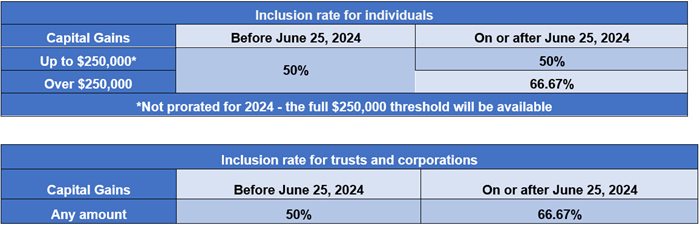
For individuals, capital gains more than $250,000 annually will be subject to an increased 66.67% inclusion rate as of June 25, 2024, while the capital gains up to $250,000 will continue to be subject to the existing 50% inclusion rate. As a transitional measure for 2024, only the capital gains realized by individuals on or after the effective date of June 25 that are above the $250,000 threshold will be subject to the increased inclusion rate.
For trusts and corporations, the inclusion rate on all capital gains will increase from 50% to 66.67% starting on June 25, 2024.
Who is affected?
Impact to individuals
Budget 2024 proposed to add transitional rules which would specifically identify capital gains and losses realized before the effective date (Period 1) and those realized on or after the effective date (Period 2). The effective date is June 25, 2024. Capital gains realized on or after that date will have an inclusion rate of 50% on the amount up to $250,000, and an inclusion rate of 66.67% on the amount above $250,000. All capital gains realized prior to the effective date will have an inclusion rate of 50%.
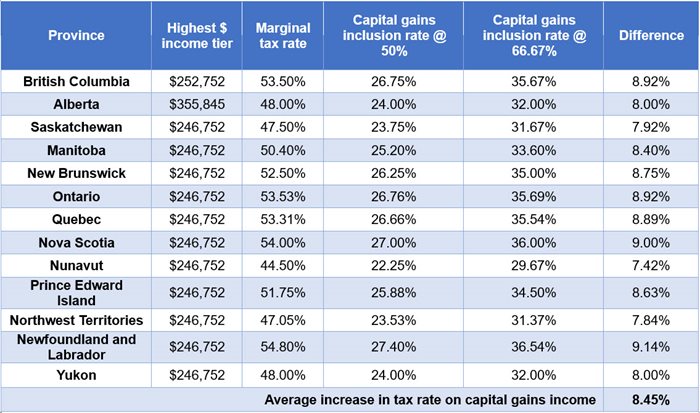
Take Ontario as an example, the proposed higher inclusion rate on capital gains would effectively increase the average federal-provincial marginal tax rate for Ontario residents on capital gains above $250,000 at the top marginal tax rate from 26.76% to 35.69%. A more detailed analysis on the impact of these changes to an individual’s tax rate is discussed below.
For net capital gains realized in Period 2, the annual $250,000 threshold would be fully available in 2024 (i.e., it would not be prorated) and it would apply only in respect of net capital gains realized in Period 2.
The $250,000 threshold would effectively apply to capital gains realized by an individual, either directly or indirectly via a partnership or trust, net of any: current-year capital losses, capital losses of other years applied to reduce current-year capital gains, and capital gains in respect of which the Lifetime Capital Gains Exemption, the proposed employee Ownership Trust Exemption or the proposed Canadian Entrepreneurs’ Incentive claimed.
Two common scenarios of reaching the $250,000 capital gain threshold are the deemed disposition of capital property at death, and the emigration from Canada (i.e., becoming a non-resident for income tax purposes). We have provided additional details on these topics below.
Deemed disposition upon death
When an individual passes away, they are deemed to have sold their capital property (e.g., units or shares of mutual funds, shares of corporations, and real property) at its fair market value (FMV) immediately before their death. If a capital gain arises because of this deemed disposition, that capital gain is reportable on the deceased’s final (terminal) tax return and the taxes owing as a result, if any, would be payable by the estate of the deceased. However, there are provisions that allow taxes to be deferred when the property is transferred to a spouse. For example, if a capital property is transferred to a surviving spouse or common-law partner, subsection 70(6) of the Income Tax Act (Canada) automatically deems the deceased to have disposed of that property and the spouse or common-law partner immediately acquires the same property at the deceased transferor’s adjusted cost base (ACB). This is commonly referred to as the “spousal rollover”. Another potential strategy to manage potential large capital gains taxes at death is life insurance, since the death benefit is typically paid out tax-free.
Without careful planning, the estate value could be substantially reduced by the changes to the capital gains inclusion rate. Furthermore, it would be prudent to ensure there are liquid assets or cash available in the estate to cover the associated tax liabilities.
Non-resident of Canada – Departure tax
Residency in Canada for income tax purposes is a question of fact, which primarily depends on the individual’s residential and social ties in Canada. When an individual becomes a non-resident of Canada, they are deemed to have disposed of and immediately reacquired certain types of property at FMV. The tax incurred because of this deemed disposition and reacquisition is also known as the departure tax. Some examples of properties subject to departure tax include securities inside a non-registered investment portfolio, shares of Canadian private corporations, and real estate situated outside of Canada. Note that there are some properties that are exempted from the departure tax, including: pensions and similar rights (including registered retirement savings plans (RRSPs), registered retirement income funds (RRIFs), and tax-free savings accounts (TFSAs)) and Canadian real property.
The departure tax rules coupled with the increased capital gain inclusion rate above the $250,000 threshold may incur additional tax payable for emigrants. However, there is an option to defer the payment of departure tax on income associated with the deemed disposition upon emigration. By making an election, the individual would pay the tax later, without interest, when the property is disposed of. This election can be done by completing CRA Form T1244, “Election Under Subsection 220(4.5) of the Income Tax Act, to Defer the Payment of Tax on Income Relating to the Deemed Disposition of Property," on or before April 30 of the year following their departure from Canada.
Impact to Entities
Corporations and trusts will also be impacted by the increased inclusion rate as of June 25, 2024. Unlike individuals, corporations and trusts will not have access to the old inclusion rate on the first $250,000 of capital gains: they will be subject to the new 66.67% inclusion rate from the very first dollar.
With the above in mind, there will be options available to shelter corporate and trust capital gains from the new inclusion rate.
For corporations:
The lifetime capital gains exemption (LCGE) can be used to eliminate capital gains taxes on the sale of qualified small business corporation shares (generally, these are shares of a Canadian-controlled private corporation that carries on an active business). The LCGE is also available on the sale of qualified farm or fishing property. The current lifetime limit for the LCGE is $1,016,836. Budget 2024 proposed to increase that limit to $1,250,000 starting on June 25, 2024, so certain business owners will be able to reduce or eliminate their exposure to the new inclusion rate if they are able to make use of the increased LCGE limit.
For trusts:
Budget 2024 suggests that capital gains allocated by a trust to its beneficiaries on or after June 25, 2024, will be included in the beneficiaries’ income at the old 50% rate up to the beneficiaries’ first $250,000 of capital gains for the year. While the specifics are not yet available, this opportunity will likely create further planning considerations surrounding the allocation of capital gains from a trust to its beneficiaries to reduce taxes. Capital gains can generally be allocated to a beneficiary for tax purposes when they are actually paid to the beneficiary, or when they are payable to a beneficiary (i.e., the beneficiary hasn’t received it, but has a right to demand payment of the capital gain). The option of making income paid (or payable) to its beneficiaries and allocating such income to be taxed in their hands will largely depend on the trust terms.
Historical reference: capital gains inclusion rate
Those of us around long enough, understand that this recent change was not the only time the capital gains inclusion rate has deviated from the 50% inclusion rate. Over the years, capital gains tax rate has ranged from nil to as high as 75% as indicated in the table below. In fact, the first instance of capital gain tax was introduced in 1972!
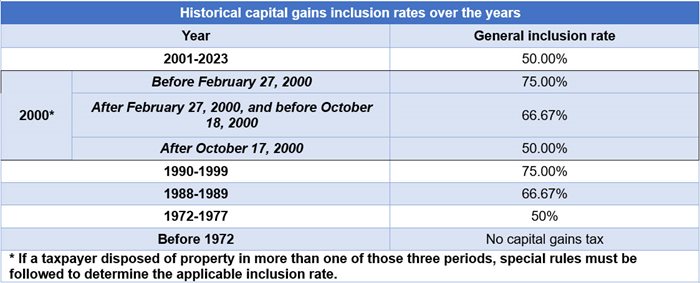
Excluding the 2024 tax year, we have given a rough estimate on the percentage of time spent at each of the various capital gains inclusion rates over the last 42 years. As we can see, for most of the time, the capital gains inclusion rate has remained at the 50 % inclusion rate. In fact, for the last 23 consecutive years, the inclusion rate has remained untouched with the last change being back in tax year 2000 with various changes introduced that year.

Tax impact by province/jurisdiction
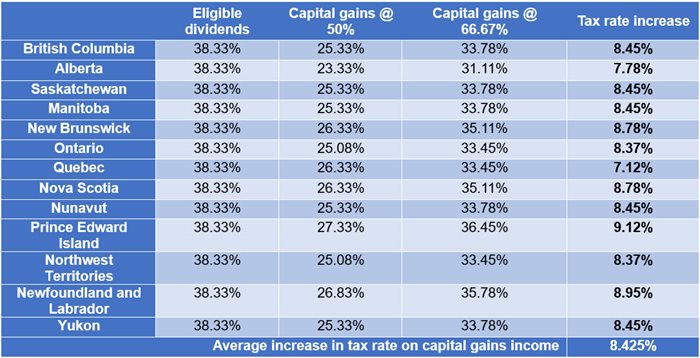
With the increase in the capital gains inclusion rate, we want to demonstrate the potential tax impact of those changes across jurisdictions in Canada. The table below shows the 2024 marginal tax rate for the highest individual income earners in each jurisdiction at both the 50% and 66.67% capital gains inclusion rate, respectively. The average difference is an increase in taxes payable by 8.45%.
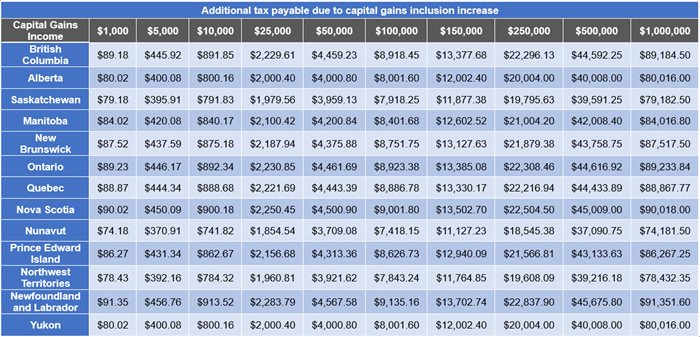
Next, we look at the additional taxes payable because of the inclusion increase, assuming varying capital gains income levels. Of course, this assumes that the capital gains do not otherwise benefit from a reduced inclusion rate or an outright exemption such as eligible in-kind donations of securities to registered charities, or shares that qualify for the lifetime capital gains exemption, to name a few.
Understanding the tax implications of investing is an essential part of financial planning and reinforces the importance of working with a knowledgeable financial advisor to understand the long-term impact of these changes as it applies to personal situations. No doubt, tax rates influence capital allocation decisions. Canadians who take more inherent risk with their capital have traditionally been afforded preferred taxation rates promoting innovation through capital investment, something the government can do with good tax policy to encourage business growth and spur economic expansion. This is evident in the breakdown of the tax rates depending on the characterization of the income as noted in the table below.
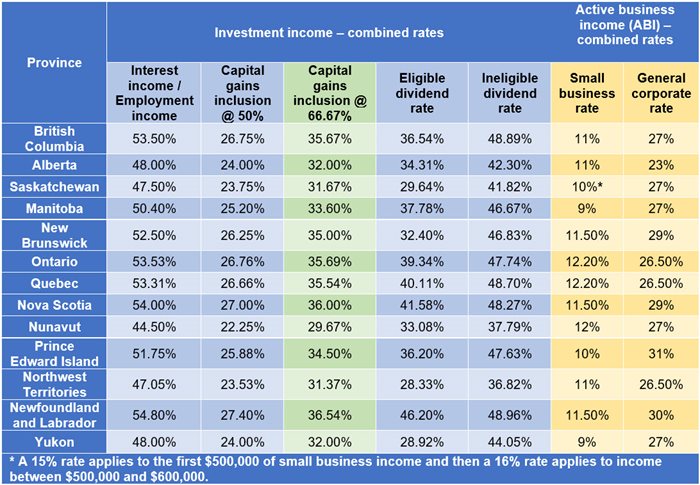
Clearly the tax rates reflect the added capital risk investors and business owners take. We can clearly see the preferred taxation rates afforded on small business income and at the general corporate tax rates on income over the small business limit, compared to the tax rate on interest income or that of employment income. That tax-preference also extends to investors of “riskier” allocations of capital in marketable securities such as stocks, bonds, mutual funds, and exchange traded funds, to name a few. The tax rates of less-risky investments (such as money market instruments) do not benefit from the capital gains tax-preferred inclusion rates. With the latest move, there is not much difference in earning eligible dividend income from Canadian resident corporations and from dispositions resulting in capital gains.
Some pundits have declared the move as a disincentive to capital and business investment and may encourage businesses to move into more tax-favoured jurisdictions outside Canada. The Federal government has promoted the change as impacting a very small overall percentage of investors, estimated at 0.13% of Canadian individuals and 12.6% of corporations. Further, the move has been argued by the Liberals as necessary to work towards “intergenerational fairness”.
How to prepare for the changes?
For now, advisors may want to start educating their clients about the basics of the changes, which starts with comparing the current inclusion rates with the new inclusion rates.
Individual investors with large unrealized capital gains will also likely ask if they should crystallize their capital gains before June 25th to save money on taxes in the long run. The assumption that selling now will result in overall savings will not be correct in all cases, however. There is an opportunity cost to paying taxes upfront, rather than deferring those taxes to a later year.
For example, let’s assume an Ontario client owns a $2.5 million non-registered equity portfolio with $2,000,000 in unrealized capital gains. They had no intention of selling those investments for another 5 yeas, but in light of the upcoming changes, they are considering selling immediately, paying the capital gains taxes now, then reinvesting the net amount after taxes back into those same investments for the 5-year investment period. They are currently in the top marginal tax bracket in Ontario (53.53%) and expect to continue to be in 5 years’ time. The assumed average rate of return on their investments is 6% annually over the next 5 years.
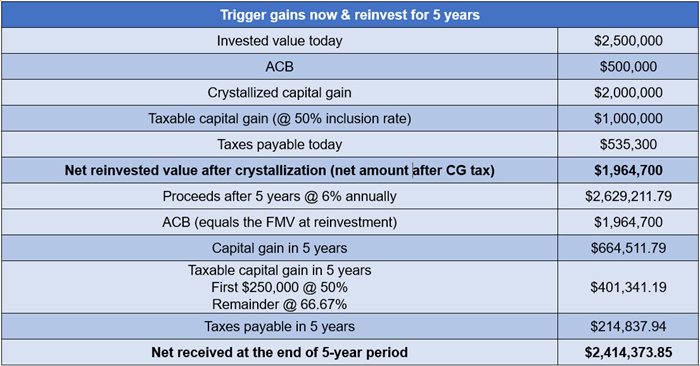
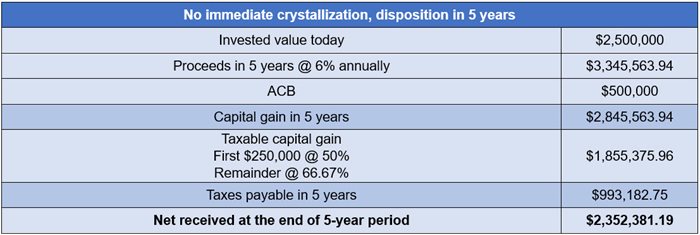
As can be seen in this example, at 6% annual compound growth rate, the option to realize much of the capital gains now resulted in a higher overall return in the amount of $61,992.66 over the 5-year period due to the lower inclusion rate. Alternatively stated, if the investor does not crystallize the gains today, the equivalent rate of return needed to have the exact net after tax amount at the end of the 5-year period (the “breakeven return”) would be a 6.60% compound annual return. While this certainly will not be true in all cases, this is the sort of analysis that will have to be conducted when assessing whether it makes sense to realize capital gains in 2024. The rate of return on investment and the investment horizon, among other things, are important determining factors.
Although we used securities investment in our example, a similar analysis can be done for other kinds of property held, such as a vacation property that is unlikely to benefit from the principal residence exemption. In addition, taxes often take a back seat to other planning considerations. These conversations should be had with the primary goals of the client in mind, which may supersede tax planning considerations.
For corporate investors, it will be important to emphasize the impact the capital gains inclusion increase will have on small business owners. As a refresher, a corporation is a separate legal entity from the shareholders who own it and is subject to tax on the income it generates. Income is first taxed within the corporation before it can be passed to the shareholders in the form of dividends out of its retained earnings. To avoid double tax on income that passes through a corporation to shareholders (and to prevent any unintended tax advantages), a dividend gross-up and tax credit model is applied at the individual level, along with a tax refund mechanism to the corporation on passive investment income. This is designed to integrate the tax system between the two entities: individual and corporation. Ideally, perfect integration is achieved when after-tax income is equal, whether it is earned individually or through a corporation. In reality, depending on the province and type of income earned, there could be a tax cost in earning passive investment income through a corporation, including earning passive investment capital gains income. Currently there is a tax cost of earning capital gains income through a corporation across all Canadian provinces/jurisdictions.
The latest change further increases the cost of earning passive investment income inside a corporation, though we do not yet know what changes will be made to the corporate tax refund mechanisms. As noted in the table below, the increase averages approximately 8.43% and closely equates the rate on eligible dividends. This rate reflects the initial tax rate on passive investment income earned within an active business.
For many small businesses, and perhaps to long-term individual investors, this increase in the tax rate will feel unfair as the accumulation of earning a pool of assets for retirement is often done within their small business corporation, and in many cases the sole source of retirement funds.
If an immediate crystallization of accumulated capital gains is not desired, what should investors consider in the longer run? Although many details of the new proposed rules are yet to be clarified, here are some general considerations.
For individuals, it may be helpful to plan the timing of future dispositions to stay below the annual $250,000 threshold. Also, it may seem obvious but maximizing investments within registered plans, including the new first home savings plan (FHSA) where eligible, can reduce exposure to future capital gains tax. Moreover, estate planning becomes even more important as the potential tax payable on the deemed disposition of capital property at death rises. On that front, strategies to reduce capital gains at death could be considered, such as inter-vivos gifting, charitable donation, spousal rollover, and acquiring life insurance to provide sufficient liquidity to the estate.
For business owners, some strategies to limit future capital gain exposure may include contributing to an individual pension plan (IPP), conducting an estate freeze to pass on future capital gains to succession owners, and ensuring the small business shares qualify for the LCGE. The suitable strategies are highly dependent on the business needs and personal situation of the business owner.
Acting too soon or not fast enough?
Finally, there is what many in the industry have been calling a “change of law” risk. That is, within the next year and a half, a federal election is scheduled, and this capital gains inclusion tax policy will surely be a primary election issue. As part of that election platform, parties may promise to repeal it outright or alter its scope and application. Consider also that any changes in the capital gains inclusion rate could be retroactive or simply not apply in all cases.
The information provided is general in nature and may not be relied upon nor considered to be the rendering of tax, legal, accounting or professional advice. Invesco Canada is not providing advice. Readers should consult with their own accountants, lawyers and/or other professionals for advice on their specific circumstances before taking any action. The information contained herein is from sources believed to be reliable, but accuracy cannot be guaranteed. Commissions, trailing commissions, management fees and expenses may all be associated with mutual fund investments. Mutual funds are not guaranteed, their values change frequently and past performance may not be repeated. Please read the simplified prospectus before investing. Copies are available from your advisor or from Invesco Canada Ltd
Date posted: May 23, 2024 - Equitable and Cloud DX
- [pdf] Financial Questionnaire - Personal
-
Equitable Life Group Benefits Bulletin – September 2021
In this issue:
- Right drug, right dose*
- Responding to New Brunswick’s Biosimilar Initiative*
- Helping plan members access our convenient digital options*
- Reminder: Please access forms on EquitableHealth.ca*
- Over-age dependents losing coverage?*
Right drug, right dose
Equitable Life partners with Personalized Prescribing Inc. to help plan members avoid treatment trial and error
Patients suffering from mental health conditions often need to try several medications before they find one that works for them. This is frustrating and can result in negative side-effects, a longer recovery, lost productivity, or a delayed return to work.
To help plan members avoid this treatment trial and error, we have partnered with Personalized Prescribing Inc. to provide easier access to pharmacogenomic testing for plan members with mental health conditions.
Pharmacogenomics 101
Pharmacogenomics is the study of how an individual’s genes influence their response to medications. Pharmacogenomic testing can help determine how compatible a patient’s body may be to a particular drug, and helps their physician prescribe the most appropriate medication. The goal is to ensure the right drug is prescribed to deliver the most positive outcome with the fewest side effects.
Easier access to pharmacogenomic testing
Through our partnership with Personalized Prescribing Inc., any Equitable Life plan member diagnosed with a mental health condition can purchase a pharmacogenomic test for a discounted price of $399 plus HST – a 20% savings.
We are also introducing the option for plan sponsors to add coverage of pharmacogenomic tests provided by Personalized Prescribing Inc. for mental health conditions.
With this coverage, plan members are eligible for pharmacogenomic testing if:- They have been diagnosed with a mental health condition;
- They are currently taking or have stopped taking a medication for a mental health condition that does not work or has side effects; and
- The pharmacogenomic test is conducted by Personalized Prescribing Inc.
Getting a test is easy. The plan member starts by visiting www.personalizedprescribing.com/equitablelife to request a test kit.
Once they receive their test kit from Personalized Prescribing Inc., they simply provide a saliva sample and send it back (postage is pre-paid). Within 7-10 business days, they receive an Rx Report™ that they can share with their doctor. This report includes details to help their doctor prescribe the right drug and the right dose for them.
Benefits for plan members:- The plan member and their physician receive a full report that is easy to understand;
- The report identifies the most compatible medications for the plan member’s condition and the medications to avoid;
- The physician is able to prescribe the most appropriate medication with the fewest side effects; and
- The plan member avoids medication trial and error.
- Pharmacogenomic testing can be an effective prevention strategy to help employees stay healthy and potentially avoid a mental health-related work absence; and
- Employees suffering from mental health conditions may be more productive when they are on the right medication for them.
Responding to New Brunswick’s Biosimilar Initiative
We are changing coverage for some biologic drugs in New Brunswick in response to the province’s Biosimilar Initiative. These changes will help protect your clients from additional drug costs while still providing access to equally safe and effective biosimilars.
What is New Brunswick’s Biosimilar Initiative?
New Brunswick’s Biosimilar Initiative will end provincial coverage of several originator biologic drugs for some or all conditions beginning on December 1, 2021. Patients who are using these drugs for the affected conditions will be required to switch to biosimilar versions of the drugs to maintain coverage under the province’s government drug plan.
What is the impact on private drug plans?
The most significant risk to plan sponsors who maintain coverage of originator biologics is coordination of benefits (CoB) risk. If other insurance carriers follow suit with the province and delist the originator biologics, it could expose a plan that doesn’t delist them to significant coordination of benefits risk.
For example, consider a patient who is covered under two private plans – their employer plan and a spousal plan. If their employer plan was the first payer for the originator biologic but delists the drug, the spousal plan now becomes the first payor. If the spousal plan continues to cover the cost of the originator, it now pays most or all of the cost of the drug.
How is Equitable Life responding?
To protect your clients’ plans from paying additional and avoidable drug costs, we are changing coverage in New Brunswick for most biologic drugs included in the provincial initiative.
Beginning Feb. 1, 2022, plan members in New Brunswick will no longer be eligible for coverage of Humira, Lantus, Humalog and Copaxone if they have a condition for which Health Canada has approved a lower cost biosimilar version of the drug. These plan members will be required to switch to a biosimilar version of those drugs to maintain coverage under their Equitable Life plan.
How will Equitable Life communicate this change to plan members?
We will be communicating with affected claimants in early-December 2021 to allow them ample time to change their prescriptions and avoid any interruptions in their treatment or their coverage.
Can my client maintain coverage of these biologic drugs?
All groups, except myFlex clients, who wish to opt out of this change and maintain coverage of these originator biologics for New Brunswick plan members can submit a policy amendment. Amendments must be submitted no later than Nov. 30, 2021.
Advisors with myFlex Benefits clients who wish to maintain coverage of these originator biologics for New Brunswick plan members should speak to their myFlex Sales Manager to confirm their eligibility to opt out of this change.
Groups that opt out of this change are also opting out of any future changes to our New Brunswick biosimilar initiative. Their drug plans will continue to cover any additional originator biologics that we subsequently add to the program.
Will this change impact my clients’ rates?
The rate impact of this change and any cost savings associated with the change will be factored in at renewal.
If plan sponsors opt out of these changes and maintain coverage for the originator biologics, it may result in a rate increase. Any rate adjustment will be applied at renewal.
What is the difference between biologics and biosimilars?
Biologics are drugs that are engineered using living organisms like yeast and bacteria. The first version of a biologic developed is also known as the “originator” biologic. Biosimilars are also biologics. They are highly similar to the originator drug they are based on and have been shown to have no clinically meaningful differences in safety or efficacy.
Questions?
If you have any questions about this change, please contact your Group Account Executive or myFlex Sales Manager.
Helping plan members access our convenient digital options
Some of your clients’ plan members aren’t benefitting from our secure and convenient digital options to access and use their Group Benefits. They can sign up to submit claims electronically for faster claim payments, get claim payments deposited directly to their bank accounts, easily review their coverage details, quickly access their Group Benefits plan booklet, benefits card and more. We’ve made it easier than ever to sign up, with more resources all conveniently located at Equitable.ca/go/digital.
Your clients’ plan members can visit this link to view:- A brochure with all the high-level instructions they need to get started on EquitableHealth.ca and the EZClaim mobile app
- A full video guide on how to access and navigate EquitableHealth.ca
Reminder: Please access forms on EquitableHealth.ca*
We routinely update our Plan Administrator forms on EquitableHealth.ca based on their feedback and to stay compliant with legal and/or regulatory requirements. If your clients need a form, they should always pull the most recent version from EquitableHealth.ca instead of reusing forms they have saved on their computer. Using an old or outdated form may result in processing delays.
Your clients can access the Plan Administrator forms by following these steps:- Login to EquitableHealth.ca
- Select “Documents”
- Toggle between English and French forms
- Click on the document name to download a PDF copy
Over-age dependents losing coverage?*
Some of your clients’ plan members may have dependents who are reaching the maximum age for eligibility under their group benefits plan.
If they are attending school full-time or are disabled, they may be eligible for continued coverage. Plan members with over-age dependents can simply complete the Application for Coverage of Dependent Child Over Age 21 (Form #441) and submit it through our online document submission tool. They can access the tool by logging into their Group Benefits account at www.equitablehealth.ca and clicking My Resources.
If they are not attending school full-time or disabled, they will no longer be covered under the plan. However, they may be eligible for Coverage2go®. It allows individuals who are losing their group coverage to purchase personal month-to-month health and dental coverage that is affordable, reliable and works like their previous group benefits plan. They can choose the level of coverage and protection that suits their personal situation.
There are no medical questions – they simply need to apply within 60 days of losing their health coverage under their group benefits plan.*
Help your clients’ plan members and their dependents who are losing coverage by letting them know about Coverage2go. They can visit our website to learn more about Coverage2go and to get a quote.
*Quebec residents are not eligible for Coverage2go