

Site Search
648 results for view link MAKEMUR.com how to bail someone out with little money HMP Channings Wood
-
REMINDER that paper applications with a version date prior to 2021/04/02 are set to expire July 1, 2
To comply with the Government of Canada’s anti-money laundering legislation and FATCA/CRS changes, Equitable Life® has updated its Savings and Retirement and Life Insurance applications.
If you currently have applications with a version date before 2021/04/02, please destroy them and use our online pdf applications or order new applications from our Supply Team. Paper applications with a version date prior to 2021/04/02 (located on the back page and in the bottom right-hand corner of the application) will no longer be accepted after July 1, 2021 for:
● Savings and Retirement (Form #1383, #1384, #799, #355), and
● Life Insurance (Form #350)
To learn more about the Government of Canada’s anti-money laundering legislation and FATCA/CRS review the following links:
Want to be sure you always have the most up-to-date application? Try our EZcomplete® online platform for Individual Life, Critical Illness and Segregated fund applications.
For a complete list of all forms and applications affected by the anti-money laundering legislation, refer to the following links:
● Savings and Retirement Anti-money Laundering Legislation Requirements Summary.
● Life Insurance Anti-money laundering Legislation Requirements Summary.
● Government of Canada - Guidance on the Common Reporting Standard
● Financial Transactions and Reports Analysis Centre of Canada
If you have any other questions, contact your Regional Sales Manager or Equitable Life’s Advisor Services Team
® denotes a registered trademark of The Equitable Life Insurance Company of Canada.
- [pdf] Claimant Statement for Individuals
-
Equitable Life Coronavirus Update – March 13, 2020
As the coronavirus (COVID-19) continues to spread, it’s important that you, your clients and their plan members have the most up-to-date information. We are providing timely updates on any developments that impact your clients and their plan members or their benefits coverage.
Please share this information with your clients. You can direct them to EquitableHealth.ca, where we have posted a version of these updates.
Coronavirus travel coverage*
For groups with Travel Assist coverage
The Public Health Agency of Canada has issued several Travel Health Notices advising Canadians to avoid travel to countries and regions where there have been outbreaks of coronavirus (COVID-19).
A good resource to help your clients and their plan members understand how the spread of the coronavirus may impact their travel plans is the Public Health Agency of Canada’s Coronavirus Travel Advice site. The levels of risk by country and region are regularly updated.
If your clients’ plan members cannot avoid travelling, Public Health recommends they take steps to prevent illness and seek medical attention if they become sick.
Where to find the latest information
The list and level of travel advisories can change at any time. Please check the Government of Canada’s Travel Advisor and Advisory page for the most current information.
If your clients’ plan members have coronavirus symptoms while travelling, please advise them to contact Travel Assist at the numbers listed below for assistance.
Advise plan members to call before they travel
If a plan member is travelling anywhere outside of the province or country and their benefits plan includes Travel Assist, plan administrators should advise them to make sure they’re prepared for a medical emergency by following these steps.
- Check the Government of Canada’s Travel Advisor and Advisory page. Note that it is important to click on the country to check whether any specific regions of that country have travel advisories.
- If they have questions, they should call Travel Assist before they travel for assistance and benefit information.
- Pack their Equitable Life benefits card and provincial health card.
- In a medical emergency, call the Travel Assist 24-Hour Hotline:
- Toll-free Canada/USA: 1.800.321/9998
- Global call collect: 519.742.3287
- Allianz Global Assistance ID #9089
Allianz Global Assistance administers Equitable Life’s Travel Assist benefits. Allianz has an international network of medical facilities, transportation providers, medical correspondents and multilingual administrative agents who aid with medical, legal and most travel-related emergencies 24-hours a day, seven days a week.
Early prescription refills and drug shortages*
In response to concerns about COVID-19 TELUS Health, our pharmacy benefits manager, has announced it is maintaining its standard rules for refills of medication. Plan members can refill their medications when at least two-thirds of the last dispensed supply has been used.
If plan members need more than the maximum supply allowed on their plan, they must pay out-of-pocket for the excess amount. They can then submit a claim to ask for an exception request.
TELUS is taking this position to help maintain access to medication for all patients. They continue to monitor the situation. We will provide an update if it changes.
Drug shortages
TELUS Health monitors for drug shortages and updates their system for any unavailable drugs. This helps to ensure accurate claims payment. If a referenced lowest-cost generic drug is unavailable, claims for drugs in the class will be paid at the next lowest-cost generic alternative available.
*Indicates content that will be shared with your clients
-
Important notice: Funds with Deferred Sales Charges
The Canadian Council of Insurance Regulators (CCIR) is requiring all insurance companies to discontinue the sale of segregated funds with deferred sales charges (DSC) effective June 1, 2023. This also impacts ongoing or new deposits to some existing segregated fund accounts. Please contact any Equitable Life clients who may be impacted.
How this impacts clients:
In response to the insurance regulator’s recommendation, Equitable Life® will be making changes to the administration of certain segregated fund products, which may impact clients. The details are outlined below:
Pivotal Select™ segregated fund product
On or about May 29, 2023:- Funds with DSC or Low Load (LL) sales charge options will be closed to additional deposits. Future deposits must be allocated to the No Load (NL) sales charge option of the funds available within the policy.
- Any existing amounts held in DSC or LL funds are not impacted and will retain the existing deferred sales charge schedule outlined in a client’s contract. The annual 10% available (20% for RIF policies) for withdrawal without fees continues to apply through to the expiry of the fee schedule.
- If the default deposit instructions that a client previously provided include funds with DSC or LL sales charge options, these instructions will be automatically updated to the NL sales charge option of the same fund for all future deposits.
- If a client has pre-authorized scheduled deposits into funds with the DSC or LL sales charge options, these instructions will be automatically updated to the NL sales charge option of the same funds for all future deposits.
- In alignment with our current administrative rules, if a client has DSC or LL funds, they will not be able to make deposits into No Load Chargeback funds (NLCB and NLCB5) within the same policy.
Legacy segregated fund products
Ongoing deposits to DSC funds are permitted when a segregated fund product does not have an alternative sales charge option available within the contract. This applies to the following products:- Personal Investment Portfolio
- Pivotal Solutions II
- Pivotal Solutions DSC
If a client plans on making additional deposits, they may be interested in alternative sales charge options that do not include DSC. For example, Equitable Life offers “No Load” (NL) and “No Load Chargeback” (NLCB and NLCB5) sales charge options within the Pivotal Select segregated fund contract. In these situations, a new application would need to be completed and submitted.
Please note that draft regulation in Quebec is currently under review which may impact Equitable Life’s approach for Quebec clients with legacy segregated fund products.
Equitable Life will continue to monitor provincial regulatory developments and adjust our approach as needed.
Client communication
We will be sending clients a letter within their December 31, 2022, statement describing their options, and the impacts to their policy (if applicable). We recommend that you contact clients to discuss the contents of Equitable Life’s letter and provide any advice that they may need regarding ongoing deposits to their segregated funds. You can access a copy of the client letter here:If you have any questions, please reach out to our Advisor Services Team at 1.866.884.7427.
December 23, 2022
™ or ® denote registered trademarks of The Equitable Life Insurance Company of Canada. -
February 2026 eNews
In this issue:
Save time and add protection — log in to your Equitable account with a passkey*
New form offers a simpler way for clients to submit special claims*
2026 dental fee guide updates*
*Indicates content that will be shared with your clients.
Save time and add protection — log in to your Equitable account with a passkey
Passkeys offer an easier, faster way for you and your clients to log in to EquitableHealth.ca®. They also add an extra layer of account protection.
Easy set-up. Secure access.
If you haven’t created a passkey yet – now is a great time. You can create one on both your computer and mobile device.
When you set up a passkey on your mobile device, you’ll use biometrics –your face or fingerprint–to log in. This verifies your identity, so only you can access your account on your device.
Setting up a passkey on your computer is slightly different. You may have more options to verify your identity, such as biometrics, a personal identification number (PIN) or a password.
To learn more about passkeys, visit Equitable.ca/effortless.You hold the ‘key’ to further protecting your account
You’re the only one who can create passkeys. We can’t create them for you.
The set-up process is quick and easy. The videos below guide you through creating a passkey on your mobile device and computer.


If you use the same email address to log in to your accounts on EquitableHealth.ca, EquiNet® and Equitable Client Access®, you can use the same passkey. Equitable Client Access is our secure site for Individual Insurance and Individual Wealth clients.
New form offers a simpler way for clients to submit special claims
Equitable has simplified the special claim process for clients by introducing an interactive Special Claims Services form.
The new form, which replaces our previous online calculator, automatically calculates the fees and taxes based on province, so clients can clearly see the total of a special claim – and how much they need to pay.
What is a special claim?
A plan sponsor can submit a claim for Special Claims Services – sometimes referred to as Cost Plus – to pay for a plan member’s health and dental expenses that are either not included or not covered in full by their group benefits plan.
When submitting the claim, the plan sponsor also pays us for the cost of the expense, plus a service fee and taxes. Then, we reimburse the plan member or another designated payee.
Anything eligible under a health-care spending account (HCSA) is eligible under Special Claims Services. Our HCSA list of eligible expenses matches the Canada Revenue Agency’s list of eligible medical expenses that can be claimed on a tax return.
When a plan sponsor submits a special claim, there is no impact to the claims experience, pooling or taxes. Given that every situation is unique, however, the plan sponsor is responsible for consulting with an accountant on tax impacts and/or claim limitations that may apply.
For more information on Special Claims Services, check out this brochure or email SpecialClaimsServices@equitable.ca.
2026 dental fee guide updates
Several Canadian dental associations have published their 2026 fee guides. We use these guides to help set benefits reimbursement limits for dental procedures.
For your reference, here is the list of this year’s fee increases for general practitioners.
Source: Canadian Life and Health Insurance Association (CLHIA) 2026 Dental Fee Increase Guide
If you have any questions, please contact your Group Account Executive. - About
-
Insights from a pandemic: Long-term COVID-19 drug risks
For the remainder of 2020 and beyond, COVID-19 will continue to add to the existing pressures driving up drug costs. Examples of contributing factors include:
- Claims for acute drugs will likely increase as elective surgeries resume and plan members address non-emergency health issues that were left unattended during COVID-19.
- Plan members whose employers are facing financial strain due to COVID-19 may stock up on their prescriptions in anticipation of losing their job and/or their benefits.
- An ongoing increase in the prevalence and severity of mental health issues and chronic conditions. In May and June, we saw a dramatic increase in the number of claimants for depression, ulcers, blood pressure and diabetes, and depression was associated with 1 in 5 claimants.
All trends thus far suggest we can expect about a 10% increase in average paid amounts per certificate in 2020 compared with 2019. But the impact won’t be the same for all groups. There will be significant variations, particularly for smaller groups, and some may see much larger cost increases.
Unknown COVID-19-related risks
Another risk exposure may come from the costs associated with drugs used to treat or prevent COVID-19. There are currently numerous vaccines in development, and more than 300 clinical trials are underway for both new and existing drugs to determine their effectiveness in treating the virus.
The cost of any vaccine or whether government or private plans will pay for it is unknown. Regardless, there will likely be other drugs indicated for the treatment or prevention of COVID-19 that private plans will be expected to cover. The cost of this impact for private payers is unknown, but potentially high.
Another unknown is what will happen with dispensing fees. While most provinces have lifted their 30-day prescription refill limits, it remains to be seen whether pharmacies will resume dispensing 60- and 90-day refills at pre-COVID levels for private plans. If not, this would mean the dispensing fees will continue to drive up drug costs.
Advisor opportunity
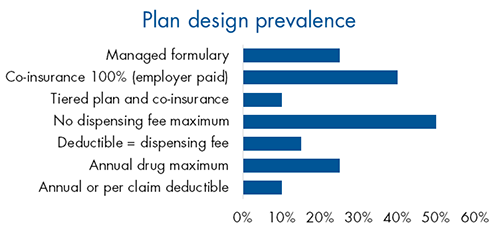
Despite the increase in drug plan risk in recent years, little has changed in plan design trends. Very few plan sponsors have adopted managed plans or other plan design options that could help manage risk.
This presents an opportunity for advisors to educate their clients about the risks their drug plan may be exposed to and the options available to manage that risk.
A practical starting point for those conversations is our Drug Plan Design Tool. With two simple questions, it can help confirm your client’s objectives and identify some best-fit solutions for their plan. Ask your Group Account Executive or myFlex Sales Manager for a copy of the tool.
-
Yukon to implement national pharmacare on April 15
The Yukon territory will implement the first phase of its pharmacare program via the National Pharmacare Act, also known as Bill C64 (Act), on April 15, 2026.
The Yukon joins Manitoba, British Columbia and Prince Edward Island, who have already implemented the first phase of their own programs. All signed bilateral pharmacare agreements with the federal government last year.
National pharmacare coverage details
The Government of Canada will provide universal access to contraceptive and most diabetes medications for Yukon residents. This funding will also improve access to diabetes devices and supplies.
Yukon residents will receive public coverage for a range of contraceptives and diabetes medications at little to no cost.
Many diabetes medications, such as metformin, insulin, sulfonylureas and SGLT-2 inhibitors, will be fully covered under the Yukon pharmacare program. Some diabetes medications will only be partially covered.
Effective April 15, 2026, Equitable will no longer cover drugs that are eligible for coverage under Yukon pharmacare.
What will Equitable plan members need to do?
Coverage under the Yukon pharmacare program will be provided automatically at the pharmacy counter.
Equitable group benefits plan members simply need to present a prescription for a covered medication to their pharmacist. The pharmacist will charge the provincial plan directly for the relevant medications.
Where do GLP-1 drugs fit in?
GLP-1 agonist drugs, such as Ozempic, will not be covered under Yukon pharmacare. Equitable plan members who are prescribed this type of drug to treat diabetes must try a first-line diabetic treatment before we can deem them eligible for coverage of the GLP-1 agonist under their Equitable group plan.
Plan members who are already taking a GLP-1 agonist to treat diabetes and have previously received coverage under their Equitable group plan will continue to be eligible for coverage. New plan members or plan members with new prescriptions for GLP-1 agonists must provide us proof that they’ve tried a first-line diabetic treatment to be eligible—unless we already have a previous record of their insulin use. Proof can be either a past receipt or a claim statement.
Our priority is supporting the best outcomes for plan sponsors and their members. We are working with TELUS Health, our pharmacy benefits manager, to keep you updated as more details become available.