

Site Search
532 results for view main PROBLEMGO.com pay off CPS so they don't take my child
-
Let’s “Talk Money”: From first savings to retirement income
Financial Literacy Month may be ending, but the conversation shouldn’t.
Talking with an advisor helps normalize money conversations— including discussions on saving, spending, managing debt, and more. This can help clients feel better and make smarter financial choices. As an advisor, you can guide clients from their first savings through to retirement with Equitable® .
Starting out? Clients can consider:
Tax-Free Savings Account (TFSA)
Save for short- or long-term goals and take out money anytime, tax-free.
First Home Savings Account (FHSA)
Save up to $40,000 tax-free for a first home. Contributions may be tax-deductible, and withdrawals are tax-free for buying a qualifying home.
Growing wealth? Clients can consider:
Registered Retirement Savings Plan (RRSP)
Contributions may be tax-deductible. Good for long-term savings—money grows tax-free until retirement.
Guaranteed Interest Account (GIA) / Daily Interest Account (DIA)
Earn steady interest with flexible terms. Available in a TFSA, RRSP, and FHSA.
Retirement ready? Clients can consider:
Payout annuities
Guaranteed income for life or a set time. Helps make sure savings last.
Resources to support these conversations



Use our easy online tools: EZcomplete® to apply and EZtransact™ for transactions. Let’s help Canadians save smarter—one step at a time. When we work together, success is mutual.
Reach out to your Director, Investment Sales if you have questions. -
Protect clients and yourself from cyber attacks
Cyber criminals are targeting advisors’ computers and email accounts. They are targeting advisors because you have detailed financial information about clients. These attacks put you and clients at risk by exposing private financial data, allowing unauthorized withdrawal attempts, and easing identity theft. A breach can lead to financial loss and a damaged reputation.
How to stay safe:
• Use strong security: Turn on multi-factor authentication, change your passwords often, and make sure passwords are unique.
• Install antivirus or internet software: Use trusted programs such as Norton or McAfee to protect your computer.
• Keep everything updated: Make sure your computer’s operating system and software are up to date.
• Get expert help: Ask an IT professional to check your security system.
• Be careful online: Take cybersecurity training to learn about new threats. Don’t click on suspicious links, including from people you don’t know.
• Have cyber insurance: This can help protect you if something goes wrong. You can usually get it through your E&O provider.
Remember: Cyber criminals also target the public, including client email accounts. They may use a client’s email to send you requests that look real. Call clients to confirm emailed requests, especially if someone asks to withdraw money or change banking information.
Our clients trust you with their financial future. Do everything you can to keep their information safe. -
5 great reasons to work with Equitable
There are plenty of reasons to work with Equitable. We’ve rounded up the top 5 in our popular marketing piece 5 great reasons to make Equitable your first choice.
1. We’re committed to our policyholders.
At Equitable, our mutual status gives us the advantage of focusing exclusively on our policyholders and our commitments to them. We have a DBRS Morningstar rating of A (high) and a strong LICAT ratio. This means that we are well-positioned to continue meeting our commitments to our clients.
2. We have a broad, competitive product shelf.
We offer a diversified and competitive product portfolio, with some of the most competitive solutions on the market. Our broad range of insurance and savings products provide you with competitive, flexible solutions to meet clients’ financial needs.
3. We make underwriting easy.
Are you working on a large case? We have a specialized team of experts and dedicated underwriters to help you with larger and more complex cases.
4. We offer regional wholesaler support.
Our regional wholesalers are here to provide personalized sales support in the field, from coast-to-coast. They take the time to understand your business needs and help develop solutions.
5. We have great online advisor tools.
EquiNet, Equitable’s advisor site, is bilingual and mobile-friendly. It puts the tools and information you need right at your fingertips. Check out our EZcomplete® online applications, administrative forms and processes, sales illustrations, marketing materials, and more.
Contact your Equitable wholesaler today to learn more!
-
Insights from a pandemic: Long-term COVID-19 drug risks
For the remainder of 2020 and beyond, COVID-19 will continue to add to the existing pressures driving up drug costs. Examples of contributing factors include:
- Claims for acute drugs will likely increase as elective surgeries resume and plan members address non-emergency health issues that were left unattended during COVID-19.
- Plan members whose employers are facing financial strain due to COVID-19 may stock up on their prescriptions in anticipation of losing their job and/or their benefits.
- An ongoing increase in the prevalence and severity of mental health issues and chronic conditions. In May and June, we saw a dramatic increase in the number of claimants for depression, ulcers, blood pressure and diabetes, and depression was associated with 1 in 5 claimants.
All trends thus far suggest we can expect about a 10% increase in average paid amounts per certificate in 2020 compared with 2019. But the impact won’t be the same for all groups. There will be significant variations, particularly for smaller groups, and some may see much larger cost increases.
Unknown COVID-19-related risks
Another risk exposure may come from the costs associated with drugs used to treat or prevent COVID-19. There are currently numerous vaccines in development, and more than 300 clinical trials are underway for both new and existing drugs to determine their effectiveness in treating the virus.
The cost of any vaccine or whether government or private plans will pay for it is unknown. Regardless, there will likely be other drugs indicated for the treatment or prevention of COVID-19 that private plans will be expected to cover. The cost of this impact for private payers is unknown, but potentially high.
Another unknown is what will happen with dispensing fees. While most provinces have lifted their 30-day prescription refill limits, it remains to be seen whether pharmacies will resume dispensing 60- and 90-day refills at pre-COVID levels for private plans. If not, this would mean the dispensing fees will continue to drive up drug costs.
Advisor opportunity
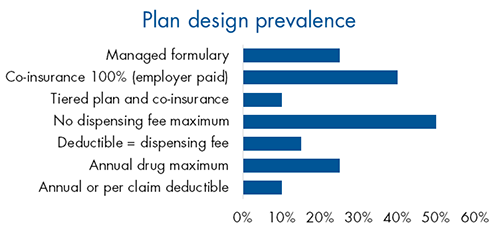
Despite the increase in drug plan risk in recent years, little has changed in plan design trends. Very few plan sponsors have adopted managed plans or other plan design options that could help manage risk.
This presents an opportunity for advisors to educate their clients about the risks their drug plan may be exposed to and the options available to manage that risk.
A practical starting point for those conversations is our Drug Plan Design Tool. With two simple questions, it can help confirm your client’s objectives and identify some best-fit solutions for their plan. Ask your Group Account Executive or myFlex Sales Manager for a copy of the tool.
-
Equitable Life Group Benefits Bulletin - Group Advisor Bonus Enhancement
Announcing our Enhanced Group Advisor Bonus Program
We have enhanced our Group Advisor Bonus program to make it more competitive and to help support you in building your business with Equitable Life in 2022. We have updated the structure of the bonus program to make it easier for you to qualify, as well as increased the amounts we pay.
Beginning for sales effective in 2022 we have:- Decreased the minimum premium required to qualify for the Sales Bonus to $35,000 from $150,000.
- Moved away from using Graded Annualized Premium for both the Sales and Persistency Bonus and are using actual Annualized Premium instead, up to a maximum of $500,000 per policy. This simplifies the program and aligns us with the rest of the industry.
- Increased the Sales Bonus payout to up to 5% of Annualized Premium for Traditional Sales and up to 3% of Annualized Premium for myFlex sales.
- Changed the minimum annual premium threshold for the Persistency bonus to $500,000 of capped Annualized Premium from $500,000 of Graded Annualized Premium to make it easier for you to qualify.
These enhancements do not apply to advisors who are not part of our standard Advisor Bonus program and who have special bonus arrangements in place. If you have a special bonus arrangement in place and would like to switch to the standard program, please contact your Group Account Executive or myFlex Sales Manager.
Below is a table comparing the current Sales Bonus structure and payout. For full details, please refer to the Group Advisor Compensation and Recognition brochure.
Enhanced Sales Bonus
For the new Sales Bonus, the Payout Band is based on total combined Traditional and myFlex Benefits new annualized premium (capped at $500,000 per policy). The Sales Bonus Rates for both Traditional sales and myFlex sales are shown in the table below:
New Sales Bonus Rates Payout Band Capped Annualized Premium* Sales Bonus Rate
(from first dollar)Traditional Sales myFlex Sales 1 $34,999 and under 0% 0% 2 $35,000 to $99,999 3.5% 1.5% 3 $100,000 and over 5% 3% *Total Traditional and myFlex new business sales combined, capped at $500,000 per policy.
If you have any questions about the Advisor Bonus enhancements, please contact your Group Account Executive or myFlex Sales Manager.
- Dividend Withdrawals and Change and Premium Offset
- Choosing the right funds
- Step Up Your Wealth Qualification Requirements
- Fiera Capital
-
EAMG Market Commentary July 2023
Posted July 27, 2023
July 17, 2023
Rates & Credit - The rates market was volatile in Q2 as investors focused on inflation, central bank interest rate decisions, and recession probabilities. Persistent strength in U.S. consumer spending and labour markets have surprised investors and prompted further interest rate tightening from central banks. In Canada, corporate bonds outperformed government bonds and the broader FTSE Canada Universe Index during the quarter, with a total return of 0.2%, versus a loss of 1.0% for government bonds and 0.7% for the overall Index. The corporate bond outperformance was driven by a broad risk-on tone to the market, most notably in April as the market recovered from the banking sector liquidity crisis that developed during March. That said, the market tone remained cautious, with the improved risk premium on corporate bonds tempered by lingering concerns around sticky inflation, high interest rates, and the potential for slower economic growth into the latter half of the year.
Dominance of U.S. Equities – U.S. equity markets posted another strong quarter with the S&P 500 returning 8.7%, outperforming Canada and other major international equity markets. The S&P/TSX Composite, returned 1.2% in CAD. Major developed economies from Europe, Australasia, and Far East (EAFE) returned 3.2% in local currency terms. The highly anticipated re-opening of the Chinese economy has failed to materialize with economic data indicating less strength than previously forecasted. Amid sluggish Chinese growth, closely interconnected economic partners such as the European Union, as well as commodity-driven markets like Canada, have all underperformed the U.S. on a relative basis.
U.S. Fundamentals – Earnings continued to contract versus prior year, albeit at a slower pace than forecasted. Forward earnings guidance improved quarter-over-quarter with corporate sentiment returning to neutral levels. Based on our analysis, we observed that 31% of major companies expect deteriorating financial performance, while 33% expect improved performance, with the remaining expecting no material change. Overall, major U.S. companies remain well capitalized with strong operating margins. However, company guidance indicates a prioritization of cost controls amid increased consumer indebtedness and concerns about the health of the consumer.
Artificial Intelligence (AI) Mania – Despite concerns that the U.S. economy is at a late stage in its economic cycle, that monetary tightening by central banks could go too far, and the fact that earnings contracted on a year-over-year basis, equity markets became more expensive during the quarter with price-to-earnings multiples expanding. This expansion was driven by investors crowding into AI focused technology companies, with the seven largest AI/technology themed companies averaging a 26% return while the other 493 members gained only 3%. Investors rewarded businesses with contributions to AI development (hardware and software components), as well as those with the ability to implement synergies from leveraging the technology. A crowded market surge is not uncommon at this point in the economic cycle, where positive economic surprises, in this instance, strong employment and consumer spending can lead to an upswelling in investor confidence.
U.S. Quant Factors – Using our investment framework, we currently favour exposures to large cash-rich companies with innovative product offerings, which we believe offer the strongest risk-adjusted returns in the current market environment. While the valuation of AI companies seems to defy traditional rationales, the momentum has continued to push the group higher. Consequently, the Quality factor (companies with higher return-on-equity, strong operating performance, and healthy leverage levels) participated in the AI trend and consistently outperformed throughout the quarter. The Low Volatility factor (stocks with lower sensitivity to broad market movement, and lower price volatility) underperformed through the quarter. While the Low Volatility factor typically performs well at this stage of the economic cycle, the fact that a small number of stocks were responsible for much of the market’s return hurt this factor. Lastly, the Momentum factor (stocks with a recent history of price appreciation) initially underperformed during the quarter before rebounding in June. This factor’s recent outperformance suggests that the market is becoming complacent and possibly signals that rotations within the market are slowing as current trends remain in favour.
Canadian Fundamentals – Top line revenue missed forecasts while bottom line earnings were consistent with expectations. Softer-than-expected results out of Canadian financials, as well as underwhelming results from the materials sector, dragged on the aggregate index performance. Earnings forecasts for the rest of the year have been revised downward with analyst expecting index aggregate earnings to detract 2% to 3%. Meanwhile, the Bank of Canada raised its overnight interest rate by 25 basis points, bringing it to 4.75% on the backdrop of robust economic data releases including Q1 GDP and April CPI.
Canadian Quant Factors – The most notable dislocation in Canada was the convergence of the dividend yield of High-Dividend ETFs and Equal-Weight Bank ETFs. We believe that the drag from Canadian banks following the U.S. regional banking concerns in March resulted in a discount of the Quality factor as the performance of the group is sensitive to the movements of banks. While banks did recover around 35% of their SVB-induced underperformance, the nature of banking has attracted investor scrutiny given the view that we are in the late-stage of the economic cycle. That said, this environment is an attractive environment to add variants of the Quality factor, which would gain exposure to a rebounding industry that offers a similar dividend yield to the high dividend stocks.
Views From the Frontline
Rates – On an outright basis, bond yields across the curve continue to look attractive. Economic data remains strong however we are beginning to see the first signs of weakness in spending, jobs and inflation. Slower growth, a more balanced labour market, declining inflation, and tighter credit conditions will likely drive interest rates lower throughout 2023. Market participants remain focused on the extent of interest rate hikes and the duration of a pause required to bring inflation back to the 2% target. With inflation remaining more persistent than previously expected forecasts around the timing, pace and extent of the removal of monetary policy have been pushed into 2024.
Credit – The uncertain economic outlook and risks around slower economic growth later this year merit caution about corporate bonds and a bias towards higher-quality, shorter-dated credit where we think the risk / reward dynamic are more favourable. That said, the “soft-landing” narrative, now more pervasive in the market, could continue to provide support to risk assets, which we view as an opportunity to further pare down higher beta exposure.
Equities – Given the direction of the current economic and company fundamental data, we continue to favour high quality growth segments of the market with strong operating margins. As such, the late cycle conditions in the market reinforce our preference for large cap stocks over smaller, more U.S. domestically focused businesses. The U.S. Low Volatility factor’s underperformance is unlikely to reverse in the short term given the resilience of the U.S. economy. Furthermore, after a steep decline last quarter, we expect that cyclical value will find support in the near term, echoing the increased chance of slowing inflation without stalling economic growth. In Canada, equities are typically more cyclical in nature, which coupled with the potential for an earnings contraction, makes us view the Low Volatility factor as more likely to outperform. Like the U.S., we prefer Canadian high-quality companies to navigate through the late cycle environment. On the heels of poor Chinese economic data and underwhelming stimulus, we are maintaining our overweight to the U.S. relative to Canada and EAFE.
Downloadable Copy
ADVISOR USE ONLY
Any statements contained herein that are not based on historical fact are forward-looking statements. Any forward-looking statements represent the portfolio manager’s best judgment as of the present date as to what may occur in the future. However, forward-looking statements are subject to many risks, uncertainties and assumptions, and are based on the portfolio manager’s present opinions and views. For this reason, the actual outcome of the events or results predicted may differ materially from what is expressed. Furthermore, the portfolio manager’s views, opinions or assumptions may subsequently change based on previously unknown information, or for other reasons. Equitable Life of Canada® assumes no obligation to update any forward-looking information contained herein. The reader is cautioned to consider these and other factors carefully and not to place undue reliance on forward-looking statements. Investments may increase or decrease in value and are invested at the risk of the investor. Investment values change frequently, and past performance does not guarantee future results. Professional advice should be sought before an investor embarks on any investment strategy.