

Site Search
527 results for see site MAKEMUR.COM Paying a witness to not show up to court
- [pdf] Segregated Fund Sales DSC Disclosure Form
-
Insights from a pandemic: COVID-19 and group benefits plans
We’ve received numerous questions about the impact of COVID-19 and what it will mean for benefits plans in the months ahead. Below is a summary of what we’re seeing so far. In the coming weeks, we’ll explore each of these topics in greater depth.
Disability
Initially, as COVID-19 started to spread, we saw STD claims ramp up quickly. Since then, we’ve seen the number of COVID-19-related STD claims slow significantly. As for LTD, we believe both the incidence and duration of those claims will increase in both the short term and medium term due to COVID-19.
Health and Dental Claims
We saw an overall spike in the volume and paid amounts for drug claims in March as plan members rushed to stock up on their medications. This was followed by a drop in April after most provinces put 30-day refill limits in place. One exception was claims for asthma drugs which surged in March but had no drop in April. Overall, the April plunge will be short-lived; drug costs have already begun to rise in May.
While paramedical and dental claims are down, we are seeing an increase in claims for virtual treatments and emergency dental services. We expect that claims will spike once the current pandemic restrictions are lifted. We’ve already started to see claims rise in provinces that are allowing health providers to re-open.
Despite the shift to more virtual services, we haven’t seen an increase in fraudulent activity. But we continue to be vigilant. Our investigative practices – verifying with the plan member that they received the treatment and have a valid receipt, and that the practitioner has treatment notes – remain the same whether treatment is provided in person or virtually.
Technology
During this time of physical distancing, people are looking for ways to interact with their providers virtually. Fortunately, our business model is almost entirely electronic, and we have several convenient digital options available for plan members and plan sponsors. Our focus in recent weeks has been to remind clients and plan members about these tools and make it as easy as possible for them to activate and use them. And we are continually adding functionality that will allow us to serve our customers even better.
Mental Health/Wellness
Usage of i-Volve, Homewood’s online cognitive behavioural therapy tool, increased significantly in March before levelling back down in April and May. And while EFAP cases fell in April and early-May, the number of cases has begun to climb in recent weeks, particularly for anxiety. In the coming weeks and months, we expect an eventual increase in marital and family issues, as well as depression. We’ve also seen an increase in mental-health-related prescriptions.
Plan Design
It’s too early to predict how the COVID-19 pandemic will impact benefits plan design and how it will change in the coming months. We would love to get your feedback and insights about how benefit plans will evolve and what new features or provisions they should include.
Please share your thoughts and suggestions with your Group Account Executive or myFlex Marketing Manager. Or, you can email your ideas to GroupCommunications@equitable.ca.
- Death Claim Requirements
- Conversions
- Conversions
-
Responding to Alberta's Biosimilar Initiative
Beginning March 15, 2021, we are changing coverage for some biologic drugs in Alberta in response to the province’s Biosimilar Initiative. These changes will help protect your clients from additional drug costs that may result from this new government policy while still providing access to equally safe and effective biosimilars.
What is Alberta’s Biosimilar Initiative?
Alberta’s Biosimilar Initiative will end provincial coverage of several originator biologic drugs for some or all conditions beginning on Jan. 15, 2021. Patients 18 and over who are using these drugs for the affected conditions will be required to switch to biosimilar versions of the drugs to maintain coverage under the province’s government drug plan.
What is the impact on private drug plans?
Industry response to Alberta’s Biosimilar Initiative has the potential to significantly impact your clients’ drug plan costs. If other insurance carriers follow suit with the province and delist the originator biologics, it could expose a plan that doesn’t delist them to significant coordination of benefits risk. (See Case Study below.)
How is Equitable Life responding?
To protect your clients’ plans from paying additional and avoidable drug costs, we are changing coverage in Alberta for most biologic drugs included in the provincial initiative.
As of March 15, 2021, several originator biologic drugs will no longer be covered for plan members of all ages in Alberta. Plan members taking these biologics will be required to switch to the biosimilar versions of these drugs to maintain eligibility under their Equitable Life plan.
What drugs and conditions are affected?
The following table outlines the drugs and conditions that will be affected by this change. The list of affected drugs or conditions is dynamic and will change as Alberta includes more biologic drugs in its Biosimilar Initiative, as new biosimilars come onto the market, and as we make changes in drug eligibility.
Drug name Originator biologic
These drugs will no longer be covered in Alberta for the conditions listed in this table.Biosimilar
Plan members will need to switch to these medications to maintain coverage under their Equitable Life plan.
Affected health conditions
The changes in coverage apply to these conditions.Etanercept Enbrel Brenzys
ErelziAnkylosing Spondylitis
Rheumatoid Arthritis
Polyarticular juvenile idiopathic arthritis (JIA)
Psoriatic Arthritis
Plaque Psoriasis (adults and children)Infliximab Remicade Inflectra
Renflexis
AvsolaAnkylosing Spondylitis
Plaque Psoriasis
Psoriatic Arthritis
Rheumatoid Arthritis
Crohn's Disease (adults and children)
Ulcerative Colitis (adults and children)Insulin glargine Lantus Basaglar Diabetes (Type 1 and 2) Filgrastim Neupogen Grastofil
NivestymNeutropenia Pegfilgrastim Neulasta Lapelga
Fulphila
ZiextenzoNeutropenia Glatiramer* Copaxone Glatect
TEVA-Glatiramer AcetateMultiple Sclerosis *Glatiramer is a non-biologic complex drug.
How will Equitable Life communicate this change to plan members?
We will be communicating with affected claimants in January 2021 to allow them ample time to change their prescriptions and avoid any interruptions in their treatment or their coverage.
Can my client maintain coverage of these biologic drugs?
Traditional groups who wish to opt out of this change and maintain coverage of these originator biologics for Alberta plan members can submit a policy amendment. Amendments must be submitted no later than January 15, 2021. Advisors with myFlex Benefits clients who wish to maintain coverage of these originator biologics for Alberta plan members should speak to their myFlex Sales Manager to confirm their eligibility to opt out of this change.
Will this change impact my clients’ rates?
The rate impact of this change in coverage will be relatively insignificant. Any cost savings associated with the change will be factored in at renewal.
If plan sponsors opt out of these changes and maintain coverage for the originator biologics, it may result in a rate increase. Any rate adjustment will be applied at renewal.
What is the difference between biologics and biosimilars?
Biologics are drugs that are engineered using living organisms like yeast and bacteria. The first version of a biologic developed is also known as the “originator” biologic. Biosimilars are also biologics. They are highly similar to the originator drug they are based on and have been shown to have no clinically meaningful differences in safety or efficacy.
Questions?
If you have any questions about this change, please contact your Group Account Executive or myFlex Sales Manager.
CASE STUDY: The Alberta Biosimilar Initiative and Coordination of Benefits (CoB) risk
CoB risk is real and can be significant, even if a pharmaceutical savings program exists.
The industry response to Alberta’s Biosimilar Initiative has the potential to significantly impact your clients’ drug plan costs. Some insurers may follow the province’s lead and delist these originator biologics. Others may cut back coverage to the cost of the biosimilars or maintain coverage of the originators. These differences could expose a plan that doesn’t delist the originator biologics to significant coordination of benefits risk. Here’s how:
Let’s assume there are two private drug plans – Plan A and Plan B. Both plans are open plans with no deductible. Plan A has 80% co-insurance and Plan B has 100% co-insurance.
BEFORE Alberta’s Biosimilar Initiative
Before Alberta’s Biosimilar Initiative, both plans cover the originator biologics listed above.
Plan A is the first private payer for an Alberta plan member taking an originator biologic drug for Rheumatoid Arthritis. Plan B is the second private payer. The cost of the originator biologic for the plan member is $30,000 annually. Here’s how the coordination of benefits would look before Alberta’s Biosimilar Initiative.

AFTER Alberta’s Biosimilar InitiativeIn response to Alberta’s Biosimilar Initiative, the insurer for Plan A delists the originator biologic and requires plan members to switch to the biosimilar. The insurer for Plan B maintains coverage of the originator biologic. Under this scenario, if the plan member doesn’t switch, Plan B essentially becomes the first payer and sees their annual cost increase by 400% (from $6,000 to $30,000).

Even if the insurer for Plan B cuts back coverage to the cost of the biosimilar or adjusts the paid amount because they have a savings program in place with the drug manufacturer, the impact could be significant. For example, if the insurer cuts back coverage to 50% (or $15,000 annually), Plan B would see a 150% annual cost increase (from $6,000 to $15,000):
- [pdf] Levelize the tax on your fixed income investments with participating whole life (individual clients)
-
Insights from a pandemic: Drug trends during COVID-19
We were expecting drug costs to rise this year due to the increase in “specialty” drugs, the shift to more expensive treatments for common conditions, and the introduction of new, costly medications. The COVID-19 pandemic has caused drug costs to rise even more than expected. While this was partly due to increased claims for certain drug categories, the most significant factor was the increase in dispensing fees as the provinces imposed 30-day refill limits.
Costs and claimants surge, drop, then climb again
Initially, as COVID-19 started to spread, we saw an overall spike in the volume and paid amounts for drug claims in March as plan members rushed to stock up on their medications. On our block, the average amount paid per certificate increased 16% in March, compared with the previous year.
This spike was followed by a drop in April after most provinces put 30-day refill limits in place. This led to a decrease in both average paid amounts and quantity per claim as people were limited to smaller refills. But the dispensing fee portion of drug cost tripled for many plan members who had to refill their prescriptions every month instead of every 90 days.
The April plunge was short-lived. Drug claims started to climb again in May as some provinces removed their 30-day refill limits. We’ve seen a continued increase so far in June as all remaining provinces have lifted their 30-day limits.
Claims for “specialty” drugs increase
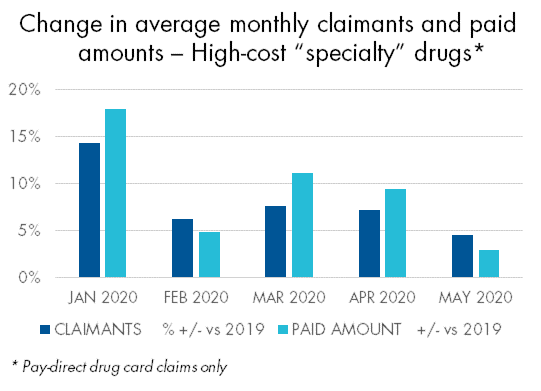 There were some notable exceptions to this trend. For example, both claimants and paid amounts for high-cost “specialty” drugs increased in March, April and May. Thirty-day refills are the norm for these drugs, so they weren’t impacted by the re-fill limits.
Claims for asthma drugs had the largest surge of any common disease category in March but had no subsequent drop in April. Not surprisingly, claims for mental health drugs increased throughout the pandemic, including a 33% increase in the number of claimants in May.
Going forward, we should see the average quantity per prescription stabilize in future months and return to normal, provided pharmacies return most patients to refills of more than 30 days.
The full impact of COVID-19 remains to be determined. We will continue to provide timely updates on any developments that impact our clients and their plan members or their benefits coverage. In the meantime, please contact your Group Account Executive or myFlex Sales Manager if you have questions.
-
Last chance to be entered to win – Snowball Your Savings contest ends March 2
There’s still time to turn client contributions into a win for both of you. Until March 2, 2026, when clients set up or contribute to their Equitable® Registered Retirement Savings Plan or Tax-Free Savings Account, they’ll be automatically entered into Equitable’s Snowball Your Savings contest. And here’s the exciting part: two winners will be randomly drawn—and their advisors will share in the celebration!
Key Dates
Contribution Period: January 1 – March 2, 2026
Draw Date: March 23, 2026
How to Enter
Advisors can easily submit client contributions through Equitable’s EZcomplete® or process transactions using EZtransact®. Every eligible entry is a chance to win!
Why Equitable?
We can help Canadians grow their savings with confidence. With a diverse range of investment funds and three distinct guarantee classes, Equitable offers flexible, goal-based solutions designed to support your clients’ financial journey.
Make the Most of It
Connect with your Director, Investment Sales to explore strategies for driving contributions, boosting engagement and supporting Canadians this season.
® and ™ denote trademarks of The Equitable Life Insurance Company of Canada.
Equitable’s Snowball Your Savings contest: No purchase necessary. Contest period January 1, 2026 to March 2, 2026. Enter by making a deposit to an Equitable Tax-Free Savings Account or Registered Retirement Savings Plan during the contest period or by submitting a no-purchase entry. Two prizes of $5,000 CAD to be drawn on March 23, 2026 will be awarded. The servicing advisor for the contract to which the selected entrants made the deposit is also an eligible winner and will receive a $1,000 CAD prize. For example, if an Equitable client is a winner of the $5,000 prize, the client’s servicing advisor for the relevant contract wins a $1,000 prize. Open to legal residents of Canada of the age of majority. Odds of winning depend on number of eligible entries received during the Contest Period. For full contest rules, including no-purchase method of entry, see the full contest rules. -
Turn ‘time in the market’ into client momentum
If clients are saving for a first home, contribution frequency matters. A simple compounding lesson helps them understand why bi‑weekly FHSA deposits can build balances faster than monthly contributions and gives you a natural bridge to Equitable’s Grow Your Way Home contest this summer.
Reinforce that bi‑weekly vs. monthly is about time in the market and consistent behaviour, not market timing. Here are a few talking points to reinforce with clients:-
“Earlier dollars work longer.”
Bi‑weekly contributions get part of the money invested sooner than a month‑end deposit, giving those dollars more days in the market. -
“More deposits create more compounding moments.”
Each deposit can begin earning right away and those earnings can earn too. More frequent contributions increase opportunities for that “interest on interest” effect. -
“Make it effortless.”
Align contributions to clients’ paydays. Automating bi‑weekly deposits helps build habit, removes friction and keeps clients steadily moving toward their first home savings goals.
As you continue FHSA conversations this summer, remind clients that contributing more frequently can get their money working sooner. And from May 1 to August 31, 2026, opening an Equitable FHSA account, contributing to their Equitable FHSA, or setting up recurring deposits to their Equitable FHSA earns automatic entries in Equitable’s Grow Your Way Home contest.
Use EZcomplete® and EZtransact® to keep contributions seamless and connect with your Director, Investment Sales for additional support, tools and ideas to help you continue these conversations throughout the summer.
® and ™ denote trademarks of The Equitable Life Insurance Company of Canada.
Equitable’s Grow Your Way Home contest: No purchase necessary. Contest period is May 1, 2026 to August 31, 2026. Enter by: opening an Equitable FHSA during the Contest Period; making a deposit to your Equitable FHSA during the Contest Period; or submitting a no-purchase entry. Two prizes of $8,000 each to be drawn on September 21, 2026 will be awarded to clients. The servicing advisor for the contract to which the selected entrant made the deposit is also an eligible winner and will receive a $1,000 prize. Open to legal residents of Canada of the age of majority. Odds of winning depend on number of eligible entries received during the Contest Period. For full contest rules, including no-purchase method of entry, see the full contest rules
-