

Site Search
690 results for go page PROBLEMGO.COM Need to get my son out of juvenile hall tonight cash waiting HMP Long Lartin
-
EAMG Market Commentary July 2024
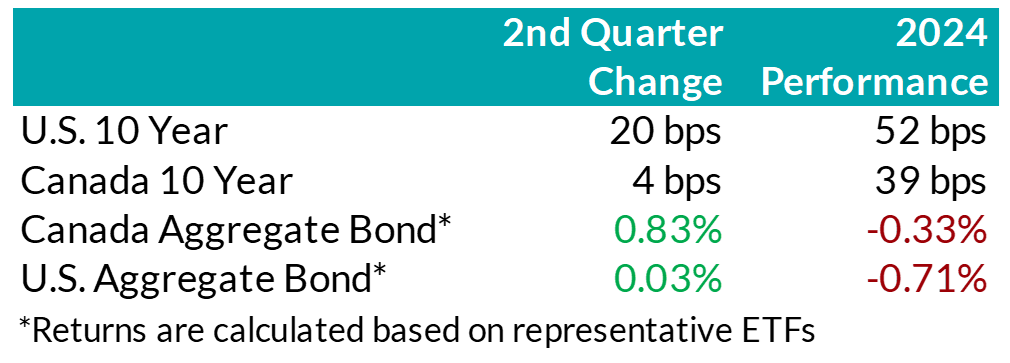.png "Picture1-(3).png") Rates & Credit – In Q2 2024, U.S. inflation and economic growth data was mixed, leading to moderately higher interest rates in the U.S. Meanwhile, in Canada, long-end interest rates were little changed during the quarter, but short-term interest rates fell. That was due to the weaker economic outlook, as well as the Bank of Canada’s decision to reduce its overnight interest rate in June, with anticipation of further monetary policy easing to come. Canadian corporate bonds returned 1.1%, outperforming the 0.8% return of government bonds as well as the 0.9% return for the overall FTSE Canada Universe Bond index. Shorter-dated bonds outperformed longer-dated bonds. Within corporate bonds, lower-rated BBBs outperformed higher-rated A bonds, while industries that have shorter-dated debt (e.g. real estate and financials) outperformed those that tend to have longer-dated debt (e.g. communications and infrastructure).
Rates & Credit – In Q2 2024, U.S. inflation and economic growth data was mixed, leading to moderately higher interest rates in the U.S. Meanwhile, in Canada, long-end interest rates were little changed during the quarter, but short-term interest rates fell. That was due to the weaker economic outlook, as well as the Bank of Canada’s decision to reduce its overnight interest rate in June, with anticipation of further monetary policy easing to come. Canadian corporate bonds returned 1.1%, outperforming the 0.8% return of government bonds as well as the 0.9% return for the overall FTSE Canada Universe Bond index. Shorter-dated bonds outperformed longer-dated bonds. Within corporate bonds, lower-rated BBBs outperformed higher-rated A bonds, while industries that have shorter-dated debt (e.g. real estate and financials) outperformed those that tend to have longer-dated debt (e.g. communications and infrastructure).
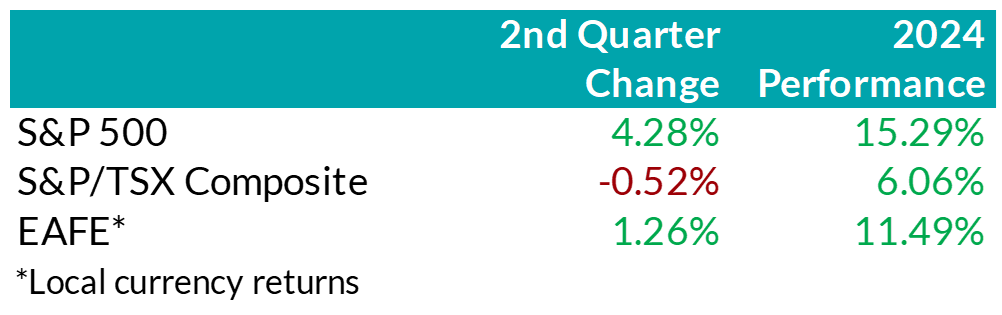.png "Picture2-(2).png") Equity Overview – Against the backdrop of volatile inflation data and a lack of indication from the Federal Reserve that it was prepared to start cutting interest rates yet, U.S. equity markets decoupled from other regions. Crowding into AI-focused, mega-cap names accelerated in Q2. More specifically, investors defaulted toward the Magnificent 7 to navigate the current period, overlooking broadening earnings breadth and less expensive valuations from the remaining S&P 493. Outside the U.S., equity returns were generally mundane in dollar terms. That said, emerging markets proved to be a bright spot for investors seeking value, as the rebound in heavily discounted Chinese equities helped push frontier markets higher.
Equity Overview – Against the backdrop of volatile inflation data and a lack of indication from the Federal Reserve that it was prepared to start cutting interest rates yet, U.S. equity markets decoupled from other regions. Crowding into AI-focused, mega-cap names accelerated in Q2. More specifically, investors defaulted toward the Magnificent 7 to navigate the current period, overlooking broadening earnings breadth and less expensive valuations from the remaining S&P 493. Outside the U.S., equity returns were generally mundane in dollar terms. That said, emerging markets proved to be a bright spot for investors seeking value, as the rebound in heavily discounted Chinese equities helped push frontier markets higher.
U.S. Fundamentals – Corporate earnings continued to surpass expectations last quarter with stable operating margins helping businesses report better-than-expected bottom line results. Investors remain focused on the ability of companies to sustain debt levels ahead of renewing debt obligations, rewarding businesses with a strong ability to generate stable cash flows. Moreover, while prior quarters have witnessed earnings growth that was largely driven by highly profitable mega-cap technology stocks, U.S. markets are witnessing a broadening trend in earnings strength, with previously stunted segments of the market recovering. Our work shows that members of the Russell 1000 index, excluding the Magnificent 7, posted a median earnings growth of about 6% last quarter, with nearly 60% of companies increasing earnings versus the year prior. Furthermore, we observed an increase in the number of major companies that expect improving financial performance to approximately 27%, suggesting that the recovery in earnings breadth may persist.
U.S. Quant Factors – As mentioned, concentration in the equity market drove a surge in valuations as investors continued to chase specific mega-cap technology stocks. In fact, within the Russell 1000 growth factor – which screens for companies whose earnings are expected to grow at an above-average rate relative to the market – the Magnificent 7 totaled nearly 55% of the entire index by quarter-end. In addition, the Nasdaq 100 – which is generally viewed as a technology-biased index – saw the weight of the Magnificent 7 rise to almost 43% of the entire index by the end of the quarter. Furthermore, the equal-weighted S&P 500 underperformed the cap-weighted index by nearly 7% last quarter, bringing the year-to-date divergence to about 10%. With concentration accelerating, the cap-weighted index outperformance has soared past Covid-era levels, a period that saw investors rapidly crowd into profitable technology names due to panic and economic uncertainty. We remain cautious of a severely crowded market that trades near all-time highs as strong performance from 5-7 names distorts the overall stature of market conditions.
Canadian Fundamentals – Although Canadian companies exceeded bleak forecasts, earnings continue to contract on a year-over-year basis. Furthermore, earnings revisions have grinded lower with easing monetary conditions unable to offset concerns of a slowing economic environment. We note the sharp contrast versus the U.S. as the bifurcation of earnings performance widens. The CRB Raw Industrials Index, a measure of price changes of basic commodities, broke out of recent ranges as metals rallied higher despite a stronger U.S. dollar and elevated interest rates. The mining industry benefited from a sustained elevation in prices, helping the materials sector outperform over the quarter. Returns from the heavily-weighted Canadian banks were constrained last quarter with company-specific drivers – including regulatory challenges from TD, and underwhelming U.S. results from BMO – limiting performance. More broadly, the banks continue to build prudent credit provisions to mitigate uncertain economic forecasts and remain well capitalized.
Canadian Quant Factors – With investors remaining attentive to businesses’ ability to create value relative to financing costs, we see value in high quality, dividend-paying companies with strong earnings sustainability and a healthy degree of leverage. Based on our work, investors of the Canadian banks appear well compensated, with the current premium between value creation and current yield remaining compressed. In our opinion, the market has modest expectations regarding prospects for value generation from the banks and, therefore, we believe the industry stands to benefit if the premium reverts closer to historical norms. We also continue to see sources of quality dividend opportunities within certain areas of the energy sector. More specifically, we believe companies that have taken steps to improve their balance sheets through deleveraging efforts, and with improved operating leverage, offer attractive prospects given their stable and high-yielding composition.
Views From the Frontline
Rates – During the first half of the second quarter, interest rates in both Canada and the U.S. increased, continuing the upward momentum from Q1. Higher-than-expected inflation data in the U.S. along with mixed economic growth data caused investors to push out expectations for when the U.S. Federal Reserve would start lowering its interest rate. This trend shifted in the second half of Q2, as positive economic momentum slowed in the U.S. economy and inflation data began to soften. Interest rates in Canada declined more rapidly than in the U.S. due to more benign inflation, a weaker job market, and economic growth remaining below population growth. This economic weakening provided the confidence required for the Bank of Canada to cut rates by 25 basis points in June to 4.75%. The Bank also signaled that if inflation continues to ease and the Bank’s confidence grows that inflation would continue to trend toward its 2% inflation target, it is reasonable to expect further cuts. The second quarter marked a pivotal point for the global policy easing cycle. Sweden, Canada, and the European Central Bank all began lowering their policy rates, and Switzerland made a second rate cut, following one in Q1. The market continues to speculate on the timing of the U.S. Federal Reserve’s first rate cut. Interest rate cut expectations are largely unchanged in Canada since last quarter, with a total of three rate cuts expected throughout 2024. Expectations for the rate cuts by the U.S. Federal Reserve declined slightly, however, to two cuts in 2024.
Credit – The risk premium for corporate bonds (versus government bonds) was largely flat over the quarter, with spreads approaching the tight post-pandemic levels experienced in 2021. Corporate bond supply continues to be very robust, with $41bn in new issuance. Year-to-date, corporate issuance has set a new record, with an impressive $80bn in issuance. On balance, we do not think the current risk premium adequately compensates for downside risk, particularly in longer-dated corporate bonds, and have a bias towards shorter-dated credit where we view the risk / reward trade-off as being more favourable.
Equity – On the backdrop of a heavily concentrated U.S. market rally, we remain cautious of the distortion to market returns from high-flying technology stocks. As a result, we continue to favour a combination of the Dow Jones Industrial Average and the S&P 500 for our broad U.S. market exposure. The Dow provides a more diversified exposure to 30 prominent large-cap companies and less concentration in technology relative to the S&P. Broadening earnings strength presents an opportunity for previously out-of-favour names to “catch-up”. In our view, companies outside the Magnificent 7 that have demonstrated robust earnings growth, strong cash flow generation, along with decreased debt loads, are well-positioned to benefit from internal market rotations. As such, we gain exposure to these companies through the quality factor – companies with higher return-on-equity, strong operating performance, and healthy leverage levels – and the dividend growth factor – businesses with a lengthy and established history of increasing dividends.
In Canada, we remain attentive to how efficiently corporations are generating profits relative to financing costs. Looking forward, we continue to monitor the ability of businesses to generate profits given a decline in capital spending. More specifically, we are focused on businesses’ ability to grow and sustain dividends amid the lag between easing monetary conditions and consumption. Due to this, we observe value in higher yielding companies that are higher on the spectrum of quality. Geographically, we maintain our overweight U.S. exposure, underpinned by encouraging U.S. inflation data trends, broadening corporate earnings growth, and normalizing consumption. In addition, sluggish Chinese data and the lack of positive earnings revisions from EAFE tilt the risk-adjusted return profile in favour of the U.S. Lastly, as a Canadian investor, fluctuations in the Loonie’s relative value versus other major currencies continues to present tactical trading opportunities within our investment mandate.
Downloadable Copy
Mark Warywoda, CFA
VP, Public Portfolio ManagementIan Whiteside, CFA, MBA
AVP, Public Portfolio ManagementJohanna Shaw, CFA
Director, Portfolio ManagementJin Li
Director, Equity Portfolio Management
Tyler Farrow, CFA
Senior Analyst, Equity
Andrew Vermeer
Senior Analyst, Credit
Elizabeth Ayodele
Analyst, Credit
Francie Chen
Analyst, Rates
ADVISOR USE ONLY
Any statements contained herein that are not based on historical fact are forward-looking statements. Any forward-looking statements represent the portfolio manager’s best judgment as of the present date as to what may occur in the future. However, forward-looking statements are subject to many risks, uncertainties, and assumptions, and are based on the portfolio manager’s present opinions and views. For this reason, the actual outcome of the events or results predicted may differ materially from what is expressed. Furthermore, the portfolio manager’s views, opinions or assumptions may subsequently change based on previously unknown information, or for other reasons. Equitable® assumes no obligation to update any forward-looking information contained herein. The reader is cautioned to consider these and other factors carefully and not to place undue reliance on forward-looking statements. Investments may increase or decrease in value and are invested at the risk of the investor. Investment values change frequently, and past performance does not guarantee future results. Professional advice should be sought before an investor embarks on any investment strategy.
-
New year tune-up for Equimax participating whole life
It’s a new year and time for an Equimax® tune up! We have made some exciting changes for new sales of Equimax Estate Builder® and Equimax Wealth Accumulator® effective February 11, 2023.
These exciting enhancements make Equimax even more robust, simpler and cost effective, to ensure it continues to be the preferred participating whole life solution for clients and advisors alike.
Watch our informative video to learn more.
Check out our Equimax splash page for complete details on all the enhancements, our transition rules, and much more.
What’s new?- All new children’s policies will now be issued as non-smoker for life – we will no longer request a non-smoker declaration for new children's policies.
- We have also removed the policy fees on new Equimax sales, reducing total premium payments – allowing clients to buy even more coverage for the same payment.
The following enhancements add more value, making it easier for you to recommend Equimax as your preferred whole life solution.- Monthly Excelerator Deposit Option(EDO) payments and EDO payments received off anniversary will now buy more paid-up additional insurance,
- Dividends earned on EDO payment paid-up additions, and credited on the base policy, can now buy even more paid-up additions,
- New clients now have the option to elect individual policies on joint last to die (JLTD) plans if their personal situation changes,
- We have also changed the way we calculate monthly premiums – resulting in lower premium payments across the board,
- And we have added our KIND™ benefit program to Equimax, as we did for our newest Generations Universal Life solution last September – making it easier for families and beneficiaries at claim time.
- And, finally, we are introducing some new sales illustration features, a Web-based software and more to help you market Equimax!
Plus, visit our Equimax product page on EquiNet®, then click on the Marketing Materials tab for the latest Equimax marketing materials.
Need more information? Please contact your local wholesaler.
® and ™ denotes a trademark of The Equitable Life Insurance Company of Canada. -
Anti-money laundering legislation changes for Savings & Retirement forms and applications
To comply with the Government of Canada’s anti-money laundering legislation and FATCA/CRS changes, Equitable Life® has updated its Savings and Retirement forms and applications. New online forms and applications are available to download from EquiNet®. Paper applications are also available to order from Equitable’s Supply Team. For a complete list of all forms and applications affected by the anti-money laundering legislation, refer to Anti-money Laundering Legislation Requirements Summary.
What should I do if I have existing paper applications?
If you currently have paper applications (Form #1383, #1384, #799, #355) with a version date that is before April 2, 2021, Equitable Life will continue to accept them, with the caveat that additional information may be required from you and your client to comply with anti-money laundering legislation.
How long can I use my existing paper applications with a version date before April 2, 2021?
Paper applications (Form #1383, #1384, #799, #355) with a version date prior to 2021/04/02 (located on the back page and in the bottom right-hand corner of the application) will no longer be accepted after July 1, 2021. If you have applications with a date that is before 2021/04/02, please destroy them and use the fillable/savable PDF on EquiNet. You can also order paper applications from our Supply Team.
Want to be sure you always have the most up-to-date application? Try our EZcomplete® online application platform. EZcomplete makes it easy to process your non face-to-face applications and allows your clients to provide their signature remotely on their own device.
To learn more about the Government of Canada’s anti-money laundering legislation and FATCA/CRS review the following links.
Government of Canada - Guidance on the Common Reporting Standard
Financial Transactions and Reports Analysis Centre of Canada
If you have any other questions, contact your Regional Investment Sales Manager.
® denotes a registered trademark of The Equitable Life Insurance Company of Canada.
-
Short-term disability coverage for plan members in quarantine or self-isolation*
Please note: This announcement applies only to groups with short-term disability coverage through Equitable Life
With the spread of COVID-19, many people have been instructed to self-isolate or quarantine themselves or are doing so voluntarily. We realize this is a stressful situation for people and they may be wondering if they are eligible for disability benefits. Short-term disability is designed to replace a plan member’s earnings if they are unable to work due to illness and injury. As a result, only plan members who meet the following criteria are eligible for benefits:
- Plan members who have tested positive for COVID-19 and are unable to work from home are eligible for coverage from Day 1 of their self-isolation period.
- Plan members who have not been tested but have symptoms consistent with COVID-19 and are unable to work from home, are eligible for coverage. Claims will be assessed according to the terms of the plan.
Plan members who are in quarantine for any other reason, but do not have symptoms consistent with COVID-19, are not eligible for coverage. These plan members should consider applying for Employment Insurance (EI) benefits, if they do not have an option to work from home.
Submitting COVID-19-related STD claims
To make things easier for plan members who need to submit claims related to COVID-19, we will not require a physician’s statement. Instead plan members should submit our simplified Short Term Disability Plan Member COVID-19 Claim Form.
Plan Administrators need to complete their portion of the regular Short Term Disability Form (Form #421).
This is a temporary process that will remain in effect through the current coronavirus situation. We will update on changes and share them on EquitableHealth.ca.
Applying for the Employment Insurance sickness benefit
Canadians quarantined due to COVID-19, who are not receiving Short Term Disability benefits, can apply for Employment Insurance (EI) sickness benefits. The one-week waiting period for EI sickness benefits has been waived. Service Canada’s dedicated toll-free support number is 1-833-381-2725 or (TTY) 1-800-529-3742.
*Indicates content that will be shared with your clients
-
Start a Conversation with EZstart – Now Available for Equimax Wealth Accumulator
Looking for an easy way to explain insurance? We have a digital tool to do just that!
Start a Conversation with EZstart™
EZstart helps to commence those initial client conversations. Think of it like a digital brochure: you start a conversation about life goals, enter a few details - and within a few clicks - get a quick quote on your phone or tablet instantly.
We have a NEW EZstart for Equimax Wealth Accumulator® available. Go to the EZstart for Equimax Wealth Accumulator now.
Don’t forget about our other EZstart tools that are available for you. Learn more.
® and TM denote trademarks of The Equitable Life Insurance Company of Canada. - [pdf] Borrowing Money to Make Money
- [pdf] Payout Annuity Advisor Guide
- [pdf] Beneficiary Change Form
-
5 topics to discuss with large case clients
Are you working with high-net-worth business owner clients? It’s important to ask the right questions to get them interested in learning how corporate-owned life insurance might benefit their situation.
Here are a few suggestions from our large case team:
1. Capital Dividend Account: Are you taking full advantage of your company’s Capital Dividend Account for your family?
2. Cash flow and surplus: Do you have surplus cash or cash flow in your corporation? Why is it there? If it is for tax deferral, would you like to make some or all of that deferral permanent?
3. Legacy: What do you want to happen to your business when you’re no longer there? How much of what you have built do you want to preserve for your family? How much will be preserved?
4. Shareholder’s agreement: Do you have a shareholder’s agreement? How is it funded? Does it deal with triggering events like death, disability, and retirement?
5. Worse-case scenarios: If you were not able to show up at your business for 3 months, and no one expected it, what would happen? What would creditors, customers, suppliers, and employees do?
Visit our large case webpage and watch Ask our Experts to learn more about the importance of careful planning when it comes to corporate policy ownership.