

Site Search
633 results for access link PROBLEMGO.com how much to make customs overlook a violation
- [pdf] Understanding Participating Whole Life
-
This year’s RSP contribution deadline is February 29, 2024
The RSP deadline is fast approaching and here are some important things to remember.
Issuing a New Policy with EZcomplete®
All online applications must be digitally signed and submitted and have a date stamp no later than February 29, 2024.
Issuing a New Policy using Paper Application
For contributions to qualify for the first 60 days, all paperwork must be completed and signed by February 29, 2024. Equitable® must receive all paperwork by March 8, 2024.
Deposits to an Existing Policy
Advisors can set up a one-time or recurring deposit or edit an existing pre-authorized debit already in place using EZtransact™. Online deposits must be made and have a date stamp by February 29, 2024, to qualify for a 2023 tax receipt.
Clients can make online deposits to Equitable through their financial institution’s online banking service. Online deposits must be made and have a date stamp by February 29, 2024, to qualify for a 2023 tax receipt.
Clients can also make a new deposit to an existing policy by cheque. The cheque must be dated and signed by February 29, 2024. Equitable must receive the cheque no later than March 8, 2024.
If online banking is being used to fund the policy – either topping up an existing policy or opening a new policy – the online banking transaction must be completed by February 29, 2024, to receive a 2023 tax receipt.
Please note that cheques and other paperwork cannot be backdated. They must be completed and signed by February 29, 2024, to qualify for a 2023 tax receipt.
If you haven’t already done so, consider EZcomplete and EZtransact our easy and fast online application and deposit tools to make life easier this RSP season.
For more information, please contact your Regional Investment Sales Manager.
® or ™ denotes a trademark of The Equitable Life Insurance Company of Canada.
Posted February 14, 2024 - Take advantage of our online services today!
-
EZtransact enhancements: New “Internal Transfer” and “Other Institution” options
At Equitable®, we’re always looking for ways to make it easier to support clients. That’s why we’re excited to share new enhancements in EZtransact® that give you more flexibility and simplify transfer processes.
What’s new
As of January 22, EZtransact now offers:
• Internal Transfers that streamline digital movement of investments between eligible client accounts within Individual Wealth.
• An “Other Institution” option when you’re initiating an external transfer. This means you can request transfers from financial institutions that are not listed in our existing dropdown menu.
These enhancements remove the need for manual workarounds and help ensure transfers are captured clearly and accurately the first time.
These updates support:
• Advisors working with Individual Wealth clients
• Clients who need to move investments either within Equitable or from another financial institution
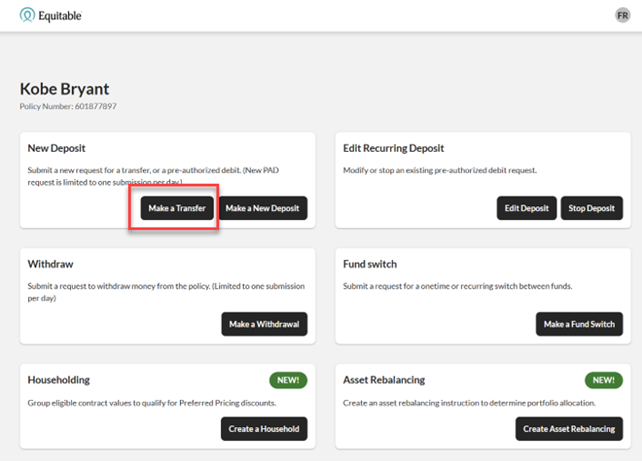
To transfer funds between existing Equitable contracts, simply go to EZtransact, select Make a Transfer on the policy you want to receive the funds, and view your client’s existing contracts all in one place.
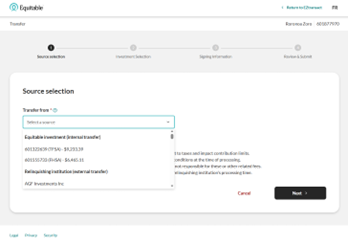
Use the new “Other Institution” option to start transfers from any financial institution, even if it’s not part of the standard list.
You’ll see these enhancements in the “Make a Transfer” flow within EZtransact on EquiNet®. It appears right at the point where you select the financial institution for the transfer.
These updates are designed to:
• Give you more flexibility when managing external transfers
• Remove the need for manual steps or workaround solutions
• Help reduce errors that can happen during manual processing
• Improve efficiency for you and deliver a smoother experience for clients
You asked, and we listened! Keep providing us with your feedback on our digital tools. When we grow together, success is mutual. Get to know EZtransact! If you have any questions, please contact your Director, Investment Sales.
Date posted: April 1, 2026 - [pdf] Build Your Business - Fully funding a client’s First Home Savings Account
- Product at a glance
- [pdf] Your guide to Coverage2go
-
Insights from a pandemic: Long-term COVID-19 drug risks
For the remainder of 2020 and beyond, COVID-19 will continue to add to the existing pressures driving up drug costs. Examples of contributing factors include:
- Claims for acute drugs will likely increase as elective surgeries resume and plan members address non-emergency health issues that were left unattended during COVID-19.
- Plan members whose employers are facing financial strain due to COVID-19 may stock up on their prescriptions in anticipation of losing their job and/or their benefits.
- An ongoing increase in the prevalence and severity of mental health issues and chronic conditions. In May and June, we saw a dramatic increase in the number of claimants for depression, ulcers, blood pressure and diabetes, and depression was associated with 1 in 5 claimants.
All trends thus far suggest we can expect about a 10% increase in average paid amounts per certificate in 2020 compared with 2019. But the impact won’t be the same for all groups. There will be significant variations, particularly for smaller groups, and some may see much larger cost increases.
Unknown COVID-19-related risks
Another risk exposure may come from the costs associated with drugs used to treat or prevent COVID-19. There are currently numerous vaccines in development, and more than 300 clinical trials are underway for both new and existing drugs to determine their effectiveness in treating the virus.
The cost of any vaccine or whether government or private plans will pay for it is unknown. Regardless, there will likely be other drugs indicated for the treatment or prevention of COVID-19 that private plans will be expected to cover. The cost of this impact for private payers is unknown, but potentially high.
Another unknown is what will happen with dispensing fees. While most provinces have lifted their 30-day prescription refill limits, it remains to be seen whether pharmacies will resume dispensing 60- and 90-day refills at pre-COVID levels for private plans. If not, this would mean the dispensing fees will continue to drive up drug costs.
Advisor opportunity
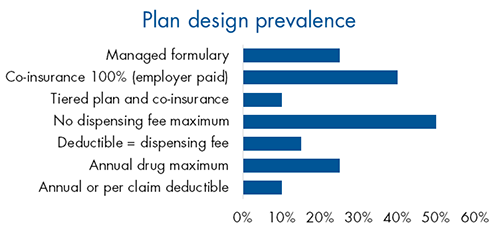
Despite the increase in drug plan risk in recent years, little has changed in plan design trends. Very few plan sponsors have adopted managed plans or other plan design options that could help manage risk.
This presents an opportunity for advisors to educate their clients about the risks their drug plan may be exposed to and the options available to manage that risk.
A practical starting point for those conversations is our Drug Plan Design Tool. With two simple questions, it can help confirm your client’s objectives and identify some best-fit solutions for their plan. Ask your Group Account Executive or myFlex Sales Manager for a copy of the tool.
- [pdf] Preserving a Family Legacy with Equimax
- How can I help to expedite the contracting process?