

Site Search
601 results for PROBLEMGO.COM pay to make criminal case vanish dark web enter portal instant freedom now
-
Let’s “Talk Money”: From first savings to retirement income
Financial Literacy Month may be ending, but the conversation shouldn’t.
Talking with an advisor helps normalize money conversations— including discussions on saving, spending, managing debt, and more. This can help clients feel better and make smarter financial choices. As an advisor, you can guide clients from their first savings through to retirement with Equitable® .
Starting out? Clients can consider:
Tax-Free Savings Account (TFSA)
Save for short- or long-term goals and take out money anytime, tax-free.
First Home Savings Account (FHSA)
Save up to $40,000 tax-free for a first home. Contributions may be tax-deductible, and withdrawals are tax-free for buying a qualifying home.
Growing wealth? Clients can consider:
Registered Retirement Savings Plan (RRSP)
Contributions may be tax-deductible. Good for long-term savings—money grows tax-free until retirement.
Guaranteed Interest Account (GIA) / Daily Interest Account (DIA)
Earn steady interest with flexible terms. Available in a TFSA, RRSP, and FHSA.
Retirement ready? Clients can consider:
Payout annuities
Guaranteed income for life or a set time. Helps make sure savings last.
Resources to support these conversations



Use our easy online tools: EZcomplete® to apply and EZtransact™ for transactions. Let’s help Canadians save smarter—one step at a time. When we work together, success is mutual.
Reach out to your Director, Investment Sales if you have questions. -
Protect clients and yourself from cyber attacks
Cyber criminals are targeting advisors’ computers and email accounts. They are targeting advisors because you have detailed financial information about clients. These attacks put you and clients at risk by exposing private financial data, allowing unauthorized withdrawal attempts, and easing identity theft. A breach can lead to financial loss and a damaged reputation.
How to stay safe:
• Use strong security: Turn on multi-factor authentication, change your passwords often, and make sure passwords are unique.
• Install antivirus or internet software: Use trusted programs such as Norton or McAfee to protect your computer.
• Keep everything updated: Make sure your computer’s operating system and software are up to date.
• Get expert help: Ask an IT professional to check your security system.
• Be careful online: Take cybersecurity training to learn about new threats. Don’t click on suspicious links, including from people you don’t know.
• Have cyber insurance: This can help protect you if something goes wrong. You can usually get it through your E&O provider.
Remember: Cyber criminals also target the public, including client email accounts. They may use a client’s email to send you requests that look real. Call clients to confirm emailed requests, especially if someone asks to withdraw money or change banking information.
Our clients trust you with their financial future. Do everything you can to keep their information safe. -
Earth Day: A simple way to talk about sustainable investing
Earth Day is a great time to talk with clients about investing with purpose. This year’s theme—Our Power, Our Planet—highlights the impact of individual and collective choices, including how we invest.
Many Canadians are interested in sustainable investing, which looks at environmental, social, and governance (ESG) factors alongside long term returns. Clients want to understand how the power of their money can support positive change—without sacrificing performance. Sustainable investing can look at things like reducing carbon impact, supporting fair workplaces, and encouraging strong company leadership.
Watch out for greenwashing
Not all investments labeled “sustainable” are the same. Some products may use the term without real environmental efforts or strategies. This is known as greenwashing.
That’s where advisors can add value. By understanding how funds are built and what they hold, you can help clients make informed choices they feel confident about.
How Equitable can help
Equitable® offers sustainable investing fund options that include ESG considerations as part of a disciplined investment approach. Take this opportunity to review available options and fund details.
You can also support sustainability through how you work with clients. Equitable’s paperless tools help reduce paper consumption and improve efficiency:
• Equitable Client Access® for online account viewing
• EZtransact® for fast, digital transactions
• EZcomplete® for easy, paper free applications
Take action
Earth Day is a great time to:
• Start simple conversations about sustainable investing
• Share Equitable’s sustainable fund options with clients
• Promote paperless tools that are better for clients and the environment
Small steps—done consistently—can make a meaningful difference for clients and the planet. If you have questions, speak with your Director, Investment Sales.
Date posted: April 22, 2026 - Helping clients build financial literacy in a changing disclosure landscape
- Advisor Guide
- [pdf] Large case insurance solutions
- About
-
Insights from a pandemic: Long-term COVID-19 drug risks
For the remainder of 2020 and beyond, COVID-19 will continue to add to the existing pressures driving up drug costs. Examples of contributing factors include:
- Claims for acute drugs will likely increase as elective surgeries resume and plan members address non-emergency health issues that were left unattended during COVID-19.
- Plan members whose employers are facing financial strain due to COVID-19 may stock up on their prescriptions in anticipation of losing their job and/or their benefits.
- An ongoing increase in the prevalence and severity of mental health issues and chronic conditions. In May and June, we saw a dramatic increase in the number of claimants for depression, ulcers, blood pressure and diabetes, and depression was associated with 1 in 5 claimants.
All trends thus far suggest we can expect about a 10% increase in average paid amounts per certificate in 2020 compared with 2019. But the impact won’t be the same for all groups. There will be significant variations, particularly for smaller groups, and some may see much larger cost increases.
Unknown COVID-19-related risks
Another risk exposure may come from the costs associated with drugs used to treat or prevent COVID-19. There are currently numerous vaccines in development, and more than 300 clinical trials are underway for both new and existing drugs to determine their effectiveness in treating the virus.
The cost of any vaccine or whether government or private plans will pay for it is unknown. Regardless, there will likely be other drugs indicated for the treatment or prevention of COVID-19 that private plans will be expected to cover. The cost of this impact for private payers is unknown, but potentially high.
Another unknown is what will happen with dispensing fees. While most provinces have lifted their 30-day prescription refill limits, it remains to be seen whether pharmacies will resume dispensing 60- and 90-day refills at pre-COVID levels for private plans. If not, this would mean the dispensing fees will continue to drive up drug costs.
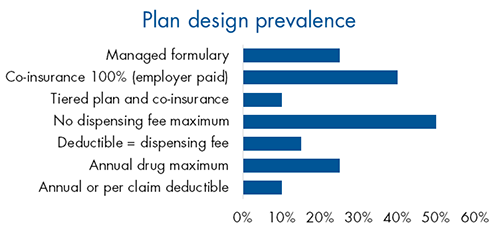
Advisor opportunity
Despite the increase in drug plan risk in recent years, little has changed in plan design trends. Very few plan sponsors have adopted managed plans or other plan design options that could help manage risk.
This presents an opportunity for advisors to educate their clients about the risks their drug plan may be exposed to and the options available to manage that risk.
A practical starting point for those conversations is our Drug Plan Design Tool. With two simple questions, it can help confirm your client’s objectives and identify some best-fit solutions for their plan. Ask your Group Account Executive or myFlex Sales Manager for a copy of the tool.
-
Update: Employment Insurance (EI) Sickness Benefit Extension
As it proposed in its 2022 Budget, the federal government has confirmed it is extending the Employment Insurance (EI) Sickness Benefits period from 15 weeks to 26 weeks later this year. The official implementation date and details have not yet been confirmed by the government and we will share further details once they are available. In the meantime, here’s what you need to know.
We will not require or implement any changes to our disability plan designs based on this extension. However, plan sponsors may wish to amend their short-term disability (STD) and long-term disability (LTD) plans and policies to align with the new 26-week EI period.Impact to short-term disability (STD) benefits integrated with EI
Plan sponsors with EI-integrated STD may wish to adjust their benefits to line up with the new 26-week extension.
Impact to plans with no STD benefits
For plan sponsors who do not offer STD, they have the option of adjusting their LTD plans to the new 26-week elimination period if members claim EI prior to LTD. This adjustment would help to avoid the plan member receiving disability and EI payments at the same time and potentially being required to return funds due to overpayment.Considerations for plan sponsors
Plan sponsors who amend their STD or LTD policies to align with the new 26-week EI period should note that there may be inadvertent delays to their employees’ return to work. While collecting EI, injured or ill employees do not benefit from our early intervention services or rigorous claims management practices that could help them get back to work sooner. So, by delaying the availability of STD or LTD coverage, the advantages that these programs are intended to provide could also be delayed.Impact to Premium Reduction Program (PRP)
The Premium Reduction Program (PRP) allows employers with eligible short-term disability plans to pay lower EI premiums. The eligibility criteria have not changed at this time. The government plans to review the PRP in 2024.Questions
If you have questions about these changes or what they mean for your clients’ disability plans, please contact your Group Account Executive or myFlex Sales Manager.
- Dividend Withdrawals and Change and Premium Offset