

Site Search
743 results for access here PROBLEMGO.com Need a bondsman who takes payment plans for release today
-
Curious about large case pricing? Our experts are here to help
Ask our Experts Episode 2
At Equitable, we’re committed to the large case market. Our dedicated team of experts is here to support you from application through to policy placement.
Ask our Experts is a mini docuseries features key members of our large case team. They talk about their work, their perspectives, and their role in the large case experience.
Watch Ask our Experts Episode 2 featuring Kevin Till, AVP of Individual Life Pricing.
Kevin chats with us about:
• What he finds interesting about large case pricing.
• How quickly Equitable can turn around a large case quote.
• The difference between a mutual and a stock insurance company.
• Equitable’s reinsurance strategy.
Learn more:
Visit our large case markets webpage to learn more about our team of dedicated experts.
Don’t miss the favourites! Watch our most viewed Ask our Experts episodes here:
Do you have a large case opportunity? Talk to your wholesaler to learn more.
3/2/2026 -
Excelerator Deposit Option – maximum payment limit changes
The Excelerator Deposit Option (EDO) gives your client the option to make additional payments, subject to specified limits and our current administrative rules and guidelines, above the required guaranteed policy premium. EDO payments can help grow the long-term values in your client’s policy. This change is regarding the maximum EDO payment limit that applies to the policy.
● NEW! If a request is received to terminate, convert, or reduce the term rider and the term rider has been in effect for 10 years or longer, the EDO maximum for the policy will not be reduced.
For Equimax policies with an Owner Signature Date of June 26, 2021 or after where a term rider has increased the maximum EDO payment limit on the policy
● If a request is received to terminate, convert, or reduce the term rider and the term rider has been in effect for less than 10 years (it has not reached the 10th policy anniversary), the EDO maximum for the policy will be reduced accordingly.
Current rules as to when underwriting is required for EDO payments continue to apply, as do current rules surrounding acceptance of EDO payments and maintaining the tax-exempt status of the policy and can be found in the Equimax Product Admin Guide.
Want more information? Contact your Regional Sales Manager for more information on these changes
-
EAMG - Macro Tear Sheet – Recent Market Volatility Summary
By separating the noise from the signals, we believe the rotation away from the mega-cap technology names is likely to continue. Recent market volatility, triggered by a multitude of factors that include the unwind of the carry trade, investor reactions to mixed mega-cap earnings, and U.S. economic data, may present more investment opportunities for long-term outperformance. Recall over the past year that the majority of U.S. stock market performance came from a limited number of mega-cap technology companies and, in our view, moving forward it will be prudent to analyze the source of returns as rapid market rotations may punish overly-concentrated portfolios.
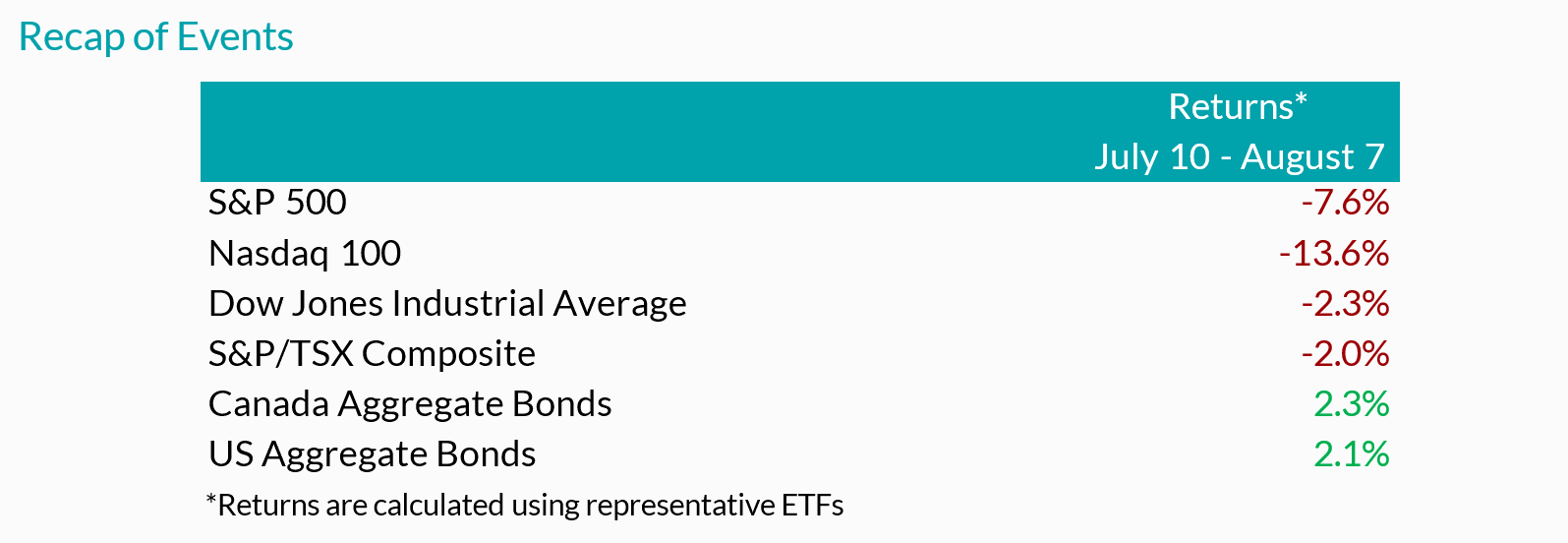
Inflation Slows (July 11) – Headline U.S. inflation readings increased 3.0% year-over-year in June, decelerating from May (3.3%). With prices slowing ahead of forecasts but economic growth remaining strong, investors became more confident regarding the prospects of an economic soft landing.
Outcome: market strength broadened with traders rotating out of highly concentrated areas of the market (“Fabulous 5”) and into more economically sensitive stocks that had been left behind.
• Big Tech Earnings (July 23 – Aug 1) – High profile mega-cap technology companies – including many members of the Magnificent 7 – reported earnings growth that generally surpassed expectations as margins remained healthy. That said, investors were more focused on spending towards AI-initiatives, rewarding businesses with greater success translating their AI investments into higher sales.
Outcome: this trend is evident through the divergence of returns from IBM and Alphabet (Google’s parent company) after releasing their quarterly earnings. The limited number of companies that contributed to the returns of the S&P 500 failed to impress investors, extending the rotation into other areas of the market.
• Caution is Brewing – Following a strong rally of economically sensitive pockets of the market, notably a breakout of returns from U.S. small cap companies, the low volatility factor, which tends to outperform during times of stress, moved in sync with the small caps’ strength.
Outcome: with a lack of fundamental justification supporting small cap performance, markets showed signs of caution.
• Central Bank Decisions (July 31)– The Federal Reserve held interest rates unchanged during its July meeting, in line with market expectations, reiterating committee members’ need for greater confidence that inflation would continue to subside. That said, policymakers signaled a reduction in policy rates could be a possibility in the coming meetings. In contrast, the Bank of Japan (BoJ) increased its key interest rate while also announcing plans to scale back bond purchases – restrictive monetary policy maneuvers aimed at backstopping the depreciating Japanese currency.
Outcome: the bifurcation between the BoJ and most other major central banks sparked a sharp appreciation of the yen and a rapid unwind of the yen carry trade (see below for explanation).
• Growth Scare (August 2)– In early August, a downside surprise in U.S. nonfarm payrolls (114k actual versus 175k expected) and an increase in the unemployment rate to 4.3%, higher than the 4.1% that was expected and up from 3.5% a year ago triggered concerns of a cooling labor market.
Outcome: speculation swelled surrounding the pace of rate cuts with market participants expecting the Federal Reserve to cut rates as much as 125bps over the next 3 policy meetings, up from 50-75bps as of the end of July. Against this backdrop, the ongoing unwind of the yen carry trade accelerated.
Yen Carry Trade Explained
• Simply put, investors have been borrowing Japanese yen – a low yielding currency – to invest in higher-yielding foreign assets. The primary risks in a carry trade can include the uncertainty of foreign exchange rates (if unhedged), as well as changes to expectations of the underlying yields, among other risks. Over the last 2 decades, the BoJ has implemented an ultra-low interest rate monetary policy to combat deflation and stimulate growth. Furthermore, investors were emboldened by the Japanese yen’s ~53% depreciation versus the U.S. dollar over the last 10 years. With the BoJ hiking its key interest rate while also announcing plans to scale back bond purchases, the yen rallied abruptly. Consequently, highly leveraged investors have had to exit their long positions in riskier assets to repay their borrowed yen exposure.
Peak Carry Trade Unwind – Buying Opportunity
• Peak carry trade unwind, which implies heightened panic levels, has historically created an attractive buying environment. That said, we are focused on companies that have demonstrated robust earnings growth and healthy leverage. Given the unprecedented level of market concentration over the last year, we view the unwind of the carry trade as another catalyst for investors to rotate out of the “Fabulous 5”.
Our Findings:
We found that the peak unwind of the carry trade may be a buying opportunity. At present, the current level of the unwind is similar to many notable market bottoms, including the Great Financial Crisis (2008), the European debt crisis (2010), the oil crash (2014), the subsequent emerging market crisis (2015), the Covid-19 crash (2020), and the collapse of Silicon Valley Bank (2023). We assessed the degree of the unwind by looking at the one-month implied volatility between three currency pairs, U.S. Dollar/Yen, Australian Dollar/Yen, and Euro/Yen. Implied volatility is a measure of the expected future volatility of the underlying assets over a given time period. Amid strong earnings growth and steady margins from quality businesses within the U.S. market, the fundamental backdrop suggests that businesses outside the concentrated AI-darlings may drive the next leg of market returns.
Downloadable Copy
Mark Warywoda, CFA
VP, Public Portfolio ManagementIan Whiteside, CFA, MBA
AVP, Public Portfolio ManagementJohanna Shaw, CFA
Director, Portfolio ManagementJin Li
Director, Equity Portfolio Management
Tyler Farrow, CFA
Senior Analyst, Equity
Andrew Vermeer
Senior Analyst, Credit
Elizabeth Ayodele
Analyst, Credit
Francie Chen
Analyst, Rates
ADVISOR USE ONLY
Any statements contained herein that are not based on historical fact are forward-looking statements. Any forward-looking statements represent the portfolio manager’s best judgment as of the present date as to what may occur in the future. However, forward-looking statements are subject to many risks, uncertainties, and assumptions, and are based on the portfolio manager’s present opinions and views. For this reason, the actual outcome of the events or results predicted may differ materially from what is expressed. Furthermore, the portfolio manager’s views, opinions or assumptions may subsequently change based on previously unknown information, or for other reasons. Equitable® assumes no obligation to update any forward-looking information contained herein. The reader is cautioned to consider these and other factors carefully and not to place undue reliance on forward-looking statements. Investments may increase or decrease in value and are invested at the risk of the investor. Investment values change frequently, and past performance does not guarantee future results. Professional advice should be sought before an investor embarks on any investment strategy. -
2023 is here and we are here for you!
Equitable Life® would like to wish everyone a Happy New Year and we are looking forward to doing more business together in 2023!
Just a reminder, we made some changes in 2022 to make doing business with Equitable Life easier. Some of the most recent enhancements include:
Opt in for text messages on new applications
● Upon submission of an application, you can opt-in to receive text message updates for your new business applications. That’s a text message when the application is received, when a decision is made, when it’s ready for delivery and when the commissions have been triggered.
Cloning pages on EZcomplete®
● You now have the ability to clone an application on EZcomplete. A whole family or a spouse can have a lot of duplicate information and the ability to clone an application can save tremendous amounts of time and make for a much more pleasant client experience.
Jump around on EZcomplete
● Jump from one part of the application to another and back again. You no longer have to complete the application one section after another in order. This will allow a lot more flexibility when submitting a policy application.
To learn more about these great enhancements contact your local wholesaler.
Continue watching for news from Equitable Life for more great launches and enhancements in 2023!
® and TM denote trademarks of The Equitable Life Insurance Company of Canada.
- How can I help to expedite the contracting process?
- General Information
- General Information
- [pdf] Building a stronger investment portfolio with participating whole life
- [pdf] Corporately Owned Segregated Funds
-
AI – Not a replacement for good judgement
When it comes to AI, clients’ interests come first
Artificial intelligence, or AI, is changing how we work in Canada. It helps us do things faster, makes talking to others easier, and takes care of many daily tasks. As of mid-2025, studies show that more than 68% of Canadian financial firms — including about 15,000 advisors and 2,500 agencies — have already started using AI to stay ahead, reach clients, and handle routine tasks.1,2
For financial advisors, AI can be useful and exciting, as long as it’s used wisely and always with client privacy and regulatory compliance in mind.
AI can make your day-to-day work easier but use it with care:
• Know the risks as well as the rewards
• Remember, AI is a tool —it can’t replace your expertise and good judgement!
• When using AI, always protect client privacy and follow the rules
AI is changing how we all work. To help you keep up, we encourage you to stay up to date with industry news and tips about AI. For example, the following recent news article has some helpful tips on using AI safely and effectively in your practice: Using artificial intelligence can pose risks for advisors
When you use AI, stay vigilant and informed, use your good judgement—and always put the client’s interests first.
1Canadian Artificial Intelligence Business Adoption Survey 2025, Finance and Technology Insights Canada.
2Financial Advisors & Agency Technology Integration Report, Canadian InsurTech Analytics, July 2025.