

Site Search
532 results for view main PROBLEMGO.com pay off CPS so they don't take my child
-
EAMG - Macro Tear Sheet – Recent Market Volatility Summary
By separating the noise from the signals, we believe the rotation away from the mega-cap technology names is likely to continue. Recent market volatility, triggered by a multitude of factors that include the unwind of the carry trade, investor reactions to mixed mega-cap earnings, and U.S. economic data, may present more investment opportunities for long-term outperformance. Recall over the past year that the majority of U.S. stock market performance came from a limited number of mega-cap technology companies and, in our view, moving forward it will be prudent to analyze the source of returns as rapid market rotations may punish overly-concentrated portfolios.
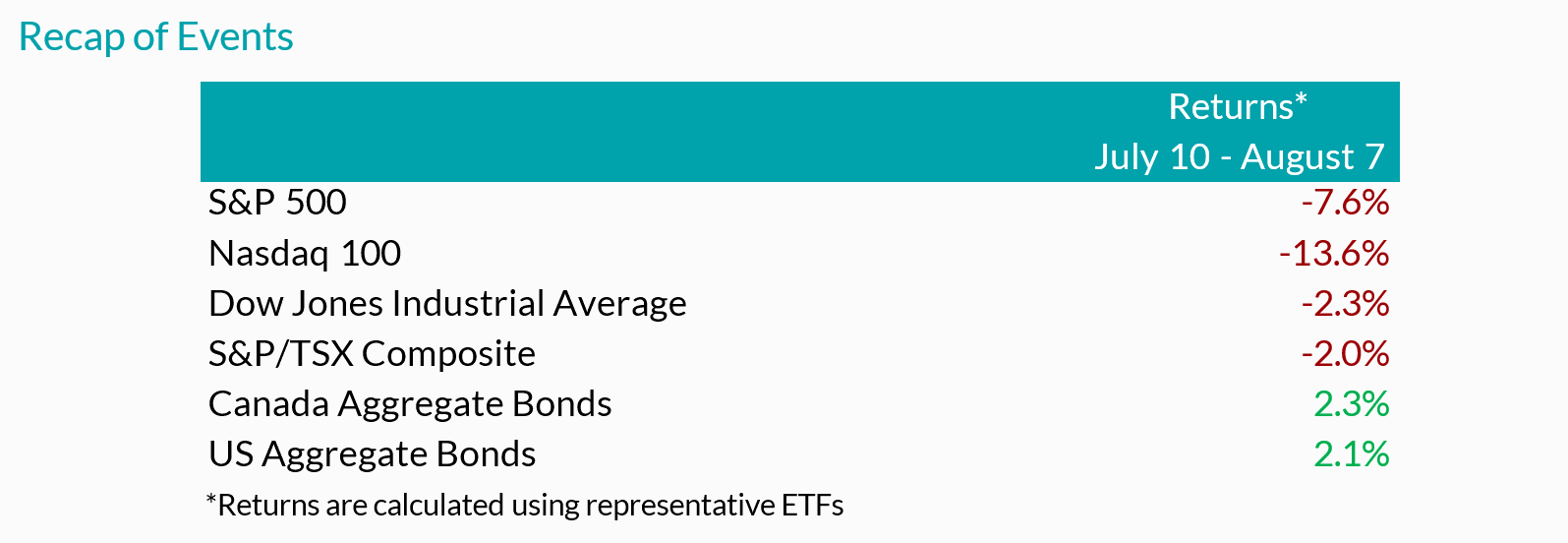
Inflation Slows (July 11) – Headline U.S. inflation readings increased 3.0% year-over-year in June, decelerating from May (3.3%). With prices slowing ahead of forecasts but economic growth remaining strong, investors became more confident regarding the prospects of an economic soft landing.
Outcome: market strength broadened with traders rotating out of highly concentrated areas of the market (“Fabulous 5”) and into more economically sensitive stocks that had been left behind.
• Big Tech Earnings (July 23 – Aug 1) – High profile mega-cap technology companies – including many members of the Magnificent 7 – reported earnings growth that generally surpassed expectations as margins remained healthy. That said, investors were more focused on spending towards AI-initiatives, rewarding businesses with greater success translating their AI investments into higher sales.
Outcome: this trend is evident through the divergence of returns from IBM and Alphabet (Google’s parent company) after releasing their quarterly earnings. The limited number of companies that contributed to the returns of the S&P 500 failed to impress investors, extending the rotation into other areas of the market.
• Caution is Brewing – Following a strong rally of economically sensitive pockets of the market, notably a breakout of returns from U.S. small cap companies, the low volatility factor, which tends to outperform during times of stress, moved in sync with the small caps’ strength.
Outcome: with a lack of fundamental justification supporting small cap performance, markets showed signs of caution.
• Central Bank Decisions (July 31)– The Federal Reserve held interest rates unchanged during its July meeting, in line with market expectations, reiterating committee members’ need for greater confidence that inflation would continue to subside. That said, policymakers signaled a reduction in policy rates could be a possibility in the coming meetings. In contrast, the Bank of Japan (BoJ) increased its key interest rate while also announcing plans to scale back bond purchases – restrictive monetary policy maneuvers aimed at backstopping the depreciating Japanese currency.
Outcome: the bifurcation between the BoJ and most other major central banks sparked a sharp appreciation of the yen and a rapid unwind of the yen carry trade (see below for explanation).
• Growth Scare (August 2)– In early August, a downside surprise in U.S. nonfarm payrolls (114k actual versus 175k expected) and an increase in the unemployment rate to 4.3%, higher than the 4.1% that was expected and up from 3.5% a year ago triggered concerns of a cooling labor market.
Outcome: speculation swelled surrounding the pace of rate cuts with market participants expecting the Federal Reserve to cut rates as much as 125bps over the next 3 policy meetings, up from 50-75bps as of the end of July. Against this backdrop, the ongoing unwind of the yen carry trade accelerated.
Yen Carry Trade Explained
• Simply put, investors have been borrowing Japanese yen – a low yielding currency – to invest in higher-yielding foreign assets. The primary risks in a carry trade can include the uncertainty of foreign exchange rates (if unhedged), as well as changes to expectations of the underlying yields, among other risks. Over the last 2 decades, the BoJ has implemented an ultra-low interest rate monetary policy to combat deflation and stimulate growth. Furthermore, investors were emboldened by the Japanese yen’s ~53% depreciation versus the U.S. dollar over the last 10 years. With the BoJ hiking its key interest rate while also announcing plans to scale back bond purchases, the yen rallied abruptly. Consequently, highly leveraged investors have had to exit their long positions in riskier assets to repay their borrowed yen exposure.
Peak Carry Trade Unwind – Buying Opportunity
• Peak carry trade unwind, which implies heightened panic levels, has historically created an attractive buying environment. That said, we are focused on companies that have demonstrated robust earnings growth and healthy leverage. Given the unprecedented level of market concentration over the last year, we view the unwind of the carry trade as another catalyst for investors to rotate out of the “Fabulous 5”.
Our Findings:
We found that the peak unwind of the carry trade may be a buying opportunity. At present, the current level of the unwind is similar to many notable market bottoms, including the Great Financial Crisis (2008), the European debt crisis (2010), the oil crash (2014), the subsequent emerging market crisis (2015), the Covid-19 crash (2020), and the collapse of Silicon Valley Bank (2023). We assessed the degree of the unwind by looking at the one-month implied volatility between three currency pairs, U.S. Dollar/Yen, Australian Dollar/Yen, and Euro/Yen. Implied volatility is a measure of the expected future volatility of the underlying assets over a given time period. Amid strong earnings growth and steady margins from quality businesses within the U.S. market, the fundamental backdrop suggests that businesses outside the concentrated AI-darlings may drive the next leg of market returns.
Downloadable Copy
Mark Warywoda, CFA
VP, Public Portfolio ManagementIan Whiteside, CFA, MBA
AVP, Public Portfolio ManagementJohanna Shaw, CFA
Director, Portfolio ManagementJin Li
Director, Equity Portfolio Management
Tyler Farrow, CFA
Senior Analyst, Equity
Andrew Vermeer
Senior Analyst, Credit
Elizabeth Ayodele
Analyst, Credit
Francie Chen
Analyst, Rates
ADVISOR USE ONLY
Any statements contained herein that are not based on historical fact are forward-looking statements. Any forward-looking statements represent the portfolio manager’s best judgment as of the present date as to what may occur in the future. However, forward-looking statements are subject to many risks, uncertainties, and assumptions, and are based on the portfolio manager’s present opinions and views. For this reason, the actual outcome of the events or results predicted may differ materially from what is expressed. Furthermore, the portfolio manager’s views, opinions or assumptions may subsequently change based on previously unknown information, or for other reasons. Equitable® assumes no obligation to update any forward-looking information contained herein. The reader is cautioned to consider these and other factors carefully and not to place undue reliance on forward-looking statements. Investments may increase or decrease in value and are invested at the risk of the investor. Investment values change frequently, and past performance does not guarantee future results. Professional advice should be sought before an investor embarks on any investment strategy. -
Equitable Life Group Benefits Bulletin – November 2020
In this issue:
- Telemedicine now included in Travel Assist*
- Take advantage of our convenient digital options*
- 2021 changes to Maximum Insurable Earnings, Maximum Weekly Insurable Earnings and Short Term Disability Benefit*
*Indicates content that will be shared with your clients
Telemedicine now included in Travel Assist*
Medical emergencies can be particularly stressful while travelling. Making your way to a medical facility can be a struggle. And once you get there, you could face long wait times, language barriers or even the risk of COVID-19 infection.
That’s why Allianz Global Assistance®, our Travel Assist provider, is adding two new virtual care options to provide plan members with timely and appropriate medical support.
As always, when a travel medical emergency strikes, plan members call Allianz for assistance. During the intake process plan members will be guided through a series of questions to triage their unique medical situation. Options for care now include two different virtual care services:
- TeleConsultation – Video and chat consultation with a locally licensed physician. This physician can diagnose simple medical conditions and provide a prescription. Available across Canada and in some high travel states in the United States.
- TeleAdvice – Video and chat consultation for situations which are not likely to require a prescription. The physician can diagnose simple medical conditions and provide medical guidance.
Plan members who use virtual care may benefit from:
- Reduced wait times;
- Care from the comfort of their current location;
- Reduced language barriers;
- No need to arrange transportation to a medical facility;
- Reduced impact on travel itinerary; and
- Reduced risk of exposure.
Both TeleConsultation and TeleAdvice will be available for all Equitable Life plan members beginning January 1st, 2021. There is no additional cost, no changes required to your client’s plans, and no change to the way plan members contact Allianz in the event of a travel medical emergency.
This PDF plan member update will also be included in the eNews to plan administrators.
If you have any questions about these new features, please contact your Equitable Life Group Account Executive or myFlex Sales Manager.
Allianz Global Assistance is a registered business name of AZGA Service Canada Inc. and AZGA Insurance Agency Canada Ltd.
Help your clients take advantage of our convenient digital options*
During this time of physical distancing, people are looking for ways to interact with their providers virtually. We recently enhanced our Online Plan Member Enrolment tool, allowing all groups to add new plan members without the need for paper forms.
Did you know, we have several other digital options available to make it easier for your clients to do business with us and for their plan members to access and use their benefits plan? Over 71% of plan administrators are managing their plan online and 78% of plan members are already using our digital tools.
For plan administrators:
- Plan Administrator Portal (EquitableHealth.ca) – plan administrators can easily manage their plan anytime and anywhere
- Digital Welcome Kits – personalized welcome kits are delivered to plan members via email
- Easy automated payments – plan administrators can avoid missed payments by setting up pre-authorized debit or electronic funds transfer
For plan members:
- Plan Member Portal (EquitableHealth.ca) – plan members get secure, 24/7 access to their claims history, coverage details and health and wellness resources
- Electronic Claim Payments and Notifications – plan members can get claim updates sooner in their email inbox and payments right into their bank account
- EZClaim Mobile App – submitting claims from a mobile device is fast, easy and secure
- Digital Benefits Cards – plan members no longer have to dig through their wallet – they can download their benefits card on their mobile device
Learn more about how we’re making it easier for your clients to do business with us
2021 changes to Maximum Insurable Earnings, Maximum Weekly Insurable Earnings and Short Term Disability Benefit*
The Canada Employment Insurance Commission and Canada Revenue Agency have announced the 2021 changes to Maximum Insurable Earnings, and premiums for employment insurance. These changes take effect January 1st, 2021.
Maximum Insurable Earnings (MIE)
The MIE will increase from $54,200 to $56,300.
Maximum Weekly Insurable Earnings (MWIE)
The MWIE will increase from $1,042 to $1,083.
EI Benefit (55% of the MWIE, rounded to the nearest dollar)
EI benefit will increase from $573 to $595
Information for Plan sponsors
If your client’s Group Policy with Equitable Life includes a Short Term Disability (STD) benefit which is tied to the EI MWIE, and at least one classification of employees has less than a $595 maximum:
- To comply with the provisions of their policy, their STD benefit will be revised with the maximums updated based on the percentage of EI MEIW shown in their policy.
- The additional premium for any increase from their previous STD amounts and new STD amounts will be show on their January 2021 Group Insurance Billing (as applicable).
If their STD maximum is currently higher than $595 or based on a flat amount (not based on a percentage or regular earnings):
- No change will be made to their plan unless otherwise directed.
If your clients wish to provide direction regarding revising their STD maximum, or have questions about the process, they can email Kari Gough, Manager, Group Quotes and Issue.
*Indicates content that will be shared with your clients
-
Equitable Life Group Benefits Bulletin – December 2021
In this issue:
- Supporting plan members affected by the flooding in Nova Scotia and Newfoundland*
- Update: Changing certificate numbers on EquitableHealth.ca*
- Help plan members take advantage of convenient digital options*
- Ontario optometrists and government to restart negotiations*
- QDIPC updates terms and conditions for 2022*
Supporting plan members affected by the flooding in Nova Scotia and Newfoundland*
The recent flooding in Nova Scotia and Newfoundland is having a devastating impact on the province’s residents.
Here are some of the ways we can help support your clients’ plan members who are affected by the flooding.
Prescription refills
Until Dec. 31, our pharmacy benefit manager, TELUS Health, will allow early refills for plan members who have been evacuated and/or lost their medication due to the flooding.
Replacement of medical or dental equipment and appliances
If plan members in Nova Scotia or Newfoundland need to replace any eligible medical or dental equipment or appliances (e.g. prescription eyeglasses, dentures, etc.) due to the flooding, they can call us at 1.800.265.4556 before incurring additional expenses to see how we can support them.
Disability or other benfit cheques
If plan members affected by the flooding are receiving disability benefits or other benefit reimbursements by cheque, they can visit www.equitable.ca/go/digital for easy instructions on how to sign up for direct deposit. It’s easy and takes just a few minutes. They can call us at 1.800.265.4556 if they need help. We can also arrange for a different mailing address or replacement cheques if necessary.
Mental Health Support
A natural disaster can also take a serious toll on people’s mental health. All of our plan members have access to the Homeweb online portal and mobile app, including numerous articles, tools and resources designed to provide guidance and support in difficult times. Homewood has put together some suggestions on how to help employees affected by a natural disaster.
For your clients with an Employee and Family Assistance Program, remind them that their plan members have 24/7 access to confidential counselling through a national network of mental health professionals. Whether it’s face-to-face, by phone, email, chat or video, plan members will receive the most appropriate, most timely support for the issue they’re dealing with.
If a client wishes to add the EFAP to their plan, we can do this quickly – often in just a few days. Simply contact your Group Account Executive or myFlex Sales Manager.
Plan Administrator support
We realize that the flooding may also be having an impact on the regular business operations of your clients in Nova Scotia and Newfoundland. If any of your clients are unable to carry out day-to-day plan administration, they can call us at 1.800.265.4556 to see how we can support them.
We know this is a challenging time for many of your clients and their plan members. We will continue to monitor the situation and provide additional updates as appropriate.
Update: Changing certificate numbers on EquitableHealth.ca*
Effective Dec. 10th, plan administrators will no longer be able to update or change plan members’ certificate numbers on EquitableHealth.ca. This change will ensure we can manage these changes more effectively to provide a smoother plan member experience.
If your clients need to update a plan member’s certificate number, please have them reach out to Group Benefits Administration for assistance at groupbenefitsadmin@equitable.ca.
Help plan members take advantage of convenient digital options*
We have several digital options available to make it easier for your clients to do business with us and for their plan members to access and use their benefits plan.
To help build awareness among plan members, we’ve created two posters that your clients can post on their intranet sites or in their office. The posters provide easy instructions on how to activate our secure, digital options.
Please click on the links below to download the posters.
EquitableHealth.ca posters: EZClaim mobile app posters:
EquitableHealth.ca English EZClaim mobile app English poster
EquitableHealth.ca French poster EZClaim mobile app French poster
Ontario optometrists and government to restart negotiations*
The Ontario Association of Optometrists (OAO) announced it has paused its job action and will restart negotiations with the Ontario Ministry of Health on funding for optometry services.
In September, Ontario optometrists began withholding services from patients covered by OHIP, including children, senior citizens and other patients with certain medical conditions, after negotiations with the Ministry of Health over compensation broke down.
Residents of Ontario between the ages of 20 to 64 who aren’t eligible for coverage of eye services under OHIP were not affected by the job action. They were able to continue to receive eye exams from their optometrist and submit eligible claims to their benefits plan.
QDIPC updates terms and conditions for 2022*
Every year, the Quebec Drug Insurance Pooling Corporation (QDIPC) reviews the terms and conditions for the high-cost pooling system in the province. Based on its latest review, QDIPC is revising its pooling levels and fees for 2022 to reflect trends in the volume of claims submitted to the pool, particularly catastrophic claims.
Size of group (# of certificates) Threshold per certificate 2022 Annual factor (without dependents Annual factor (with dependents) Fewer than 25 $8,000 $276.00 $771.00 25 – 49 $16,500 $188.00 $527.00 50 – 124 $32,500 $97.00 $328.00 125 – 249 $55,000 $66.00 $223.00 250 – 499 $80,000 $51.00 $173.00 500 – 999 $105,000 $39.00 $153.00 1,000 – 3,999 $130,000 $34.00 $133.00 4,000 – 5,999 $300,000 $18.00 $71.00 6,000 and over Free market – Groups not subject to Quebec Industry Pooling
We will apply the new pooling levels and fees to future renewal calculations that involve Quebec plan members. -
Responding to Alberta's Biosimilar Initiative
Beginning March 15, 2021, we are changing coverage for some biologic drugs in Alberta in response to the province’s Biosimilar Initiative. These changes will help protect your clients from additional drug costs that may result from this new government policy while still providing access to equally safe and effective biosimilars.
What is Alberta’s Biosimilar Initiative?
Alberta’s Biosimilar Initiative will end provincial coverage of several originator biologic drugs for some or all conditions beginning on Jan. 15, 2021. Patients 18 and over who are using these drugs for the affected conditions will be required to switch to biosimilar versions of the drugs to maintain coverage under the province’s government drug plan.
What is the impact on private drug plans?
Industry response to Alberta’s Biosimilar Initiative has the potential to significantly impact your clients’ drug plan costs. If other insurance carriers follow suit with the province and delist the originator biologics, it could expose a plan that doesn’t delist them to significant coordination of benefits risk. (See Case Study below.)
How is Equitable Life responding?
To protect your clients’ plans from paying additional and avoidable drug costs, we are changing coverage in Alberta for most biologic drugs included in the provincial initiative.
As of March 15, 2021, several originator biologic drugs will no longer be covered for plan members of all ages in Alberta. Plan members taking these biologics will be required to switch to the biosimilar versions of these drugs to maintain eligibility under their Equitable Life plan.
What drugs and conditions are affected?
The following table outlines the drugs and conditions that will be affected by this change. The list of affected drugs or conditions is dynamic and will change as Alberta includes more biologic drugs in its Biosimilar Initiative, as new biosimilars come onto the market, and as we make changes in drug eligibility.
Drug name Originator biologic
These drugs will no longer be covered in Alberta for the conditions listed in this table.Biosimilar
Plan members will need to switch to these medications to maintain coverage under their Equitable Life plan.
Affected health conditions
The changes in coverage apply to these conditions.Etanercept Enbrel Brenzys
ErelziAnkylosing Spondylitis
Rheumatoid Arthritis
Polyarticular juvenile idiopathic arthritis (JIA)
Psoriatic Arthritis
Plaque Psoriasis (adults and children)Infliximab Remicade Inflectra
Renflexis
AvsolaAnkylosing Spondylitis
Plaque Psoriasis
Psoriatic Arthritis
Rheumatoid Arthritis
Crohn's Disease (adults and children)
Ulcerative Colitis (adults and children)Insulin glargine Lantus Basaglar Diabetes (Type 1 and 2) Filgrastim Neupogen Grastofil
NivestymNeutropenia Pegfilgrastim Neulasta Lapelga
Fulphila
ZiextenzoNeutropenia Glatiramer* Copaxone Glatect
TEVA-Glatiramer AcetateMultiple Sclerosis *Glatiramer is a non-biologic complex drug.
How will Equitable Life communicate this change to plan members?
We will be communicating with affected claimants in January 2021 to allow them ample time to change their prescriptions and avoid any interruptions in their treatment or their coverage.
Can my client maintain coverage of these biologic drugs?
Traditional groups who wish to opt out of this change and maintain coverage of these originator biologics for Alberta plan members can submit a policy amendment. Amendments must be submitted no later than January 15, 2021. Advisors with myFlex Benefits clients who wish to maintain coverage of these originator biologics for Alberta plan members should speak to their myFlex Sales Manager to confirm their eligibility to opt out of this change.
Will this change impact my clients’ rates?
The rate impact of this change in coverage will be relatively insignificant. Any cost savings associated with the change will be factored in at renewal.
If plan sponsors opt out of these changes and maintain coverage for the originator biologics, it may result in a rate increase. Any rate adjustment will be applied at renewal.
What is the difference between biologics and biosimilars?
Biologics are drugs that are engineered using living organisms like yeast and bacteria. The first version of a biologic developed is also known as the “originator” biologic. Biosimilars are also biologics. They are highly similar to the originator drug they are based on and have been shown to have no clinically meaningful differences in safety or efficacy.
Questions?
If you have any questions about this change, please contact your Group Account Executive or myFlex Sales Manager.
CASE STUDY: The Alberta Biosimilar Initiative and Coordination of Benefits (CoB) risk
CoB risk is real and can be significant, even if a pharmaceutical savings program exists.
The industry response to Alberta’s Biosimilar Initiative has the potential to significantly impact your clients’ drug plan costs. Some insurers may follow the province’s lead and delist these originator biologics. Others may cut back coverage to the cost of the biosimilars or maintain coverage of the originators. These differences could expose a plan that doesn’t delist the originator biologics to significant coordination of benefits risk. Here’s how:
Let’s assume there are two private drug plans – Plan A and Plan B. Both plans are open plans with no deductible. Plan A has 80% co-insurance and Plan B has 100% co-insurance.
BEFORE Alberta’s Biosimilar Initiative
Before Alberta’s Biosimilar Initiative, both plans cover the originator biologics listed above.
Plan A is the first private payer for an Alberta plan member taking an originator biologic drug for Rheumatoid Arthritis. Plan B is the second private payer. The cost of the originator biologic for the plan member is $30,000 annually. Here’s how the coordination of benefits would look before Alberta’s Biosimilar Initiative.

AFTER Alberta’s Biosimilar InitiativeIn response to Alberta’s Biosimilar Initiative, the insurer for Plan A delists the originator biologic and requires plan members to switch to the biosimilar. The insurer for Plan B maintains coverage of the originator biologic. Under this scenario, if the plan member doesn’t switch, Plan B essentially becomes the first payer and sees their annual cost increase by 400% (from $6,000 to $30,000).

Even if the insurer for Plan B cuts back coverage to the cost of the biosimilar or adjusts the paid amount because they have a savings program in place with the drug manufacturer, the impact could be significant. For example, if the insurer cuts back coverage to 50% (or $15,000 annually), Plan B would see a 150% annual cost increase (from $6,000 to $15,000):
- [pdf] Advisor Attestation - Stylus Signatures
- [pdf] Asset Rebalancing - Equitable GIF
- [pdf] Pre-Authorized Debit (PAD)
-
Claims payments and notifications will go fully digital on July 1, 2023
We are committed to providing a better benefits experience. We have secure and convenient digital options to make it easier for plan members to access and use their benefits plan, including EquitableHealth.ca and the EZClaim Mobile app.
Most plan members are already using these tools to set up email claim notifications and direct deposit. They get their claim updates faster and their claims paid more quickly, right into their bank account.
To help ensure that all plan members benefit from faster claim payments and notifications, we are making these services fully digital as of July 1, 2023. That means, in most cases, we will no longer mail paper claim cheques or explanation of benefits (EOB) notifications.**
Plan members who haven’t already activated direct deposit and email notifications will need to activate these services via their plan member account on EquitableHealth.ca.How we’ll help plan members get set up
Fortunately, it’s simple for plan members to set up these features. And it only takes a few minutes. To make it even easier, we’ve created a Plan Member Guide to Getting Started Online. It includes simple instructions to help plan members use our digital features and get the most from their benefits plan.
We have also created a toolkit that plan administrators can email to their plan members to walk them through the simple steps. Access the toolkit here.
And we’re available to guide plan members who may need help. They can call us at 1.800.265.4556 and select “Plan Member Web Support”. Our Client Care Centre Team is happy to help them activate these services.How we’ll communicate with plan members
We will start communicating this change to plan members in April. For plan members who aren’t taking advantage of these convenient features, we will send them an email to let them know about the change, with instructions and support on getting set up.
We will also include an insert with all mailings of paper cheques and EOB notifications sent out. And we will post an announcement and banner on EquitableHealth.ca to let plan members know about the change.
How we’ll support plan members who need extra help or accommodations
After July 1, 2023, we will follow up with plan members who have not yet activated direct deposit or email notifications for their claims and provide any extra help and support they may need. And, of course, we’ll make exceptions for plan members who aren’t willing or reasonably able to use these features.Questions?
If you have any questions, please contact your Group Account Executive or myFlex Sales Manager.
** Disability claimants will continue to receive paper Explanation of Benefits notifications in the mail. Some pay-direct drug claims will also continue to be paid by cheque. - [pdf] Borrowing Money to Make Money