

Site Search
657 results for enter source PROBLEMGO.com Buying early release from county jail
-
EAMG - Macro Tear Sheet – Recent Market Volatility Summary
By separating the noise from the signals, we believe the rotation away from the mega-cap technology names is likely to continue. Recent market volatility, triggered by a multitude of factors that include the unwind of the carry trade, investor reactions to mixed mega-cap earnings, and U.S. economic data, may present more investment opportunities for long-term outperformance. Recall over the past year that the majority of U.S. stock market performance came from a limited number of mega-cap technology companies and, in our view, moving forward it will be prudent to analyze the source of returns as rapid market rotations may punish overly-concentrated portfolios.
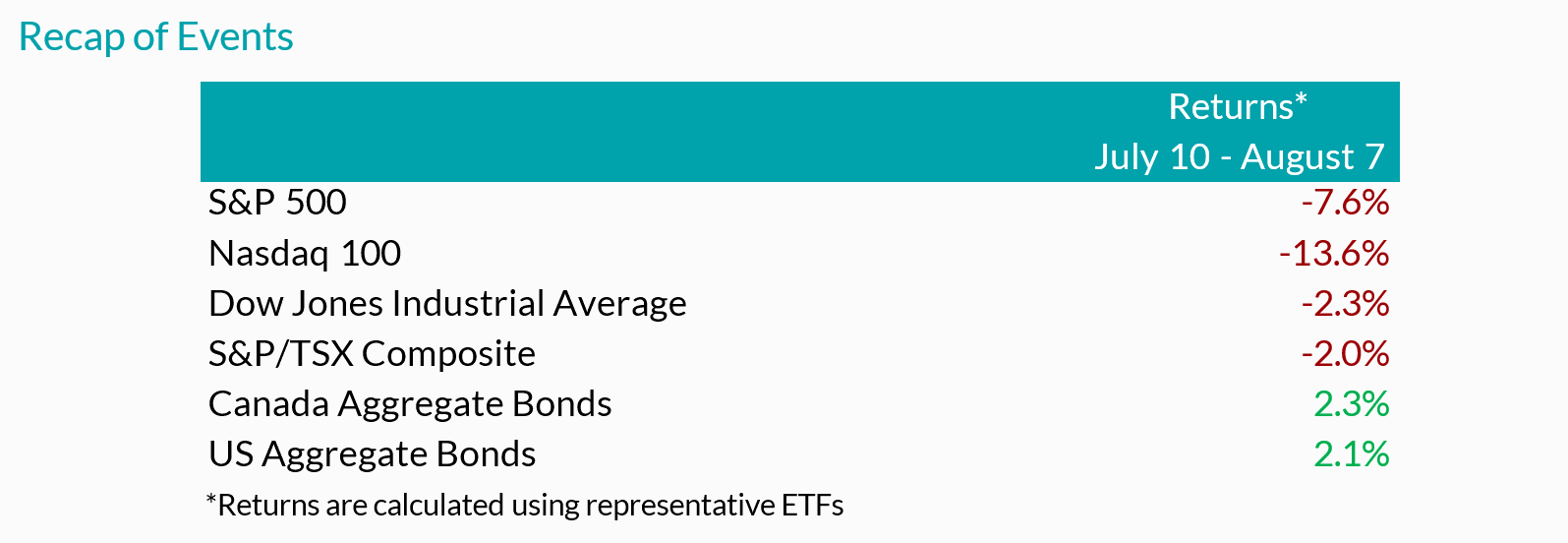
Inflation Slows (July 11) – Headline U.S. inflation readings increased 3.0% year-over-year in June, decelerating from May (3.3%). With prices slowing ahead of forecasts but economic growth remaining strong, investors became more confident regarding the prospects of an economic soft landing.
Outcome: market strength broadened with traders rotating out of highly concentrated areas of the market (“Fabulous 5”) and into more economically sensitive stocks that had been left behind.
• Big Tech Earnings (July 23 – Aug 1) – High profile mega-cap technology companies – including many members of the Magnificent 7 – reported earnings growth that generally surpassed expectations as margins remained healthy. That said, investors were more focused on spending towards AI-initiatives, rewarding businesses with greater success translating their AI investments into higher sales.
Outcome: this trend is evident through the divergence of returns from IBM and Alphabet (Google’s parent company) after releasing their quarterly earnings. The limited number of companies that contributed to the returns of the S&P 500 failed to impress investors, extending the rotation into other areas of the market.
• Caution is Brewing – Following a strong rally of economically sensitive pockets of the market, notably a breakout of returns from U.S. small cap companies, the low volatility factor, which tends to outperform during times of stress, moved in sync with the small caps’ strength.
Outcome: with a lack of fundamental justification supporting small cap performance, markets showed signs of caution.
• Central Bank Decisions (July 31)– The Federal Reserve held interest rates unchanged during its July meeting, in line with market expectations, reiterating committee members’ need for greater confidence that inflation would continue to subside. That said, policymakers signaled a reduction in policy rates could be a possibility in the coming meetings. In contrast, the Bank of Japan (BoJ) increased its key interest rate while also announcing plans to scale back bond purchases – restrictive monetary policy maneuvers aimed at backstopping the depreciating Japanese currency.
Outcome: the bifurcation between the BoJ and most other major central banks sparked a sharp appreciation of the yen and a rapid unwind of the yen carry trade (see below for explanation).
• Growth Scare (August 2)– In early August, a downside surprise in U.S. nonfarm payrolls (114k actual versus 175k expected) and an increase in the unemployment rate to 4.3%, higher than the 4.1% that was expected and up from 3.5% a year ago triggered concerns of a cooling labor market.
Outcome: speculation swelled surrounding the pace of rate cuts with market participants expecting the Federal Reserve to cut rates as much as 125bps over the next 3 policy meetings, up from 50-75bps as of the end of July. Against this backdrop, the ongoing unwind of the yen carry trade accelerated.
Yen Carry Trade Explained
• Simply put, investors have been borrowing Japanese yen – a low yielding currency – to invest in higher-yielding foreign assets. The primary risks in a carry trade can include the uncertainty of foreign exchange rates (if unhedged), as well as changes to expectations of the underlying yields, among other risks. Over the last 2 decades, the BoJ has implemented an ultra-low interest rate monetary policy to combat deflation and stimulate growth. Furthermore, investors were emboldened by the Japanese yen’s ~53% depreciation versus the U.S. dollar over the last 10 years. With the BoJ hiking its key interest rate while also announcing plans to scale back bond purchases, the yen rallied abruptly. Consequently, highly leveraged investors have had to exit their long positions in riskier assets to repay their borrowed yen exposure.
Peak Carry Trade Unwind – Buying Opportunity
• Peak carry trade unwind, which implies heightened panic levels, has historically created an attractive buying environment. That said, we are focused on companies that have demonstrated robust earnings growth and healthy leverage. Given the unprecedented level of market concentration over the last year, we view the unwind of the carry trade as another catalyst for investors to rotate out of the “Fabulous 5”.
Our Findings:
We found that the peak unwind of the carry trade may be a buying opportunity. At present, the current level of the unwind is similar to many notable market bottoms, including the Great Financial Crisis (2008), the European debt crisis (2010), the oil crash (2014), the subsequent emerging market crisis (2015), the Covid-19 crash (2020), and the collapse of Silicon Valley Bank (2023). We assessed the degree of the unwind by looking at the one-month implied volatility between three currency pairs, U.S. Dollar/Yen, Australian Dollar/Yen, and Euro/Yen. Implied volatility is a measure of the expected future volatility of the underlying assets over a given time period. Amid strong earnings growth and steady margins from quality businesses within the U.S. market, the fundamental backdrop suggests that businesses outside the concentrated AI-darlings may drive the next leg of market returns.
Downloadable Copy
Mark Warywoda, CFA
VP, Public Portfolio ManagementIan Whiteside, CFA, MBA
AVP, Public Portfolio ManagementJohanna Shaw, CFA
Director, Portfolio ManagementJin Li
Director, Equity Portfolio Management
Tyler Farrow, CFA
Senior Analyst, Equity
Andrew Vermeer
Senior Analyst, Credit
Elizabeth Ayodele
Analyst, Credit
Francie Chen
Analyst, Rates
ADVISOR USE ONLY
Any statements contained herein that are not based on historical fact are forward-looking statements. Any forward-looking statements represent the portfolio manager’s best judgment as of the present date as to what may occur in the future. However, forward-looking statements are subject to many risks, uncertainties, and assumptions, and are based on the portfolio manager’s present opinions and views. For this reason, the actual outcome of the events or results predicted may differ materially from what is expressed. Furthermore, the portfolio manager’s views, opinions or assumptions may subsequently change based on previously unknown information, or for other reasons. Equitable® assumes no obligation to update any forward-looking information contained herein. The reader is cautioned to consider these and other factors carefully and not to place undue reliance on forward-looking statements. Investments may increase or decrease in value and are invested at the risk of the investor. Investment values change frequently, and past performance does not guarantee future results. Professional advice should be sought before an investor embarks on any investment strategy. -
April 2024 eNews
In this issue:
- Competitive – and easy – benefits plans for your small business clients
- Simplifying benefits enrolment for your clients*
- NEW time-off tracking tool from HRdownloads*
- Focus on benefits fraud: Protecting your clients’ plans from abuse*
Competitive – and easy – benefits plans for your small business clients
Supporting your small business clients can be a challenge. It’s tough to find a competitively-priced benefits plan with the features they want. Small business owners may also need more of your time – especially if this is their first benefits plan.
That’s why we created Equitable EZBenefits™, a benefits solution designed with the needs of small businesses in mind. With a range of plan design options and valuable embedded services for plan sponsors and plan members, EZBenefits is available for groups with 2 to 25 employees. And to make things simpler for you, we’ve created an Advisor Concierge Service exclusively for EZBenefits. Whether you have a question about submitting a quote request for a new client or an issue with an in-force client, our Concierge Service is your go-to resource for EZBenefits support.Don’t have any EZBenefits clients yet?
To learn more about EZBenefits, watch our video to learn more or view our brochure.Simplifying benefits enrolment for your clients*
Navigating the benefits enrolment period can be overwhelming – for you, your clients and their employees. It’s difficult to ensure all plan members complete the necessary paperwork before the enrolment deadline.
That’s why we offer our secure Online Plan Member Enrolment tool at no extra cost to plan sponsors. The tool simplifies the onboarding process for your clients and their plan members by eliminating the need for paper enrolment forms.
It also makes enrolment faster and easier for your clients by:- Reducing errors and rework that can occur due to spelling mistakes or missing information on paper forms; and
- Sending automatic enrolment reminders to plan members, resulting in fewer late applicants.
- Enrol in their benefits plan in just minutes from their computer or mobile device;
- Easily enter all their enrolment information, including dependent details, banking information for direct deposit of claim payments and details for coordination of benefits; and
- Designate their beneficiary electronically.
Ready to share our Online Plan Enrolment Tool with your clients? Get them started with these helpful resources:
- Online Plan Member Enrolment Flyer for Plan Administrators
- Online Plan Member Enrolment Quick Reference Guide for Plan Administrators
- Quick Reference Guide for Plan Members
To learn more about how Online Plan Member Enrolment can simplify benefits enrolment for your clients, contact your Group Account Executive or myFlex Account Executive.
NEW time-off tracking tool from HRdownloads*
Through our partnership with HRdownloads®, EZBenefits clients now have complimentary access to Timetastic —a time-off tracking tool that can make it easier to manage employee vacation time, sick days and more.
Timetastic integrates seamlessly with HRdownloads and includes a mobile app to help manage time-off requests from any mobile device.
To see Timetastic in action, check out this demo.
EZBenefits also includes other helpful resources and tools from HRdownloads that can make daily human resources tasks easier, including:- A robust, award-winning HR management platform (HRIS);
- HR documents, templates, compliance resources and articles; and
- A live HR advice helpline.
Learn more about accessing HRdownloads.Focus on benefits fraud: protecting your clients’ plans from abuse*
According to the Canadian Life and Health Insurance Association (CLHIA), benefits fraud costs insurers and plan sponsors millions of dollars each year, which can lead to increased premium costs.
Resources for your clients
Both plan administrators and plan members play a role in preventing benefits abuse. So, we’ve compiled some resources you can share with your clients to help them understand what benefits fraud is and how to prevent it:- CLHIA’s free 15-minute Protect Your Benefits online course for plan administrators and their members
- CLHIA’s Fraud is Fraud program, including their FAQs on benefits fraud
- Our online guide to benefits abuse
- Tips for plan administrators and plan members to protect their plan
How we’re fighting benefits fraud
Our Investigative Claims Unit (ICU) works to detect and eliminate benefits fraud. We use a variety of investigative techniques, including CLHIA-led industry tools to detect and eliminate benefits fraud:- Joint Provider Fraud Investigation Program: A robust program that allows insurers to collaborate on fraud investigations that affect multiple insurers;
- Data Pooling Program: An initiative that pools data between insurers and uses advanced artificial intelligence to further identify and reduce benefits fraud; and
- Provider Alert Registry: A registry that allows insurers to view the results of other insurers’ anti-fraud investigations into specific practitioners.
- [pdf] Authorization to Release Evidence
-
What’s your saving style?
A TFSA for its flexibility or an RRSP for tax-deferred growth.
Did you know? More than 65% of people who put money into a TFSA* earn less than $80,000 a year. That’s why TFSAs are popular with middle-income Canadians. They’re simple and flexible: you don’t get a tax break when you put money in, but you don’t pay tax when you take money out. This makes them great for people who don’t get big benefits from tax deductions.
On the other hand, 54% of RRSP contributors earn more than $80,000 per year*. RRSPs often work better for higher-income earners because contributions lower taxable income. That means bigger tax savings for people in higher tax brackets.
Here’s the good news: From January 1 to March 2, 2026, when clients open or add money to an Equitable TFSA or RRSP, they’ll be entered into Equitable’s Snowball Your Savings contest. Two winners will be chosen—and their advisors will celebrate too!
How to Enter
Advisors can help clients submit contributions through EZcomplete® or process transactions using EZtransact®. Every entry is a chance to win!
Want ideas to boost contributions and help Canadians save more? Connect with your Director, Investment Sales today.
* Source: advisor.ca/news/tfsas-more-popular-than-rrsps-in-2023/
® and ™ denote trademarks of The Equitable Life Insurance Company of Canada.
Equitable’s Snowball Your Savings contest: No purchase necessary. Contest period January 1, 2026 to March 2, 2026. Enter by making a deposit to an Equitable Tax-Free Savings Account or Registered Retirement Savings Plan during the contest period or by submitting a no-purchase entry. Two prizes of $5,000 CAD to be drawn on March 23, 2026 will be awarded. The servicing advisor for the contract to which the selected entrants made the deposit is also an eligible winner and will receive a $1,000 CAD prize. For example, if an Equitable client is a winner of the $5,000 prize, the client’s servicing advisor for the relevant contract wins a $1,000 prize. Open to legal residents of Canada of the age of majority. Odds of winning depend on number of eligible entries received during the Contest Period. For full contest rules, including no-purchase method of entry, see the full contest rules. - [pdf] Consent and Authorization for Release of Medical Information to Advisor
- Investment loans
- Investment loans
-
The average FHSA balance is $3,899—Let’s help clients aim higher
The First Home Savings Account (FHSA) is a powerful tool for Canadians working toward homeownership. With tax-deductible contributions and tax-free withdrawals for qualifying purchases, it’s designed to make saving easier and more rewarding.
Yet, with a lifetime contribution limit of $40,000 and an annual cap of $8,000, many clients may not be taking full advantage. The average FHSA balance currently sits at just $3,899*, leaving plenty of room for growth.
Equitable offers three straightforward strategies to help clients boost their FHSA contributions and get closer to their first home—faster:
Set it and forget it with automated contributions
Consistency is key. By setting up automatic monthly deposits of up to $667, clients can effortlessly reach the annual maximum of $8,000. Equitable makes it easy to schedule recurring transfers from a bank account, helping clients stay on track without the hassle of manual deposits.
Make the most of windfalls with lump sum deposits
Bonuses, tax refunds, or inheritances can be powerful savings tools. Equitable allows clients to make one-time contributions anytime, helping them catch up on unused FHSA room from previous years and accelerate their savings.
Transfer from RRSPs—tax-free
Clients who’ve already been saving in an RRSP can transfer those funds into their FHSA—up to their available contribution room—without triggering taxes. This strategy lets them benefit from the FHSA’s tax-free withdrawal feature while staying within their overall savings plan.
Bonus Opportunity: Win big with the Close to Home contest
From May 1 to September 30, 2025, clients who contribute to an Equitable FHSA will be entered to win one of two $8,000 prizes. Whether opening a new account or making a contribution, it’s a great chance for clients to get closer to homeownership.
Advisors, your efforts matter too!
You have a chance to win a $1,000 prize if the client you are assisting, in alignment with their unique homeownership needs, is selected as a winner. At Equitable, we believe that when we grow together, success is mutual.
Don’t forget about Equitable’s user-friendly online application platform, EZcomplete®, or process an online transaction with ease using Equitable’s EZtransact®. These tools are fast, simple, and could bring clients closer to achieving their goals.
Want to learn more? Speak to your Director, Investment Sales.
* Source: https://www.canada.ca/en/revenue-agency/services/tax/individuals/topics/first-home-savings-account/fhsa-statistics.html
® and ™ denote trademarks of The Equitable Life Insurance Company of Canada.
Equitable’s Close to Home Contest: No purchase necessary. Contest period May 1, 2025 to September 30, 2025. Clients enter by making a deposit to an Equitable FHSA during the contest period or by submitting a no-purchase entry. Two prizes of $8,000 CAD each to be drawn on October 15, 2025 will be awarded. The servicing advisor for the policy to which the selected entrants made the deposit is also an eligible winner and will receive a $1,000 CAD prize. For example, if an Equitable client is a winner of the $8,000 prize, the client’s servicing advisor wins a $1,000 prize. Open to legal residents of Canada of the age of majority. Odds of winning depend on number of eligible entries received during the Contest Period. For full contest rules, including no-purchase method of entry, see here.
Date posted: September 4, 2025
- [pdf] Payout Annuity Advisor Guide
- Fiera Capital