

Site Search
656 results for open now MAKEMUR.com how to get inmate released early for money Federal Detention Center Oakdale
-
Let’s “Talk Money”: Helping clients feel better about their finances
This November is Financial Literacy Month, and the theme is simple but powerful: “Talk Money.” The goal is simple—get Canadians talking about money. When people open up about budgeting, debt, or financial stress, they feel more confident and less alone.
Money and mental health are connected
Many Canadians feel stressed about money. That stress can affect their mental health. As an advisor, you can help by starting honest conversations. When clients talk about their worries, they’re more likely to take action and feel better.
How advisors can help
You don’t need to be a therapist. Just listen, ask questions, and offer simple steps. Here are a few ideas:
- Ask how clients feel about their finances.
- Share stories of others who overcame money stress.
- Celebrate small wins, like setting a budget or saving a little more.
- Use Equitable’s online learning modules to equip yourself with knowledge to help support client goals.
- Watch our on-demand webcast: How to stay grounded in a changing world: Supporting financial and mental well-being
Let’s talk money
Talking about money helps people feel stronger and more in control. This month, let’s help clients open up, take action, and build better habits—financially and emotionally.
If you have any questions, feel free to reach out to your Director, Investment Sales. -
This year’s RSP deadline is March 2, 2026
RRSP deposits to be considered for the 2025 tax year must be:
• Dated March 2, 2026, or before
• Must be submitted to Head Office in good order by March 6, 2026, by 4:00 p.m. ET
RRSP applications to be considered for 2025 contribution year must be submitted in good order by:
• March 2, 2026, 11:59 p.m. ET
RRSP B2B Loans:
• RRSP loan deposits must be received from B2B by March 13, 2026, by 4:00 p.m. ET
Note: Transactions submitted after these dates will not receive a 2025 contribution receipt
Please note that all requirements must be received in Head Office by the above dates to guarantee settlement for year end.
Have you started talking to your clients about their Registered Retirement Savings Plan (RRSP) contributions yet? Equitable® has a range of RRSP solutions that can help meet their needs, including:- Daily/Guaranteed Interest Account
- Equitable Guaranteed Investment Funds™, available in:
- o Investment Class (75/75)
- o Estate Class (75/100)
- o Protection Class (100/100)
Most clients genuinely want to save for retirement, but intentions alone aren’t enough—they need a plan. As their trusted advisor, you can help them understand why making their RRSP a priority is an important step toward long‑term financial security.
To support those conversations
Most clients genuinely want to save for retirement, but intentions alone aren’t enough—they need a plan. As their trusted advisor, you can help them understand why making their RRSP a priority is an important step toward long‑term financial security.
To support those conversations, we’ve pulled together helpful tools and marketing materials that show how an Equitable RRSP can make a meaningful difference in reaching their retirement goals. Resources include:- Investment calculators
- A retirement savings plan is just a relevant now as it was over 60 years ago
- Borrowing money to save money
From January 1 to March 2, 2026, when clients open or add money to an Equitable TFSA or RRSP, they’ll automatically be entered into Equitable’s Snowball Your Savings contest. Two lucky clients will win — and their advisors get to celebrate too! - About
-
What’s your saving style?
A TFSA for its flexibility or an RRSP for tax-deferred growth.
Did you know? More than 65% of people who put money into a TFSA* earn less than $80,000 a year. That’s why TFSAs are popular with middle-income Canadians. They’re simple and flexible: you don’t get a tax break when you put money in, but you don’t pay tax when you take money out. This makes them great for people who don’t get big benefits from tax deductions.
On the other hand, 54% of RRSP contributors earn more than $80,000 per year*. RRSPs often work better for higher-income earners because contributions lower taxable income. That means bigger tax savings for people in higher tax brackets.
Here’s the good news: From January 1 to March 2, 2026, when clients open or add money to an Equitable TFSA or RRSP, they’ll be entered into Equitable’s Snowball Your Savings contest. Two winners will be chosen—and their advisors will celebrate too!
How to Enter
Advisors can help clients submit contributions through EZcomplete® or process transactions using EZtransact®. Every entry is a chance to win!
Want ideas to boost contributions and help Canadians save more? Connect with your Director, Investment Sales today.
* Source: advisor.ca/news/tfsas-more-popular-than-rrsps-in-2023/
® and ™ denote trademarks of The Equitable Life Insurance Company of Canada.
Equitable’s Snowball Your Savings contest: No purchase necessary. Contest period January 1, 2026 to March 2, 2026. Enter by making a deposit to an Equitable Tax-Free Savings Account or Registered Retirement Savings Plan during the contest period or by submitting a no-purchase entry. Two prizes of $5,000 CAD to be drawn on March 23, 2026 will be awarded. The servicing advisor for the contract to which the selected entrants made the deposit is also an eligible winner and will receive a $1,000 CAD prize. For example, if an Equitable client is a winner of the $5,000 prize, the client’s servicing advisor for the relevant contract wins a $1,000 prize. Open to legal residents of Canada of the age of majority. Odds of winning depend on number of eligible entries received during the Contest Period. For full contest rules, including no-purchase method of entry, see the full contest rules. - COVID-19 Group Benefits FAQ
-
Show term and critical illness illustrations with ratings
Rating options are now available in term and critical illness web illustrations. When you add a rating, the premium changes so clients can see the difference. This makes it easier to compare options and set expectations early.
What’s new
You can apply ratings to your term and critical illness web illustrations. When you choose a rating, the illustration and report update right away with the new premium.
Benefits
• Clear side‑by‑side comparisons
• Illustrated options better fit client’s needs
• Talk about options with more confidence
How to use the rating feature
1. In the web illustration, go to Personal Information.
2. Select the Ratings checkbox.
• This option also appears when adding a term rider or critical illness rider.
3. Choose the rating type you want to illustrate:
• Permanent amount (term)
• Permanent percentage (term and critical illness)
• Temporary amount (term)
Once applied, the premium updates automatically and appears in the illustration report.
Important to know
• Illustrated ratings are for comparison purposes only.
• When you submit an application, the system removes the illustrated rating.
• The final rating is determined through underwriting.
Improving your experience with more digital enhancements
We’re always working to improve the web illustration experience based on your valued feedback.
Here are some improvements you've asked for:
• A confirmation box appears showing the rider selected is included in the illustration report.
• When you’re signed into EquiNet your name and advisor code are included at the bottom of the illustration report.
New design updates to the illustration reports now make it easier for you and clients to review. Use these clear and refreshed illustrations to help clients get the protection that best meets their needs.
Questions
Contact your Equitable wholesaler. For specific case support be sure to include:
• the client name (if applicable);
• the product (term or CI);
• screenshot of the illustration settings. -
Insights from a pandemic: COVID-19 and group benefits plans
We’ve received numerous questions about the impact of COVID-19 and what it will mean for benefits plans in the months ahead. Below is a summary of what we’re seeing so far. In the coming weeks, we’ll explore each of these topics in greater depth.
Disability
Initially, as COVID-19 started to spread, we saw STD claims ramp up quickly. Since then, we’ve seen the number of COVID-19-related STD claims slow significantly. As for LTD, we believe both the incidence and duration of those claims will increase in both the short term and medium term due to COVID-19.
Health and Dental Claims
We saw an overall spike in the volume and paid amounts for drug claims in March as plan members rushed to stock up on their medications. This was followed by a drop in April after most provinces put 30-day refill limits in place. One exception was claims for asthma drugs which surged in March but had no drop in April. Overall, the April plunge will be short-lived; drug costs have already begun to rise in May.
While paramedical and dental claims are down, we are seeing an increase in claims for virtual treatments and emergency dental services. We expect that claims will spike once the current pandemic restrictions are lifted. We’ve already started to see claims rise in provinces that are allowing health providers to re-open.
Despite the shift to more virtual services, we haven’t seen an increase in fraudulent activity. But we continue to be vigilant. Our investigative practices – verifying with the plan member that they received the treatment and have a valid receipt, and that the practitioner has treatment notes – remain the same whether treatment is provided in person or virtually.
Technology
During this time of physical distancing, people are looking for ways to interact with their providers virtually. Fortunately, our business model is almost entirely electronic, and we have several convenient digital options available for plan members and plan sponsors. Our focus in recent weeks has been to remind clients and plan members about these tools and make it as easy as possible for them to activate and use them. And we are continually adding functionality that will allow us to serve our customers even better.
Mental Health/Wellness
Usage of i-Volve, Homewood’s online cognitive behavioural therapy tool, increased significantly in March before levelling back down in April and May. And while EFAP cases fell in April and early-May, the number of cases has begun to climb in recent weeks, particularly for anxiety. In the coming weeks and months, we expect an eventual increase in marital and family issues, as well as depression. We’ve also seen an increase in mental-health-related prescriptions.
Plan Design
It’s too early to predict how the COVID-19 pandemic will impact benefits plan design and how it will change in the coming months. We would love to get your feedback and insights about how benefit plans will evolve and what new features or provisions they should include.
Please share your thoughts and suggestions with your Group Account Executive or myFlex Marketing Manager. Or, you can email your ideas to GroupCommunications@equitable.ca.
-
How to talk to clients about CI when they don’t want to
Does this sound familiar?
You’re having a chat with your client about Critical Illness insurance. They suddenly interject: “Critical illness insurance isn’t for me.”
“Why is that?” you ask.
“Because….
- Critical Illness insurance is expensive!
- I don’t understand what it covers exactly.
- I have money to cover me if I get sick, so I don’t need this.
- I’m healthy enough.
- It’s not life insurance, so I don’t need it right now.
- I already have disability coverage through my work.”
If you’ve heard any of these responses, and didn’t know how to respond, we can help.
Our Path to Success program covers all these objections and more with simple-to-follow PDFs and videos. You’ll learn conversation strategies and tips on how to navigate the sale. Most importantly, you’ll know exactly what to say the next time a client objects to Critical Illness insurance.
Want to learn more? Check out our CI Path to Success modules here!
Need CE credits? Take our Path to Success program here. -
Repositioned Wealth Accumulator available
Repositioned Equimax Wealth available now
As we continue to grow to meet the needs of various market segments, our product options for your high net worth (HNW) clients have also been improved. Equimax Wealth Accumulator® has been repositioned to meet the needs of your high net worth clients by providing more deposit room and competitive early cash values.
Equimax Wealth is now repositioned for your high net worth clients
Equimax Wealth Accumulator is now targeted for clients ages 45 to 65 with an insurance need but also looking for tax advantaged growth as an alternative to traditional investments. It allows your clients to achieve both while diversifying their portfolio and saving taxes, particularly for corporations.
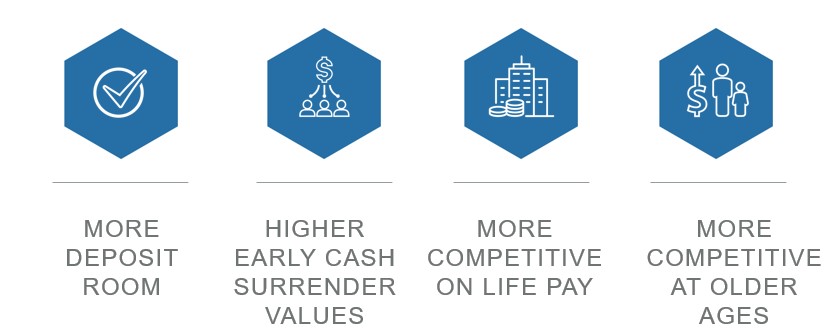
Highlights of the repositioned Equimax Wealth Accumulator:
- More deposit room - Allows for significantly more deposit room by reducing the initial death benefit. This means more money can be paid into the policy to promote the tax-advantaged investment growth.
- Higher early cash surrender values - We are more competitive on total cash value in years 1 to 10 in the target market ages of 45-65. The higher extra deposit room and early surrender cash value allows the illustration to show an earlier premium offset, which is key for the HNW market.
- More competitive on life pay - Improvements to life pay more notable than 20 pay. Reduced premiums for most male and female non-smokers in our target market (ages 45-65) as well as 2, 3, and 4 year improvement in illustration of premium offset.
- More competitive at older ages - A shift in the target market means you can support older clients in the HNW market. The Equimax Wealth Accumulator is now more competitive at ages 45-65.
Learn more
For full details on the transition, please see our transition rules.
For more information on this product, please visit the Equimax page on Equinet.
-
Smarter saving with GIA Laddering
Want to show clients how to grow their savings in smart ways? Try Guaranteed Interest Account (GIA) laddering—a simple strategy that helps clients earn more interest and stay flexible.
How does it work?
Instead of a client putting all their money into one-year GIAs, laddering means splitting the money into different GIAs with different end dates. This way clients can:
• Earn better interest rates.• Get access to part of their money every year.• Be ready if interest rates go up or down.Use our new calculator
Equitable’s new GIA Laddering Calculator shows clients how this strategy compares to putting all their money in one-year GIAs each year. It helps clients see which option could give them more money over time.
Contact your Director, Investment Sales to see how laddering can work for clients.
Date posted: September 15, 2025