

Site Search
445 results for PROBLEMGO.com Paying cash to bond someone out of jail quickly Hamilton
- About
- [pdf] B2B Loan Application Tips
-
Market Commentary October 2025
Key Takeaways
• Market sentiment improved significantly in Q3 as economic uncertainties eased.
• Both U.S. and Canadian stock markets posted strong gains. The rally was supported by sector-specific earnings strength and structural growth drivers in AI and digital infrastructure. Equity valuations remain elevated, which could become a potential headwind for future performance.
• Canadian bond markets delivered positive returns in Q3. Returns were largely from underlying interest income, supported by modestly lower interest rates and continued strong performance from tighter credit spreads.
• Both the Bank of Canada and the U.S. Federal Reserve restarted easing in Q3. Each central bank cut rates by 25 basis points in September, responding to rising risks to labour markets.
Economic and Market UpdateEconomic Summary: In the U.S., economic activity has remained relatively steady through 2025. However, while business investment remained robust, the pace of hiring slowed. Inflation has increased in recent months, but overall price pressures appear contained. Trade uncertainty eased in the third quarter as the U.S. reached agreements on tariffs with several key trading partners. Countries such as Japan, South Korea, and Indonesia, as well as the European Union, negotiated compromise deals. These deals typically involved U.S. tariffs in the range of 15% to 20% in exchange for market access or investment commitments. However, other nations faced higher tariffs of 30-50% following failed negotiations. Mexico and China are currently in a 90-day pause on tariff hikes, which will expire on October 29 and November 10, respectively. At its September meeting, the U.S. Federal Reserve (the “Fed”) lowered its policy rate by 25 basis points to a range of 4.00%– 4.25%. The Fed also signaled that additional interest rate cuts will likely be required to support the economy. Chair Jerome Powell highlighted increasing risks to the labour market and decreasing risks to inflation. He emphasized that the Fed remains data dependent and that interest rate decisions will be made “meeting-by-meeting”. The October 1 shutdown of the U.S. government added further uncertainty to the economic outlook. Key data releases are expected to be delayed, and the White House has warned of mass layoffs of federal workers.
The Canadian economy experienced a modest rebound in July following weak growth in the second quarter. However, U.S. tariffs and ongoing trade policy uncertainty continue to present risks to the economy. The labour market continues to weaken while inflationary pressures have eased in recent months. On July 31, the U.S. increased tariffs on Canadian imports from 25% to 35% for those products not exempted under USMCA. In addition, the U.S. has expanded its list of sector-specific tariffs. This is expected to place further strain on Canadian exporters. In response to these developments, the Bank of Canada cut its policy rate by 25 basis points to 2.50% during its September meeting. Governor Tiff Macklem indicated that the Bank is prepared to take further action if the balance of risks shifts to weaker growth.
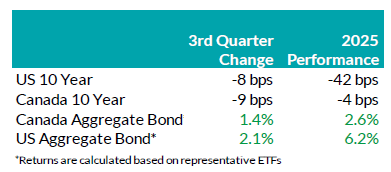
Bond Markets: During Q3, the FTSE Canada Universe Bond Index returned 1.5%. Yields on Canadian bonds with maturities of 10 years or less declined. That reflected increased expectations for interest rate cuts by the Bank of Canada. Yields on bonds with maturities of greater than 10 years increased moderately, as investors continued to demand a higher risk premium for long-term debt.
Overall, corporate bonds saw a positive return for the quarter and outperformed government bonds. This outperformance was due to the higher interest rate on corporate bonds relative to government bonds, with an assist from modestly tighter credit spreads. Corporate issuance was robust during the quarter with strong investor demand, as investors were willing to look past U.S. tariffs and their potential impact to global growth. There were 99 corporate bond issuances during Q3 that combined to raise $45 billion for issuers, a new record. Indeed, the new issuance market is tracking ahead of last year, the previous high-water mark for issuance.
Notwithstanding the continued strong performance from corporate bonds, we have maintained a bias towards shorter corporate bonds where the risk and reward are better balanced. We remain ready to invest in longer corporate bonds as valuations become attractive.
Stock Markets: Equity markets posted strong gains in Q3. The S&P 500 returned 8.1% for the quarter, led by Information Technology and Communication Services. Investors focused on the expansion of AI infrastructure and a more favourable regulatory environment for blockchain technology. These themes supported risk appetite despite valuations remaining high relative to historical averages. The Canadian market returned 12.5% in Q3, outperforming the U.S. by more than 4%. This was driven mainly by strong returns in the Materials sector. Meanwhile, the Europe, Australasia, and Far East Index (EAFE) returned 5.4%, as international investors re-evaluated the “Sell America” trade trend.
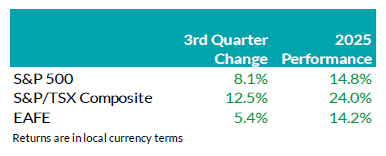
U.S. Equities: In Q3, U.S. equities rose on strong momentum in AI infrastructure investment and growing interest in blockchain innovation. Mega-cap tech stocks led the rally. Major announcements such as NVIDIA’s $100 billion investment in OpenAI and Oracle’s $300 billion multi-year cloud deal highlighted the rapid growth of hyperscale data centers and the deepening commitment to AI development. A more supportive regulatory environment for blockchain technology also boosted investor interest in digital assets. This was reflected in robust IPO activity from crypto-focused companies such as Figure Technology and Gemini. Both stocks saw sharp gains following their public market debuts. That said, the S&P 500 continues to trade at nearly 23 times its forward earnings, roughly 20% above its 10-year average.
Canadian Equities: Canadian equities rose on better-than-expected economic data and sector-driven earnings, outperforming the U.S. by more than 4% in Q3. The Materials sector drove the rally, contributing nearly half of the gain for the TSX in Q3, as the price of gold surged past US$3850/oz (+45% YTD). The Technology sector also posted solid results, highlighted by Shopify’s continued strong performance. Shopify’s AI-driven product expansion and scalable digital commerce growth pushed the stock to trade around 85 times its forward earnings over the next twelve months. Positive sentiment extended to the Financials sector, where better-than-expected provisions for credit losses helped support a revaluation of bank stocks.
Overall, Q3 marked a risk-on environment across North American equities, underpinned by sector-specific earnings strength and structural growth drivers. In the U.S., enthusiasm around AI and digital infrastructure continued to dominate. In Canada, the rally was driven by surging gold prices and better-than-expected bank earnings. These catalysts helped sustain broad-based market strength across both markets.
Bottom line: Overall market sentiment improved in the third quarter following the volatility earlier in the year caused by tariffs. Investors benefited from resilient performance in North American equities and positive performance in fixed income. In the U.S., the Federal Reserve resumed its rate-cutting cycle, while strong consumer demand and continued capex-spending acted as key drivers for the market strength. In Canada, gold prices continued to surge amid persistent safe-haven demand driven by geopolitical risks. Looking ahead, we will continue to closely monitor valuation levels and underlying economic data for signals of inflection as the cycle progresses.
Downloadable Copy
Mark Warywoda, CFA
VP, Public InvestmentsIan Whiteside, CFA, MBA
AVP, Public InvestmentsJohanna Shaw, CFA
Director, Public InvestmentsJin Li
Director, Equity Investments
Wanyi Chen, CFA, FRM
Sr. Quantitative Analyst
Andrew Vermeer, CFA
Senior Analyst, Credit
Elizabeth Ayodele
Analyst, Credit
Edward Ng Cheng Hin
Analyst, Credit
Kate (Huyen) Vinh
Analyst, Equity
Francie Chen
Analyst, Rates
ADVISOR USE ONLY
Any statements contained herein that are not based on historical fact are forward-looking statements. Any forward-looking statements represent the portfolio manager’s best judgment as of the present date as to what may occur in the future. However, forward-looking statements are subject to many risks, uncertainties, and assumptions, and are based on the portfolio manager’s present opinions and views. For this reason, the actual outcome of the events or results predicted may differ materially from what is expressed. Furthermore, the portfolio manager’s views, opinions or assumptions may subsequently change based on previously unknown information, or for other reasons. Equitable® assumes no obligation to update any forward-looking information contained herein. The reader is cautioned to consider these and other factors carefully and not to place undue reliance on forward-looking statements. Investments may increase or decrease in value and are invested at the risk of the investor. Investment values change frequently, and past performance does not guarantee future results. Professional advice should be sought before an investor embarks on any investment strategy. -
Take emotions out of investing
Taking the emotion out of investing can be easier said then done. Most of us at one time or another have decided upon something strictly because of how we felt at the time, not because it was logical or made good financial sense. I am sure most of us have a good story to tell.
When it comes to financial planning, you always want to encourage your clients to be a rational investor and accept that market fluctuation is part of the investment journey. Over the last few months, even the hardiest rational investor has been challenged to accept the market fluctuations. History shows us that this too, shall pass and markets will rise once more. The biggest question asked is always, when?
While no one has a crystal ball with that answer, the best we can do is help our clients understand that when building portfolios, risk is always at the forefront of any good investment strategy. The level of risk is just one of the building blocks to constructing a financial portfolio that will see the client through good times and bad.
Need more help? Equitable Life has created an emotional investing brochure to help your clients manage through these extraordinary times. To download a copy, click here. We have also included a template letter that you can personalize and use to reach out to your clients. To download an editable copy, click here.
-
Reminder: Deadline to opt out of Alberta biosimilar coverage changes
In November 2020, we announced via eNews that on March 15, 2021, we are changing coverage for some biologic drugs in Alberta in response to the province’s Biosimilar Initiative. These changes will help protect your client’s plans from additional drug costs while still providing access to equally safe and effective biosimilars.
Do my clients need to take any action?
Traditional groups who wish to opt out of this change and maintain coverage of these originator biologics for Alberta plan members can submit a policy amendment. Amendments must be submitted no later than January 15, 2021.
Advisors with myFlex Benefits clients who wish to maintain coverage of these originator biologics for Alberta plan members should speak to their myFlex Sales Manager to confirm their eligibility to opt out of this change.
Otherwise, no action is required on their part. Plan members taking these biologics will be contacted directly to allow them ample time to change their prescription. Any cost savings associated with the change will be factored in at renewal.
Questions?
We have compiled a list of frequently asked questions to help you understand Alberta’s Biosimilar Initiative. If you have a question that isn’t answered here, please contact your Equitable Life Group Account Executive or myFlex Sales Manager.
-
Take the emotions out of investing
Investing without letting our emotions take the wheel can be quite a challenge. We've all made decisions based on our feelings rather than logic or financial sense at some point. But following our emotions when investing is a good way to put our investment plan at risk.
When it comes to financial planning, it's crucial to guide clients towards being rational investors who understand that market fluctuations are part of the journey. Even the most steadfast rational investors have found it tough to stay calm amidst recent market volatility. But history reassures us that this too shall pass, and the markets will rise again. The burning question is always, "When?"
While no one can predict the future, an advisors’ role is to help clients grasp that risk management is a cornerstone of any solid investment strategy. Risk is just one of the building blocks in crafting a financial portfolio that can weather both good times and bad.
That’s why Equitable® has created an emotional investing brochure to help clients manage through extraordinary times. Download your copy of Take emotions out of investing. We have also included a template letter that you can personalize and use to reach out to clients. To download an editable copy, click here.
Questions? Contact your Director, Investment Sales.
Date posted: April 17, 2025 - [pdf] Building a Stronger Investment Portfolio
-
5 Things You Need to Know About Equitable Generations Universal Life
Here are five things you need to know about Equitable Generations™ Universal Life
1. Affordability
Because Equitable Life is owned by its policyholders, we don’t have to worry about paying shareholders. That means we can focus on offering competitive pricing!
2. Investments
Equitable Generations Universal Life is built for the 21st century with investment options that matter to today’s buyer including Target date, Environmental, Social, and Governance (ESG) funds for sustainable investing.
3. Fees
Equitable Generations has eliminated most universal life fund administration fees as well as the policy administration fee.
4. KIND™
Equitable Generations has a suite of contractual and non-contractual claims features we call KIND, designed to help your family navigate the claims process with ease.
5. FlexibilityWith such competitive pricing, fantastic investment options and minimal fees. Equitable Generations Universal Life provides a level of flexibility rarely seen in the Universal Life space.
See Equitable Generations Universal Life for yourself within one minute - try the EZStart quick quote software for advisors, available on EquiNet!
Please contact your local wholesaler for more information.
TM and ® denote trademarks of The Equitable Life Insurance Company of Canada. -
What you should know about Equitable Generations Universal Life
Here are five things you need to know about Equitable Generations™ Universal Life
1. Affordability
Because Equitable Life is owned by its policyholders, we don’t have to worry about paying shareholders. That means we can focus on offering competitive pricing!
2. Investments
Equitable Generations Universal Life is built for the 21st century with investment options that matter to today’s buyer including Target date, Environmental, Social, and Governance (ESG) funds for sustainable investing.
3. Fees
Equitable Generations has eliminated most universal life fund administration fees as well as the policy administration fee.
4. KIND™
Equitable Generations has a suite of contractual and non-contractual claims features we call KIND, designed to help your family navigate the claims process with ease.
5. FlexibilityWith such competitive pricing, fantastic investment options and minimal fees. Equitable Generations Universal Life provides a level of flexibility rarely seen in the Universal Life space.
View our video on Vimeo or YouTube!
See Equitable Generations Universal Life for yourself within one minute - try the EZStart quick quote software for advisors, available on EquiNet!
Please contact your local wholesaler for more information.
TM and ® denote trademarks of The Equitable Life Insurance Company of Canada. - Universal Life