
Site Search
698 results for browse official page MAKEMUR.COM Paying to get my daughter out of jail now pay later West Virginia
-
New online course available
Boost your knowledge and earn CE Credits
Looking to deepen your understanding of Universal Life insurance and get a new CE Credit?
Equitable is excited to offer a new addition to our online learning center: The mechanics of Universal Life. Whether you are new to the concept or looking to refresh your expertise, this course will help provide the knowledge you need to start conversations with clients.
Our CE credit courses allow you to learn at your own pace and earn CE credits quickly and easily.
Available Courses:
• The mechanics of Universal Life *NEW*
• Introduction to Whole Life Insurance
• Participating Whole Life for the Children’s Market – A head start for tomorrow
• Path to Success - Expert Advice on Navigating CI Sales
• Ensuring a Compliant, Needs-based Insurance Sale
• Where UL Fits in your product portfolio
• Building your business with Critical Illness insurance
• Harness the Power of Whole Life Cash Value
A few important notes before you get started:
• The programs are hosted on Teachable: https://equitable-life-education.teachable.com
• Username: Please use your email address that you are contracted with
• Password: Equitable
• Please use Google Chrome to access the courses
You can earn CE credits right away when you complete these courses.
Start earning CE Credits!
Check out the individual insurance online learning centre on EquiNet to stay up to date on new courses.
All courses are accredited by Alberta Insurance Council, Insurance Council of Manitoba, The Institute for Advanced Financial Education, and Chambre de la sécurité financière*.
Questions?
Contact your local wholesaler.
Are you having trouble logging in?
Email equitableiimarketing@equitable.ca for assistance. - Policy Change and Conversions eDelivery - Quick Tips and Tricks
-
Let’s talk about Critical Illness insurance, the Equitable way.
Having critical illness insurance benefits in an important time of need is so valuable. Get the right critical illness insurance coverage for your clients.
In 2022, we made some significant updates to our EquiLiving® Critical Illness insurance plans to provide better choices and features for clients.
These significant updates included:
● The addition of Acquired Brain Injury as a covered condition
● The addition of 20 pay options allowing more choice when choosing the right plan for your clients
● The removal of the age restriction for juveniles to claim for Loss of Independent Existence
Plus, a Canadian first, the addition of Cloud DX. Cloud DX is a value-added service that provides remote patient monitoring to claimants in addition to the full critical illness benefit paid by Equitable Life®. Cloud DX delivers medical grade hardware directly to the client so that Cloud DX can remotely monitor their vitals to help ensure they are on and stay on the road to recovery.
View our new Critical Illness video on YouTube or Vimeo!
With these updates and more, EquiLiving Critical Illness Insurance is there for clients, not only at time of their claim but also during their recovery. To learn more about Critical Illness insurance, the Equitable way, contact your local wholesaler.
*Cloud DX is a non-contractual benefit and may be withdrawn or changed by Equitable Life® at any time. To be eligible for the Cloud DX offering, a claimant must be age 12 or older and have received payment on or after February 12, 2022 for a covered critical condition benefit under an individual critical illness insurance policy issued by Equitable Life. An early detection benefit payment does not qualify. Equitable Life pays for 6 months of Cloud DX subscription fees. If the claimant wishes to continue the Cloud DX service after 6 months, they will be responsible for the cost.
® and TM denote trademarks of The Equitable Life Insurance Company of Canada.
-
May 2026 eNews
In this issue:
-
Save the date: Group benefits advisor roadshow is returning to a city near you
-
One-time passcodes will be added to our login experience this week*
-
Delisted service providers: What clients need to know*
-
Keeping plan member information up to date*
*Indicates content we will share with your clients.
Save the date: Group benefits advisor roadshow is returning to a city near you
Mark your calendars—our annual group benefits advisor roadshow will be travelling across Canada this fall.
Watch your inbox for an invitation with more details soon. In the meantime, here’s our full list of event dates and cities.
-
Monday, Sept. 28 – Vancouver, BC
-
Tuesday, Sept. 29 – Edmonton, AB
-
Wednesday, Sept. 30 – Calgary, AB
-
Thursday, Oct. 1 – Saskatoon, SK
-
Friday, Oct. 2 – Winnipeg, MB
-
Tuesday, Oct. 6 – Halifax, NS
-
Wednesday, Oct. 7 – Ottawa, ON
-
Thursday, Oct. 8 – Markham, ON
-
Tuesday, Oct. 20 – London, ON
-
Wednesday, Oct. 21 – Kitchener, ON
-
Thursday, Oct. 22 – Oakville, ON
One-time passcodes will be added to our login experience this week
Starting next week, anyone who logs in to EquitableHealth.ca® or the Equitable EZClaim® mobile app with an email address and password may also need to enter a one-time passcode to access their account. The one-time passcode will be provided by email.
Adding this form of multi-factor authentication (MFA) to our login process will further enhance our digital security and help safeguard your account and our clients’ personal data.
Don’t forget—you can create a passkey instead.
Passkeys are another form of MFA. They provide a quick, easy and secure way to access your account, using either biometrics—your face or fingerprint—or a PIN authenticator to confirm your identity.
Anyone who uses a passkey to log in to their account will never be required to enter a one-time passcode.
In case you get questions…
If a client asks you about these changes to our login process, consider sharing this fact sheet with them. The fact sheet highlights the value of adding MFA to the login process and describes the differences between logging in with a one-time passcode versus a passkey.
More information about one-time passcodes and passkeys is included at equitable.ca/effortless. There, you’ll also find short videos that show how easy it is to create a passkey on your mobile device and computer.
Please reach out to your Group Account Executive if you have any questions.
If you use the same email address to log in to your accounts on EquitableHealth.ca, EquiNet® and Equitable Client Access®, you can use the same passkey. Equitable Client Access is our secure site for Individual Insurance and Individual Wealth clients.
Delisted service providers: What clients need to know
Protecting clients’ group benefits plans is our priority. That’s why we regularly assess healthcare service providers, clinics, facilities and medical suppliers in our network. These reviews help ensure the claims plan members submit meet eligibility requirements.
If our review indicates a provider is not meeting those requirements, we may delist them.
Common reasons we delist providers include:
-
Billing for services that weren’t provided or aren’t medically required
-
Changing information about treatments provided (e.g., service dates or patient names)
-
Incomplete records or treatment notes
-
Lack of cooperation with an audit
-
Suspension of the provider by their licensing college or association
-
Criminal convictions
What clients need to know
If a provider is delisted, we will not accept or process claims for services or supplies they provide. However, plan members can still choose to use delisted providers at their own expense.
We provide clients instructions on where to find our current list of delisted providers in each Plan Administrator eNews announcement. We also encourage them to share the list with their plan members.
Whenever we delist a provider, we try to contact plan members, who have recently submitted claims for their services, to inform them of the change and help prevent future claim submissions. However, plan members are responsible for checking our list of delisted providers before purchasing any product or service to avoid having to pay at their expense. The list is available on EquitableHealth.ca.
If you have questions about our list of delisted service providers or our process of reviewing providers, please contact your Group Account Executive.
Keeping plan member information up to date
Keeping plan member information current helps ensure accurate benefits coverage and premium calculations.
When a plan member’s earnings or occupation changes, the plan administrator must update this information as soon as possible. Updates made before a benefits plan renewal helps ensure renewals are based on current data.
If a plan includes short-term disability (STD) or long-term disability (LTD) benefits, outdated earning information can affect disability claim payments for plan members.
We send an annual reminder to plan administrators before renewal. The email includes step-by-step instructions on how to review and update plan members’ earnings and occupation information.
Three ways to update earnings and occupation information
Plan administrators can review and update plan members’ information by either:
-
Making updates directly through the plan administrator site (update access required),
-
Generating an earnings and occupations worksheet through the plan administrator site (online reporting access required), or
-
Requesting a worksheet by emailing groupbenefitsadmin@equitable.ca.
The worksheet includes instructions on how to submit completed updates to us. If you have any questions, please contact your Client Relationship Specialist or email groupbenefitsadmin@equitable.ca.
-
- Get in touch
- [pdf] Business Information Form
-
EAMG Market Commentary July 2023
Posted July 27, 2023
July 17, 2023
Rates & Credit - The rates market was volatile in Q2 as investors focused on inflation, central bank interest rate decisions, and recession probabilities. Persistent strength in U.S. consumer spending and labour markets have surprised investors and prompted further interest rate tightening from central banks. In Canada, corporate bonds outperformed government bonds and the broader FTSE Canada Universe Index during the quarter, with a total return of 0.2%, versus a loss of 1.0% for government bonds and 0.7% for the overall Index. The corporate bond outperformance was driven by a broad risk-on tone to the market, most notably in April as the market recovered from the banking sector liquidity crisis that developed during March. That said, the market tone remained cautious, with the improved risk premium on corporate bonds tempered by lingering concerns around sticky inflation, high interest rates, and the potential for slower economic growth into the latter half of the year.
Dominance of U.S. Equities – U.S. equity markets posted another strong quarter with the S&P 500 returning 8.7%, outperforming Canada and other major international equity markets. The S&P/TSX Composite, returned 1.2% in CAD. Major developed economies from Europe, Australasia, and Far East (EAFE) returned 3.2% in local currency terms. The highly anticipated re-opening of the Chinese economy has failed to materialize with economic data indicating less strength than previously forecasted. Amid sluggish Chinese growth, closely interconnected economic partners such as the European Union, as well as commodity-driven markets like Canada, have all underperformed the U.S. on a relative basis.
U.S. Fundamentals – Earnings continued to contract versus prior year, albeit at a slower pace than forecasted. Forward earnings guidance improved quarter-over-quarter with corporate sentiment returning to neutral levels. Based on our analysis, we observed that 31% of major companies expect deteriorating financial performance, while 33% expect improved performance, with the remaining expecting no material change. Overall, major U.S. companies remain well capitalized with strong operating margins. However, company guidance indicates a prioritization of cost controls amid increased consumer indebtedness and concerns about the health of the consumer.
Artificial Intelligence (AI) Mania – Despite concerns that the U.S. economy is at a late stage in its economic cycle, that monetary tightening by central banks could go too far, and the fact that earnings contracted on a year-over-year basis, equity markets became more expensive during the quarter with price-to-earnings multiples expanding. This expansion was driven by investors crowding into AI focused technology companies, with the seven largest AI/technology themed companies averaging a 26% return while the other 493 members gained only 3%. Investors rewarded businesses with contributions to AI development (hardware and software components), as well as those with the ability to implement synergies from leveraging the technology. A crowded market surge is not uncommon at this point in the economic cycle, where positive economic surprises, in this instance, strong employment and consumer spending can lead to an upswelling in investor confidence.
U.S. Quant Factors – Using our investment framework, we currently favour exposures to large cash-rich companies with innovative product offerings, which we believe offer the strongest risk-adjusted returns in the current market environment. While the valuation of AI companies seems to defy traditional rationales, the momentum has continued to push the group higher. Consequently, the Quality factor (companies with higher return-on-equity, strong operating performance, and healthy leverage levels) participated in the AI trend and consistently outperformed throughout the quarter. The Low Volatility factor (stocks with lower sensitivity to broad market movement, and lower price volatility) underperformed through the quarter. While the Low Volatility factor typically performs well at this stage of the economic cycle, the fact that a small number of stocks were responsible for much of the market’s return hurt this factor. Lastly, the Momentum factor (stocks with a recent history of price appreciation) initially underperformed during the quarter before rebounding in June. This factor’s recent outperformance suggests that the market is becoming complacent and possibly signals that rotations within the market are slowing as current trends remain in favour.
Canadian Fundamentals – Top line revenue missed forecasts while bottom line earnings were consistent with expectations. Softer-than-expected results out of Canadian financials, as well as underwhelming results from the materials sector, dragged on the aggregate index performance. Earnings forecasts for the rest of the year have been revised downward with analyst expecting index aggregate earnings to detract 2% to 3%. Meanwhile, the Bank of Canada raised its overnight interest rate by 25 basis points, bringing it to 4.75% on the backdrop of robust economic data releases including Q1 GDP and April CPI.
Canadian Quant Factors – The most notable dislocation in Canada was the convergence of the dividend yield of High-Dividend ETFs and Equal-Weight Bank ETFs. We believe that the drag from Canadian banks following the U.S. regional banking concerns in March resulted in a discount of the Quality factor as the performance of the group is sensitive to the movements of banks. While banks did recover around 35% of their SVB-induced underperformance, the nature of banking has attracted investor scrutiny given the view that we are in the late-stage of the economic cycle. That said, this environment is an attractive environment to add variants of the Quality factor, which would gain exposure to a rebounding industry that offers a similar dividend yield to the high dividend stocks.
Views From the Frontline
Rates – On an outright basis, bond yields across the curve continue to look attractive. Economic data remains strong however we are beginning to see the first signs of weakness in spending, jobs and inflation. Slower growth, a more balanced labour market, declining inflation, and tighter credit conditions will likely drive interest rates lower throughout 2023. Market participants remain focused on the extent of interest rate hikes and the duration of a pause required to bring inflation back to the 2% target. With inflation remaining more persistent than previously expected forecasts around the timing, pace and extent of the removal of monetary policy have been pushed into 2024.
Credit – The uncertain economic outlook and risks around slower economic growth later this year merit caution about corporate bonds and a bias towards higher-quality, shorter-dated credit where we think the risk / reward dynamic are more favourable. That said, the “soft-landing” narrative, now more pervasive in the market, could continue to provide support to risk assets, which we view as an opportunity to further pare down higher beta exposure.
Equities – Given the direction of the current economic and company fundamental data, we continue to favour high quality growth segments of the market with strong operating margins. As such, the late cycle conditions in the market reinforce our preference for large cap stocks over smaller, more U.S. domestically focused businesses. The U.S. Low Volatility factor’s underperformance is unlikely to reverse in the short term given the resilience of the U.S. economy. Furthermore, after a steep decline last quarter, we expect that cyclical value will find support in the near term, echoing the increased chance of slowing inflation without stalling economic growth. In Canada, equities are typically more cyclical in nature, which coupled with the potential for an earnings contraction, makes us view the Low Volatility factor as more likely to outperform. Like the U.S., we prefer Canadian high-quality companies to navigate through the late cycle environment. On the heels of poor Chinese economic data and underwhelming stimulus, we are maintaining our overweight to the U.S. relative to Canada and EAFE.
Downloadable Copy
ADVISOR USE ONLY
Any statements contained herein that are not based on historical fact are forward-looking statements. Any forward-looking statements represent the portfolio manager’s best judgment as of the present date as to what may occur in the future. However, forward-looking statements are subject to many risks, uncertainties and assumptions, and are based on the portfolio manager’s present opinions and views. For this reason, the actual outcome of the events or results predicted may differ materially from what is expressed. Furthermore, the portfolio manager’s views, opinions or assumptions may subsequently change based on previously unknown information, or for other reasons. Equitable Life of Canada® assumes no obligation to update any forward-looking information contained herein. The reader is cautioned to consider these and other factors carefully and not to place undue reliance on forward-looking statements. Investments may increase or decrease in value and are invested at the risk of the investor. Investment values change frequently, and past performance does not guarantee future results. Professional advice should be sought before an investor embarks on any investment strategy. -
NEW Process for Applications for Term Conversion to Equimax with Excelerator Deposit Option (EDO)
Great news! We are now allowing term conversions to Equimax with EDO with no additional underwriting provided the maximum net amount at risk (NAAR) for the new Equimax policy does not exceed the Term coverage amount being converted.
We have created an easy-to-use Excel worksheet (1616 worksheet) to help you confirm that the conversion to Equimax with EDO satisfies the NAAR requirement and will assist you with properly completing the Application for Term Conversion (Form 1616). This worksheet is only for use in situations where the term coverage is to be converted to Equimax with EDO and must be submitted along with the signed illustration and completed Application for Term Conversion. The maximum NAAR can be found on the Underwriting page of the illustration report.
The signed Equimax illustration, application and term conversion worksheet should be sent to: inforcelifemail@equitable.ca.
Resources can be found on Equinet: -
FasatWeb Upgrade Implementation
At Equitable, we are making continuous improvements to our advisor services. We are excited to share some upcoming enhancements to FasatWeb—Equitable’s compensation inquiry system.
What’s new?
On January 20, 2024, Equitable is implementing changes to FasatWeb. These changes include:
● Single sign-on has been enabled. Once you log into EquiNet, you won’t have to log in again to access Compensation Inquiry.
● Compensation Inquiry (FasatWeb) can be accessed using MS Edge, Chrome, or Firefox. Compensation Inquiry will no longer run on Internet Explorer.
● Compensation Inquiry screens will now have a new look and feel.
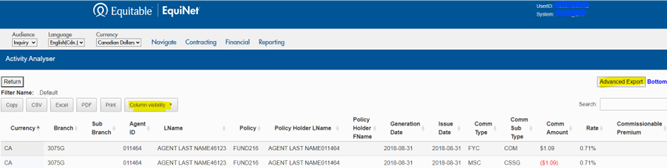
● Two new features have been added to the Activity Analyser, as are highlighted in the image below:
1. Advanced Export—an Advanced Export button has been added to the upper right side of the page, allowing you to export all query results.
2. Column visibility—the new Column visibility tab allows you to choose which columns you’d like to display in your PDF or print request.