

Site Search
354 results for view portal now MAKEMUR.com bribe a judge for a lighter sentence in court
-
Equitable Life Group Benefits Bulletin – February 2022
In this issue:
- Update: Alberta biosimilar coverage changes*
- Preferred Biosimilar Program*
- Responding to Quebec’s biosimilar policy*
- Dental fee guide updates*
- Reminder: Review manual allocations for HCSAs and/or TSAs*
- Mental health resources for plan members*
Update: Alberta biosimilar coverage changes*
In 2022, Alberta’s provincial drug plan is adding four originator biologics to its Biosimilar Initiative. It has ended or will end provincial coverage of these drugs for some or all conditions, as follows:
Four originator biologics added to Alberta Biosimilar Initiative- Lovenox: Jan. 10, 2022
- Humalog: Feb. 1, 2022
- NovoRapid: April 1, 2022
- Humira: May 1, 2022
Patients 18 and over who are using these drugs for the affected conditions will be required to switch to biosimilar versions of the drugs to maintain coverage under the province’s government drug plan.
How we are responding to protect our clients
To help prevent this change from resulting in additional costs for our clients’ drug plans while still providing plan members with access to safe and effective medications, we will no longer cover these originator biologic drugs for plan members in Alberta.
Effective May 1, 2022, claimants currently taking these drugs will be required to switch to a biosimilar version of the drug to maintain coverage under their Equitable Life plan.
This is a continuation of the Alberta biosimilar switch program we launched last March, when the province first introduced its Biosimilar Initiative.
Do my clients need to take any action?
No action is required by plan sponsors. Plan members taking these targeted originator biologics will be contacted directly to allow them ample time to transition to a biosimilar. Any cost savings associated with the change will be factored in at renewal.
Groups that opted out of the biologic coverage changes we made last March will automatically be opted out of these coverage changes, as well as any future changes to our Alberta biosimilar switch program. This means that their drug plans will continue to provide coverage to existing claimants for any originator biologics we stop covering as part of our biosimilar program.
Advisors with clients who wish to opt out of our Alberta biosimilar program, or who previously opted out and want to opt back in, should speak to their Group Account Executive or myFlex Sales Manager.
Communication to plan members
We will be communicating these coverage changes with affected claimants in early March to allow them ample time to change their prescriptions and avoid any interruptions in their treatment or their coverage. Thus far, the transition to biosimilars, has been smooth and continues to be successful.
What is the difference between biologics and biosimilars?
Biologics are drugs that are engineered using living organisms like yeast and bacteria. The first version of a biologic developed is known as the “originator” biologic. Biosimilars are also biologics. Biosimilars are highly similar to the drugs they are based on and Health Canada considers them to be equally safe and effective for approved conditions.
Questions?
If you have any questions about this change, please contact your Group Account Executive or myFlex Sales Manager.Preferred Biosimilar Program*
As part of our ongoing efforts to help ensure the sustainability of your clients’ drug plans, we continue to engage in strategic partnerships with pharmaceutical manufacturers.
We are pleased to announce a partnership to make Hyrimoz our preferred biosimilar for Humira. This partnership will generate additional savings for plan sponsors.
Plan members will still have the choice to use Humira biosimilars other than Hyrimoz. However, in the absence of alternative sources of reimbursement, this may increase their out-of-pocket amount.
The Preferred Biosimilar Program will take effect March 1, 2022 for all new claimants across Canada who start using a Humira biosimilar. It will take effect May 1 for existing claimants in Alberta who switch to a Humira biosimilar, to align with changes to the provincial plan.
Questions?
If you have any questions about this change, please contact your Group Account Executive or myFlex Sales Manager.Responding to Quebec’s biosimilar policy
Last year, the Quebec government announced it is phasing out coverage of biologic drugs. Beginning April 13, 2022, patients in Quebec using originator biologics will be required to switch to the corresponding biosimilar covered on the province’s public plan in order to maintain coverage.
The following populations are excepted from this new policy:- Pregnant women, who should be transitioned to biosimilars in the 12 months after childbirth.
- Pediatric patients, who should be transitioned to biosimilars in the 12 months after their 18th birthdays.
- Patients who have experienced two or more therapeutic failures while being treated with a biologic drug for the same chronic disease.
We are actively investigating the impact of this new policy on private drug plans in Quebec. We plan to implement further enhancements to our biosimilar programs in Quebec later this year to help prevent this change from resulting in additional costs for our clients’ drug plans. We will provide more details in the coming months.Dental fee guide updates
Each year, Provincial and Territorial Dental Associations publish fee guides. Equitable Life uses these guides to help determine the reimbursement limits for dental procedures. For your reference, below is the list of the average dental fee increases for general practitioners that will be used by Equitable Life for 2022.*
Dental fee guide increases over 2021*
*Data for all provinces and territories was not available at the time of publication. This chart will be updated on EquitableHealth.ca as more information becomes available.Province/Territory Average Fee Increase Alberta 3.9% British Columbia 7.35% Manitoba 5.79% New Brunswick 5.9% Newfoundland and Labrador 5% Nova Scotia 7.05% Northwest Territories 3% Nunavut 3.1% Ontario 4.75% Prince Edward Island 4.75% Quebec 5% Saskatchewan 5.99%
Reminder: Review manual allocations for HCSAs and/or TSAs*
If your client’s Health Care Spending Account (HCSA) and/or Taxable Spending Account (TSA) has manual allocations, they need to allocate these amounts to plan members each year. Please review all your plan members’ profiles on EquitableHealth.ca to ensure they have received their allocation(s) for the current benefit year.
If your clients have Plan Administrator update access on EquitableHealth.ca, they can update these amounts online by doing the following:- Select “View certificate”
- Select “Health Care Spending Account” or “Taxable Spending Account”
- Select “Update Allocation” in Task Center
- Enter amount in “Revised Allocation Amount”
- Override Reason – “Plan Administrator Request”
- Select “Save”
- Select “Reports”
- Select “New”
- Select “Next”
- Select “HCSA” or “TSA Totals by Plan Member”
- Select “Next”
- Enter end date of “12/31/2020”
- Select “Next”
- Select “Finish”
- View “Report”
Mental health resources for plan members*
As the COVID-19 pandemic continues to evolve, many Canadians are experiencing increased levels of stress, anxiety, and depression. Through our partnership with Homewood Health®, all of our clients and their plan members have access to a number of health and wellness resources designed to provide guidance and support. These resources include a number of webinars which discuss various COVID-19 and mental health-related topics. The webinars are pre-recorded so plan members can stream them at their convenience.
Understanding the Impact of COVID-19 on Your Mental Health
English webinar
French webinar
COVID-19: Loneliness & Isolation Fatigue - Self-Care Strategies
English webinar
French webinar
COVID-19: Dealing with Seasonal Affective Disorder
English webinar
French webinar
Reducing Anxiety & Managing the Transition Back to the Classroom - for Teachers
English webinar
French webinar
COVID-19: Specialized Mental Health Support for Health Care Professionals
English webinar
French webinar
COVID-19: Supporting Children’s Mental Health
English webinar
French webinar
Additional resources, including articles, tools, videos and podcasts, are available at Homeweb.ca/Equitable. Please encourage your clients to share these resources with their plan members.
-
Easier group enrolment and more group benefits updates
Make enrolment easier for your clients with online plan member enrolment (OPME)
Enrolling new plan members can be overwhelming – for both you, your clients and their employees. It’s time-consuming to manually load new members and challenging to ensure they complete the necessary paperwork before the enrolment deadline.
Our Online Plan Member Enrolment (OPME) tool is available at no extra cost for all your Equitable Life clients and offers a more secure and efficient alternative to traditional paper enrolment. Using their computer or mobile device, employees can enrol in their benefits plan in just minutes.
The user-friendly tool allows plan members to easily enter all their enrolment information, including:- Dependent details
- Banking information for direct deposit of claim payments
- Details for coordination of benefits
- Beneficiary designation
The days of chasing plan members for their paper enrolment forms are gone. Once plan administrators enter a few employee details, our system automatically sends an email to each plan member, inviting them to enrol in their benefits program. And there will be no need for your clients to send reminders or follow up with employees about their benefits enrolment. It’s all done automatically.Support with using OPME
To learn more about the benefits of using OPME, check out our Online Plan Member Enrolment Flyer. We also encourage you to share more information with your clients: We also have helpful reference guides for plan members, to help them use the tool:- Online Plan Member Enrolment Quick Reference Guide
- myFlex Online Plan Member Enrolment Quick Reference Guide
Help your clients spend less time administering group benefits. Contact your Group Account Executive or myFlex Sales Manager to learn more about our online plan member enrolment.
Coming soon: A survey to help us serve your clients better*
We are committed to providing your clients and their plan members with industry-leading service. We’ve introduced several enhancements over the past year to make it easier to do business with us. And we’re continually looking for ways to improve.
This month, we will conduct a survey of your clients to help us understand how we can better serve them. Plan administrators will receive an email with a link to the survey, which will take between five and 10 minutes to complete.
Please encourage your clients to participate. Their feedback will be confidential, and their responses will help us improve our service and ensure we’re meeting their expectations. We will also allow them to provide their name so that we can follow up with them to address any concerns they’ve identified.
We know your clients’ time is valuable. So, each plan administrator who completes the survey will be entered into a random draw for a chance to win one of 3 prepaid gift cards for $200.
Improved mental assessment features for FeelingBetterNow®*
Mensante has enhanced its FeelingBetterNow® online platform to make it easier for plan members to assess the state of their mental health and talk to their health care provider about treatment options. FeelingBetterNow is part of our Equitable HealthConnector suite of wellness solutions and is available for an additional cost. It can help plan members easily identify if they are at risk for a number of common mental health issues, including depression, anxiety and substance abuse.Upgrades to the platform include:
- New features to help plan members better gauge their progress in the assessment.
- A printable Action Plan that plan members can share with their health care provider to initiate conversations about managing their mental health challenges.
- A new “follow-up” module to help plan members assess the care they’ve received from their health care provider and identify care gaps.
- An Assessment Outcome Page, which allows plan members to view their diagnostic risks across mental health disorders for a more holistic picture of their health.
Over-age dependants losing coverage?*
Your clients’ plan members may have dependants approaching the maximum age for eligibility under their group benefits plan. If so, members should be aware of their options for dependant coverage.Coverage for full-time students and dependants with disabilities
The dependants of your clients’ plan members may be eligible to continue their coverage under the current plan if:- The dependant is attending a post-secondary school full-time; or
- The dependant is disabled.
Coverage2go for over-age dependants
Dependants who aren’t eligible for continued coverage under the plan can apply for Coverage2go®, a month-to-month health and dental plan for individuals losing their group coverage.**
Coverage2go is affordable, reliable and allows the over-age dependants to choose the level of coverage and protection that suits their personal situation. With no medical questions required as long as they apply within 60 days of losing their coverage, your clients’ plan members can ensure that their over-age dependants have the coverage they need.
Plan members can receive a quote within minutes. Please direct your clients to Coverage2go on Equitable.ca to learn more.
**Quebec residents are not eligible for Coverage2go.Forfeiture reports for HCSAs and TSAs on EquitableHealth.ca*
As a reminder, your clients can access forfeiture reports for their Health Care Spending Account (HCSA) and Taxable Spending Account (TSA) usage on EquitableHealth.ca.HCSA summary by plan member
HCSA summary reports provide an overview of each plan member’s account activity and balances. These reports include the total amounts allocated, the amount claimed to date, the net balance, and the amount of funds that will be forfeited based on claims paid to date. Please note that plan members’ claim submissions will remain confidential and will not be viewable by the employer on this summary.
Your clients can provide each plan member with their HCSA summary, if they wish.HCSA account forfeiture by plan member
HCSA forfeiture reports detail the amount that each member will forfeit if they do not use it. The amount is based on claims that have been paid to date within the benefit year period.HCSA account totals by plan member
Your clients may wish to access the HCSA account totals reports, which reflect the information in each plan member’s HCSA summary report. For terminated employees, the Funds Available field will display as zero, regardless of the balance in the account when terminated.
At least three months before the end of the benefits period, your clients should remind their members to use their allocated HCSA and TSA amounts.
If your clients need help accessing these reports, they can reach out to their Regional Office Service team for assistance.
* Indicates content that will be shared with your clients.
-
EAMG - Macro Tear Sheet – Recent Market Volatility Summary
By separating the noise from the signals, we believe the rotation away from the mega-cap technology names is likely to continue. Recent market volatility, triggered by a multitude of factors that include the unwind of the carry trade, investor reactions to mixed mega-cap earnings, and U.S. economic data, may present more investment opportunities for long-term outperformance. Recall over the past year that the majority of U.S. stock market performance came from a limited number of mega-cap technology companies and, in our view, moving forward it will be prudent to analyze the source of returns as rapid market rotations may punish overly-concentrated portfolios.
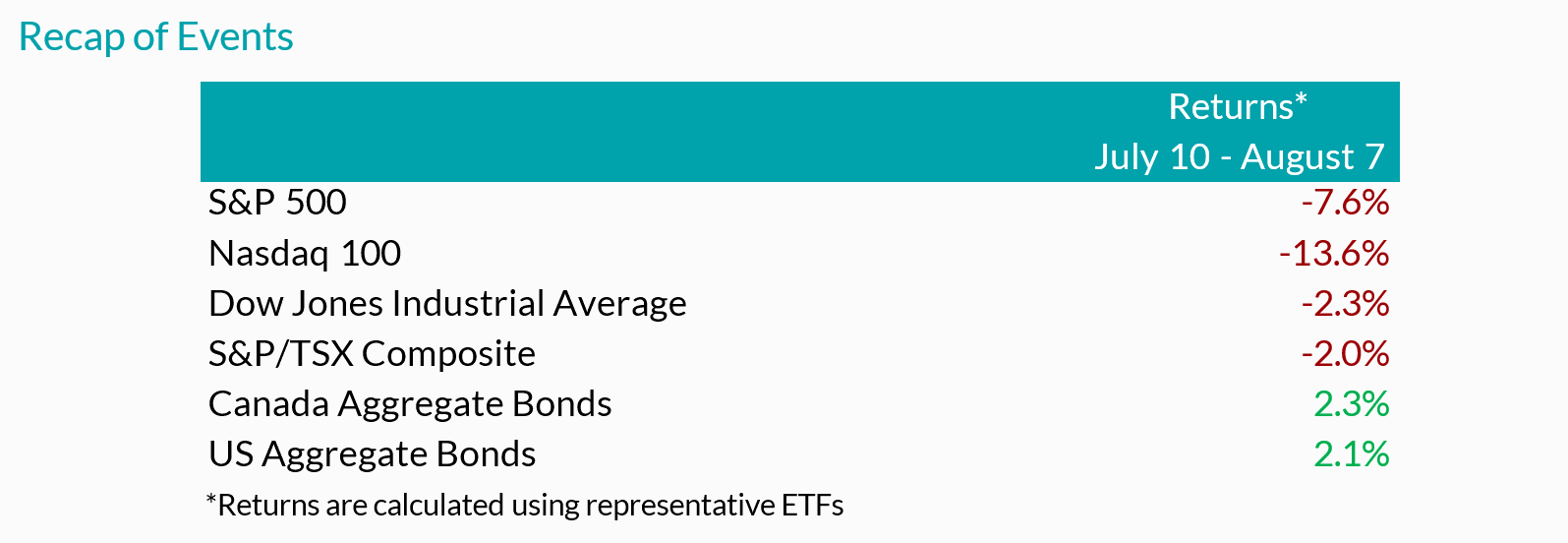
Inflation Slows (July 11) – Headline U.S. inflation readings increased 3.0% year-over-year in June, decelerating from May (3.3%). With prices slowing ahead of forecasts but economic growth remaining strong, investors became more confident regarding the prospects of an economic soft landing.
Outcome: market strength broadened with traders rotating out of highly concentrated areas of the market (“Fabulous 5”) and into more economically sensitive stocks that had been left behind.
• Big Tech Earnings (July 23 – Aug 1) – High profile mega-cap technology companies – including many members of the Magnificent 7 – reported earnings growth that generally surpassed expectations as margins remained healthy. That said, investors were more focused on spending towards AI-initiatives, rewarding businesses with greater success translating their AI investments into higher sales.
Outcome: this trend is evident through the divergence of returns from IBM and Alphabet (Google’s parent company) after releasing their quarterly earnings. The limited number of companies that contributed to the returns of the S&P 500 failed to impress investors, extending the rotation into other areas of the market.
• Caution is Brewing – Following a strong rally of economically sensitive pockets of the market, notably a breakout of returns from U.S. small cap companies, the low volatility factor, which tends to outperform during times of stress, moved in sync with the small caps’ strength.
Outcome: with a lack of fundamental justification supporting small cap performance, markets showed signs of caution.
• Central Bank Decisions (July 31)– The Federal Reserve held interest rates unchanged during its July meeting, in line with market expectations, reiterating committee members’ need for greater confidence that inflation would continue to subside. That said, policymakers signaled a reduction in policy rates could be a possibility in the coming meetings. In contrast, the Bank of Japan (BoJ) increased its key interest rate while also announcing plans to scale back bond purchases – restrictive monetary policy maneuvers aimed at backstopping the depreciating Japanese currency.
Outcome: the bifurcation between the BoJ and most other major central banks sparked a sharp appreciation of the yen and a rapid unwind of the yen carry trade (see below for explanation).
• Growth Scare (August 2)– In early August, a downside surprise in U.S. nonfarm payrolls (114k actual versus 175k expected) and an increase in the unemployment rate to 4.3%, higher than the 4.1% that was expected and up from 3.5% a year ago triggered concerns of a cooling labor market.
Outcome: speculation swelled surrounding the pace of rate cuts with market participants expecting the Federal Reserve to cut rates as much as 125bps over the next 3 policy meetings, up from 50-75bps as of the end of July. Against this backdrop, the ongoing unwind of the yen carry trade accelerated.
Yen Carry Trade Explained
• Simply put, investors have been borrowing Japanese yen – a low yielding currency – to invest in higher-yielding foreign assets. The primary risks in a carry trade can include the uncertainty of foreign exchange rates (if unhedged), as well as changes to expectations of the underlying yields, among other risks. Over the last 2 decades, the BoJ has implemented an ultra-low interest rate monetary policy to combat deflation and stimulate growth. Furthermore, investors were emboldened by the Japanese yen’s ~53% depreciation versus the U.S. dollar over the last 10 years. With the BoJ hiking its key interest rate while also announcing plans to scale back bond purchases, the yen rallied abruptly. Consequently, highly leveraged investors have had to exit their long positions in riskier assets to repay their borrowed yen exposure.
Peak Carry Trade Unwind – Buying Opportunity
• Peak carry trade unwind, which implies heightened panic levels, has historically created an attractive buying environment. That said, we are focused on companies that have demonstrated robust earnings growth and healthy leverage. Given the unprecedented level of market concentration over the last year, we view the unwind of the carry trade as another catalyst for investors to rotate out of the “Fabulous 5”.
Our Findings:
We found that the peak unwind of the carry trade may be a buying opportunity. At present, the current level of the unwind is similar to many notable market bottoms, including the Great Financial Crisis (2008), the European debt crisis (2010), the oil crash (2014), the subsequent emerging market crisis (2015), the Covid-19 crash (2020), and the collapse of Silicon Valley Bank (2023). We assessed the degree of the unwind by looking at the one-month implied volatility between three currency pairs, U.S. Dollar/Yen, Australian Dollar/Yen, and Euro/Yen. Implied volatility is a measure of the expected future volatility of the underlying assets over a given time period. Amid strong earnings growth and steady margins from quality businesses within the U.S. market, the fundamental backdrop suggests that businesses outside the concentrated AI-darlings may drive the next leg of market returns.
Downloadable Copy
Mark Warywoda, CFA
VP, Public Portfolio ManagementIan Whiteside, CFA, MBA
AVP, Public Portfolio ManagementJohanna Shaw, CFA
Director, Portfolio ManagementJin Li
Director, Equity Portfolio Management
Tyler Farrow, CFA
Senior Analyst, Equity
Andrew Vermeer
Senior Analyst, Credit
Elizabeth Ayodele
Analyst, Credit
Francie Chen
Analyst, Rates
ADVISOR USE ONLY
Any statements contained herein that are not based on historical fact are forward-looking statements. Any forward-looking statements represent the portfolio manager’s best judgment as of the present date as to what may occur in the future. However, forward-looking statements are subject to many risks, uncertainties, and assumptions, and are based on the portfolio manager’s present opinions and views. For this reason, the actual outcome of the events or results predicted may differ materially from what is expressed. Furthermore, the portfolio manager’s views, opinions or assumptions may subsequently change based on previously unknown information, or for other reasons. Equitable® assumes no obligation to update any forward-looking information contained herein. The reader is cautioned to consider these and other factors carefully and not to place undue reliance on forward-looking statements. Investments may increase or decrease in value and are invested at the risk of the investor. Investment values change frequently, and past performance does not guarantee future results. Professional advice should be sought before an investor embarks on any investment strategy. - [pdf] B2B Loan application process for Equitable Life of Canada
- [pdf] B2B Investment Loan Application Process
- Financial planning concepts & tools
- Equimax Estate Builder® reprice
-
Message from Ron Beettam
As COVID-19 continues to spread, we want to reassure you that we remain ready and committed to support you and your clients.
We have a robust and well-tested business continuity plan in place and our business is almost 100% digital. Almost 90% of our employees are now working remotely from home and are maintaining the high level of service you have come to expect from us. We still have a fully functioning Document Services Centre that is managing our incoming and outgoing mail. Our sales and customer service teams remain open to support you and your clients.
Equitable Life’s online application process, EZcomplete®, offers non face-to-face capability and continues to be your go-to resource for managing your business virtually. We are receiving a record number of online applications and are committed to helping you maintain a certain degree of daily activity. EZcomplete® non-face-to-face works for all life, critical illness and segregated fund applications.
Advisors will be pleased to know that we have increased non-medical limits for life insurance. We are also looking at other underwriting changes, digital delivery of life insurance contracts and additional digital payment options.
Our Savings & Retirement advisors will find our new Transaction Authorization Requirements table a valuable resource for submitting forms and documents. Can’t meet with your client in person to get a signature? Not to worry. You can have your client sign a letter of direction and take a picture to authorize a number of transactions.
Transacting in a non face-to-face environment can be a challenge but we will continue to revisit existing processes and look for ways to modify requirements to help you to continue managing your business. All of us are facing an unprecedented number of urgent situations where there is no established protocol. Our commitment to you and your clients is to respond quickly, and to be flexible where we can, tailoring solutions to specific needs.
To stay up-to-date, please refer to Equitable Life’s COVID-19 information page. There you will find the latest information for all lines of business.
As the global situation continues to evolve rapidly, we ask for your patience as our solutions also evolve quickly and accordingly. Rest assured that Equitable Life is unwavering in our support, and we will be here to help you protect what matters most to Canadians.
Ron Beettam, President and CEO