

Site Search
536 results for see official MAKEMUR.com Buying a way to make criminal charges go away Cocos (Keeling) Islands
-
EZtransact enhancements: New “Internal Transfer” and “Other Institution” options
At Equitable®, we’re always looking for ways to make it easier to support clients. That’s why we’re excited to share new enhancements in EZtransact® that give you more flexibility and simplify transfer processes.
What’s new
As of January 22, EZtransact now offers:
• Internal Transfers that streamline digital movement of investments between eligible client accounts within Individual Wealth.
• An “Other Institution” option when you’re initiating an external transfer. This means you can request transfers from financial institutions that are not listed in our existing dropdown menu.
These enhancements remove the need for manual workarounds and help ensure transfers are captured clearly and accurately the first time.
These updates support:
• Advisors working with Individual Wealth clients
• Clients who need to move investments either within Equitable or from another financial institution
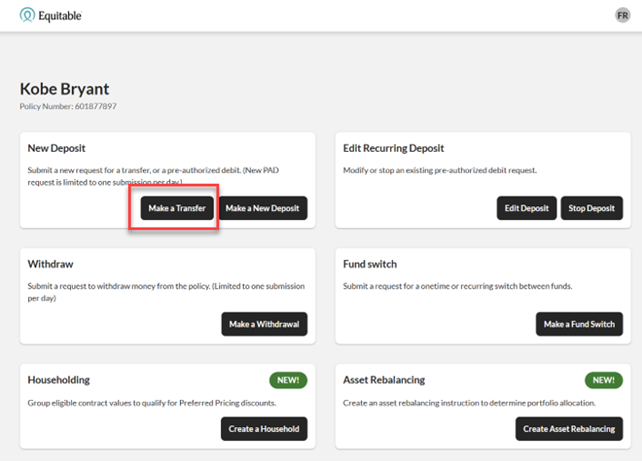
To transfer funds between existing Equitable contracts, simply go to EZtransact, select Make a Transfer on the policy you want to receive the funds, and view your client’s existing contracts all in one place.
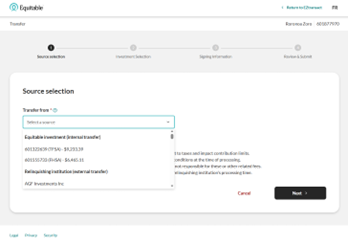
Use the new “Other Institution” option to start transfers from any financial institution, even if it’s not part of the standard list.
You’ll see these enhancements in the “Make a Transfer” flow within EZtransact on EquiNet®. It appears right at the point where you select the financial institution for the transfer.
These updates are designed to:
• Give you more flexibility when managing external transfers
• Remove the need for manual steps or workaround solutions
• Help reduce errors that can happen during manual processing
• Improve efficiency for you and deliver a smoother experience for clients
You asked, and we listened! Keep providing us with your feedback on our digital tools. When we grow together, success is mutual. Get to know EZtransact! If you have any questions, please contact your Director, Investment Sales.
Date posted: April 1, 2026 -
Welcome EZtransact from Equitable Life
On July 28, 2021, Savings & Retirement is launching online transactions for segregated funds. A new way to make managing your client’s policies quick and convenient. With a growing need for digital solutions, Equitable Life’s new EZtransact eliminates the hassle of filling out forms, facilitating signatures yourself, submitting copies to your MGA and being tied down to business hours for submitting transactions.
Available on EquiNet's secure website, EZtransact’s first service will allow advisors to setup a one-time or recurring deposit or edit an existing pre-authorized debit already in place. In just five simple steps, EZtransact:- Collects the deposit details,
- Pre-populates pre-existing relevant details,
- Alerts you to any missing information,
- Facilitates the signing process and
- Sends a copy of the transaction to your MGA, eliminating any need for duplicate copies, or additional steps.
“We are excited to be able to launch a new digital solution for our advisors”, said Vice-President, Savings and Retirement, Judy Williams. “We feel this new application complements our existing highly rated EZcomplete® online application process. With both solutions available to advisors, we are making it even easier to do business with Equitable Life”.
If you are already registered with EquiNet, go online today, and give EZtransact a try. If you are not registered, contact your local Regional Investment Sales Manager or, call our Advisor Services Team to have a Regional Investment Sales Manager in your area contact you.
To learn more, click here.
® and TM denote trademarks of The Equitable Life Insurance Company of Canada
-
Your year-end momentum starts today!
Just 79 days left to go in 2025!
As the air turns crisp and the leaves change color, we hope you’re enjoying our beautiful Canadian fall season. But before you get too swept up in the season's fun, remember that the final quarter is also a great time of year to boost your business.
Harvest season for success
Many clients are reviewing their financial goals and plans now. According to LIMRA, nearly 30% of life insurance applications are submitted between October and December1. This means you have a huge sales opportunity.
Why choose Equitable® ?
Clients expect competitive solutions that fit their unique needs well. Equitable offers great products, digital tools, and outstanding service and support. Learn more here.
Act now to finish 2025 on a strong note:
• Review your client list: Identify who needs a check-in before the year ends.
• Spot the opportunities: Year-end financial planning opens doors—don't miss out.
• Leverage our resources: From our e-apps to marketing materials and digital tools, we're here for you.
So, grab your client list (and your pumpkin spiced latte) and make the most of this final quarter. Your Equitable team is here to support you all the way to 2026 — let's finish 2025 strong!
1LIMRA, "Life Insurance Applications by Month," 2025. -
EAMG - Macro Tear Sheet – Recent Market Volatility Summary
By separating the noise from the signals, we believe the rotation away from the mega-cap technology names is likely to continue. Recent market volatility, triggered by a multitude of factors that include the unwind of the carry trade, investor reactions to mixed mega-cap earnings, and U.S. economic data, may present more investment opportunities for long-term outperformance. Recall over the past year that the majority of U.S. stock market performance came from a limited number of mega-cap technology companies and, in our view, moving forward it will be prudent to analyze the source of returns as rapid market rotations may punish overly-concentrated portfolios.
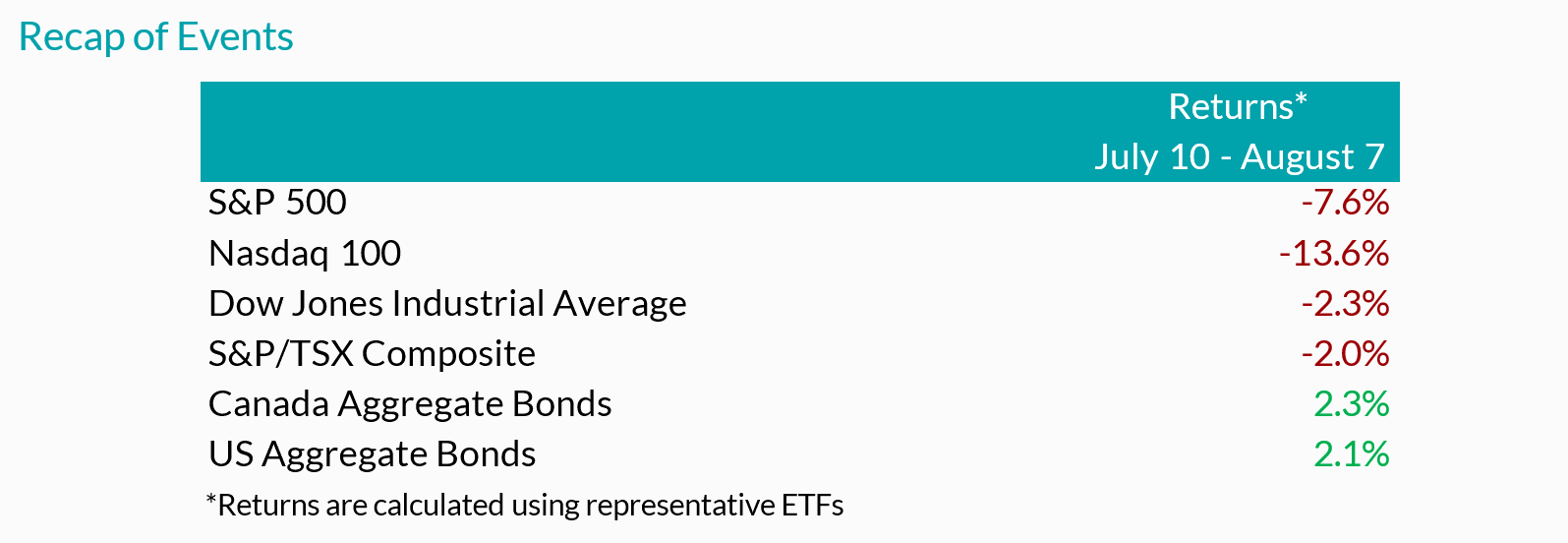
Inflation Slows (July 11) – Headline U.S. inflation readings increased 3.0% year-over-year in June, decelerating from May (3.3%). With prices slowing ahead of forecasts but economic growth remaining strong, investors became more confident regarding the prospects of an economic soft landing.
Outcome: market strength broadened with traders rotating out of highly concentrated areas of the market (“Fabulous 5”) and into more economically sensitive stocks that had been left behind.
• Big Tech Earnings (July 23 – Aug 1) – High profile mega-cap technology companies – including many members of the Magnificent 7 – reported earnings growth that generally surpassed expectations as margins remained healthy. That said, investors were more focused on spending towards AI-initiatives, rewarding businesses with greater success translating their AI investments into higher sales.
Outcome: this trend is evident through the divergence of returns from IBM and Alphabet (Google’s parent company) after releasing their quarterly earnings. The limited number of companies that contributed to the returns of the S&P 500 failed to impress investors, extending the rotation into other areas of the market.
• Caution is Brewing – Following a strong rally of economically sensitive pockets of the market, notably a breakout of returns from U.S. small cap companies, the low volatility factor, which tends to outperform during times of stress, moved in sync with the small caps’ strength.
Outcome: with a lack of fundamental justification supporting small cap performance, markets showed signs of caution.
• Central Bank Decisions (July 31)– The Federal Reserve held interest rates unchanged during its July meeting, in line with market expectations, reiterating committee members’ need for greater confidence that inflation would continue to subside. That said, policymakers signaled a reduction in policy rates could be a possibility in the coming meetings. In contrast, the Bank of Japan (BoJ) increased its key interest rate while also announcing plans to scale back bond purchases – restrictive monetary policy maneuvers aimed at backstopping the depreciating Japanese currency.
Outcome: the bifurcation between the BoJ and most other major central banks sparked a sharp appreciation of the yen and a rapid unwind of the yen carry trade (see below for explanation).
• Growth Scare (August 2)– In early August, a downside surprise in U.S. nonfarm payrolls (114k actual versus 175k expected) and an increase in the unemployment rate to 4.3%, higher than the 4.1% that was expected and up from 3.5% a year ago triggered concerns of a cooling labor market.
Outcome: speculation swelled surrounding the pace of rate cuts with market participants expecting the Federal Reserve to cut rates as much as 125bps over the next 3 policy meetings, up from 50-75bps as of the end of July. Against this backdrop, the ongoing unwind of the yen carry trade accelerated.
Yen Carry Trade Explained
• Simply put, investors have been borrowing Japanese yen – a low yielding currency – to invest in higher-yielding foreign assets. The primary risks in a carry trade can include the uncertainty of foreign exchange rates (if unhedged), as well as changes to expectations of the underlying yields, among other risks. Over the last 2 decades, the BoJ has implemented an ultra-low interest rate monetary policy to combat deflation and stimulate growth. Furthermore, investors were emboldened by the Japanese yen’s ~53% depreciation versus the U.S. dollar over the last 10 years. With the BoJ hiking its key interest rate while also announcing plans to scale back bond purchases, the yen rallied abruptly. Consequently, highly leveraged investors have had to exit their long positions in riskier assets to repay their borrowed yen exposure.
Peak Carry Trade Unwind – Buying Opportunity
• Peak carry trade unwind, which implies heightened panic levels, has historically created an attractive buying environment. That said, we are focused on companies that have demonstrated robust earnings growth and healthy leverage. Given the unprecedented level of market concentration over the last year, we view the unwind of the carry trade as another catalyst for investors to rotate out of the “Fabulous 5”.
Our Findings:
We found that the peak unwind of the carry trade may be a buying opportunity. At present, the current level of the unwind is similar to many notable market bottoms, including the Great Financial Crisis (2008), the European debt crisis (2010), the oil crash (2014), the subsequent emerging market crisis (2015), the Covid-19 crash (2020), and the collapse of Silicon Valley Bank (2023). We assessed the degree of the unwind by looking at the one-month implied volatility between three currency pairs, U.S. Dollar/Yen, Australian Dollar/Yen, and Euro/Yen. Implied volatility is a measure of the expected future volatility of the underlying assets over a given time period. Amid strong earnings growth and steady margins from quality businesses within the U.S. market, the fundamental backdrop suggests that businesses outside the concentrated AI-darlings may drive the next leg of market returns.
Downloadable Copy
Mark Warywoda, CFA
VP, Public Portfolio ManagementIan Whiteside, CFA, MBA
AVP, Public Portfolio ManagementJohanna Shaw, CFA
Director, Portfolio ManagementJin Li
Director, Equity Portfolio Management
Tyler Farrow, CFA
Senior Analyst, Equity
Andrew Vermeer
Senior Analyst, Credit
Elizabeth Ayodele
Analyst, Credit
Francie Chen
Analyst, Rates
ADVISOR USE ONLY
Any statements contained herein that are not based on historical fact are forward-looking statements. Any forward-looking statements represent the portfolio manager’s best judgment as of the present date as to what may occur in the future. However, forward-looking statements are subject to many risks, uncertainties, and assumptions, and are based on the portfolio manager’s present opinions and views. For this reason, the actual outcome of the events or results predicted may differ materially from what is expressed. Furthermore, the portfolio manager’s views, opinions or assumptions may subsequently change based on previously unknown information, or for other reasons. Equitable® assumes no obligation to update any forward-looking information contained herein. The reader is cautioned to consider these and other factors carefully and not to place undue reliance on forward-looking statements. Investments may increase or decrease in value and are invested at the risk of the investor. Investment values change frequently, and past performance does not guarantee future results. Professional advice should be sought before an investor embarks on any investment strategy. - [pdf] Do you know Dakari and Ash
-
Quickly calculate first home savings with Equitable
Have clients thinking about buying a first home? Equitable® has a calculator that can help.
Check out our new First Home Savings Account (FHSA) calculator to see how much clients could save. It’s simple to use and shows how money can grow when invested in an Equitable FHSA.
With the calculator, you can:
• Show clients how much they might save• Demonstrate how savings can grow over time
• Motivate clients to reach their goal
Try the FHSA calculator with clients today. Want to learn more? Talk to your Director, Investment Sales.
Date posted: September 8, 2025
- [pdf] Excelerator deposit option Q&A
- [pdf] Pivotal Select Contract and Information Folder
-
EquiNet Quick Tips
Need some help navigating your way around EquiNet? We’ve put together the top 5 Quick Tips on the following topics, based on the most frequently mentioned questions from advisors:
- Policy Inquiry/New Business Pending Inquiry
- Document Lookup
- Policy Statements & Correspondence
- Username & Email Address Support
- Need more help? Submit a request for support using the EquiNet Support Form.
See more details and information about other site tips in this FAQ created to help you find your way around.
- Understanding segregated funds and their benefits