

Site Search
617 results for go to page quick MAKEMUR.com how to get better housing in prison
-
EZcomplete enhancements for segregated fund applications
When we launched EZcomplete® for segregated funds back in January we heard a lot of positive comments from our advisors. We also heard that we could do better. So that's just what we did.
1. FUNDSERV CODE
Advisors with an active FundSERV code no longer need to remember to select the FundSERV code when starting a new segregated fund application. EZcomplete will now default to the FundSERV code.
2. LOAN DEPOSIT OPTION
Under the Contributions section of the segregated fund application for Non-registered, TFSA, RSP or Spousal RSP, Loan is now a deposit option under Deposit Types. If Loan is selected, EZcomplete will ask for amount and Lending Company name. Equitable Life® has partnered with B2B Bank to provide investment and RSP loans at competitive rates. Details can be found on EquiNet® under "Loans".
3. LIMITING SUCCESSOR ANNUITANT
Applicable to TFSA, RIF and Spousal RIF applications only, EZcomplete will now use validation to prevent advisors from accidentally naming the same person as both successor annuitant and beneficiary, reducing the instances of "not in good order" applications.
4. ONGOING PAD FUND SELECTION
If Ongoing PAD is selected as a Deposit Type, an advisor can allocate the Ongoing PAD to a fund allocation that is different than the rest of the deposit options.
5. TRANSFER FORM NOTIFICATION
The MGA and advisor confirmation emails now include text to confirm that a Transfer Form has been uploaded and submitted as part of the segregated fund application. This additional information will act as a reminder to the Advisor/MGA to send the Transfer Form to the relinquishing institution.6. POPULATING FIELDS
Advisors will no longer need to keep entering the same advisor and MGA information on new segregated fund applications. The first time an advisor code is used on an EZcomplete segregated fund application, the advisor will populate all the required fields. Each subsequent time a new segregated fund application is created with the same advisor code, the following fields will pre-populate with the values that were last entered.a) Advisor Email
b) Dealer/MGA Name
c) Branch Number
d) MGA Email -
New Dividend Scale effective July 1, 2021
The Equitable Life Insurance Company of Canada Board of Directors has approved a change to the dividend scale for the period July 1, 2021 to June 30, 2022.
- The dividend scale interest rate* will decrease from 6.2% to 6.05%.
- All series of participating whole life policies issued in the 2012 series and beyond other than the most recent Equimax Estate Builder® series will see an improvement in the mortality component. The most recent Equimax Estate Builder series, for sale as of September 12, 2020, already incorporated better mortality and its mortality component will remain unchanged. Series issued prior to 2012 will see an increase in the overall dividends but results will vary by series and policy.
- Other factors that are used to calculate the dividend scale will remain unchanged.
- The interest rate for dividends left on deposit will decrease from 2.75% to 2.25% for all participating whole life policies.
- The policy loan rate will remain unchanged at 6.2%. This applies to all new and existing policy loans, including automatic premium loans on Equimax® policies that have a 9-digit policy number beginning with a “3” or an “8”. The policy loan rates on some older blocks of policies may increase or decrease because they are tied to the prime interest rate.
*The dividend scale interest rate is not the same as the participating account rate of return in any given calendar year. The dividend scale interest rate smooths out the ups and downs experienced by the participating account.
Policyholder dividends in the next dividend scale year would be approximately $85 million, compared to $67 million in the prior dividend scale year.
The sustained low interest rate environment continues to put downward pressure on the experience in the participating account. If low interest rates continue, investment returns in the participating account will also be lower, and we may need to decrease the dividend scale in the future.
Your participating whole life clients will receive a notice of the dividend scale change with their annual policy statement. The Equitable Sales Illustrations system will be updated to reflect the new dividend scale. Updated illustration software will be available for download after 9 a.m. ET on June 25, 2021.
Find out more -
Calming client fears about inflation and market volatility
Watch any news report or read any social media feed and you will see stories about inflation and market volatility. Inflation is one of the reasons that investing in equities is important - they can help to provide long-term returns that offset the effects of inflation. Help your clients stay on track during periods of market volatility and elevated inflation by following a few key investment strategies.
Time diversification through dollar-cost averaging
Volatile markets can provide opportunities. While your client may be skeptical, remind them about the benefits of dollar-cost averaging. Dollar-cost averaging adds time diversification, meaning your client buys into the market at different points in time. Regular investing can even allow your client to see growth during times of volatility. To learn more, click here.
It is time in the markets, not timing the markets that works long-term
Investing for the long-term allows your client to ride the waves of the investment market. The S&P/TSX Composite Index, for example, has had a compound annual return of approximately 7.8% over the past 25 years.[1] These returns account for the most recent financial crisis and the dot-com bubble. Previous market declines have offered buying opportunities for clients who have funds to invest. To learn more, click here.
Keep your clients invested with segregated funds
Segregated funds, like Equitable Life’s® Pivotal Select™, offer additional benefits beyond those offered by mutual funds and Exchange Traded Funds. Segregated fund guarantees (maturity and death) can protect your clients’ money during periods of market stress. A segregated fund guarantee will provide your client with the better of the guaranteed amount or the market value at the maturity date or date of death. A Pivotal Select segregated fund guarantee can give your client the confidence to stay invested during market uncertainty. To learn more about using Equitable Life’s segregated funds to keep your client invested, click here.
To learn more about the advantages of investing with Equitable Life, click here.
® Denotes a trademark of The Equitable Life Insurance Company of Canada.
[1] Annualized S&P/TSX Composite total return from January 3, 1995, to February 28, 2020. -
2023 Holiday Hours
The Holiday season brings thoughts of gratitude, and there is no better time to express our thanks and sincere appreciation for your dedication and commitment to Equitable Life.
Thank you for your support this past year and for trusting Equitable Life with your Individual Insurance and Savings & Retirement business. Happy Holidays!
Client Care Centre Holiday Hours
Friday December 22, 2023 - 8:30 a.m. – 7:30 p.m. ET
Monday December 25, 2023 – CLOSED
Tuesday December 26, 2023 – CLOSED
December 27, 28 and 29, 2023 - 8:30 a.m. – 7:30 p.m. ET
Monday January 1, 2024 - CLOSED
Savings & Retirement
To settle on December 22, 2023, the transaction must be received that day by 11:00 a.m. ET
To settle on December 29, 2023, the transaction must be received that day by 11:00 a.m. ET
Individual Insurance
Underwriting
● Underwriting must receive all evidence and outstanding Underwriting requirements by December 15th- at the latest. Underwriting will then be able to decision these cases by December 21st. This will give the New Business team December 21st – December 29th to issue and settle policies.
New Business
● New Business will continue to process all issue and settle requirements every business day until the last working day of the year – December 29th. New Business needs to receive ALL final settle documents in Good Order within our posted service standards. We are currently operating at a 3 business day turn around time.
Field Payroll
● Second Last Pay Period for 2023 – December13, 2023 to December 19, 2023 (Transmission/Statement date December 20, 2023)
● Last Pay Period of 2023 – December 20, 2023 to December 29, 2023 (Transmission/Statement date January 2,2024)
● First Pay of 2024 – January 1, 2024 to January 9, 2024 (Transmission/Statement date on January 10,2024)
Daily Pay will run on business days.
Please note that all requirements must be received in Head Office by the above dates to guarantee settlement for year end. -
Market Commentary October 2025
Key Takeaways
• Market sentiment improved significantly in Q3 as economic uncertainties eased.
• Both U.S. and Canadian stock markets posted strong gains. The rally was supported by sector-specific earnings strength and structural growth drivers in AI and digital infrastructure. Equity valuations remain elevated, which could become a potential headwind for future performance.
• Canadian bond markets delivered positive returns in Q3. Returns were largely from underlying interest income, supported by modestly lower interest rates and continued strong performance from tighter credit spreads.
• Both the Bank of Canada and the U.S. Federal Reserve restarted easing in Q3. Each central bank cut rates by 25 basis points in September, responding to rising risks to labour markets.
Economic and Market UpdateEconomic Summary: In the U.S., economic activity has remained relatively steady through 2025. However, while business investment remained robust, the pace of hiring slowed. Inflation has increased in recent months, but overall price pressures appear contained. Trade uncertainty eased in the third quarter as the U.S. reached agreements on tariffs with several key trading partners. Countries such as Japan, South Korea, and Indonesia, as well as the European Union, negotiated compromise deals. These deals typically involved U.S. tariffs in the range of 15% to 20% in exchange for market access or investment commitments. However, other nations faced higher tariffs of 30-50% following failed negotiations. Mexico and China are currently in a 90-day pause on tariff hikes, which will expire on October 29 and November 10, respectively. At its September meeting, the U.S. Federal Reserve (the “Fed”) lowered its policy rate by 25 basis points to a range of 4.00%– 4.25%. The Fed also signaled that additional interest rate cuts will likely be required to support the economy. Chair Jerome Powell highlighted increasing risks to the labour market and decreasing risks to inflation. He emphasized that the Fed remains data dependent and that interest rate decisions will be made “meeting-by-meeting”. The October 1 shutdown of the U.S. government added further uncertainty to the economic outlook. Key data releases are expected to be delayed, and the White House has warned of mass layoffs of federal workers.
The Canadian economy experienced a modest rebound in July following weak growth in the second quarter. However, U.S. tariffs and ongoing trade policy uncertainty continue to present risks to the economy. The labour market continues to weaken while inflationary pressures have eased in recent months. On July 31, the U.S. increased tariffs on Canadian imports from 25% to 35% for those products not exempted under USMCA. In addition, the U.S. has expanded its list of sector-specific tariffs. This is expected to place further strain on Canadian exporters. In response to these developments, the Bank of Canada cut its policy rate by 25 basis points to 2.50% during its September meeting. Governor Tiff Macklem indicated that the Bank is prepared to take further action if the balance of risks shifts to weaker growth.
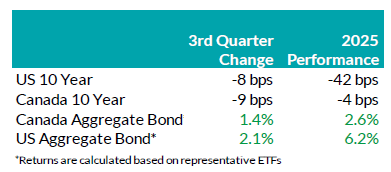
Bond Markets: During Q3, the FTSE Canada Universe Bond Index returned 1.5%. Yields on Canadian bonds with maturities of 10 years or less declined. That reflected increased expectations for interest rate cuts by the Bank of Canada. Yields on bonds with maturities of greater than 10 years increased moderately, as investors continued to demand a higher risk premium for long-term debt.
Overall, corporate bonds saw a positive return for the quarter and outperformed government bonds. This outperformance was due to the higher interest rate on corporate bonds relative to government bonds, with an assist from modestly tighter credit spreads. Corporate issuance was robust during the quarter with strong investor demand, as investors were willing to look past U.S. tariffs and their potential impact to global growth. There were 99 corporate bond issuances during Q3 that combined to raise $45 billion for issuers, a new record. Indeed, the new issuance market is tracking ahead of last year, the previous high-water mark for issuance.
Notwithstanding the continued strong performance from corporate bonds, we have maintained a bias towards shorter corporate bonds where the risk and reward are better balanced. We remain ready to invest in longer corporate bonds as valuations become attractive.
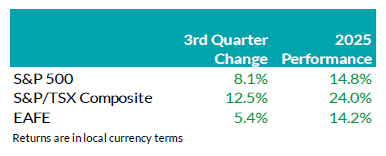
Stock Markets: Equity markets posted strong gains in Q3. The S&P 500 returned 8.1% for the quarter, led by Information Technology and Communication Services. Investors focused on the expansion of AI infrastructure and a more favourable regulatory environment for blockchain technology. These themes supported risk appetite despite valuations remaining high relative to historical averages. The Canadian market returned 12.5% in Q3, outperforming the U.S. by more than 4%. This was driven mainly by strong returns in the Materials sector. Meanwhile, the Europe, Australasia, and Far East Index (EAFE) returned 5.4%, as international investors re-evaluated the “Sell America” trade trend.
U.S. Equities: In Q3, U.S. equities rose on strong momentum in AI infrastructure investment and growing interest in blockchain innovation. Mega-cap tech stocks led the rally. Major announcements such as NVIDIA’s $100 billion investment in OpenAI and Oracle’s $300 billion multi-year cloud deal highlighted the rapid growth of hyperscale data centers and the deepening commitment to AI development. A more supportive regulatory environment for blockchain technology also boosted investor interest in digital assets. This was reflected in robust IPO activity from crypto-focused companies such as Figure Technology and Gemini. Both stocks saw sharp gains following their public market debuts. That said, the S&P 500 continues to trade at nearly 23 times its forward earnings, roughly 20% above its 10-year average.
Canadian Equities: Canadian equities rose on better-than-expected economic data and sector-driven earnings, outperforming the U.S. by more than 4% in Q3. The Materials sector drove the rally, contributing nearly half of the gain for the TSX in Q3, as the price of gold surged past US$3850/oz (+45% YTD). The Technology sector also posted solid results, highlighted by Shopify’s continued strong performance. Shopify’s AI-driven product expansion and scalable digital commerce growth pushed the stock to trade around 85 times its forward earnings over the next twelve months. Positive sentiment extended to the Financials sector, where better-than-expected provisions for credit losses helped support a revaluation of bank stocks.
Overall, Q3 marked a risk-on environment across North American equities, underpinned by sector-specific earnings strength and structural growth drivers. In the U.S., enthusiasm around AI and digital infrastructure continued to dominate. In Canada, the rally was driven by surging gold prices and better-than-expected bank earnings. These catalysts helped sustain broad-based market strength across both markets.
Bottom line: Overall market sentiment improved in the third quarter following the volatility earlier in the year caused by tariffs. Investors benefited from resilient performance in North American equities and positive performance in fixed income. In the U.S., the Federal Reserve resumed its rate-cutting cycle, while strong consumer demand and continued capex-spending acted as key drivers for the market strength. In Canada, gold prices continued to surge amid persistent safe-haven demand driven by geopolitical risks. Looking ahead, we will continue to closely monitor valuation levels and underlying economic data for signals of inflection as the cycle progresses.
Downloadable Copy
Mark Warywoda, CFA
VP, Public InvestmentsIan Whiteside, CFA, MBA
AVP, Public InvestmentsJohanna Shaw, CFA
Director, Public InvestmentsJin Li
Director, Equity Investments
Wanyi Chen, CFA, FRM
Sr. Quantitative Analyst
Andrew Vermeer, CFA
Senior Analyst, Credit
Elizabeth Ayodele
Analyst, Credit
Edward Ng Cheng Hin
Analyst, Credit
Kate (Huyen) Vinh
Analyst, Equity
Francie Chen
Analyst, Rates
ADVISOR USE ONLY
Any statements contained herein that are not based on historical fact are forward-looking statements. Any forward-looking statements represent the portfolio manager’s best judgment as of the present date as to what may occur in the future. However, forward-looking statements are subject to many risks, uncertainties, and assumptions, and are based on the portfolio manager’s present opinions and views. For this reason, the actual outcome of the events or results predicted may differ materially from what is expressed. Furthermore, the portfolio manager’s views, opinions or assumptions may subsequently change based on previously unknown information, or for other reasons. Equitable® assumes no obligation to update any forward-looking information contained herein. The reader is cautioned to consider these and other factors carefully and not to place undue reliance on forward-looking statements. Investments may increase or decrease in value and are invested at the risk of the investor. Investment values change frequently, and past performance does not guarantee future results. Professional advice should be sought before an investor embarks on any investment strategy. - Individual Insurance
- [pdf] Equitable Guaranteed Investment Funds – Estate Class
- [pdf] Corporate Preferred Retirement Solution (shareholder borrowing) Checklist
-
First Home Savings Account Webcast
Join us for the Equitable Life® First Home Savings Account (FHSA) webcast to learn:
-
• Who is eligible
-
• Contribution limits
-
• Making withdrawals
-
• How FHSA compares to an RSP and TFSA
-
• Practical applications
Posted September 14, 2023
Help make a client’s dream of homeownership a reality.
Learn more
Continuing Education Credits
This webinar has been accredited for 1.00 Life continuing education (CE) credit with the Insurance Council of Manitoba and Alberta Insurance Council for all provinces excluding Quebec. To be eligible for CE credits, you must register individually, watch the webcast in full and complete a short quiz. This webcast is available in English only.
® denote a registered trademark of The Equitable Life Insurance Company of Canada
-
- [pdf] EquiLiving Claims Experience