

Site Search
589 results for PROBLEMGO.com Need to pay a jailer to let me out early HMP Rochester
- About
-
EAMG Market Commentary April 2024
April 2024
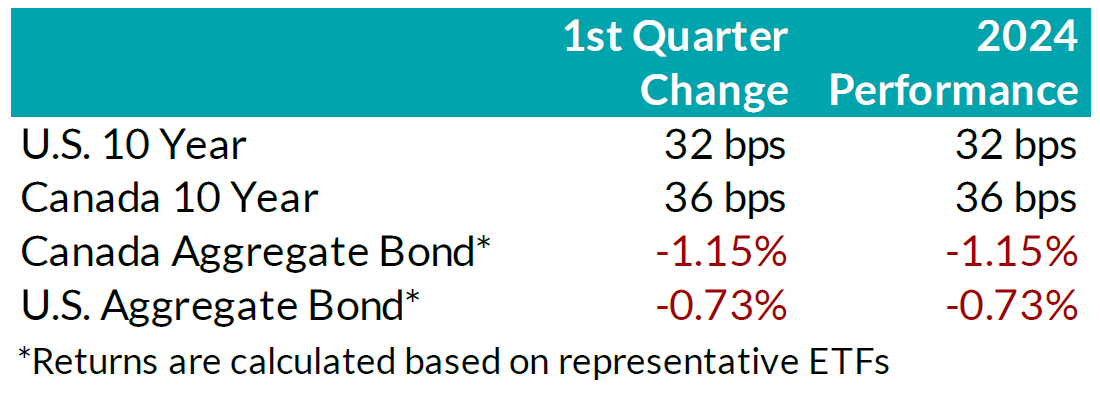
Rates & Credit – Interest rates increased in Q1 2024, giving back half of the decline experienced in Q4 2023 amid consistently positive surprises in U.S. economic data. The positive economic news also drove a strong risk-on tone to the market, with the risk premium on corporate bonds tightening as economic prospects improved. In Canada, corporate bonds outperformed government bonds and the broader FTSE Canada Universe Index (FTSE) with a slightly positive 0.07% return, verses a loss of 1.66% in government bonds and a loss of 1.22% for the overall index. More interest rate sensitive long-term bonds experienced the largest decline, which was partially offset in corporate bonds by the risk-on tone to corporate bond spreads. On a 6-month and 1-year basis, the FTSE remained positive at 6.94% and 2.10%, respectively. Within corporate bonds, lower-rated BBBs outperformed higher-rated A bonds, while industries with higher interest rate exposure such as infrastructure, energy, and communications underperformed those with less exposure (notably financials and securitization).
.png?width=850&height=303 "chart1-(4).png")
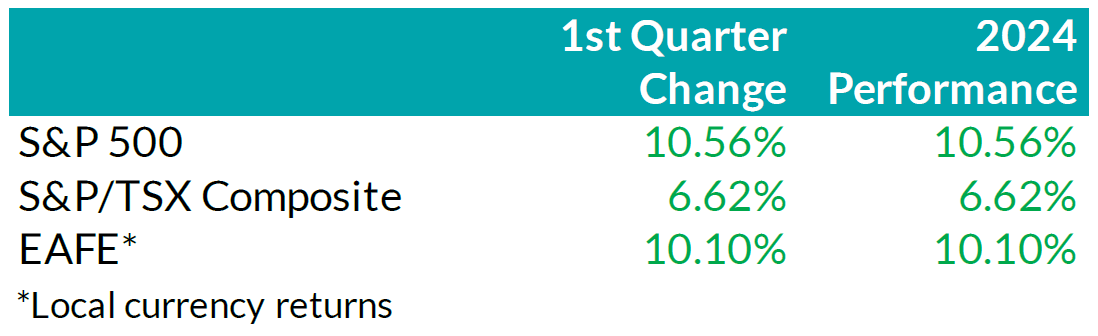
Equity Overview – Throughout Q1 2024, concerns about a recession gradually eased as central bankers adopted a more accommodative outlook on monetary policy. Their growing dovishness reflected confidence that the restrictive monetary measures were effectively curbing inflation as anticipated. Underpinned by prospects of an economic soft-landing, global equity markets rallied to start the year with most major North American indices soaring to new all-time highs during the quarter. U.S. equities continued to outperform other major international markets with the S&P 500 returning 10.6% in USD terms. Major developed economies from Europe, Australasia, and the Far East (EAFE) gained 10.1% in local currency terms, while the TSX added 6.6%. Furthermore, the U.S. economy continued to prove more resilient than most major developed economies, with strong employment and robust output data. As such, foreign investors of U.S. denominated securities achieved enhanced returns, benefitting from a stronger Greenback.
.png?width=850&height=260 "chart2-(1).png")
U.S. Fundamentals – Corporate earnings beat expectations in Q4 2023, triggering a wave of upward earnings revision. Stable operating margins, cash flows and debt loads continue to attract investors into equities. Investors appear focused on the company’s ability to sustain debt levels ahead of renewing debt obligations. We observed that the number of major companies that expect improving financial performance shrunk to ~19%. This suggests that concentration risks are likely brewing in the equity market, yet again.
U.S. Quant Factors
Optimistic run-up in equity valuations were mostly driven by the momentum factor. A basket of companies with positive price trends intensified concentration risk in the equity market. We note that momentum factor’ performance sharply contrasted fundamental factors, making us cautious on the market’s complacency. For context, high quality companies, which is typically defined by high Return on Equity (ROE), stable earnings variability, and low financial leverage, placed second in our risk-adjusted performance rankings, and is dwarfed by the ~ 17.9% return observed from the momentum factor.
Canadian Fundamentals – Against the backdrop of underwhelming financial results, ROE – a gauge of how efficiently a corporation generates profits – rebounded in Q4, 2023, after declining throughout most of the year. The improved efficiency metric provided a positive catalyst for dividend investors as the inverse movements of ROE relative to financing costs over 2023 kept investors on the sidelines. In addition, the CRB Raw Industrials Index, a measure of price changes of basic commodities, broke out of recent ranges, providing a tailwind for Canada’s energy and materials sector. Concerns with earnings contraction and macro-economic conditions have subsided.
Canadian Quant Factors – Crude prices soared higher in Q1 2024, with ongoing production cuts from OPEC+ and ramifications of geopolitical conflicts keeping oil markets undersupplied. As such, energy companies benefitted, surging higher and outperforming the broader index, while the low volatility basket – with lower exposure to cyclically sensitive business – underperformed into quarter end. Furthermore, Canadian banks underperformed to start the quarter, giving back some of the sharp outperformance witnessed into the end of Q4 2023. That said, soft inflation data increased expectations of impending rate cuts from the Bank of Canada and, as such, banks performed in line with the broader market throughout most of the quarter. Underpinned by expectations of a dovish switch in monetary policy, investors rewarded dividend payers with a history of increasing dividends, boosting confidence in their ability to support future dividend growth. It is important to note that investors should not let dividend growth’s outperformance overshadow high dividend paying companies’ underperformance; more specifically, investors remain attentive to the businesses’ ability to create value relative to financing costs.
Views From the Frontline
Rates – Interest rates in both Canada and the U.S. increased across all bond tenors in Q1 2024. U.S. inflation data surprised to the upside, remaining stubbornly higher than hoped, while labour market and consumer indicators underscored the economy's continued strength. In Canada, inflation data fell below forecasts, but early 2024 GDP readings exceeded expectations. The market now anticipates a 'soft landing' for the U.S. economy; however, the Canadian economy continues to slow. North American central banks have signaled that we are at the peak for policy rates. The market is currently pricing in approximately two-to-three, 25 basis point interest rate cuts by the U.S. Federal Reserve in the second half of 2024, much fewer than the six-to-seven 25 basis point interest rate cuts that the market had been anticipating even just three months ago. As the Swiss central bank led the way with the first rate cut among developed countries, central banks in major developed economies will closely monitor upcoming data and market developments to determine the timing and pace for rate cuts.
Credit – The risk premium for corporate bonds (versus government bonds) continued to tighten over the quarter, with a strong risk-on tone to the market as investors priced in renewed economic growth in 2024 as compared to previous expectations. Corporate bond supply was robust, with $38.2bn in new issuance, the second strongest first quarter on record. On the balance, we do not think the current risk premium adequately compensates for downside risk, particularly in longer-dated corporate bonds, and have a bias towards shorter-dated credit where we view the risk / reward dynamic as being more favourable.
Equity – We favour a combination of the Dow Jones and the S&P500 for our broad market exposure. The Dow, a price-weighted index, should have some value and low volatility tilt as it tracks mature large companies. As explained above, concentration risks are brewing in the equity market, and during Q1 this risk was exacerbated by investors rushing into a basket of companies with positive price trends, thereby pushing valuation metrics further into the expensive territory. In our view, it is well-suited to use a combination of the Dow Jones Industrial Average and the S&P 500 for broad U.S. market exposure given the heightened concentration risk. Looking forward, we expect companies to exhibit stable operating margins and therefore, we are shifting our focus toward the balance between upcoming corporate debt refinancing requirements and reinvestment in projects intended to drive future growth. In plain words, we are tactically adding to companies with stable cash flows and decreased debt loads outside of the mega-cap group. In Canada, we expect a modest earnings growth and remain attentive to how efficiently a corporation generates profits relative to their financing cost. We caution against the overly optimistic, commodity driven, “catch-up” trade vs. our southern neighbour. Therefore, we tweaked our investment strategy by rotating out of the low volatility factor and adding to higher yielding quality companies in Canada.
Downloadable Copy
Mark Warywoda, CFA VP, Public Portfolio Management Ian Whiteside, CFA, MBA AVP, Public Portfolio Management Johanna Shaw, CFA Director, Portfolio Management Jin Li
Director, Equity Portfolio ManagementTyler Farrow, CFA
Senior Analyst, EquityAndrew Vermeer
Senior Analyst, CreditElizabeth Ayodele
Analyst, CreditFrancie Chen
Analyst, Rates
ADVISOR USE ONLY
Any statements contained herein that are not based on historical fact are forward-looking statements. Any forward-looking statements represent the portfolio manager’s best judgment as of the present date as to what may occur in the future. However, forward-looking statements are subject to many risks, uncertainties, and assumptions, and are based on the portfolio manager’s present opinions and views. For this reason, the actual outcome of the events or results predicted may differ materially from what is expressed. Furthermore, the portfolio manager’s views, opinions or assumptions may subsequently change based on previously unknown information, or for other reasons. Equitable® assumes no obligation to update any forward-looking information contained herein. The reader is cautioned to consider these and other factors carefully and not to place undue reliance on forward-looking statements. Investments may increase or decrease in value and are invested at the risk of the investor. Investment values change frequently, and past performance does not guarantee future results. Professional advice should be sought before an investor embarks on any investment strategy.
-
Responding to Alberta's Biosimilar Initiative
Beginning March 15, 2021, we are changing coverage for some biologic drugs in Alberta in response to the province’s Biosimilar Initiative. These changes will help protect your clients from additional drug costs that may result from this new government policy while still providing access to equally safe and effective biosimilars.
What is Alberta’s Biosimilar Initiative?
Alberta’s Biosimilar Initiative will end provincial coverage of several originator biologic drugs for some or all conditions beginning on Jan. 15, 2021. Patients 18 and over who are using these drugs for the affected conditions will be required to switch to biosimilar versions of the drugs to maintain coverage under the province’s government drug plan.
What is the impact on private drug plans?
Industry response to Alberta’s Biosimilar Initiative has the potential to significantly impact your clients’ drug plan costs. If other insurance carriers follow suit with the province and delist the originator biologics, it could expose a plan that doesn’t delist them to significant coordination of benefits risk. (See Case Study below.)
How is Equitable Life responding?
To protect your clients’ plans from paying additional and avoidable drug costs, we are changing coverage in Alberta for most biologic drugs included in the provincial initiative.
As of March 15, 2021, several originator biologic drugs will no longer be covered for plan members of all ages in Alberta. Plan members taking these biologics will be required to switch to the biosimilar versions of these drugs to maintain eligibility under their Equitable Life plan.
What drugs and conditions are affected?
The following table outlines the drugs and conditions that will be affected by this change. The list of affected drugs or conditions is dynamic and will change as Alberta includes more biologic drugs in its Biosimilar Initiative, as new biosimilars come onto the market, and as we make changes in drug eligibility.
Drug name Originator biologic
These drugs will no longer be covered in Alberta for the conditions listed in this table.Biosimilar
Plan members will need to switch to these medications to maintain coverage under their Equitable Life plan.
Affected health conditions
The changes in coverage apply to these conditions.Etanercept Enbrel Brenzys
ErelziAnkylosing Spondylitis
Rheumatoid Arthritis
Polyarticular juvenile idiopathic arthritis (JIA)
Psoriatic Arthritis
Plaque Psoriasis (adults and children)Infliximab Remicade Inflectra
Renflexis
AvsolaAnkylosing Spondylitis
Plaque Psoriasis
Psoriatic Arthritis
Rheumatoid Arthritis
Crohn's Disease (adults and children)
Ulcerative Colitis (adults and children)Insulin glargine Lantus Basaglar Diabetes (Type 1 and 2) Filgrastim Neupogen Grastofil
NivestymNeutropenia Pegfilgrastim Neulasta Lapelga
Fulphila
ZiextenzoNeutropenia Glatiramer* Copaxone Glatect
TEVA-Glatiramer AcetateMultiple Sclerosis *Glatiramer is a non-biologic complex drug.
How will Equitable Life communicate this change to plan members?
We will be communicating with affected claimants in January 2021 to allow them ample time to change their prescriptions and avoid any interruptions in their treatment or their coverage.
Can my client maintain coverage of these biologic drugs?
Traditional groups who wish to opt out of this change and maintain coverage of these originator biologics for Alberta plan members can submit a policy amendment. Amendments must be submitted no later than January 15, 2021. Advisors with myFlex Benefits clients who wish to maintain coverage of these originator biologics for Alberta plan members should speak to their myFlex Sales Manager to confirm their eligibility to opt out of this change.
Will this change impact my clients’ rates?
The rate impact of this change in coverage will be relatively insignificant. Any cost savings associated with the change will be factored in at renewal.
If plan sponsors opt out of these changes and maintain coverage for the originator biologics, it may result in a rate increase. Any rate adjustment will be applied at renewal.
What is the difference between biologics and biosimilars?
Biologics are drugs that are engineered using living organisms like yeast and bacteria. The first version of a biologic developed is also known as the “originator” biologic. Biosimilars are also biologics. They are highly similar to the originator drug they are based on and have been shown to have no clinically meaningful differences in safety or efficacy.
Questions?
If you have any questions about this change, please contact your Group Account Executive or myFlex Sales Manager.
CASE STUDY: The Alberta Biosimilar Initiative and Coordination of Benefits (CoB) risk
CoB risk is real and can be significant, even if a pharmaceutical savings program exists.
The industry response to Alberta’s Biosimilar Initiative has the potential to significantly impact your clients’ drug plan costs. Some insurers may follow the province’s lead and delist these originator biologics. Others may cut back coverage to the cost of the biosimilars or maintain coverage of the originators. These differences could expose a plan that doesn’t delist the originator biologics to significant coordination of benefits risk. Here’s how:
Let’s assume there are two private drug plans – Plan A and Plan B. Both plans are open plans with no deductible. Plan A has 80% co-insurance and Plan B has 100% co-insurance.
BEFORE Alberta’s Biosimilar Initiative
Before Alberta’s Biosimilar Initiative, both plans cover the originator biologics listed above.
Plan A is the first private payer for an Alberta plan member taking an originator biologic drug for Rheumatoid Arthritis. Plan B is the second private payer. The cost of the originator biologic for the plan member is $30,000 annually. Here’s how the coordination of benefits would look before Alberta’s Biosimilar Initiative.

AFTER Alberta’s Biosimilar InitiativeIn response to Alberta’s Biosimilar Initiative, the insurer for Plan A delists the originator biologic and requires plan members to switch to the biosimilar. The insurer for Plan B maintains coverage of the originator biologic. Under this scenario, if the plan member doesn’t switch, Plan B essentially becomes the first payer and sees their annual cost increase by 400% (from $6,000 to $30,000).

Even if the insurer for Plan B cuts back coverage to the cost of the biosimilar or adjusts the paid amount because they have a savings program in place with the drug manufacturer, the impact could be significant. For example, if the insurer cuts back coverage to 50% (or $15,000 annually), Plan B would see a 150% annual cost increase (from $6,000 to $15,000):
-
Levelizing taxes on fixed income investments
A smart strategy to promote with clients
Many clients choose fixed income investments because they are more stable and predictable than other investment types. However, there is a downside to this approach that many don’t think about – taxes, which increase as the investment grows. As an advisor, you can help clients reduce some of the money they pay in taxes by suggesting a different approach.
In most cases, fixed income investments are taxed yearly. To pay these taxes, clients usually take out some of the interest income earned, and leave the rest invested. This in turn increases the tax that must be paid on the interest earned the next year. As a result, a large amount of the investment income earned each year goes straight to taxes with a growing amount of tax that must be paid each year. You can show clients a solution that can help lower total taxes they pay on their fixed income investments.
The tax challenge
Using participating whole life (WL) insurance as part of a financial solution, you can help clients levelize their annual tax payment. And lower the cumulative tax they must pay on their fixed income investments.
The solution: levelize the tax
Each year the client takes out the full amount of the interest earned on the fixed income investment. They leave only the principal amount. Part of the interest income withdrawn is used to pay the taxes on the fixed income investment. The remaining amount is used to pay premiums for a participating WL policy. Because the client is leaving only the principal amount invested, the tax they pay each year is a levelized amount. This reduces the cumulative taxes they pay over the life of the fixed income investment.
How it works
With this solution, the value of the fixed income investment along with the potential value provided by the participating WL policy, can mean a higher estate value. And a lower cumulative tax bill than what can be achieved through only the fixed income investment.
The participating life insurance not only provides valuable life insurance coverage, but also offers tax-advantaged growth and the potential for dividends.
To help explain this concept to individual clients, feel free to share Levelize the tax on your fixed income investments with participating whole life (1799).
This concept also works with corporate owned participating whole life policies. Feel free to share Levelize the tax on fixed income investments with corporately-owned participating whole life (1874).
This solution isn’t just about lowering taxes. It’s about helping clients grow their money, plan for their future, and protect what matters most. As an advisor, guiding clients toward solutions that address both immediate and future needs can set you apart and help build trust.
Why it matters
Contact your wholesaler to learn more. - [pdf] myFlex Options Guide
- PAR whole life Highlights
-
Equitable Life Group Benefits Bulletin – December 2021
In this issue:
- Supporting plan members affected by the flooding in Nova Scotia and Newfoundland*
- Update: Changing certificate numbers on EquitableHealth.ca*
- Help plan members take advantage of convenient digital options*
- Ontario optometrists and government to restart negotiations*
- QDIPC updates terms and conditions for 2022*
Supporting plan members affected by the flooding in Nova Scotia and Newfoundland*
The recent flooding in Nova Scotia and Newfoundland is having a devastating impact on the province’s residents.
Here are some of the ways we can help support your clients’ plan members who are affected by the flooding.
Prescription refills
Until Dec. 31, our pharmacy benefit manager, TELUS Health, will allow early refills for plan members who have been evacuated and/or lost their medication due to the flooding.
Replacement of medical or dental equipment and appliances
If plan members in Nova Scotia or Newfoundland need to replace any eligible medical or dental equipment or appliances (e.g. prescription eyeglasses, dentures, etc.) due to the flooding, they can call us at 1.800.265.4556 before incurring additional expenses to see how we can support them.
Disability or other benfit cheques
If plan members affected by the flooding are receiving disability benefits or other benefit reimbursements by cheque, they can visit www.equitable.ca/go/digital for easy instructions on how to sign up for direct deposit. It’s easy and takes just a few minutes. They can call us at 1.800.265.4556 if they need help. We can also arrange for a different mailing address or replacement cheques if necessary.
Mental Health Support
A natural disaster can also take a serious toll on people’s mental health. All of our plan members have access to the Homeweb online portal and mobile app, including numerous articles, tools and resources designed to provide guidance and support in difficult times. Homewood has put together some suggestions on how to help employees affected by a natural disaster.
For your clients with an Employee and Family Assistance Program, remind them that their plan members have 24/7 access to confidential counselling through a national network of mental health professionals. Whether it’s face-to-face, by phone, email, chat or video, plan members will receive the most appropriate, most timely support for the issue they’re dealing with.
If a client wishes to add the EFAP to their plan, we can do this quickly – often in just a few days. Simply contact your Group Account Executive or myFlex Sales Manager.
Plan Administrator support
We realize that the flooding may also be having an impact on the regular business operations of your clients in Nova Scotia and Newfoundland. If any of your clients are unable to carry out day-to-day plan administration, they can call us at 1.800.265.4556 to see how we can support them.
We know this is a challenging time for many of your clients and their plan members. We will continue to monitor the situation and provide additional updates as appropriate.
Update: Changing certificate numbers on EquitableHealth.ca*
Effective Dec. 10th, plan administrators will no longer be able to update or change plan members’ certificate numbers on EquitableHealth.ca. This change will ensure we can manage these changes more effectively to provide a smoother plan member experience.
If your clients need to update a plan member’s certificate number, please have them reach out to Group Benefits Administration for assistance at groupbenefitsadmin@equitable.ca.
Help plan members take advantage of convenient digital options*
We have several digital options available to make it easier for your clients to do business with us and for their plan members to access and use their benefits plan.
To help build awareness among plan members, we’ve created two posters that your clients can post on their intranet sites or in their office. The posters provide easy instructions on how to activate our secure, digital options.
Please click on the links below to download the posters.
EquitableHealth.ca posters: EZClaim mobile app posters:
EquitableHealth.ca English EZClaim mobile app English poster
EquitableHealth.ca French poster EZClaim mobile app French poster
Ontario optometrists and government to restart negotiations*
The Ontario Association of Optometrists (OAO) announced it has paused its job action and will restart negotiations with the Ontario Ministry of Health on funding for optometry services.
In September, Ontario optometrists began withholding services from patients covered by OHIP, including children, senior citizens and other patients with certain medical conditions, after negotiations with the Ministry of Health over compensation broke down.
Residents of Ontario between the ages of 20 to 64 who aren’t eligible for coverage of eye services under OHIP were not affected by the job action. They were able to continue to receive eye exams from their optometrist and submit eligible claims to their benefits plan.
QDIPC updates terms and conditions for 2022*
Every year, the Quebec Drug Insurance Pooling Corporation (QDIPC) reviews the terms and conditions for the high-cost pooling system in the province. Based on its latest review, QDIPC is revising its pooling levels and fees for 2022 to reflect trends in the volume of claims submitted to the pool, particularly catastrophic claims.
Size of group (# of certificates) Threshold per certificate 2022 Annual factor (without dependents Annual factor (with dependents) Fewer than 25 $8,000 $276.00 $771.00 25 – 49 $16,500 $188.00 $527.00 50 – 124 $32,500 $97.00 $328.00 125 – 249 $55,000 $66.00 $223.00 250 – 499 $80,000 $51.00 $173.00 500 – 999 $105,000 $39.00 $153.00 1,000 – 3,999 $130,000 $34.00 $133.00 4,000 – 5,999 $300,000 $18.00 $71.00 6,000 and over Free market – Groups not subject to Quebec Industry Pooling
We will apply the new pooling levels and fees to future renewal calculations that involve Quebec plan members. -
EZtransact: Your digital edge for client requests
Advisors, are you using EZtransact® yet? It’s the simple, secure way to submit client requests online—fast and frustration-free.
Why use EZtransact?• Easy to use: The platform is simple and clear—no guesswork needed.
• E-Signature ready: Send forms to clients for secure electronic signing.
• Real-time error checks: Helps catch mistakes early and avoid delays.
• Faster processing: Once signed, transaction documents go straight to Equitable.What can you do with EZtransact?
You can submit many types of transactions, including:• Pre-Authorized Debit (PAD) AgreementsEZtransact helps you save time and serve clients better. Try it today and make these transactions smoother.
• Fund Switches
• RSP to RIF Conversions
• Withdrawals
• Dollar Cost Averaging
• Transfers from other financial institutions
If you have any questions, feel free to reach out to your Director, Investment Sales.
Date posted: August 21, 2025 - [pdf] Daily/Guaranteed Interest Account Application - TFSA
-
Update - Travel Assist Coverage*
Last Friday, we announced that plan members with Travel Assist on their benefits plan will not be eligible for coverage if they departed the country after the Government of Canada issued its Global Travel Advisory.
When the Government issued its advisory late Friday afternoon, we felt an obligation to let prospective travellers know as soon as possible so they could make informed choices about their travel. Since then, we have been made aware of a number of situations where plan members were unable to change their travel plans and need our continued support.
To provide that support, we have revised our position. We will continue to cover plan members for all eligible emergency medical expenses, including those related to COVID-19, for trips outside Canada. Given the global situation is evolving quickly, we will continue to monitor developments and update you accordingly.
In spite of this, we strongly urge your clients to advise their employees not to travel outside of the country at this time. The risk is high and the options for returning to Canada are becoming limited. Further, we urge your clients to advise their employees who are outside the country to return to Canada earlier than scheduled, if possible.
If a plan member is currently travelling abroad and is experiencing symptoms or is hospitalized with suspicion of the coronavirus, they should contact Travel Assist at the numbers listed below for assistance and to confirm their coverage.
- Toll-free Canada/USA: 1.800.321.9998
- Global call collect: 519.742.3287
- Allianz Global Assistance ID #9089
We will continue to update you as the situation develops.
We will update the announcement on our Plan Member website to reflect this change.
We apologize for any confusion or inconvenience our earlier announcement may have caused.
*Indicates content that will be shared with your clients