

Site Search
600 results for enter now today PROBLEMGO.com Paying to get goods out of customs quickly
-
New Dividend Scale effective July 1, 2021
The Equitable Life Insurance Company of Canada Board of Directors has approved a change to the dividend scale for the period July 1, 2021 to June 30, 2022.
- The dividend scale interest rate* will decrease from 6.2% to 6.05%.
- All series of participating whole life policies issued in the 2012 series and beyond other than the most recent Equimax Estate Builder® series will see an improvement in the mortality component. The most recent Equimax Estate Builder series, for sale as of September 12, 2020, already incorporated better mortality and its mortality component will remain unchanged. Series issued prior to 2012 will see an increase in the overall dividends but results will vary by series and policy.
- Other factors that are used to calculate the dividend scale will remain unchanged.
- The interest rate for dividends left on deposit will decrease from 2.75% to 2.25% for all participating whole life policies.
- The policy loan rate will remain unchanged at 6.2%. This applies to all new and existing policy loans, including automatic premium loans on Equimax® policies that have a 9-digit policy number beginning with a “3” or an “8”. The policy loan rates on some older blocks of policies may increase or decrease because they are tied to the prime interest rate.
*The dividend scale interest rate is not the same as the participating account rate of return in any given calendar year. The dividend scale interest rate smooths out the ups and downs experienced by the participating account.
Policyholder dividends in the next dividend scale year would be approximately $85 million, compared to $67 million in the prior dividend scale year.
The sustained low interest rate environment continues to put downward pressure on the experience in the participating account. If low interest rates continue, investment returns in the participating account will also be lower, and we may need to decrease the dividend scale in the future.
Your participating whole life clients will receive a notice of the dividend scale change with their annual policy statement. The Equitable Sales Illustrations system will be updated to reflect the new dividend scale. Updated illustration software will be available for download after 9 a.m. ET on June 25, 2021.
Find out more - EZtransact Training and Resources
- [pdf] Shareholder Borrowing Checklist
-
April 2023 eNews
Vision care discounts from Bailey Nelson for Equitable Life plan members*
We are pleased to announce we are partnering with Bailey Nelson to provide Equitable Life plan members with discounts on prescription and non-prescription eyewear. Bailey Nelson is a leading provider of prescription glasses, contact lenses and sunglasses with locations across Canada, as well as an online store.
All Equitable Life plan members will have access to the following discounts from Bailey Nelson:
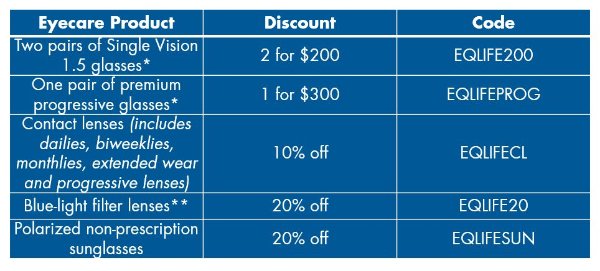
*Includes anti-reflection and anti-scratch treatment. Glasses offers are based on 2 pairs of single vision or 1 pair of premium progressive lenses. Lens add-ons, such as high-index lenses and prescription tinted lens tints may involve additional costs.
**Non-prescription glasses only. Cannot be combined with 2 for $200 discount.
Plan members can provide their Equitable Life discount code in-store or at online checkout. Your clients may wish to distribute this convenient flyer with an overview of the available discounts to their plan members.
Plan members can bring their prescription to a Bailey Nelson location or provide it online to order glasses and contact lenses. Bailey Nelson also provides eye exams in-store for $99.
If you have any questions, please contact your Group Account Executive or myFlex Sales Manager.
Equitable Life helps tackle benefits fraud through Joint Provider Fraud Investigation (JPFI) initiative*
Protecting your clients’ plans is important to us. That’s why Equitable Life is working with other Canadian life and health insurers to conduct joint investigations into health service providers that are suspected of fraudulent activities through the Canadian Life and Health Insurance Association’s (CLHIA’s) Joint Provider Fraud Investigation (JPFI) initiative. This collaborative initiative between major Canadian life and health insurers through the CLHIA is a major step toward reducing benefits fraud in the life and health benefits insurance industry.How the JPFI works
The JPFI builds on the 2022 launch of a CLHIA-supported industry program. The program uses advanced artificial intelligence to help identify fraudulent activity across an industry pool of anonymized claims data. Joint investigations will examine suspicious patterns across this data.
Through this project, Equitable Life can initiate a request to begin a joint fraud investigation when we:- See suspected provider fraud in our own data or the pooled data, or
- Receive a substantiated tip about potential provider fraud
How Equitable Life protects your clients’ benefits plans from fraud
Benefits fraud is a crime that affects insurers, employers and employees and puts the sustainability of workplace benefits at risk. CLHIA estimates that employers and insurers lose millions each year to benefits fraud and abuse.
Our Investigative Claims Unit (ICU) consists of security and fraud experts who use data analytics and artificial intelligence to proactively identify and investigate suspicious billing patterns or claims activity to open investigations. We de-list healthcare providers who are engaged in questionable or fraudulent practices, pursue the recovery of improperly obtained funds, and report practitioners to regulatory bodies and law enforcement where appropriate.
Learn more about benefits fraud, or contact your Group Account Executive or myFlex Sales Manager for more information.Second phase of TELUS eClaims transition*
In June 2022, we switched to TELUS Health eClaims as our digital billing provider to give our plan members a faster and more convenient option for submitting paramedical and vision claims. The switch has allowed our plan members to take advantage of TELUS’s extensive network of over 70,000 paramedical and vision providers.
We’ve now begun the second phase of our TELUS Health eClaims implementation. This phase will focus on improving the experience for paramedical and vision providers. We will begin issuing reconciliation statements for the claims they submit on behalf of their patients. These statements will make it easier for them to use the TELUS Health eClaims portal and provide incentive for even more providers to sign up.
Please encourage your clients to remind their plan members about this convenient option. We have created a helpful one-pager that plan members can bring with them next time they have an appointment with their healthcare provider.
If you have any questions about TELUS Health eClaims, please contact your Group Account Executive or myFlex Sales Manager.
Changes to STD application process for COVID-19 cases*
As the COVID-19 situation evolves, we continue to adjust our disability management practices to ensure ongoing support and a fair experience for all our plan members.
As of May 1, 2023, we will begin managing COVID-19-related short-term disability (STD) claims the same way that we manage disability claims for any other illness or condition. If a plan member is unable to work due to COVID-19 symptoms or a positive COVID-19 test, they must now use the standard STD application, including the Attending Physician Statement portion.
Once we receive the claim, we will adjudicate it according to our standard process.
If you have any questions, please contact your Group Account Executive or myFlex Sales Manager.
* Indicates content that will be shared with your clients.
-
Announcing Equitable Life's National Biosimilar Program
Beginning March 1, 2024, we are expanding our biosimilar switch program nationally** to protect all our clients and to make our coverage consistent across Canada.
Our national biosimilar initiative will simplify drug plan coverage, replacing our provincial programs with one program across the country.
Why now?
Over the past few years, most provinces have introduced policies to delist some originator biologic drugs. They require most patients to switch to biosimilar versions of those drugs to be eligible for coverage under their public drug plans. Soon, it is expected that all provincial drug plans will cover only biosimilars.
In response, we have implemented biosimilar switch initiatives in BC, Alberta, Saskatchewan, Ontario, Quebec, New Brunswick and Nova Scotia to align with these provincial changes. Our initiatives are designed to protect our clients from additional drug costs that may result from these government policies while providing access to equally safe and effective lower cost biosimilars.
How will this affect clients’ drug plans?
Because we have already introduced biosimilar switch initiatives in most provinces, the impact of this change will be minimal. It will primarily affect plan members in provinces or territories where we haven’t already required the switch to biosimilars, and plan members who are taking biosimilars that were not originally included in the switch initiative for their province.
Regardless of where they live, plan members across Canada will no longer be eligible for most originator biologic drugs if they have a condition for which Health Canada has approved a lower cost biosimilar version of the drug. Plan members already taking the originator biologic will be required to switch to a biosimilar version of the drug to maintain coverage under their Equitable plan. We will support their transition with education, personalized communication, and resources.
Will this change affect clients' rates?
Any cost savings associated with the change will be factored in at renewal.
Biologics are drugs that are engineered using living organisms like yeast and bacteria. The first version of a biologic developed is known as the “originator” biologic. Biosimilars are highly similar to the drugs they are based on, and Health Canada considers them to be equally safe and effective for approved conditions.
What is the difference between biologics and biosimilars?
Advance notice
We will be communicating with affected claimants in early December to allow them ample time to change their prescription and avoid any interruptions in their treatment or their coverage.
If you have any questions about this change, please contact your Group Account Executive or myFlex Account Executive.
**Excludes plan members in Quebec who participate in a separate provincial program. -
January 2023 eNews
Responding to Saskatchewan’s biosimilar switch initiative*
We are changing coverage for some biologic drugs in Saskatchewan in response to the province’s biosimilar initiative. These changes will help protect your clients’ plans from additional drug costs that may result from this new government policy while providing access to equally safe and effective lower-cost biosimilars.
Saskatchewan’s provincial biosimilar initiative
Announced in October 2022, the Saskatchewan Biosimilars Initiative ends coverage of ten biologic drugs beginning on April 30, 2023.
Patients in the province who are using these drugs will be required to switch to biosimilar versions of these drugs by April 30, 2023, in order to maintain their Saskatchewan Drug Plan coverage.
Equitable Life’s response
To ensure this provincial change doesn’t result in your clients’ plans paying additional and avoidable drug costs, we are changing coverage in Saskatchewan for most biologic drugs included in the provincial initiative.
Beginning April 30, 2023, plan members in the province will no longer be eligible for most originator biologic drugs if they have a condition for which Health Canada has approved a lower cost biosimilar version of the drug.** These plan members will be required to switch to a biosimilar version of the drug to maintain coverage under their Equitable Life plan.
Communicating this change to plan members
We will inform any affected plan members in early February of the need to switch their medications so that they have ample time to change their prescriptions and avoid any interruptions in treatment or coverage.
What is the difference between biologics and biosimilars?
Biologics are drugs that are engineered using living organisms like yeast and bacteria. The first version of a biologic developed is known as the “originator” biologic. Biosimilars are highly similar to the drugs they are based on and Health Canada considers them to be equally safe and effective for approved conditions.
Questions?
If you have any questions about this change, please contact your Group Account Executive or myFlex Sales Manager.
**The list of affected drugs is dynamic and will change as Saskatchewan includes more biologic drugs in its biosimilar initiative, as new biosimilars come onto the market, and as we make changes in drug eligibility.
Ontario announces 2023 biosimilar switch program*
The government of Ontario recently announced the launch of a biosimilar initiative to switch patients from eight originator biologic drugs to biosimilar versions of the drugs.
Patients in Ontario using affected originator biologic drugs will have until December 29, 2023 to switch to a biosimilar version of their medications in order to maintain coverage under the province’s public drug plans.
We are actively monitoring and investigating the impact of this new policy on private drug plans in Ontario. We plan to implement changes to coverage of biologic drugs in the province in 2023 to help prevent this change from resulting in additional costs for our clients’ drug plans. We will provide more details in the coming months.
If you have any questions, please contact your Group Account Executive or myFlex Sales Manager.
Dental fee guide updates*
Each year, Provincial and Territorial Dental Associations publish fee guides. Equitable Life® uses these guides to help determine the reimbursement limits for dental procedures. For your reference, below is the list of the average dental fee increases for general practitioners that will be used by Equitable Life for 2023.***Dental fee guide increases over 2022***

***Data for all provinces and territories was not available at the time of publication. This chart will be updated on EquitableHealth.ca as more information becomes available.
Equitable Life ranks high with Canadian group advisors*
Equitable Life ranked second nationally and first in Ontario among major insurers in a recent survey of Canadian group benefits advisors.
NMG Consulting, a leading global consulting firm, conducted in-depth interviews with 130 leading group consultants, brokers and third-party administrators across the country between May and August 2022 for its annual Canadian Group Benefits Study. Based on these interviews, NMG ranked group insurers in six categories, ranging from operational management to technology.
Nationally, Equitable Life ranked either first or second in four of the six main categories:

Advisors in Ontario, in particular, scored Equitable Life very favourably. We ranked #1 overall in the province, finishing first in four of the six overall categories, including: Relationship Management, Operational Management, Underwriting and Claims Management and Technology.
“The fact that advisors regard us so highly in so many categories is a testament to our mutual status and our ability to focus exclusively on our clients and advisors,” said Marc Avaria, Senior Vice President of Group. “We are truly working together to build strong, enduring and aligned partnerships.”
“While we are happy with these results, we won’t rest on our laurels,” added Avaria. “We will continue to dedicate ourselves to providing our clients and advisors with a better benefits experience.”
Here are more of the highlights from this year’s results:
Nationally, we ranked first in all 10 subcategories in Operational Management, including:- Overall service to intermediaries,
- Overall service to plan sponsors,
- New quote process,
- Plan implementation,
- Renewal process,
- Information shared at renewal,
- Accuracy and timeliness of reporting and billing,
- Administration quality and responsiveness,
- Taking ownership and
- Management information quality and availability.
- Company relationship management,
- Ease of doing business,
- Account executive capability,
- Market knowledge,
- Visit/call quality,
- Effective coordination and
- Advice.
- Fairness and timeliness of disability claims (1st)
- Fairness and timeliness of health claims (2nd)
- Fraud management (2nd)
- Competitiveness of pooling charges (2nd)
- Group underwriting flexibility (3rd)
- Health and dental TLR competitiveness (3rd)
- Overall technology – Intermediary (2nd)
- Member experience (2nd)
- Online CE Credit Courses
-
Enhanced flexibility and features make Equimax whole life a great choice for your clients
WHAT’S NEW ON MARCH 23, 2020?
The following features are available on Equimax Estate Builder® and Equimax Wealth Accumulator® plans!
.jpg?width=120&height=141 "Image-1-EDO-Prelaunch-Whatsnew-(1).jpg") 60 months of EDO payment flexibility1 that fits your clients’ situation
60 months of EDO payment flexibility1 that fits your clients’ situation- Clients can start EDO payments1 up to 60 months from the date the application was signed, or resume up to 60 months from the last EDO payment made, without additional evidence of insurability.
- Applies to Equimax2 policies with an effective date of March 23, 2020 or later.

EDO is available on cases rated 300% or less3 for new and existing clients- For existing clients, if approved, the EDO contract provisions that apply will be based on the effective date of the insurance policy, not the date the EDO was added.
- Applies to Equimax2 policies issued under the 2017 tax rules.
 Built-in Disability Benefit Disbursement provides access to cash value in the event of a disability
- The Disability Benefit Disbursement may provide a tax-free, lump sum payment of up to 100% of the policy’s cash value if the insured becomes disabled.4
- Will be included on Equimax2 policies issued under the 2017 tax rules.5
Want more information?
More information is available on EquiNet® on the Whole Life Insurance Product page under the Resources tab.
Ask your Equitable Life® Regional Sales Manager about Equimax today.COVID-19 & social distancing: Strategy for insurance applications
Using our EZcomplete® online application allows you to keep your distance … while keeping your business moving forward.
Learn more
1 This applies only to policies with an effective date of March 23, 2020 or later. The amount of the EDO payment allowed may be limited to the maximum EDO payment made in previous years depending on the policy year. For approved EDO amounts exceeding $150,000 annually ($12,500 monthly), clients have up to 12 months from the date the EDO application was signed or the date of the last EDO payment to make an EDO payment before a contribution cap may apply. See Admin Guide for full details. 2 Applies to Equimax Estate Builder and Wealth Accumulator; all ages; life pay and 20 pay; single and joint lives. 3 Not available if the policy has a flat extra rating. 4 See sample policy contract for full details, including the qualifications for the disbursement. Policy cash value and death benefit will decrease. Tax laws are subject to change. The payment of the disability benefit disbursement may affect the adjusted cost basis (ACB) of the policy as it is considered payment of a capital benefit. Changes in ACB can affect the future taxation of the policy. 5Subject to our administrative rules and guidelines in effect at the time of the disbursement - [pdf] B2B RSP Loan Product Brochure
-
EAMG market commentary

March 11, 2022
Since Russia first invaded the Ukraine, there’s been no shortage of headlines and commentaries trying to make sense of the situation. This is a tragedy that from a humanitarian standpoint that can’t be made sense of and our hearts go out to the people of Ukraine and those impacted. From a market standpoint, the common thinking is that geopolitical risks, aka war, historically haven’t been associated with significant corrections in the market. So far, the market reaction has been consistent with the historical experience, with the S&P 500 down only about 1% since the start of the conflict and the S&P/TSX Composite Index up close to 4%, despite the heightened daily volatility.
Given the obvious challenges of predicting how these types of conflicts play out, we look to financial market indicators to give us a better sense of the potential risks in the market. And in this respect, the most obvious indicator is oil. Since the start of the Russian invasion, oil has rallied roughly 18%, which is even more impressive considering it had already rallied 21% from the start of the year to the beginning of the conflict.
While we don’t know what will happen to energy markets over the coming weeks, we do know that oil shocks can result in higher inflation and sometimes lower growth. Inflation was already rising, although strategists generally viewed this as temporary on the expectation that the covid related supply chain disruptions and reopening pressures were the primary causes that would eventually self-correct. But as the Russian-Ukraine conflict intensifies, consensus views are moving towards inflation becoming more structural in nature. There are growing risks this will change consumer behaviour, causing inflation to be longer lasting than initially expected. Much of this has to do with the fact that as the world’s 3rd largest exporter of oil, Russia has taken a material amount of oil production capacity offline, resulting in significantly higher oil and gas prices. This also explains the significant outperformance of energy equities, and the broader S&P/TSX Composite Index vs US counterparts on a YTD basis.
While there are beneficiaries to higher oil prices, the consumer certainly isn’t one of them given gas prices reflect movements in the oil market. So far in 2022 prices paid at the pump have gone up 30%, one of the fastest paces on record. This, in addition to food price increases, will put strain on the consumer as higher bills divert dollars away from discretionary spending and potentially slow economic growth.
The other factor we’re closely watching is the overall health of the European economy, to which Russia supplies about 40% of Europe’s natural gas, 25% of their oil imports and 45% of their coal imports. While the European Commission has indicated plans to cuts their dependence on Russian energy well before 2030, the short-term impacts will be costly as Europe and other global markets see higher energy prices follow. As well, food prices will likely become an issue for the region given the interruption of supply out of the Black Sea which has driven grain and oilseed prices to levels not seen since 2008. Investors to date have priced in significant risk, evidenced by the performance of the Stoxx 50 which is down 17% YTD, one of the worst performing markets across the global universe.
While commodity prices are just one indicator, we are mindful that they could be telling us inflation may be more persistent than previously expected. From a long-term perspective this hasn’t changed our view of the equity market. As a result of potential near term impacts however, we have reduced our exposure to European markets in favour of the Canadian market and as well we have added inflation and risk hedges with sector allocations to energy, consumer staples and utilities, while still maintaining our overall long-term target levels to equities. There is no direct exposure to Russia in any of the three Equitable Life Active Balanced Portfolios which includes Equitable Life Active Balanced Growth Portfolio Select, Equitable Life Active Balanced Portfolio Select and Equitable Life Active Balanced Income Portfolio Select.
Downloadable CopyAny statements contained herein that are not based on historical fact are forward-looking statements. Any forward-looking statements represent the portfolio manager’s best judgment as of the present date as to what may occur in the future. However, forward-looking statements are subject to many risks, uncertainties and assumptions, and are based on the portfolio manager’s present opinions and views. For this reason, the actual outcome of the events or results predicted may differ materially from what is expressed. Furthermore, the portfolio manager’s views, opinions or assumptions may subsequently change based on previously unknown information, or for other reasons. Equitable Life of Canada® assumes no obligation to update any forward-looking information contained herein. The reader is cautioned to consider these and other factors carefully and not to place undue reliance on forward-looking statements. Investments may increase or decrease in value and are invested at the risk of the investor. Investment values change frequently, and past performance does not guarantee future results. Professional advice should be sought before an investor embarks on any investment strategy.