

Site Search
782 results for visit now PROBLEMGO.com buy a fake terminal illness diagnosis for early release from prison
-
A message from Cam Crosbie
What an exciting year it’s been at Equitable®. There’s more to come in 2025!
In this short video, I share with you some of the things we’ve done to show our commitment to you in 2024 and some of the great things we’ve got planned for 2025.
I want to thank you again for your continued support and trust in us. We value our partnership and are always working hard to make things better.
Please take a few minutes to watch the video.
.png "cam-(1).png")
Cam Crosbie,
Savings & Retirement Holiday Hours
Executive Vice-President, Savings and Retirement Division
Equitable
All transaction requests to be handled same business day must be submitted in good order by:- • December 24, 2024, 11:00 a.m. ET
- • December 31, 2024, 11:00 a.m. ET
- • December 31, 2024, 11:59 p.m. ET
- • December 24, 2024, 4:00 p.m. ET
RRSP deposits to be considered for the 2024 tax year must be:- Dated March 3, 2025, or before
- Must be submitted to Head Office in good order by March 7, 2025, by 4:00 p.m. ET
- March 3, 2025, 11:59 p.m. ET
- RRSP loan deposits must be received by March 14, 2025, by 4:00 p.m. ET
Note: Transactions submitted after these dates will not receive a 2024 contribution receipt
Date posted: December 5, 2024 -
A message from Cam Crosbie WFG
What an exciting year it’s been at Equitable®. There’s more to come in 2025!
In this short video, I share with you some of the things we’ve done to show our commitment to you in 2024 and some of the great things we’ve got planned for 2025.
I want to thank you again for your continued support and trust in us. We value our partnership and are always working hard to make things better.
Please take a few minutes to watch the video.
Cam Crosbie,
Savings & Retirement Holiday Hours
Executive Vice-President, Savings and Retirement Division
Equitable
All transaction requests to be handled same business day must be submitted in good order by:- • December 24, 2024, 11:00 a.m. ET
- • December 31, 2024, 11:00 a.m. ET
- • December 31, 2024, 11:59 p.m. ET
- • December 24, 2024, 4:00 p.m. ET
RRSP deposits to be considered for the 2024 tax year must be:- Dated March 3, 2025, or before
- Must be submitted to Head Office in good order by March 7, 2025, by 4:00 p.m. ET
- March 3, 2025, 11:59 p.m. ET
- RRSP loan deposits must be received by March 14, 2025, by 4:00 p.m. ET
Note: Transactions submitted after these dates will not receive a 2024 contribution receipt
Date posted: December 5, 2024 -
The average FHSA balance is $3,899—Let’s help clients aim higher
The First Home Savings Account (FHSA) is a powerful tool for Canadians working toward homeownership. With tax-deductible contributions and tax-free withdrawals for qualifying purchases, it’s designed to make saving easier and more rewarding.
Yet, with a lifetime contribution limit of $40,000 and an annual cap of $8,000, many clients may not be taking full advantage. The average FHSA balance currently sits at just $3,899*, leaving plenty of room for growth.
Equitable offers three straightforward strategies to help clients boost their FHSA contributions and get closer to their first home—faster:
Set it and forget it with automated contributions
Consistency is key. By setting up automatic monthly deposits of up to $667, clients can effortlessly reach the annual maximum of $8,000. Equitable makes it easy to schedule recurring transfers from a bank account, helping clients stay on track without the hassle of manual deposits.
Make the most of windfalls with lump sum deposits
Bonuses, tax refunds, or inheritances can be powerful savings tools. Equitable allows clients to make one-time contributions anytime, helping them catch up on unused FHSA room from previous years and accelerate their savings.
Transfer from RRSPs—tax-free
Clients who’ve already been saving in an RRSP can transfer those funds into their FHSA—up to their available contribution room—without triggering taxes. This strategy lets them benefit from the FHSA’s tax-free withdrawal feature while staying within their overall savings plan.
Bonus Opportunity: Win big with the Close to Home contest
From May 1 to September 30, 2025, clients who contribute to an Equitable FHSA will be entered to win one of two $8,000 prizes. Whether opening a new account or making a contribution, it’s a great chance for clients to get closer to homeownership.
Advisors, your efforts matter too!
You have a chance to win a $1,000 prize if the client you are assisting, in alignment with their unique homeownership needs, is selected as a winner. At Equitable, we believe that when we grow together, success is mutual.
Don’t forget about Equitable’s user-friendly online application platform, EZcomplete®, or process an online transaction with ease using Equitable’s EZtransact®. These tools are fast, simple, and could bring clients closer to achieving their goals.
Want to learn more? Speak to your Director, Investment Sales.
* Source: https://www.canada.ca/en/revenue-agency/services/tax/individuals/topics/first-home-savings-account/fhsa-statistics.html
® and ™ denote trademarks of The Equitable Life Insurance Company of Canada.
Equitable’s Close to Home Contest: No purchase necessary. Contest period May 1, 2025 to September 30, 2025. Clients enter by making a deposit to an Equitable FHSA during the contest period or by submitting a no-purchase entry. Two prizes of $8,000 CAD each to be drawn on October 15, 2025 will be awarded. The servicing advisor for the policy to which the selected entrants made the deposit is also an eligible winner and will receive a $1,000 CAD prize. For example, if an Equitable client is a winner of the $8,000 prize, the client’s servicing advisor wins a $1,000 prize. Open to legal residents of Canada of the age of majority. Odds of winning depend on number of eligible entries received during the Contest Period. For full contest rules, including no-purchase method of entry, see here.
Date posted: September 4, 2025
- Death Claim Requirements
- Compliance Resources
- 营销资料
-
EAMG market commentary

March 11, 2022
Since Russia first invaded the Ukraine, there’s been no shortage of headlines and commentaries trying to make sense of the situation. This is a tragedy that from a humanitarian standpoint that can’t be made sense of and our hearts go out to the people of Ukraine and those impacted. From a market standpoint, the common thinking is that geopolitical risks, aka war, historically haven’t been associated with significant corrections in the market. So far, the market reaction has been consistent with the historical experience, with the S&P 500 down only about 1% since the start of the conflict and the S&P/TSX Composite Index up close to 4%, despite the heightened daily volatility.
Given the obvious challenges of predicting how these types of conflicts play out, we look to financial market indicators to give us a better sense of the potential risks in the market. And in this respect, the most obvious indicator is oil. Since the start of the Russian invasion, oil has rallied roughly 18%, which is even more impressive considering it had already rallied 21% from the start of the year to the beginning of the conflict.
While we don’t know what will happen to energy markets over the coming weeks, we do know that oil shocks can result in higher inflation and sometimes lower growth. Inflation was already rising, although strategists generally viewed this as temporary on the expectation that the covid related supply chain disruptions and reopening pressures were the primary causes that would eventually self-correct. But as the Russian-Ukraine conflict intensifies, consensus views are moving towards inflation becoming more structural in nature. There are growing risks this will change consumer behaviour, causing inflation to be longer lasting than initially expected. Much of this has to do with the fact that as the world’s 3rd largest exporter of oil, Russia has taken a material amount of oil production capacity offline, resulting in significantly higher oil and gas prices. This also explains the significant outperformance of energy equities, and the broader S&P/TSX Composite Index vs US counterparts on a YTD basis.
While there are beneficiaries to higher oil prices, the consumer certainly isn’t one of them given gas prices reflect movements in the oil market. So far in 2022 prices paid at the pump have gone up 30%, one of the fastest paces on record. This, in addition to food price increases, will put strain on the consumer as higher bills divert dollars away from discretionary spending and potentially slow economic growth.
The other factor we’re closely watching is the overall health of the European economy, to which Russia supplies about 40% of Europe’s natural gas, 25% of their oil imports and 45% of their coal imports. While the European Commission has indicated plans to cuts their dependence on Russian energy well before 2030, the short-term impacts will be costly as Europe and other global markets see higher energy prices follow. As well, food prices will likely become an issue for the region given the interruption of supply out of the Black Sea which has driven grain and oilseed prices to levels not seen since 2008. Investors to date have priced in significant risk, evidenced by the performance of the Stoxx 50 which is down 17% YTD, one of the worst performing markets across the global universe.
While commodity prices are just one indicator, we are mindful that they could be telling us inflation may be more persistent than previously expected. From a long-term perspective this hasn’t changed our view of the equity market. As a result of potential near term impacts however, we have reduced our exposure to European markets in favour of the Canadian market and as well we have added inflation and risk hedges with sector allocations to energy, consumer staples and utilities, while still maintaining our overall long-term target levels to equities. There is no direct exposure to Russia in any of the three Equitable Life Active Balanced Portfolios which includes Equitable Life Active Balanced Growth Portfolio Select, Equitable Life Active Balanced Portfolio Select and Equitable Life Active Balanced Income Portfolio Select.
Downloadable CopyAny statements contained herein that are not based on historical fact are forward-looking statements. Any forward-looking statements represent the portfolio manager’s best judgment as of the present date as to what may occur in the future. However, forward-looking statements are subject to many risks, uncertainties and assumptions, and are based on the portfolio manager’s present opinions and views. For this reason, the actual outcome of the events or results predicted may differ materially from what is expressed. Furthermore, the portfolio manager’s views, opinions or assumptions may subsequently change based on previously unknown information, or for other reasons. Equitable Life of Canada® assumes no obligation to update any forward-looking information contained herein. The reader is cautioned to consider these and other factors carefully and not to place undue reliance on forward-looking statements. Investments may increase or decrease in value and are invested at the risk of the investor. Investment values change frequently, and past performance does not guarantee future results. Professional advice should be sought before an investor embarks on any investment strategy.
-
Homewood Health COVID-19 Resources
As the COVID-19 situation continues to rapidly evolve, you may need information from a trusted source to support your clients, their organizations and their employees.
Through our partnership with Homewood Health, the Canadian leader in mental health and addiction services, all of our clients and their plan members have access to a number of tools and resources designed to provide guidance and support.
Online Cognitive Behavioural Therapy
For plan members dealing with increased anxiety during these uncertain times, Homewood’s Online Cognitive Behavioural Therapy tool, i-Volve, can help. Through self-paced, web-based therapy, i-Volve can help plan members identify, challenge and overcome anxious thoughts, behaviours and emotions.
All Equitable Life clients and their plan members have access to i-Volve. It’s available 24 hours a day, seven days a week, wherever you choose to access it.
Learn more about Online CBT or access i-Volve at Homeweb.ca/Equitable.
COVID-19 Support Resources
Drawing on their expertise in mental health, as well as guidance from trusted sources including Health Canada, the Public Health Agency of Canada and the World Health Organization, Homewood has created a number of resources to help support your clients and their plan members.
- Self-isolation and quarantine: What you need to know
- Quelling COVID-19 Anxiety
- Managing stress and anxiety
- How to speak to children
- How to stay productive and motivated when working from home
- The COVID-19 Pandemic: Managing the Impact
- Support for First Responders, Front Line Workers and Public Facing Employees
- Financial tips for your financial health
- Increases in Domestic Violence
- Those with family members in long-term care facilities
- Parenting during a pandemic
- COVID-19: Employee Fatigue, Isolation and Loneliness
- COVID-19 Back to School - Considerations and tips for parents and caregivers
- COVID-19: Back to School Support for Kids
-
Insights from a pandemic: Drug trends during COVID-19
We were expecting drug costs to rise this year due to the increase in “specialty” drugs, the shift to more expensive treatments for common conditions, and the introduction of new, costly medications. The COVID-19 pandemic has caused drug costs to rise even more than expected. While this was partly due to increased claims for certain drug categories, the most significant factor was the increase in dispensing fees as the provinces imposed 30-day refill limits.
Costs and claimants surge, drop, then climb again
Initially, as COVID-19 started to spread, we saw an overall spike in the volume and paid amounts for drug claims in March as plan members rushed to stock up on their medications. On our block, the average amount paid per certificate increased 16% in March, compared with the previous year.
This spike was followed by a drop in April after most provinces put 30-day refill limits in place. This led to a decrease in both average paid amounts and quantity per claim as people were limited to smaller refills. But the dispensing fee portion of drug cost tripled for many plan members who had to refill their prescriptions every month instead of every 90 days.
The April plunge was short-lived. Drug claims started to climb again in May as some provinces removed their 30-day refill limits. We’ve seen a continued increase so far in June as all remaining provinces have lifted their 30-day limits.
Claims for “specialty” drugs increase
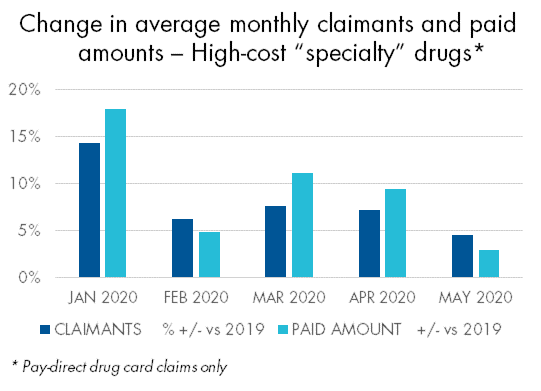 There were some notable exceptions to this trend. For example, both claimants and paid amounts for high-cost “specialty” drugs increased in March, April and May. Thirty-day refills are the norm for these drugs, so they weren’t impacted by the re-fill limits.
Claims for asthma drugs had the largest surge of any common disease category in March but had no subsequent drop in April. Not surprisingly, claims for mental health drugs increased throughout the pandemic, including a 33% increase in the number of claimants in May.
Going forward, we should see the average quantity per prescription stabilize in future months and return to normal, provided pharmacies return most patients to refills of more than 30 days.
The full impact of COVID-19 remains to be determined. We will continue to provide timely updates on any developments that impact our clients and their plan members or their benefits coverage. In the meantime, please contact your Group Account Executive or myFlex Sales Manager if you have questions.
- [pdf] Why do business with Equitable