

Site Search
690 results for go page PROBLEMGO.COM Need to get my son out of juvenile hall tonight cash waiting HMP Long Lartin
-
Open doors with our updated CI & UL solutions!
Have you heard the news? On October 8th, we rolled out several updates to our competitive Equitable® product lineup—including our Critical Illness (CI) and Universal Life (UL) plans.
These updates are all about cost savings for clients and helping advisors like you grow your business. And the response has been fantastic!
What’s new for CI and UL?1. Lower monthly costs for new EquiLiving® critical illness (CI) policies paid monthly – hello savings!
• The monthly modal factor for CI decreased from 0.09 to 0.0867.
• The monthly policy fee decreased from $4.50 to $4.34.
*Note: EquiLiving premium rates and annual policy fees have not changed.
2. Lower monthly costs for UL policies with CI riders added – now it’s more affordable to add CI coverage when selling UL!
Commissions got a makeover tooGood news! Commissions on Term and EquiLiving CI policies are now calculated based on the total premium paid for the policy year—even if clients opt for monthly payments. No more annual premium commission calculations!
Learn more!
Questions? Contact your Equitable wholesaler for all the details.
Cheers to savings and growing your business with Equitable!
® or TM denotes a trademark of The Equitable Life Insurance Company of Canada. -
Sharpen your skills with Equitable’s Path to Invest summer learning modules
Want to stay ahead, bring more value to clients, and earn Continuing Education (CE) credits?
Equitable® now offers new online summer modules to help you grow your financial knowledge. These self-paced Path to Invest modules are available on our ON24 platform. You can learn on your own schedule and earn CE credits with ease.
Whether you want to boost your investment skills or have better client conversations, these courses are here to support your growth.
The first module, Index Investing, explores the basics of index investing, how it compares to active management, and how using indexes can help diversify client portfolios.
The second module, Saving for a Home with Equitable, equips you with strategies and tools to guide clients through the homebuying journey, including insights on savings vehicles, intergenerational wealth transfers, and mortgage planning.
Each course is approved by the Alberta Insurance Council and the Insurance Council of Manitoba. You will earn 1 CE credit for each course after passing the quiz.
Start learning today! Visit our Learning Centre to begin.
If you have any questions, reach out to your Director, Investment Sales. When we work together, success is mutual.
Continuing Education Credits
To be eligible for CE credits, you must register individually, watch the webcast in full and complete a short quiz. These webcasts are available in English only. It is the advisor's responsibility to ensure Continuing Education credits being offered are accepted by the licensing body. Alberta Insurance Council (AIC) credits are valid in Yukon, British Columbia, Alberta, Saskatchewan, Ontario, New Brunswick, Prince Edward Island and Nova Scotia. Insurance Council of Manitoba (ICM) credits are valid in Manitoba only.
Date posted: July 17, 2025 -
Equitable’s DSIR leads the way
Equitable® offers a 6.40% dividend scale interest rate (DSIR) – the best in our industry1. But our DSIR is only one of the many benefits of choosing Equitable!
Why choose Equitable?
• Equitable proudly leads the way: We are the #1 seller of PAR whole life policies in Canada2!
• Our top DSIR: Helps clients save for the future and builds lasting value.
• Our Canadian heritage: Established in 1920, we are 100% Canadian-owned, based in Canada and dedicated exclusively to serving the needs of the Canadian market.
• Our financial strength & growth momentum: We invest with care, keeping clients’ savings safe and growing over time.
• Our mutuality: As a mutual, our clients come first – and eligible clients share in our success through dividends3.
• Our service & support: We offer great service, easy-to-use digital tools, and support at every step, making Equitable a trusted choice for clients and advisors alike.
In client meetings, be sure to share these outstanding benefits with clients. Doing so can demonstrate real value and boost your sales.
Questions? Reach out to your Equitable wholesaler or visit EquiNet. We’re ready to help you succeed.
Resources:
The Power of Together (Video)
5 Reasons to choose Equitable (1271)
Dividend Scale Announcement - 2024/2025
1 Source: Latest posted DSIR data on competitor websites – 2025.
2 Source: LIMRA – Canadian Individual Life Insurance Sales Participant Report - Q4 2024.
3 Dividends are not guaranteed and are paid at the sole discretion of the Board of Directors. To learn more about our dividend policy and participating account management policy, please visit www.equitable.ca/en/already-a-client/dividend-information/
-
How to Stay Grounded in a Changing World: Supporting Financial & Mental Well-Being
Are clients feeling the strain of global uncertainty? Join our Master Class webcast, "How to Stay Grounded in a Changing World: Supporting Financial & Mental Well-Being," to gain insights on managing financial and mental well-being.
We will explore how economic instability, geopolitical conflict, and climate change impact mental health and financial behaviours.
Join Shannon Labby, Vice President, National Investment Sales, Equitable as she welcomes Homewood Health’s clinical expert, Gabrielle Provencher who will provide tools to help advisors recognize signs of mental strain and support clients in maintaining financial focus.
Why Attend?- Understand the psychological impacts of global crises and media exposure.
- Learn how financial stress can affect mental health and decision-making.
- Enhance media literacy to help navigate misinformation and stay focused.
- Develop coping strategies to help manage anxiety and promote resilience.
- Gain techniques to help clients form self-care habits for long-term financial security.
Learn more
Continuing Education Credits
This webcast has been submitted for continuing education (CE) approval for all provinces excluding Quebec via the Insurance Council of Manitoba and Alberta Insurance Council. Upon approval, you will be sent an email notification to come back to the webcast presentation console to download your personalized certificate from the tool bar. To be eligible for CE credits, you must register individually, watch the webcast in full, and complete a short quiz. It is the advisor's responsibility to ensure Continuing Education credits being offered are accepted by their licensing body. Alberta Insurance Council (AIC) credits are valid in Yukon, British Columbia, Alberta, Saskatchewan, Ontario, New Brunswick, Prince Edward Island and Nova Scotia. Insurance Council of Manitoba (ICM) credits are valid in Manitoba only.
This webcast is available in English only.
Date posted: June 5, 2025 -
From Insight to Inclusion: Engaging Women Investors with Confidence
Ready to help future‑proof your practice?
Create an experience that truly resonates with women investors.
Join our February Master Class, “From Insight to Inclusion: Engaging Women Investors with Confidence.” Learn how to design strategies that help attract, retain and deepen advisory relationships with women – today and for the long term. We will explore why women are essential to building and sustaining a successful advisory business. We will also share practical steps to help you engage them effectively.
We’ll cover:- Why women remain an underserved client group,
- Why inclusion is critical to your business growth, and
- How to develop strategies that help attract and retain women as value clients.
Why attend?- Turn research into real conversations that can build trust.
- Create a clear plan that speaks to women investors.
- Build a repeatable process for prospecting, onboarding and reviews – one that includes women in a meaningful way.
Join Joseph Trozzo, Vice President, National Investment Sales at Equitable, for an insightful conversation with Susan Silma – lawyer, former regulator, client‑experience strategist and regular columnist for Investment Executive.
Don’t miss this opportunity.
Learn more
Continuing Education Credits
This webcast has been submitted for continuing education (CE) approval for all provinces excluding Quebec via the Insurance Council of Manitoba and Alberta Insurance Council. Upon approval, you will be sent an email notification to come back to the webcast presentation console to download your personalized certificate from the tool bar. To be eligible for CE credits, you must register individually, watch the webcast in full, and complete a short quiz. It is the advisor's responsibility to ensure Continuing Education credits being offered are accepted by their licensing body. Alberta Insurance Council (AIC) credits are valid in Yukon, British Columbia, Alberta, Saskatchewan, Ontario, New Brunswick, Prince Edward Island and Nova Scotia. Insurance Council of Manitoba (ICM) credits are valid in Manitoba only.
This webcast is available in English only.
-
Tax impacts of the Canadian Dental Care Plan for your clients
Tax impacts of the Canadian Dental Care Plan for your clients*
Earlier this year, the government shared its progress on the Canadian Dental Care Plan (CDCP).
The CDCP will be available to Canadians with an annual family income of less than $90,000 who do not have dental benefits. Co-pays will be waived for eligible Canadians with a family income of less than $70,000.
Canadians who have access to private dental coverage are not eligible for the CDCP. This means that your clients must now report on T4s/T4As if dental coverage** was available on December 31 of the reporting tax year for:- Employees,
- Employees’ spouses and/or dependents,
- Former employees, and
- Spouses of deceased employees.
This new tax reporting requirement is mandatory starting with the 2023 tax year. Employee tax slips will include new boxes for employers to complete:- Box 45 (T4): Employer Offered Dental Benefits. This new box will be mandatory.
- Box 015 (T4A): Payer Offered Dental Benefits. This new box will be mandatory if plan sponsors report in Box 016, Pension or Superannuation. The box will otherwise be optional.
- Code 1: The plan member has no access to dental care insurance or coverage of dental services of any kind.
- Code 2: Only the plan member has access to any dental care insurance, or coverage of dental services of any kind.
- Code 3: The plan member, their spouse and their dependents have access to any dental care insurance, or coverage of dental services of any kind.
- Code 4: Only the plan member and their spouse have access to any dental care insurance, or coverage of dental services of any kind.
- Code 5: Only the plan member and their dependents have access to any dental care insurance, or coverage of dental services of any kind.
Reports for dependents
We have a report available for plan members who have enrolled their dependents in benefits coverage. Your clients can contact their local service team representative to receive a copy of the report. We are working to make it available on our Advisor and PA websites.
Questions
For guidance on your tax slips and reporting obligations, please encourage your clients to contact their accountant, payroll provider or tax advisor.
Supporting plan members affected by the Israeli-Palestinian conflict*
Traumatic events continue to unfold in the Middle East. Enduring ongoing news of conflict and suffering could challenge many Canadians. During this difficult time, Equitable encourages affected clients and plan members to access the mental health support they need.
Large-scale traumatic news events can cause people to experience intense reactions. This puts a lot of strain on their mental health. Having coping mechanisms to deal with the current crisis can be a huge help. Any Equitable Life plan member who needs mental health support can visit Homeweb.ca/equitable to access online resources or contact Homewood at 1.888.707.2115.
Support available to all Equitable plan members
Support available to plan members with the Homewood Health EFAP
For your clients that have purchased Homewood Health’s Employee and Family Assistance Program (EFAP), remind them that their plan members also have access to confidential counselling services. The EFAP provides plan members with 24/7 access to confidential counselling through a national network of mental health professionals. Whether it’s face-to-face, by phone, email, chat or video, plan members and their dependent family members will receive appropriate, timely support for the issue they’re dealing with.
Questions?
If you need more information, contact your Group Account Executive or myFlex account executive.
*Indicates content that will be shared with your clients. -
GIA Coming to the Equitable FHSA
Many clients have already taken advantage of Equitable’s First Home Savings Account (FHSA), available on Pivotal Select™ Investment Class (75/75) and Pivotal Select Estate Class (75/100).
And now, we’ve got some more great news. We’re working to expand the Equitable® FHSA to include our Guaranteed Interest Account (GIA). But clients don’t need to wait to start earning tax-free income in a FHSA.
If clients want to open a FHSA now but may be interested in an Equitable GIA, simply choose the No-Load Equitable Money Market Fund Select investment option while we work on including the GIA on FHSA. The current yield to maturity is 5.41% gross.1
We will let you know when the GIA is available in FHSA in the coming months. Once it is available, advisors can speak to clients about the GIA options available in the FHSA and select what best suits their needs.
Don’t forget, clients who make a contribution to their FHSA, RRSP or TFSA between January 1 and February 29, 2024, could win $5,000 and you could win $1,000 in Equitable’s New Year’s Resolution, New Year’s Contribution Contest.2
For more information, please contact your Regional Investment Sales Manager.
1 As of January 16, 2024, 4.06% net after deducting the management expense ratio. Yield to Maturity: the market value weighted-average yield to maturity includes the coupon payments and any capital gain or loss that the investor will realize by holding the bonds to maturity.
2 Equitable’s New Year’s Resolution, New Year’s Contribution Contest: No purchase necessary. Contest period January 1, 2024, to February 29, 2024. Enter by making a deposit to an Equitable FHSA, TFSA or RRSP during the contest period or by submitting a no-purchase entry. One prize for a total value of $5,000 CAD to be drawn on March 8, 2024, will be awarded. The servicing advisor for the policy to which the selected entrant made the deposit is also an eligible winner and will receive a $1,000 CAD prize. For example, if an Equitable client is a winner of the $5,000 prize, the client’s servicing advisor wins a $1,000 prize. Open to legal residents of Canada of the age of majority. Odds of winning depend on number of eligible Entries received during the Contest Period. For full contest rules, including no-purchase method of entry, see the full contest rules.Posted January 17, 2024
- Path to Invest
-
Market Commentary April 2026

Key Takeaways
• Markets started 2026 constructively, with positive returns in both stock and bond markets in the first two months of the year. However, the war on Iran by the U.S. and Israel drove significant changes to markets in March. The biggest driver was the spike in oil prices. Oil prices increased over 70% during the quarter to over US$100 per barrel as 20% of global oil production became trapped in the Middle East when Iran closed the Strait of Hormuz.
• Canadian equities returned 3.9% in the first quarter, outperforming U.S. equities which lost -4.3%. The Canadian market benefitted from its 40% exposure to strong performing Energy, Materials and Utilities sectors, which each gained over 10% in Q1. Conversely, the U.S. market has much less exposure to those strong performing sectors and therefore fell as geopolitical tensions weighed on performance of most other sectors.
• Canadian bonds posted modest gains as early-quarter strength was largely offset by March weakness. Rising commodity prices reignited inflation fears and prompted speculation for central bank interest rate hikes. Credit spreads widened as concerns regarding defaults and liquidity in the private credit market intensified.
• The Bank of Canada and the U.S. Federal Reserve held policy rates unchanged during the first quarter. Both central banks maintained a wait-and-see approach amid slowing labour markets, persistent inflation risks, and heightened global uncertainty.
Economic and Market UpdateEconomic Summary: The U.S. economy continued to grow at a steady pace in the first quarter. Inflation remained above the Federal Reserve’s target. The labour market showed signs of cooling as hiring slowed, but the unemployment rate remained stable. However, higher energy prices and risks to global supply chains added near term inflation pressures and weighed on the global outlook. The Federal Reserve held its policy interest rate unchanged during the quarter, maintaining the target range at 3.50% to 3.75%. Chair Powell highlighted ongoing uncertainty and reiterated that the Federal Reserve is well positioned to adjust policy as economic conditions evolve.
In Canada, economic growth remained subdued in the first quarter as excess supply persisted, and the labour market softened. Inflation stayed close to the 2.0% target, though rising global energy prices increased short term inflation risks. Trade uncertainty continued to weigh on confidence and business activity. The Bank of Canada held its policy interest rate steady at 2.25% throughout the quarter. The Governing Council noted it stands ready to respond if the economic outlook shifts materially.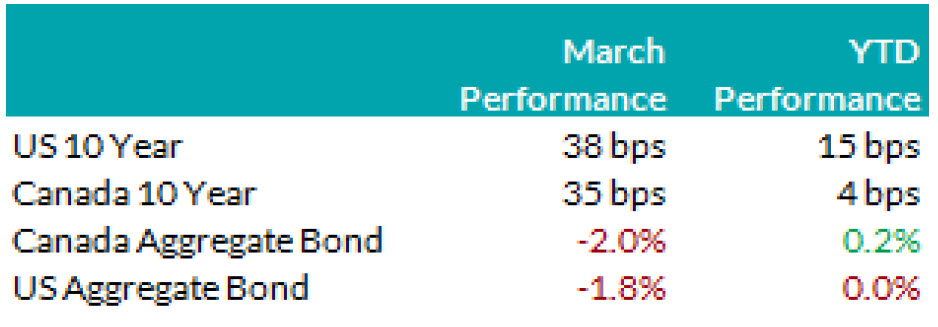 Bond Markets: The Canada Aggregate Bond Index returned 0.23% in the first quarter. A strong start to the year in January and February (+2.25%) was mostly offset by a weak March (-1.97%), as higher oil prices from the war in Iran led to higher interest rates on Canadian bonds (bond prices fall as interest rates go up). The increase in interest rates was most predominant in shorter term bonds, with higher oil prices driving inflation fears. These inflation fears reframed the market’s interest rate cut expectations for 2026: a 40% chance of an interest cut by the Bank of Canada has now shifted to a 70% chance of not just one, but two 25 basis point increases to the Bank of Canada overnight rate in 2026. In addition, the war in Iran has resulted in a higher risk premium for corporate bonds: credit spreads (i.e. the extra yield on corporate bonds versus government bonds to compensate for their extra risk) moved higher in March after reaching record low levels in January and February. These higher credit spreads resulted in corporate bonds modestly underperforming the overall index, albeit still with positive returns. Despite the modest risk off tone, investors remain buyers of corporate bonds as evidenced by investors’ enthusiasm to support the primary issuance market. Corporate bond supply continues to set new records, with an impressive $50 billion in new issuance in the quarter, a record start to the year and 23% higher than the same period in 2025.
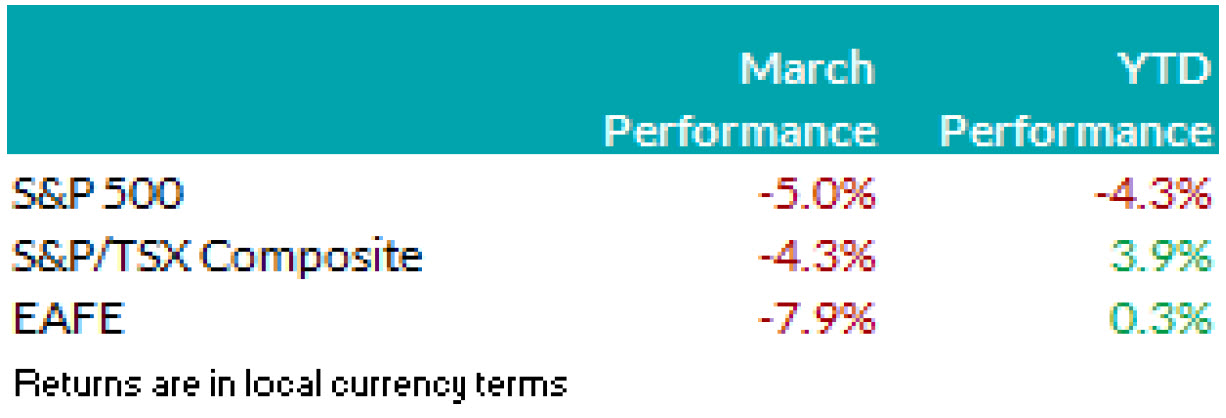 Stock Markets: The first quarter of 2026 marked a period of heightened investor caution with geopolitical tensions rising. Equity markets remained under pressure in March, as dip buyers remained cautious. Early market volatility was driven by several geopolitical developments, including Japan’s snap election, events in Venezuela, and U.S. interest in Greenland. Private credit markets also came under pressure as liquidity tightened and default risks increased, particularly in semi-liquid lending structures. The war on Iran raised concerns around demand destruction and inflation, pushing oil prices above US$100 per barrel for the first time since 2022. Gold continued to rise strongly early in the quarter. However, it later recorded its sharpest decline in years, driven by central bank selling. Despite this pullback, gold finished the quarter up 8% and continues to be viewed as a key safe-haven asset.
U.S. Equities: U.S. equities entered the first quarter with strong momentum, supported by robust earnings growth from technology companies. While earnings results confirmed this strength, investor sentiment weakened, particularly toward Software-as-a-Service (SaaS) companies. Rapid progress in AI agents developed by firms such as Anthropic and Google highlighted how quickly generative AI could automate core SaaS functions. As a result, software stocks sold off sharply in February, triggering a broader rotation away from largecap growth. Furthermore, tighter financial conditions and rising geopolitical tensions reduced risk tolerance and drove sharp sector rotation. The Energy sector led market performance, while Technology lagged and Financials underperformed due to stress in credit markets.
Canadian Equities: The Canadian stock market was supported by its high exposure to commodities. That structural tilt helped Canadian equities outperform U.S. equities as macro narratives shifted toward inflation concerns and supply risks. Performance during the quarter was marked by a sharp whipsaw between gold and oil, reflecting shifting investor sentiment. Investors sold gold aggressively and scrambled to source U.S. dollars as financial conditions tightened. Conversely, oil prices rose sharply on Middle East supply disruptions, lifting Energy stocks to become the strongest-performing sector of the quarter, up 29%.
Bottom line: The first quarter showed how quickly geopolitical shocks can reshape sectors’ performance. Canada outperformed U.S. growth markets due to its higher exposure to commodities, as energy prices rose and inflation concerns returned. The sharp move in gold and oil prices highlighted the market’s sensitivity to macro developments. The war against Iran forced investors to reprice both inflation expectations and Federal Reserve policy expectations. Looking ahead, geopolitical stability, energy prices, and central bank policy are likely to remain key drivers of market performance and sector leadership.
Downloadable Copy
Mark Warywoda, CFA
VP, Public InvestmentsIan Whiteside, CFA, MBA
AVP, Public InvestmentsJohanna Shaw, CFA
Director, Public InvestmentsJin Li
Director, Equity Investments
Wanyi Chen, CFA, FRM
Sr. Quantitative Analyst
Andrew Vermeer, CFA
Senior Analyst, Credit
Elizabeth Ayodele
Analyst, Credit
Edward Ng Cheng Hin
Analyst, Credit
Kate (Huyen) Vinh
Analyst, Equity
Francie Chen
Analyst, Rates
ADVISOR USE ONLY
Except for statements of historical fact, all statements in this document are forward-looking statements. These forward-looking statements represent the portfolio manager’s current best judgment as to what may occur in the future. However, forward-looking statements are subject to many risks, uncertainties, and assumptions, and are based on the portfolio manager’s present opinions and views. For this reason, the actual outcome of the events or results predicted may be materially different from what is expressed. Furthermore, the portfolio manager’s views, opinions, or assumptions may subsequently change based on previously unknown information, or for other reasons. Equitable assumes no obligation to update any forward-looking information contained in this document. The reader is cautioned to consider these and other factors carefully and to not to place undue reliance on forward-looking statements. Investments may increase or decrease in value and are invested at the risk of the investor. Investment values change frequently, and past performance does not guarantee future results. Professional advice should be sought before an investor embarks on any investment strategy. - [pdf] Now it’s even easier to grow your savings online!