

Site Search
551 results for UZQ.UOUOXO.ORG how to find cocaine flake Jekyll legit market list
- Dynamic
- Congratulations on qualifying as an Elite Advisor
-
Take emotions out of investing
Taking the emotion out of investing can be easier said then done. Most of us at one time or another have decided upon something strictly because of how we felt at the time, not because it was logical or made good financial sense. I am sure most of us have a good story to tell.
When it comes to financial planning, you always want to encourage your clients to be a rational investor and accept that market fluctuation is part of the investment journey. Over the last few months, even the hardiest rational investor has been challenged to accept the market fluctuations. History shows us that this too, shall pass and markets will rise once more. The biggest question asked is always, when?
While no one has a crystal ball with that answer, the best we can do is help our clients understand that when building portfolios, risk is always at the forefront of any good investment strategy. The level of risk is just one of the building blocks to constructing a financial portfolio that will see the client through good times and bad.
Need more help? Equitable Life has created an emotional investing brochure to help your clients manage through these extraordinary times. To download a copy, click here. We have also included a template letter that you can personalize and use to reach out to your clients. To download an editable copy, click here.
-
Give clients guaranteed retirement income with Payout Annuities
With increased market volatility and interest rates higher than we have seen for much of the past decade, now is a great time to consider payout annuities. Payout annuities can provide regular guaranteed income regardless of how markets perform.
Clients using only a Systematic Withdrawal Plan (SWP) for retirement income are potentially vulnerable during times of market volatility due to the sequence-of-returns risk.1 When markets are down, more units are redeemed to cover income needs. When markets later rise, clients are not able to participate fully in the recovery because more units were redeemed to provide income. That is why having a guaranteed income component, like a payout annuity, as part of an overall retirement strategy is so important.
Three great reasons to consider Equitable Life® for your payout annuity business:
1. Choose from a variety of payout annuity options including:
A. Life Annuity – guaranteed income for one life
B. Joint Life Annuity – guaranteed income for two lives
C. Term Certain – guaranteed income for a specific period of time (5 to 30 years)
D. Term Certain to Age 90 – guaranteed income until age 90
2. Attractive rates, particularly in Registered and Term Certain Annuities
3. Step Up Your Wealth Sales program - 25% of payout annuity net sales qualify for the 0.75% bonus commission earned on net deposits for 20222
.png "button-(1).png")
For more information, please contact your Equitable Life Regional Investment Sales Manager.
1Sequence-of-returns risk, or sequence risk, is the risk that an investor will experience negative portfolio returns very late in their working life and/or early in retirement.
2All eligible deposits, sales, and redemptions occurring between January 1 and December 31, 2022, will be used to calculate an advisor’s 2022 net deposits.
® denotes a registered trademark of The Equitable Life Insurance Company of Canada. -
Give clients guaranteed retirement income with Payout Annuities
With increased market volatility and interest rates higher than we have seen for much of the past decade, now is a great time to consider payout annuities. Payout annuities can provide regular guaranteed income regardless of how markets perform.
Clients using only a Systematic Withdrawal Plan (SWP) for retirement income are potentially vulnerable during times of market volatility due to the sequence-of-returns risk.1 When markets are down, more units are redeemed to cover income needs. When markets later rise, clients are not able to participate fully in the recovery because more units were redeemed to provide income. That is why having a guaranteed income component, like a payout annuity, as part of an overall retirement strategy is so important.
Two great reasons to consider Equitable Life® for your payout annuity business:
1. Choose from a variety of payout annuity options including:
A. Life Annuity – guaranteed income for one life
B. Joint Life Annuity – guaranteed income for two lives
C. Term Certain – guaranteed income for a specific period of time (5 to 30 years)
D. Term Certain to Age 90 – guaranteed income until age 90
2. Attractive rates, particularly in Registered and Term Certain Annuities

For more information, please contact your Equitable Life Regional Investment Sales Manager.
1Sequence-of-returns risk, or sequence risk, is the risk that an investor will experience negative portfolio returns very late in their working life and/or early in retirement.
® denotes a registered trademark of The Equitable Life Insurance Company of Canada. -
Elevate your business with industry best practices and needs-based selling
Keeping your business aligned with industry best practices is vital for your success. It not only supports the fair treatment of clients – it also helps you meet certain market conduct requirements and Equitable’s expectations for needs-based selling.
The Financial Services Regulatory Authority of Ontario (FSRA) has a program that checks how well advisors follow the Insurance Act and its conduct rules. FSRA looks at how well advisors follow industry best practices and fair treatment of clients guidance (see CLHIA’s guidance document, “The Approach”). Their focus is on key areas such as giving sound advice, managing conflicts of interest, and putting clients’ needs first. FSRA selects advisors’ client files and looks for documentation that indicates needs-based selling.
In December 2024, FSRA released its latest Market Conduct Supervision Report. It highlights the need for advisors to follow certain rules and industry best practices. The report found five key areas where improvement is needed:
1. Missing notes from client meetings and calls
2. Inadequate advisor disclosure
3. Missing sales illustrations for different product options
4. Missing insurance needs analysis
5. Missing policy delivery receipts
By following industry best practices and keeping thorough records, you show your commitment to providing clients with the solutions they need. For example, taking notes during client meetings helps you track all discussions that support your recommendations. Having an insurance needs analysis shows you are providing clients with suitable advice to buy the solutions that best meet their needs.
Resources: Equitable® has resources that can help improve your business practices and help you treat clients fairly. We encourage you to check these out:
1. PPT: “Ensuring a Compliant, Needs-based Insurance Sale”. The steps to follow in needs-based selling and the records to keep.
Get CE credits! We offer the above as a self-study course that qualifies for 1 Continuing Education (CE) credit. Access it here: https://equitable-life-education.teachable.com/. (Use your contracted email to log in).
2. Client File Reference: The records to keep when selling investments, life insurance, or critical illness insurance, including key documents insurers and regulators look for during compliance audits.
3. Investor Profile Questionnaires: These will help you document your sales recommendations for:
● Universal Life (UL) sales: 1190.pdf, and
● Pivotal Select (Segregated Fund) sales: 1165.pdf
Questions? Contact your Equitable wholesaler. They are ready to support your success! -
Market Commentary January 2026
.png "EAMG-(1).png")
Key Takeaways
Full year 2025:
• Government policy was very impactful for markets in 2025. U.S. trade policy unsettled markets in the first half of the year, as the U.S. implemented significant tariffs and engaged in tough negotiations with major trading partners. However, by mid-year, fiscal policy provided positive support for markets, particularly with the passing in the U.S. of the One Big Beautiful Bill Act in July.
• Artificial Intelligence (“AI”) continued to attract investment, particularly in the United States. This investment provided strong support for equity market performance.
• Global equity markets delivered strong performance, most notably Canadian equities, which returned an impressive 31.7%.
• Positive risk appetite supported solid corporate bond performance, which outpaced government bonds.
Fourth Quarter:
• U.S. equities advanced at a slower pace in the fourth quarter after a strong surge in the prior two quarters. Canadian equities outperformed U.S. equities, fueled by a powerful rally in the Materials, Consumer Discretionary, and Financials sectors.
• Canadian bond markets posted slightly negative returns during the quarter as higher interest rates weighed on performance. Strong corporate bond performance partially offset weakness in government bonds.
• Both the Bank of Canada and the U.S. Federal Reserve lowered policy interest rates during the quarter, with Canada dropping its benchmark rate by 25 basis points and the U.S. dropping its policy rate by 50 basis points. Both central banks signalled a cautious approach for further easing.
Economic and Market UpdateEconomic Summary: The U.S. economy continued to expand at a moderate pace, supported by strong consumer spending and AI investment. However, job growth slowed and the unemployment rate has edged higher. Inflation remains higher than the 2% target, despite easing trends. While some U.S. trading partners have made trade agreements, uncertainty remains regarding reciprocal tariffs, with a case before the U.S. Supreme Court as to their legality. The Federal Reserve lowered its policy interest rate twice during the quarter, first in October and again in December, to reach a target rate of 3.50% to 3.75%. Chair Powell cited downside risks to employment as a key factor behind the rate cut decisions and emphasized that officials are “well positioned” to wait and assess how the economy evolves.
In Canada, U.S. tariffs on steel, aluminum, autos, and lumber have weighed heavily on these sectors. While most goods continue to enter the U.S. tariff-free due to the Canada-United States-Mexico Agreement (“CUSMA”), broader uncertainty around U.S. trade policy is dampening business investment. Third quarter GDP growth exceeded market expectations, but growth tracked weaker in the fourth quarter amid the trade disputes. The labour market showed signs of improvement in the fourth quarter after earlier weakness. Headline inflation has hovered near the 2% target, while core inflation remained persistent. The Bank of Canada lowered its policy interest rate by 25 basis points to 2.25% in October and made no changes in December. Going into 2026, trade uncertainty remains with the CUSMA up for renegotiation. The Bank of Canada reiterated its readiness to respond if new shocks or accumulating evidence materially alter the outlook.
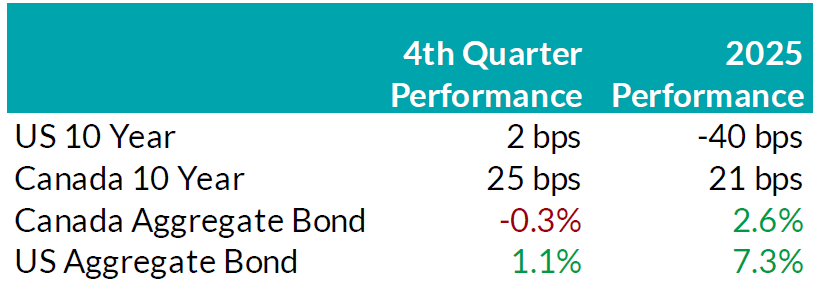 Bond Markets: During the quarter, the FTSE Canada Universe Bond Index returned -0.3% as interest rates on Canadian bonds rose (bond prices fall as interest rates go up). The increase reflected reduced expectations for interest rate cuts by the Bank of Canada and a higher risk premium demanded by investors for long-term debt. Although interest rates increased, credit spreads (i.e. the extra yield on corporate bonds versus government bonds to compensate for their extra risk) continued to move lower. These lower credit spreads resulted in positive overall returns for corporate bonds in the quarter, despite the overall bond market recording a loss. Tightening credit spreads reflected the continued risk-on tone to the market. Despite some volatility, lower-rated BBB bonds generally performed better than higher-quality A-rated bonds. Credit spreads have now rallied back to the tightest spreads since the 2008 financial crisis, nearing the tightest spreads in history. Despite expensive levels, investors remain buyers of corporate bonds, evidenced not just by falling credit spreads, but also by investors’ enthusiasm to support the primary issuance market. Corporate bond supply continues to set new records, with an impressive $37.5 billion in new issuance in the fourth quarter helping 2025 to exceed the prior year’s issuance. All told, 2025 saw an impressive $160 billion in new issuance via 358 new bonds, versus 2024’s prior record of $139 billion from 301 new bonds.
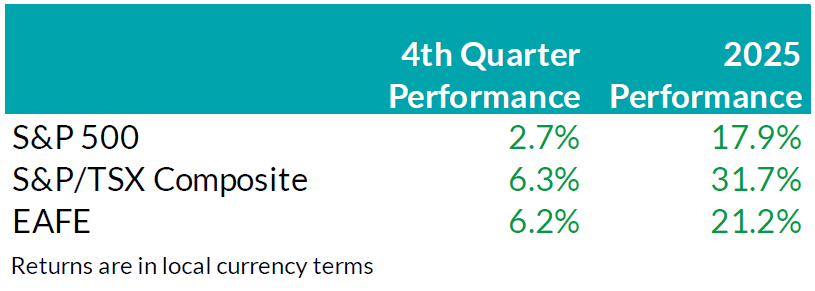 Stock Markets: The fourth quarter marked a pivotal shift in the global equity market rally of 2025. After three quarters of a highly concentrated, tech-led rally in the U.S., cyclical and valueoriented sectors outperformed in Q4. The S&P 500 advanced at a slower 2.7% in the fourth quarter, reflecting a market that is recalibrating after an extended period of concentrated gains. Canadian equities outperformed U.S. equities as the S&P/TSX Composite returned 6.3% in the quarter, finishing the year with an impressive 31.7% return. That was its strongest annual gain since 2009. The strong returns in Canadian equities were fueled by a powerful rally in the Materials sector, supported by soaring gold and base metal prices, and reinforced by the resilience of the Consumer Discretionary and Financials sectors. Internationally, developed markets in Europe and Asia gained 6.2% for the quarter, bringing their annual return to 21.2%. This move signals a healthy rebalancing as global investors rotated into attractivelyvalued international equities to hedge against elevated U.S. valuations. Capital is now flowing toward regions and sectors offering stronger earnings visibility and defensive characteristics rather than purely speculative growth.
U.S. Equities: U.S. equities entered the fourth quarter at elevated valuations. Despite fundamentally strong earnings growth, stock prices struggled to move higher because investor expectations were for even stronger growth. Technology remained the primary driver of earnings, but the sector faced intense pressure to prove its value. Specifically, investors questioned the pace at which companies could convert AI investments into actual revenue. Investors also worried that growth remained concentrated among too few companies rather than more broadly across the economy. Sector-wise, Communication Services emerged as the top performer for the full year due to significant margin expansion. This was driven by a wave of media-related merger activity and the successful use of AI to make digital advertising more efficient. Industrials also advanced as new tax incentives for domestic manufacturing boosted factory orders. Nevertheless, the market remains concentrated with the top ten stocks representing nearly 40% of the S&P 500 Index. This level of concentration makes the market vulnerable to sudden price swings. As inflation moderated and the Federal Reserve cut rates in December, investors shifted toward more defensive sectors and international equities. This rotation signals a preference for companies with stable cash flows over speculative growth.
Canadian Equities: The Canadian market was a global standout during the quarter, supported by lower borrowing costs, a stable Financials sector, and rally in the prices of metals (including gold, but also base metals like nickel and copper). The Materials sector led the way as a weaker U.S. dollar and geopolitical tensions pushed gold to a record of US$4,550 per ounce in late December. For major mining companies, these prices generated record cash flow allowing them to raise dividends and buy back shares. The Bank of Canada interest rate cut supported both the Consumer Discretionary and Financials sectors, reducing borrowing costs, and helping banks maintain stable net interest margins. The Big Six Canadian Banks delivered strong earnings results in Q4. These were driven by a surge in capital markets activity and better-than-expected provisions for credit losses, as the economy remained resilient. Trading at 17 times forward earnings, the Canadian market appears attractively valued, prompting investors to shift away from U.S. volatility toward more tangible assets and reliable dividends.
Bottom line: The final quarter of 2025 saw a notable shift in investor positioning. As recession fears receded, attention turned to navigating a period of moderate economic expansion. In Canada, capital flowed into profitable, cash flow-generating companies in the Financials and Material sectors. Momentum in U.S. equities slowed as investors reduced risk amid caution around AI developments. Although major indices remain highly valued, opportunities persist in sectors and regions with stable cash flows and pricing power.
Downloadable Copy
Mark Warywoda, CFA
VP, Public InvestmentsIan Whiteside, CFA, MBA
AVP, Public InvestmentsJohanna Shaw, CFA
Director, Public InvestmentsJin Li
Director, Equity Investments
Wanyi Chen, CFA, FRM
Sr. Quantitative Analyst
Andrew Vermeer, CFA
Senior Analyst, Credit
Elizabeth Ayodele
Analyst, Credit
Edward Ng Cheng Hin
Analyst, Credit
Kate (Huyen) Vinh
Analyst, Equity
Francie Chen
Analyst, Rates
ADVISOR USE ONLY
Any statements contained herein that are not based on historical fact are forward-looking statements. Any forward-looking statements represent the portfolio manager’s best judgment as of the present date as to what may occur in the future. However, forward-looking statements are subject to many risks, uncertainties, and assumptions, and are based on the portfolio manager’s present opinions and views. For this reason, the actual outcome of the events or results predicted may differ materially from what is expressed. Furthermore, the portfolio manager’s views, opinions or assumptions may subsequently change based on previously unknown information, or for other reasons. Equitable® assumes no obligation to update any forward-looking information contained herein. The reader is cautioned to consider these and other factors carefully and not to place undue reliance on forward-looking statements. Investments may increase or decrease in value and are invested at the risk of the investor. Investment values change frequently, and past performance does not guarantee future results. Professional advice should be sought before an investor embarks on any investment strategy. - [pdf] Payout Annuities Client Brochure
-
Join us for an Equitable Life Master Class webcast featuring Daryl Diamond, Dynamic Funds
Building Your Business in the Retirement Income Market featuring Daryl Diamond, Chief Retirement Income Strategist, Dynamic Funds
You’re invited to our next Equitable Life Master Class webcast offering compelling topics and unique ideas from leading experts to help you manage and grow your business.
Daryl Diamond is an author, educator and sought-after speaker on how clients can achieve the greatest security and satisfaction during the retirement years.
In this Master Class, Daryl Diamond will discuss how the last four years have been extremely challenging for retirees, pre-retirees and for the advisors who service them. He will focus on key aspects of retirement income planning from the perspective of:-
delivering and sustaining tax-efficient income,
-
managing high inflation,
-
investing in volatile markets, and
-
navigating high interest rates.
Learn more
Posted October 11, 2023Continuing Education Credits
This webinar has been submitted for continuing education (CE) approval with the Insurance Council of Manitoba and Alberta Insurance Council for all provinces excluding Quebec. Upon approval, you will be sent an email notification to come back to the webinar presentation console to download your personalized certificate from the tool bar. To be eligible for CE credits, you must register individually, watch the webcast in full and complete a short quiz. This webcast is available in English only.
® denote a registered trademark of The Equitable Life Insurance Company of Canada -
-
Update: Improved Employee Assistance from Homewood Health
As we announced in June, we are expanding our relationship with Homewood Health to help you meet the mental health and wellness needs of your employees and their families. Beginning Oct. 1, 2019, Homewood will be the new provider of both our Employee and Family Assistance Program (EFAP) and our online health and wellness services.
Following the transition to Homewood, plan members will benefit from added features:
- Signing in to Homewood Health online allows the platform to customize content unique to your interests.
- All plan members will have access to a Health Risk Assessment to help identify health and wellness barriers.
- i-Volve, Homewood's online cognitive behavioural therapy program is available for all plan members to help them manage anxiety and depression.
Learn more about Homewood Health and how they will be providing your plan members with exceptional EFAP and online health and wellness resources.
What does the transition to Homewood mean for you and your plan members?
We will be working with you in the coming months to facilitate the transition and support your employees. Most importantly, there will be no disruption of service delivery to employees who are currently in short-term counselling with our current EFAP provider.
The transition timeline
Groups without an EFAP
Online health and wellness resources will be available through EquitableHealth.ca just as they are now. Here's what you can expect in the coming months.
September
- We will send plan administrators an email with more details about the resources available to assist in the transition, including:
- How to register for Homewood Health online
- A video orientation for plan members
October
- October 1st – plan members can access the Homewood online resources! They simply need to visit homeweb.ca/Equitable to sign up and create their unique login.
The transition timeline
Groups with an EFAP
We’ve created a helpful infographic that outlines the steps involved in the transition to the Homewood Health EFAP over the coming months. Please save or print it for easy reference. Below are some of the highlights.
August
- We will send plan administrators an email with official notice that the enrolment certificate for our current EAP provider, LifeWorks, will terminate on Sept. 30, 2019, and that Homewood Health Inc. will be our new Employee Assistance Program provider as of Oct. 1.
September
- Homewood will send you a welcome email, including how to access the EFAP, who to contact for support and where to find resources to help share the news with plan members.
- Homewood will follow up directly to answer any questions you may have.
- Homewood will begin offering orientation and training sessions for both plan administrators and plan members. These will be running throughout the fall so you can attend at your convenience.
October
- October 1st – plan members can access the Homewood EFAP and online resources! They simply need to visit homeweb.ca/Equitable to sign up and create their unique login.
- Orientation and training sessions will continue to be available for both plan administrators and plan members throughout October.
Learn More
The resources listed below answer common questions about Homewood and our EFAP transition:
If you have a question that is not addressed here, please contact your Group Account Executive or myFlex Sales Manager.