

Site Search
224 results for enter portal PROBLEMGO.com Buying a release on ones own recognizance
- Policy Loan
-
Win with clients this winter – Equitable’s Snowball Your Savings contest
This winter, clients’ savings could do more than grow—they could win. From January 1 to March 2, 2026, when clients set up or contribute to a Registered Retirement Savings Plan (RRSP) or Tax-Free Savings Account (TFSA), they will be automatically entered into Equitable’s Snowball Your Savings contest. Here’s the exciting part: two client winners will be randomly selected to receive a prize—just for saving.
Key Dates:
Contribution Period: January 1 – March 2, 2026
Draw Date: March 23, 2026
How to Enter
Getting started is easy—and every eligible contribution is a chance to win!
Step 1: Connect with your clients
Step 2: Help your clients set up or contribute to a RRSP or TFSA that is aligned with their financial needs and goals
Step 3: That’s it! Clients’ entry is automatic—no forms, no hassle!
Whether clients are topping up their TFSA or making a RRSP contribution ahead of tax season, their smart saving could lead to something extra this winter.
Equitable offers trusted, personalized investment solutions and, as a mutual, we provide financial strength and a commitment to helping Canadians grow and protect their wealth.
Visit equitable.ca/snowball for full details
® or ™ denotes trademarks of The Equitable Life Insurance Company of Canada.
Equitable’s Snowball Your Savings contest: No purchase necessary. Contest period January 1, 2026 to March 2, 2026. Enter by making a deposit to an Equitable Tax-Free Savings Account or Registered Retirement Savings Plan during the contest period or by submitting a no-purchase entry. Two prizes for a total value of $10,000 CAD to be drawn on March 23, 2026, will be awarded. The servicing advisor for the contract to which the selected entrant made the deposit is also an eligible winner and will receive a $1,000 CAD prize. For example, if an Equitable client is a winner of the $5,000 prize, the client’s servicing advisor wins a $1,000 prize. Open to legal residents of Canada of the age of majority. Odds of winning depend on number of eligible Entries received during the Contest Period. For full contest rules, including no-purchase method of entry, see the full contest rules. -
What’s your saving style?
A TFSA for its flexibility or an RRSP for tax-deferred growth.
Did you know? More than 65% of people who put money into a TFSA* earn less than $80,000 a year. That’s why TFSAs are popular with middle-income Canadians. They’re simple and flexible: you don’t get a tax break when you put money in, but you don’t pay tax when you take money out. This makes them great for people who don’t get big benefits from tax deductions.
On the other hand, 54% of RRSP contributors earn more than $80,000 per year*. RRSPs often work better for higher-income earners because contributions lower taxable income. That means bigger tax savings for people in higher tax brackets.
Here’s the good news: From January 1 to March 2, 2026, when clients open or add money to an Equitable TFSA or RRSP, they’ll be entered into Equitable’s Snowball Your Savings contest. Two winners will be chosen—and their advisors will celebrate too!
How to Enter
Advisors can help clients submit contributions through EZcomplete® or process transactions using EZtransact®. Every entry is a chance to win!
Want ideas to boost contributions and help Canadians save more? Connect with your Director, Investment Sales today.
* Source: advisor.ca/news/tfsas-more-popular-than-rrsps-in-2023/
® and ™ denote trademarks of The Equitable Life Insurance Company of Canada.
Equitable’s Snowball Your Savings contest: No purchase necessary. Contest period January 1, 2026 to March 2, 2026. Enter by making a deposit to an Equitable Tax-Free Savings Account or Registered Retirement Savings Plan during the contest period or by submitting a no-purchase entry. Two prizes of $5,000 CAD to be drawn on March 23, 2026 will be awarded. The servicing advisor for the contract to which the selected entrants made the deposit is also an eligible winner and will receive a $1,000 CAD prize. For example, if an Equitable client is a winner of the $5,000 prize, the client’s servicing advisor for the relevant contract wins a $1,000 prize. Open to legal residents of Canada of the age of majority. Odds of winning depend on number of eligible entries received during the Contest Period. For full contest rules, including no-purchase method of entry, see the full contest rules. -
Last chance to be entered to win – Snowball Your Savings contest ends March 2
There’s still time to turn client contributions into a win for both of you. Until March 2, 2026, when clients set up or contribute to their Equitable® Registered Retirement Savings Plan or Tax-Free Savings Account, they’ll be automatically entered into Equitable’s Snowball Your Savings contest. And here’s the exciting part: two winners will be randomly drawn—and their advisors will share in the celebration!
Key Dates
Contribution Period: January 1 – March 2, 2026
Draw Date: March 23, 2026
How to Enter
Advisors can easily submit client contributions through Equitable’s EZcomplete® or process transactions using EZtransact®. Every eligible entry is a chance to win!
Why Equitable?
We can help Canadians grow their savings with confidence. With a diverse range of investment funds and three distinct guarantee classes, Equitable offers flexible, goal-based solutions designed to support your clients’ financial journey.
Make the Most of It
Connect with your Director, Investment Sales to explore strategies for driving contributions, boosting engagement and supporting Canadians this season.
® and ™ denote trademarks of The Equitable Life Insurance Company of Canada.
Equitable’s Snowball Your Savings contest: No purchase necessary. Contest period January 1, 2026 to March 2, 2026. Enter by making a deposit to an Equitable Tax-Free Savings Account or Registered Retirement Savings Plan during the contest period or by submitting a no-purchase entry. Two prizes of $5,000 CAD to be drawn on March 23, 2026 will be awarded. The servicing advisor for the contract to which the selected entrants made the deposit is also an eligible winner and will receive a $1,000 CAD prize. For example, if an Equitable client is a winner of the $5,000 prize, the client’s servicing advisor for the relevant contract wins a $1,000 prize. Open to legal residents of Canada of the age of majority. Odds of winning depend on number of eligible entries received during the Contest Period. For full contest rules, including no-purchase method of entry, see the full contest rules. -
Mental health support for all plan members
As the COVID-19 pandemic continues, many Canadians are dealing with increased stress and anxiety. Now, more than ever, plan members need easy to access resources to help them cope with these uncertain times.
Through our partnership with Homewood Health®, the Canadian leader in mental health and addiction services, all of our clients and their plan members have access to tools designed to provide guidance and support, including i-Volve, Homewood’s Online Cognitive Behavioural Therapy tool.
Proven therapy, at your own pace
Included with Homewood Online resources in every Equitable Life® plan, i-Volve can help plan members identify, challenge and overcome anxious thoughts, behaviours and emotions. It encourages incremental changes in behaviour and is proven to be an effective therapeutic approach for dealing with mild to moderate anxiety or depression. Plan members work at their own pace through a series of web-based exercises, ultimately helping to change the ways in which they think, feel and react in various situations.
Free for all Equitable Life plan members
All Equitable Life clients and their plan members have access to i-Volve. It’s available 24 hours a day, seven days a week, wherever you choose to access it.
Contact your Group Account Executive or myFlex Sales Manager to learn more about Homewood Health and i-Volve Online CBT. -
Enhancements to ID Verification and Business Forms
We have made enhancements to some of our forms and created an additional form to help make it easier for you to do business with Equitable Life®.
The first enhancement is an update to the ID Verification section to allow for Third Party ID Verification when a client doesn’t want to provide ID documents to an Advisor. They are now given additional options to either use the Alternative Identification requirements, or consent to Equitable Life verifying their identity through a third party service provider. We’ve also clarified in the Advisor declaration that they can’t sign for their own policies as they aren’t able to validate their own ID.
The above changes have been made to the following forms:- 671OC – Ownership Change Form
- 1027 – Additional/Updated Customer Information
- 1616 – Application for Term Conversion
The second enhancement is an update to Business forms. We’ve created a new form, 2004 Signing Authorities Certificate, to help Businesses provide the Signing Authority information needed more easily! Forms 594 and 682ENT have been updated to point to the new Form 2004 and also have new “Ownership structure” requirements added in section 2.
View the below forms for details on these changes:- 2004 – Signing Authorities Certificate (NEW)
- 594 – Business Information Form
- 682ENT – Claimants’ Statement for Entities
® denotes a registered trademark of The Equitable Life Insurance Company of Canada.
-
Cloud DX, Signs Contract with Heart Centre
Our partner, Cloud DX, has signed a 3-year contract with an Ontario hospital to help put patients with congestive heart failure at ease.
Cloud DX’s digital health platform works to improve healthcare delivery, provide better care outcomes, and lessen the burden on our national healthcare system. Now, an Ontario heart centre will use the Cloud DX platform to improve its patient monitoring services.
Cloud DX is a value-added service for Equitable Life’s Critical Illness claimants. Cloud DX delivers clinical grade hardware directly to the client so that they can remotely monitor the client’s vitals to help ensure they stay on the road to recovery*.
To learn more about our partnership with CloudDX, click here or contact your local wholesaler.
Watch our video on YouTube or Vimeo!
*Cloud DX is a non-contractual benefit and may be withdrawn or changed by Equitable Life® at any time. To be eligible for the Cloud DX offering, a claimant must be age 12 or older and have received payment on or after February 12, 2022 for a covered critical condition benefit under an individual critical illness insurance policy issued by Equitable Life. An early detection benefit payment does not qualify. Equitable Life pays for 6 months of Cloud DX subscription fees. If the claimant wishes to continue the Cloud DX service after 6 months, they will be responsible for the cost. The claimant must supply their own device to connect to Cloud DX app– a laptop, tablet or cellphone. As well, the claimant needs to supply their own data or internet service.
® and TM denote trademarks of The Equitable Life Insurance Company of Canada. -
EAMG - Macro Tear Sheet – Recent Market Volatility Summary
By separating the noise from the signals, we believe the rotation away from the mega-cap technology names is likely to continue. Recent market volatility, triggered by a multitude of factors that include the unwind of the carry trade, investor reactions to mixed mega-cap earnings, and U.S. economic data, may present more investment opportunities for long-term outperformance. Recall over the past year that the majority of U.S. stock market performance came from a limited number of mega-cap technology companies and, in our view, moving forward it will be prudent to analyze the source of returns as rapid market rotations may punish overly-concentrated portfolios.
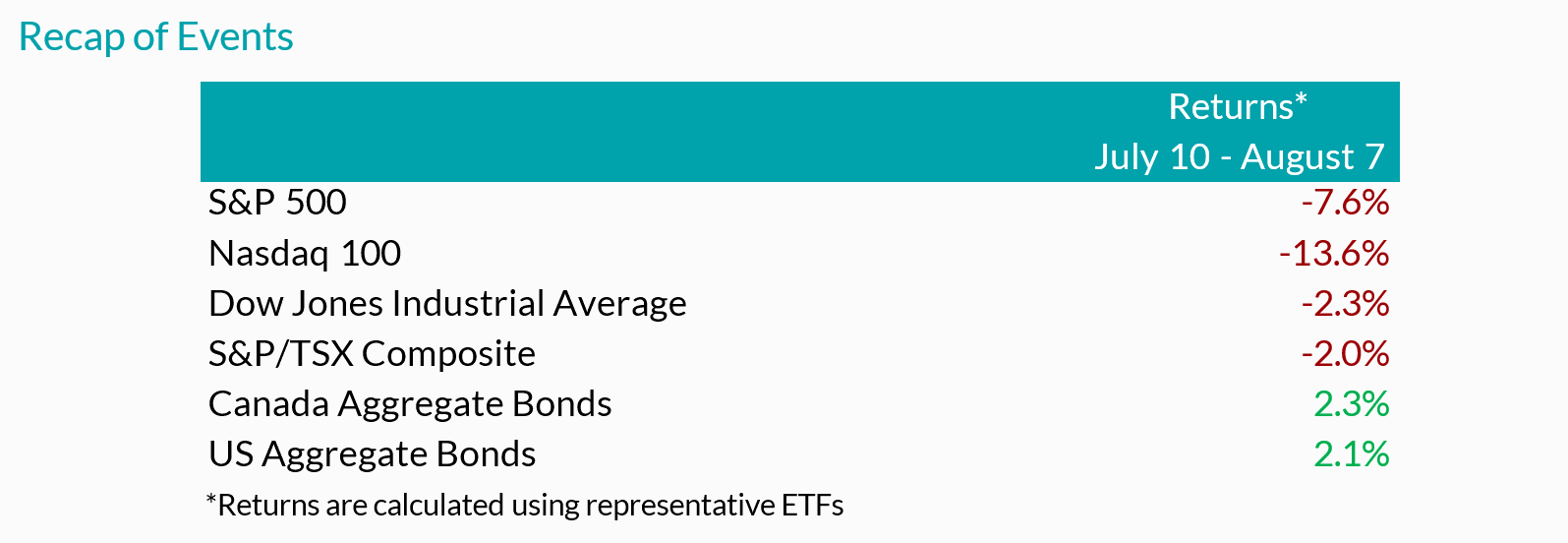
Inflation Slows (July 11) – Headline U.S. inflation readings increased 3.0% year-over-year in June, decelerating from May (3.3%). With prices slowing ahead of forecasts but economic growth remaining strong, investors became more confident regarding the prospects of an economic soft landing.
Outcome: market strength broadened with traders rotating out of highly concentrated areas of the market (“Fabulous 5”) and into more economically sensitive stocks that had been left behind.
• Big Tech Earnings (July 23 – Aug 1) – High profile mega-cap technology companies – including many members of the Magnificent 7 – reported earnings growth that generally surpassed expectations as margins remained healthy. That said, investors were more focused on spending towards AI-initiatives, rewarding businesses with greater success translating their AI investments into higher sales.
Outcome: this trend is evident through the divergence of returns from IBM and Alphabet (Google’s parent company) after releasing their quarterly earnings. The limited number of companies that contributed to the returns of the S&P 500 failed to impress investors, extending the rotation into other areas of the market.
• Caution is Brewing – Following a strong rally of economically sensitive pockets of the market, notably a breakout of returns from U.S. small cap companies, the low volatility factor, which tends to outperform during times of stress, moved in sync with the small caps’ strength.
Outcome: with a lack of fundamental justification supporting small cap performance, markets showed signs of caution.
• Central Bank Decisions (July 31)– The Federal Reserve held interest rates unchanged during its July meeting, in line with market expectations, reiterating committee members’ need for greater confidence that inflation would continue to subside. That said, policymakers signaled a reduction in policy rates could be a possibility in the coming meetings. In contrast, the Bank of Japan (BoJ) increased its key interest rate while also announcing plans to scale back bond purchases – restrictive monetary policy maneuvers aimed at backstopping the depreciating Japanese currency.
Outcome: the bifurcation between the BoJ and most other major central banks sparked a sharp appreciation of the yen and a rapid unwind of the yen carry trade (see below for explanation).
• Growth Scare (August 2)– In early August, a downside surprise in U.S. nonfarm payrolls (114k actual versus 175k expected) and an increase in the unemployment rate to 4.3%, higher than the 4.1% that was expected and up from 3.5% a year ago triggered concerns of a cooling labor market.
Outcome: speculation swelled surrounding the pace of rate cuts with market participants expecting the Federal Reserve to cut rates as much as 125bps over the next 3 policy meetings, up from 50-75bps as of the end of July. Against this backdrop, the ongoing unwind of the yen carry trade accelerated.
Yen Carry Trade Explained
• Simply put, investors have been borrowing Japanese yen – a low yielding currency – to invest in higher-yielding foreign assets. The primary risks in a carry trade can include the uncertainty of foreign exchange rates (if unhedged), as well as changes to expectations of the underlying yields, among other risks. Over the last 2 decades, the BoJ has implemented an ultra-low interest rate monetary policy to combat deflation and stimulate growth. Furthermore, investors were emboldened by the Japanese yen’s ~53% depreciation versus the U.S. dollar over the last 10 years. With the BoJ hiking its key interest rate while also announcing plans to scale back bond purchases, the yen rallied abruptly. Consequently, highly leveraged investors have had to exit their long positions in riskier assets to repay their borrowed yen exposure.
Peak Carry Trade Unwind – Buying Opportunity
• Peak carry trade unwind, which implies heightened panic levels, has historically created an attractive buying environment. That said, we are focused on companies that have demonstrated robust earnings growth and healthy leverage. Given the unprecedented level of market concentration over the last year, we view the unwind of the carry trade as another catalyst for investors to rotate out of the “Fabulous 5”.
Our Findings:
We found that the peak unwind of the carry trade may be a buying opportunity. At present, the current level of the unwind is similar to many notable market bottoms, including the Great Financial Crisis (2008), the European debt crisis (2010), the oil crash (2014), the subsequent emerging market crisis (2015), the Covid-19 crash (2020), and the collapse of Silicon Valley Bank (2023). We assessed the degree of the unwind by looking at the one-month implied volatility between three currency pairs, U.S. Dollar/Yen, Australian Dollar/Yen, and Euro/Yen. Implied volatility is a measure of the expected future volatility of the underlying assets over a given time period. Amid strong earnings growth and steady margins from quality businesses within the U.S. market, the fundamental backdrop suggests that businesses outside the concentrated AI-darlings may drive the next leg of market returns.
Downloadable Copy
Mark Warywoda, CFA
VP, Public Portfolio ManagementIan Whiteside, CFA, MBA
AVP, Public Portfolio ManagementJohanna Shaw, CFA
Director, Portfolio ManagementJin Li
Director, Equity Portfolio Management
Tyler Farrow, CFA
Senior Analyst, Equity
Andrew Vermeer
Senior Analyst, Credit
Elizabeth Ayodele
Analyst, Credit
Francie Chen
Analyst, Rates
ADVISOR USE ONLY
Any statements contained herein that are not based on historical fact are forward-looking statements. Any forward-looking statements represent the portfolio manager’s best judgment as of the present date as to what may occur in the future. However, forward-looking statements are subject to many risks, uncertainties, and assumptions, and are based on the portfolio manager’s present opinions and views. For this reason, the actual outcome of the events or results predicted may differ materially from what is expressed. Furthermore, the portfolio manager’s views, opinions or assumptions may subsequently change based on previously unknown information, or for other reasons. Equitable® assumes no obligation to update any forward-looking information contained herein. The reader is cautioned to consider these and other factors carefully and not to place undue reliance on forward-looking statements. Investments may increase or decrease in value and are invested at the risk of the investor. Investment values change frequently, and past performance does not guarantee future results. Professional advice should be sought before an investor embarks on any investment strategy. - [pdf] myFlex Options Overview
- [pdf] Equitable GIF Contract Provisions and Information Folder