

Site Search
252 results for open today MAKEMUR.COM hire cops to arrest someone
-
Extending premium relief for Dental and Extended Health Care benefits
We know this is a challenging time for Canadian employers and we continue to look for ways to help your clients manage while still supporting their employees.
As many health practitioners continue to keep their offices closed due to the pandemic restrictions, plan member use of dental benefits and some health benefits remains lower than normal.
So, we are pleased to announce that we are extending premium relief for all Traditional and myFlex insured non-refund customers for Health and Dental benefits for the month of May, as follows:
- A 50% reduction on Dental premiums in all provinces except Saskatchewan, where a 25% reduction will apply due to the re-opening of dental clinics in early-May; and
- A 20% reduction on vision and extended healthcare rates (excluding prescription drugs) in all provinces, which equates to an 8% reduction on Health premiums.
These reductions are effective for May 2020 and will appear as a credit against the next available billing. We will assess the situation monthly and expect to continue with monthly refunds for as long as the current crisis period continues. The size of the credit may change over time as dentists and other health practitioners gradually reopen their offices. We will confirm premium credits for June (if any) at a later date. Credits for subsequent months will be communicated on a month-by-month basis.
In order to be eligible for the monthly credit calculation and payout, a policy must be in force on the first of the month and remain in force thereafter. The monthly credit calculation is based on employees in force on the May bill. If employees experienced layoffs during the month, that would not affect eligibility for a premium credit as long as the benefit itself is not terminated.
We expect that claims experience and premiums will return to normal once the current pandemic restrictions are lifted.
In the meantime, plan members will continue to have full access to their benefits coverage throughout the pandemic. In many cases, dental offices remain open for emergency services, and a variety of healthcare providers are available virtually.
Commissions
We know the pandemic has put financial strain on your business as well, so we will continue to pay full compensation. Although your overall commission will be unaffected by these premium reduction adjustments, you may see a temporary reduction in your commission payments if you are on a pay-as-earned basis. We will begin to process the commission top-up payments in mid-June and will reflect both April and May premium credits.
Communication
We will be communicating this premium relief program to your clients later this week.
Questions?
If you have any questions, please contact your Group Account Executive or myFlex Sales Manager. In the meantime, we have provided some Questions and Answers below. You can also refer to our online COVID-19 Group Benefits FAQ.
-
Equitable Life Group Benefits COVID-19 Update
The test of a great partner is one who stands tall when you and your clients need to rely on them most. As the COVID-19 pandemic continues, we thought you might find it helpful to have a summary of where we are during this crisis.
You can download this PDF version to refer to when meeting with your clients.
We are here with you and for you
We’ve taken several steps to support you, your clients and their plan members during this crisis, including:
- Providing premium refunds for insured, non-refund Health and Dental benefits;
- Waiving the waiting period for short-term disability claimants who tested positive for COVID-19;
- Extending out-of-country travel coverage for plan members who were unable to return to Canada;
- Providing increased flexibility for premium payments; and
- Keeping you and your clients informed with timely Q&As and announcements, webinars, and insights into the impact of COVID-19 on benefits plans.
As well, to commemorate our 100th Anniversary this year, we donated $4.5 million to purchase and install a new MRI for Grand River Hospital. And we donated $50,000 – $10,000 each – to five charities in British Columbia, Alberta, Manitoba, Ontario and Quebec. For more information about our celebrations, check out our website at www.equitable100.ca.
We have adjusted our business to become digital
Our business is near 100% digital, so the vast majority of our employees are now working remotely from home and are fully functional. Since the pandemic began, our IT and operations teams have digitally enhanced more than 20 different processes and services to make it easier for us to integrate with our distribution partners in this new reality.
We pride ourselves on our customer service
In 2019, our dedication to customer service was recognized with outstanding survey results.
- In a 2019 survey of customers from 15 life insurance companies,1 Equitable Life ranked #1 on the Net Promoter Score, a measure used across industries to gauge the loyalty of a firm's customer relationships; and
- A survey of Group consultants, brokers and third-party administrators 2 ranked Equitable Life in the top two insurers across all categories.
For 2020, we continue to deliver service at the same level with no disruptions during this crisis. Our Customer Care Centre remains open to support plan members and can be reached at 1.800.265.4556. And our Client Relationship Specialists are available for Plan Administrator questions and support.
We are financially strong and stable
We remain financially strong and continue to focus on meeting the needs of Canadians. At the end of the first quarter, our Life Insurance Capital Adequacy Test (LICAT) ratio is at 152.5%, well above our goal and the regulatory requirement.
As the global situation continues to evolve, rest assured that Equitable Life is unwavering in our commitments to you and the communities we serve. We are here with you and for you. Please contact your Group Account Executive or myFlex Sales Manager if you have questions or need assistance.
1 LIMRA CxP Customer Experience Benchmarking Program, Life Insurance In-Force Experience 2019
2 NMG Consulting’s Canadian Group Benefits Survey 2019
-
Insights from a pandemic: COVID-19 and group benefits plans
We’ve received numerous questions about the impact of COVID-19 and what it will mean for benefits plans in the months ahead. Below is a summary of what we’re seeing so far. In the coming weeks, we’ll explore each of these topics in greater depth.
Disability
Initially, as COVID-19 started to spread, we saw STD claims ramp up quickly. Since then, we’ve seen the number of COVID-19-related STD claims slow significantly. As for LTD, we believe both the incidence and duration of those claims will increase in both the short term and medium term due to COVID-19.
Health and Dental Claims
We saw an overall spike in the volume and paid amounts for drug claims in March as plan members rushed to stock up on their medications. This was followed by a drop in April after most provinces put 30-day refill limits in place. One exception was claims for asthma drugs which surged in March but had no drop in April. Overall, the April plunge will be short-lived; drug costs have already begun to rise in May.
While paramedical and dental claims are down, we are seeing an increase in claims for virtual treatments and emergency dental services. We expect that claims will spike once the current pandemic restrictions are lifted. We’ve already started to see claims rise in provinces that are allowing health providers to re-open.
Despite the shift to more virtual services, we haven’t seen an increase in fraudulent activity. But we continue to be vigilant. Our investigative practices – verifying with the plan member that they received the treatment and have a valid receipt, and that the practitioner has treatment notes – remain the same whether treatment is provided in person or virtually.
Technology
During this time of physical distancing, people are looking for ways to interact with their providers virtually. Fortunately, our business model is almost entirely electronic, and we have several convenient digital options available for plan members and plan sponsors. Our focus in recent weeks has been to remind clients and plan members about these tools and make it as easy as possible for them to activate and use them. And we are continually adding functionality that will allow us to serve our customers even better.
Mental Health/Wellness
Usage of i-Volve, Homewood’s online cognitive behavioural therapy tool, increased significantly in March before levelling back down in April and May. And while EFAP cases fell in April and early-May, the number of cases has begun to climb in recent weeks, particularly for anxiety. In the coming weeks and months, we expect an eventual increase in marital and family issues, as well as depression. We’ve also seen an increase in mental-health-related prescriptions.
Plan Design
It’s too early to predict how the COVID-19 pandemic will impact benefits plan design and how it will change in the coming months. We would love to get your feedback and insights about how benefit plans will evolve and what new features or provisions they should include.
Please share your thoughts and suggestions with your Group Account Executive or myFlex Marketing Manager. Or, you can email your ideas to GroupCommunications@equitable.ca.
-
Meghan Vallis named head of distribution for myFlex Benefits and other group benefits updates
Meghan Vallis named head of distribution for myFlex Benefits
We are pleased to announce that Meghan Vallis, our Group Sales Vice President for Western Canada, will head national distribution for myFlex Benefits in addition to her existing responsibilities.
As part of her expanded role, Meghan will lead the myFlex Benefits sales team and develop and implement strategies to achieve the growth of this offering. Meghan and the myFlex team will continue to focus on delivering market leading services for our clients and advisors.
Meghan joined Equitable Life in 2020 and brings more than 15 years of experience in the group benefits industry to her expanded role. She is passionate about helping Advisors succeed to transform their clients' employee benefit experience.
myFlex Benefits is one of the most unique and versatile benefits solutions for small businesses in Canada. It is fully pooled, includes a two-year renewal and features a user-friendly portal for plan members to make their benefit selections. And it’s simple to use: Plan sponsors set a budget and choose from a selection of benefit options. Plan members then use flex dollars to select from the options offered by their employer. Any leftover flex dollars are saved in a health care spending account (HCSA).
If you have any questions or are interested in learning more about myFlex Benefits, please contact your Group Account Executive or myFlex Sales Manager.Changes to Short Term Disability (STD) benefit calculations for 2023*
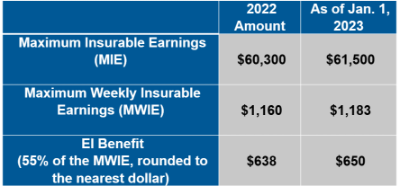
The Canada Employment Insurance Commission and Canada Revenue Agency have announced the 2023 changes to Maximum Insurable Earnings and premiums for employment insurance.
The following changes to Employment Insurance (EI) will come into effect on Jan. 1, 2023:
How does this affect your clients?
Your clients’ STD benefit will be revised with the updated maximums based on the percentage of EI Maximum Weekly Insurable Earnings shown in their policy if:- Their Equitable Life Group Policy includes an STD benefit that is tied to the EI Maximum Weekly Insurable Earnings, and
- At least one classification of employees has a maximum of less than $650.
If their STD maximum is currently higher than $650 or based on a flat amount instead of a percentage or regular earnings, no change will be made to their plan unless otherwise directed.
If your clients wish to provide direction regarding revising their STD maximum, or if they have questions about the process, they can email Kari Gough, Manager, Group Issue and Special Projects.Coming soon: Survey for Plan Administrators with recent disability claims*
We’ve enhanced our communication processes to help your clients with disability plans manage their workplace absences more effectively. In early December, we will distribute a short survey to plan administrators who may have submitted an approved disability claim in the past six months. The survey will ask recipients about their satisfaction with the frequency and detail of our disability management communications.
The email will come from GBClientFeedback@equitable.ca, and the survey will remain open until the end of the day on December 16, 2022. All responses will be confidential. We plan to use the feedback to help ensure that we’re meeting your clients’ expectations and delivering industry-leading service.
We may also follow up with survey respondents directly, to address any concerns they’ve identified.
* Indicates content that will be shared with your clients. -
May 2023 eNews
Update: Introducing changes to our Diabetes Management Program
Beginning June 1, 2023, we are introducing additional standard drug plan controls as part of our Diabetes Management Program.
The controls will apply to GLP-1 agonists approved by Health Canada for the treatment of diabetes, such as: Adlyxine, Mounjaro, Ozempic, Rybelsus, Trulicity, and Victoza.
This change will help manage the impact of these high-cost diabetes medications for your clients while continuing to provide plan members with access to effective treatments to manage their disease.
Why are we introducing this change?
GLP-1 agonists are the highest cost diabetes drugs on the market. Current Diabetes Canada Clinical Practice Guidelines recommend that most Type 2 diabetics begin treatment with lower-cost and equally effective first-line therapies, such as Metformin.
Some GLP-1 agonists are also used “off-label”. In other words, they are often prescribed for conditions for which they have not been approved by Health Canada, such as weight loss.
These additional controls will help ensure that these drugs are used appropriately – only for the treatment of diabetes and only after other first-line treatments have been tried.
If a client wishes to provide coverage for drugs specifically approved by Health Canada for weight loss, we have coverage options available.
How will this program work?
Plan members who receive a new prescription for a GLP-1 agonist will need to try a first-line diabetic treatment before they are eligible for coverage of the GLP-1 agonist. If the plan member has previously tried first-line therapies and found them ineffective, they will be eligible for a GLP-1 agonist.
Plan members who are already taking a GLP-1 agonist to treat diabetes will continue to be eligible for coverage. Some claimants may need to provide confirmation of their diabetes diagnosis from their physician or pharmacist in order to maintain coverage. We will provide claimants ample time to confirm their diagnosis.
Questions?
If you have any questions about these additional standard controls or how they will impact your clients, please contact your Group Account Executive or myFlex Sales Manager.
Coming soon: Survey for plan administrators with recent disability claims
We are regularly enhancing our communication processes to help your clients with disability plans manage their workplace absences more effectively. Later this month, we will distribute a short survey to plan administrators who have submitted a disability claim in the past six months. The survey will ask recipients about their satisfaction with the frequency and detail of our disability management communications.
The email will come from GBClientFeedback@equitable.ca, and the survey will remain open until the end of the day on May 19, 2023. All responses will be confidential. Survey respondents will receive the option to provide their contact information so that we can follow up on feedback they have provided.
We plan to use the feedback to help ensure that we’re meeting your clients’ expectations and delivering industry-leading service.
In a previous issue of eNews, we published a list of the average dental fee increases for general practitioners based on the latest Provincial and Territorial Dental Association fee guides.
Since then, the Canadian Life and Health Insurance Association (CLHIA) has updated the 2023 dental fees for some provinces. Provinces with dental fee updates since our previous eNews are bolded and italicized. Equitable Life uses these guides to help determine the reimbursement limits for dental procedures. For your reference, below is the list of the average dental fee increases for general practitioners that will be used by Equitable Life for 2023.
-
The average FHSA balance is $3,899—Let’s help clients aim higher
The First Home Savings Account (FHSA) is a powerful tool for Canadians working toward homeownership. With tax-deductible contributions and tax-free withdrawals for qualifying purchases, it’s designed to make saving easier and more rewarding.
Yet, with a lifetime contribution limit of $40,000 and an annual cap of $8,000, many clients may not be taking full advantage. The average FHSA balance currently sits at just $3,899*, leaving plenty of room for growth.
Equitable offers three straightforward strategies to help clients boost their FHSA contributions and get closer to their first home—faster:
Set it and forget it with automated contributions
Consistency is key. By setting up automatic monthly deposits of up to $667, clients can effortlessly reach the annual maximum of $8,000. Equitable makes it easy to schedule recurring transfers from a bank account, helping clients stay on track without the hassle of manual deposits.
Make the most of windfalls with lump sum deposits
Bonuses, tax refunds, or inheritances can be powerful savings tools. Equitable allows clients to make one-time contributions anytime, helping them catch up on unused FHSA room from previous years and accelerate their savings.
Transfer from RRSPs—tax-free
Clients who’ve already been saving in an RRSP can transfer those funds into their FHSA—up to their available contribution room—without triggering taxes. This strategy lets them benefit from the FHSA’s tax-free withdrawal feature while staying within their overall savings plan.
Bonus Opportunity: Win big with the Close to Home contest
From May 1 to September 30, 2025, clients who contribute to an Equitable FHSA will be entered to win one of two $8,000 prizes. Whether opening a new account or making a contribution, it’s a great chance for clients to get closer to homeownership.
Advisors, your efforts matter too!
You have a chance to win a $1,000 prize if the client you are assisting, in alignment with their unique homeownership needs, is selected as a winner. At Equitable, we believe that when we grow together, success is mutual.
Don’t forget about Equitable’s user-friendly online application platform, EZcomplete®, or process an online transaction with ease using Equitable’s EZtransact®. These tools are fast, simple, and could bring clients closer to achieving their goals.
Want to learn more? Speak to your Director, Investment Sales.
* Source: https://www.canada.ca/en/revenue-agency/services/tax/individuals/topics/first-home-savings-account/fhsa-statistics.html
® and ™ denote trademarks of The Equitable Life Insurance Company of Canada.
Equitable’s Close to Home Contest: No purchase necessary. Contest period May 1, 2025 to September 30, 2025. Clients enter by making a deposit to an Equitable FHSA during the contest period or by submitting a no-purchase entry. Two prizes of $8,000 CAD each to be drawn on October 15, 2025 will be awarded. The servicing advisor for the policy to which the selected entrants made the deposit is also an eligible winner and will receive a $1,000 CAD prize. For example, if an Equitable client is a winner of the $8,000 prize, the client’s servicing advisor wins a $1,000 prize. Open to legal residents of Canada of the age of majority. Odds of winning depend on number of eligible entries received during the Contest Period. For full contest rules, including no-purchase method of entry, see here.
Date posted: September 4, 2025
-
EAMG Market Commentary August 2022

August 2022
The S&P 500 fell into bear market territory over the first half of 2022 with the index down -20.6%. This represented a top 10 ranking amongst the most dismal back-to-back quarterly performances going back to 1928. While comparisons have been made to the inflation driven bear market of 1973-74, the economic backdrop today has some significant differences including greater production capacity (factory utilization rates are running about 20% lower vs the 70’s) and a meaningful decline in raw industrial prices which have fallen -11% over the quarter. While these economic anecdotes are potential positives for the future, it’s important to remain cognizant that prices remain elevated.
As such, the US Federal Reserve seems to be taking every opportunity to telegraph their intentions of raising interest rates at the expense of both market and economic performance, so long as inflation remains a threat. Given this hawkish tone, the market narrative has morphed from fears of inflation to a fed driven recession. As a result, the move in the bond market has been swift with the 10-year treasury yield peaking at approximately 3.5% in June to today’s level of 2.7% (lower rates = higher bond prices). This positive bond performance reflects the consensus view that inflation is temporary (2023 CPI forecasts are approximately 3.6% vs the second quarter’s 8.7% CPI reading) and could allow the Fed to adjust their higher interest rate trajectory downward. The Fed also remains confident that a soft landing is achievable, and a recession avoidable.
Investors seem less convinced however, given the Fed has never been able to engineer a soft landing before, and so it’s no surprise equity markets entered a bear market over the quarter, and currently remain in a technical correction (defined as losses greater than -10%). To better assess future performance, we closely monitor earnings results to understand how companies are navigating these economic trends. With nearly 80% of the S&P 500 reported, the results have been better than expected, but still the EPS beat rate and magnitude of beats (actual vs expectation) remain below 5-year averages. This tells us companies are finding today’s economic conditions more challenging than the recent past. Consumer sectors including marketing, retail, autos and textiles posted the 2nd worst performance vs other sectors while the Financials sector saw the greatest challenges with aggregate EPS falling by -15% year-over-year. Wall Street analysts have started to revise S&P 500 forward growth estimates lower, a trend which we expect will continue for several quarters ahead. The forward (12-month blended) P/E ratio of 17.5 times remains 1.5 multiple points above the long-term average which potentially suggests risks may not be fully priced in.
In terms of the S&P/TSX Composite, after declining nearly -14% in Q2 as recession fears around the world jeopardized the global demand outlook, its’ since rebounded over 4.0%. Still, valuation remains below longer-term averages at 11.8x forward earnings with the heavier weighted Financials and Energy sectors trading at 9.5x and 7.9x, respectively. TSX earnings expectations have stalled as of late but downward revisions are lagging US and European counterparts. Additionally, the domestic labour market remains tight which has allowed the Bank of Canada to continue its aggressive rate hike path to curb soaring inflation. For most of 2022 the TSX has benefitted from surging commodity prices but an economic slowdown in China resulting from its commitment to a zero-Covid policy and a potential global recession could prove to be a challenge for the Canadian market.
Equity markets on average lose 30% of their value in recession led bear markets. If we use this as a potential road map, it suggests the S&P 500 could have further to fall. Using past performance as a forward-looking tool however is an imperfect technique and used in isolation of what’s happening today can often mislead.
Accounting for today’s backdrop, we come up with three scenarios of varying probabilities. The first is the most optimistic and includes an engineered soft landing by the Fed, meaning no recession and inflation cools. A less optimistic view is the fed tames inflation with higher interest rates but tips the economy into a mild-to-moderate recession. The outcome would be consumer spending and corporate hiring slow as a result of tighter financial conditions, and therefore financial results are negatively impacted. The least optimistic scenario is one where stagflationary conditions emerge as inflation continues to accelerate at the expense of growth despite higher interest rates, in other words the Fed loses control. The net result would be similar to our second scenario but with much more dire results in terms of unemployment, household spending and impacts to corporate profitability. While we don’t rule out any of the above scenarios completely, we assign the highest probability to the second one where macro economic issues get resolved at some point in the future, but the full effects of inflation and a possible recession have yet to be priced into the market. Currently, this view translates into a slight underweight equity position versus our benchmark with a tilt towards low volatility and defensive strategies along with an overlay of value and dividend paying securities. In other words, we’ve de-risked the portfolios relative to our benchmark to manage potential downside risks but remain meaningfully invested an on absolute basis. As always, time in the market tends to overcome trying to time the market, and so employing a strategic and diversified strategy is often the most prudent approach.
Downloadable Copy
ADVISOR USE ONLY
Any statements contained herein that are not based on historical fact are forward-looking statements. Any forward-looking statements represent the portfolio manager’s best judgment as of the present date as to what may occur in the future. However, forward-looking statements are subject to many risks, uncertainties and assumptions, and are based on the portfolio manager’s present opinions and views. For this reason, the actual outcome of the events or results predicted may differ materially from what is expressed. Furthermore, the portfolio manager’s views, opinions or assumptions may subsequently change based on previously unknown information, or for other reasons. Equitable Life of Canada® assumes no obligation to update any forward-looking information contained herein. The reader is cautioned to consider these and other factors carefully and not to place undue reliance on forward-looking statements. Investments may increase or decrease in value and are invested at the risk of the investor. Investment values change frequently, and past performance does not guarantee future results. Professional advice should be sought before an investor embarks on any investment strategy. - EZcomplete Training and Resources
- [pdf] myFlex Options Guide
- [pdf] Underwriting cover letter template