

Site Search
281 results for PAPHOS.SNOWNOW.ORG buying clophedrone 3-CMC Paphos magnificent escrow market list
- Rates and Performance
-
FHSA conversations that move clients closer to home
Today’s first‑time homebuyers face higher housing costs, rising interest rates and the challenge of saving while renting. A recent survey suggests two-thirds of Canadians still dream of owning a home despite a challenging market1. As advisors, you can play a critical role in helping clients navigate these realities and make informed, tax‑efficient decisions.
Join us for a webcast focused on the First Home Savings Account (FHSA) and how it can be integrated with other savings vehicles to support clients on their path to home ownership.
You’ll learn:
• FHSA basics like eligibility, contribution limits, deductions and withdrawals.
• How the Home Buyers’ Plan via RRSPs, TFSAs and non-registered savings accounts work together with an FHSA.
• Practical planning ideas using real‑life client scenarios.
• How Equitable® can support you with FHSA solutions and advisor tools.
This session will help you confidently position the FHSA within a broader savings and home‑buying strategy, even for clients who may be unsure when or if they’ll buy.
Date: Wednesday, June 17, 2026
Time: 2:00 p.m. ET | 11:00 a.m. PT
Duration: 1 hour
Host: Joseph Trozzo, Investment Sales Vice President, Equitable
Speaker: Ally Kulak, Inside Sales Associate, EquitableStrengthen your FHSA planning — register now! Help clients move closer to their first home.
1 www.investmentexecutive.com
Continuing Education Credits
This webcast has been accredited for 1.00 Life continuing education (CE) credit via the Insurance Council of Manitoba and Alberta Insurance Council for all provinces excluding Quebec. To be eligible for CE credits, you must register individually, watch the webcast in full, and complete a short quiz. It is the advisor's responsibility to ensure Continuing Education credits being offered are accepted by their licensing body. Alberta Insurance Council (AIC) credits are valid in Yukon, British Columbia, Alberta, Saskatchewan, Ontario, New Brunswick, Prince Edward Island and Nova Scotia. Insurance Council of Manitoba (ICM) credits are valid in Manitoba only.
This webcast is available in English only.
Date posted: June 3, 2026 -
Market Comments - October 2024
Key Takeaways for Q3· Central banks eased monetary policy by reducing their target interest rates.
· Bond markets performed very well during the quarter as interest rates fell.
· Risk markets experienced some volatility, but stock markets had robust returns.
· Canadian stocks outperformed U.S. stocks in Q3, while the sources of returns in the U.S. market were more balanced and diversified than in the first half of the year.
Views From the Frontline
Bond Markets: During the third quarter, interest rates in both Canada and the U.S. moved significantly lower as markets anticipated that the Bank of Canada would continue – and the Federal Reserve would start – cutting rates. Additionally, the expectation became that the central banks would end up lowering rates more aggressively than previously assumed. That’s because inflation data has softened sufficiently to give the central banks the scope to ease policy, and other economic data, especially from the labour market, indicated the need for them to ease policy in order to prevent economic activity from cooling too much. For instance, in Canada, inflation slowed to the Bank of Canada’s 2% target, while the labour market showed warning signs with the unemployment rate rising to 6.6%. The Bank of Canada cut its target interest rate by 0.25% at each of its July and September meetings. Governor Macklem indicated that if growth does not materialize as expected, “it could be appropriate to move faster on interest rates”. In the U.S., the Federal Reserve kicked off its easing cycle by cutting its target rate by 0.50% in September. The growing signs of a cooling labour market amidst slowing inflation motivated the larger-than-typical move. That said, consumer spending in the U.S. continued to be strong, and GDP is still tracking a healthy growth rate.
While interest rates fell, bonds returns were also boosted by solid behaviour of corporate bonds. Credit spreads (i.e. the risk premium for corporate bonds versus government bonds) continued to grind lower over the quarter. Tightening credit spreads reflected the generally positive risk-on tone to the market, despite some volatility. Lower-rated BBB bonds performed better than higher-quality A-rated bonds. Credit spreads have now generally fallen back to levels that are largely consistent with the tight post-pandemic levels experienced in 2021. The on-going appetite of investors for the extra yield offered by corporate bonds over government bonds is indicated not just by falling credit spreads, but also by investors’ enthusiasm to support the primary issuance market. Corporate bond supply continues to be very robust, with $29B (billion) in new issuance during the quarter, resulting in an impressive $119B issued year-to-date, a new record. Nonetheless, on balance, we do not think the current risk premium adequately compensates for downside risk, particularly in longer-dated corporate bonds, and have a bias towards shorter-dated credit where we view the risk / reward trade-off as being more favourable.
Stock Markets: In the U.S., we continue to caution against heavily concentrated sources of market returns and emphasize a diversified portfolio. Last quarter, diversification proved essential as a multitude of factors heightened market volatility. These factors – which included the unwind of the yen carry trade, investor reactions to mixed mega-cap earnings, and concerns of a slowing labour market – drove investors away from mega-cap technology names and into defensive areas of the market. Following the Federal Reserve’s decision to reduce interest rates by 0.5%, sources of investment returns continued to broaden as investors rotated into economically-sensitive baskets. Underpinned by decelerating inflation and easing monetary policy, we believe the rotation away from the mega-cap tech names is likely to persist and we continue to emphasize portfolio diversification. In Canada, high-quality, high-yielding businesses – composed of the financial sector and non-financial dividend payers – outperformed over the quarter as investors rewarded companies that demonstrated a strong ability to sustain dividends, as well as greater efficiency generating profits. While we continue to favour these businesses, we have taken profit on our financial sector dividend exposure after a sharp reversion in the premium between value creation and current yield. In addition, Chinese officials introduced a wave of stimulus to revitalize growth, bringing life back to the metals and luxury goods sectors. Accordingly, Canadian and European equities have benefitted recently.
Market Update
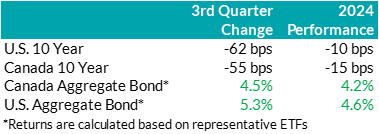 Rates & Credit: In Q3, interest rates in both Canada and the U.S. decreased significantly, with front-end interest rates declining faster than long-end interest rates amid cooling inflation and a weakening labour market. As a result, the FTSE Canada Universe Index posted a positive return of 4.7%. Coincidentally, Canadian corporate bonds and government bonds each also generated returns of 4.7%, totally in-line with the Universe index. On the other hand, despite short-term interest rates falling much more than long-term interest rates, the higher price sensitivity of long-dated bonds had them outperform shorter-dated bonds, with the Long-Term bond index up 5.8% while the Short-Term bond index gained 3.4%. Similarly, within corporate bonds, industries that have longer-dated debt (e.g. energy and infrastructure) outperformed those that tend to have shorter-dated debt (e.g. real estate and financials).
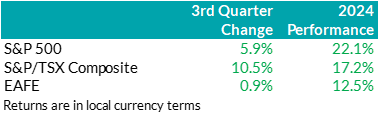 Equity Overview: Underpinned by decelerating inflation data and easing monetary policy – including the outsize 50-basis cut from the Federal Reserve – prospects for an economic soft landing increased over the quarter. That favourable outlook spurred global equity markets to all-time highs, with previously lagging areas of the market narrowing the performance gap compared to the U.S. mega-cap technology names that had led returns in the first half of the year. Canadian equities outperformed their U.S. counterpart last quarter, rising 10.5% as strength in the banking and materials sectors pushed the index higher. Major developed markets from Europe, Australasia, and the Far East (EAFE) were more subdued, gaining 0.9% (in local currency terms) last quarter. That said, grand expectations for further interest rate cuts in the U.S. pushed the greenback to its lowest level in over a year, boosting EAFE returns to over 7% in U.S. dollar terms. Within the U.S., sources of market returns broadened as well, with investors rotating out of concentrated AI companies and into more economically sensitive businesses.
U.S. Fundamentals: Outside of the Magnificent 7, investors are interpreting downside earnings surprises as a normalization of financial performance rather than a deterioration. For example, McDonald’s share price rallied over 17% into quarter-end following its earnings release despite announcing declining sales and contracting earnings per share. Within the AI-ecosystem, investors are beginning to look for opportunities beyond chip manufacturers, such as nuclear energy providers. At an index level, our work shows that members of the Russell 1000 index, excluding the Mag-7, posted a median earnings growth of nearly 9% year-over-year, expanding from the ~6% witnessed in Q2. Furthermore, the number of companies from this group reporting positive earnings growth grew to approximately 67%, up from 60% in the prior quarter. In our view, the ongoing broadening of earnings strength outside of the Mag-7 can provide tailwinds to current market rotations into previously left-behind companies. Within the mega-cap tech space, investors have become more discriminant than in prior quarters, rewarding businesses with greater success monetizing their AI-investments. This trend was evident through the divergence of returns from IBM and Alphabet (Google’s parent company) following their quarterly earnings.
U.S. Quant Factors: Decelerating U.S. inflation data prompted a rotation out of highly concentrated areas of the market (growth) and into more economically-sensitive companies (value). Then, concerns of a slowing U.S. labour market and the unwind of the yen carry trade increased market volatility, leading investors to shelter their positions by reallocating to low volatility. As the quarter progressed, expectations of easing monetary policy and stabilizing employment data helped calm return to the market and the rotation from mega-cap tech sector resumed, albeit at a lesser pace. Notably, this “catch-up” trade also benefitted dividend-paying companies, particularly those with a lengthy and established history of increasing dividends, as investors favoured those more mature operations.
Canadian Fundamentals: Investors returned to the Canadian market after Canadian companies showed signs of recovery last quarter with earnings expanding by more than expected. With inflation showing clearer signs of deceleration and the outlook regarding the path of monetary policy increasingly implying lower interest rates going forward, investors are allocating toward high-quality, dividend-paying companies. From a sector level, surging gold prices provided a tailwind for Canadian miners, helping the materials sector outperform over the quarter. More recently, the materials sector has benefitted from elevated base metal prices following the arrival of Chinese stimulus. In contrast, oil prices declined over 16% last quarter as fears of an oversupplied market swelled following speculation that OPEC+ would look to dial back production cuts. As a result, investors looked past lingering geopolitical risks and the energy sector underperformed.
Canadian Quant Factors: Amid an improving Canadian macroeconomic backdrop and clearer outlook on the trajectory of monetary policy, dividend-yielding businesses became sought after. More specifically, investors continued to emphasize dividend sustainability last quarter, rewarding dividend-paying businesses that demonstrated strong financial performance and the ability to support future payouts. For example, the major Canadian banks sharply outperformed in Q3 after reporting earnings growth that mostly exceeded expectations. In essence, investors have become more constructive on this high-yielding group as their ability to create value relative to financing costs improves.
Downloadable Copy
ADVISOR USE ONLYMark Warywoda, CFA
VP, Public Portfolio ManagementIan Whiteside, CFA, MBA
AVP, Public Portfolio ManagementJohanna Shaw, CFA
Director, Portfolio ManagementJin Li
Director, Equity Portfolio Management
Tyler Farrow, CFA
Senior Analyst, Equity
Andrew Vermeer
Senior Analyst, Credit
Elizabeth Ayodele
Analyst, Credit
Francie Chen
Analyst, Rates
 Any statements contained herein that are not based on historical fact are forward-looking statements. Any forward-looking statements represent the portfolio manager’s best judgment as of the present date as to what may occur in the future. However, forward-looking statements are subject to many risks, uncertainties, and assumptions, and are based on the portfolio manager’s present opinions and views. For this reason, the actual outcome of the events or results predicted may differ materially from what is expressed. Furthermore, the portfolio manager’s views, opinions or assumptions may subsequently change based on previously unknown information, or for other reasons. Equitable® assumes no obligation to update any forward-looking information contained herein. The reader is cautioned to consider these and other factors carefully and not to place undue reliance on forward-looking statements. Investments may increase or decrease in value and are invested at the risk of the investor. Investment values change frequently, and past performance does not guarantee future results. Professional advice should be sought before an investor embarks on any investment strategy.
- Brandes
- [pdf] The Right Time To Buy And Sell
-
May 2023 eNews
Update: Introducing changes to our Diabetes Management Program
Beginning June 1, 2023, we are introducing additional standard drug plan controls as part of our Diabetes Management Program.
The controls will apply to GLP-1 agonists approved by Health Canada for the treatment of diabetes, such as: Adlyxine, Mounjaro, Ozempic, Rybelsus, Trulicity, and Victoza.
This change will help manage the impact of these high-cost diabetes medications for your clients while continuing to provide plan members with access to effective treatments to manage their disease.
Why are we introducing this change?
GLP-1 agonists are the highest cost diabetes drugs on the market. Current Diabetes Canada Clinical Practice Guidelines recommend that most Type 2 diabetics begin treatment with lower-cost and equally effective first-line therapies, such as Metformin.
Some GLP-1 agonists are also used “off-label”. In other words, they are often prescribed for conditions for which they have not been approved by Health Canada, such as weight loss.
These additional controls will help ensure that these drugs are used appropriately – only for the treatment of diabetes and only after other first-line treatments have been tried.
If a client wishes to provide coverage for drugs specifically approved by Health Canada for weight loss, we have coverage options available.
How will this program work?
Plan members who receive a new prescription for a GLP-1 agonist will need to try a first-line diabetic treatment before they are eligible for coverage of the GLP-1 agonist. If the plan member has previously tried first-line therapies and found them ineffective, they will be eligible for a GLP-1 agonist.
Plan members who are already taking a GLP-1 agonist to treat diabetes will continue to be eligible for coverage. Some claimants may need to provide confirmation of their diabetes diagnosis from their physician or pharmacist in order to maintain coverage. We will provide claimants ample time to confirm their diagnosis.
Questions?
If you have any questions about these additional standard controls or how they will impact your clients, please contact your Group Account Executive or myFlex Sales Manager.
Coming soon: Survey for plan administrators with recent disability claims
We are regularly enhancing our communication processes to help your clients with disability plans manage their workplace absences more effectively. Later this month, we will distribute a short survey to plan administrators who have submitted a disability claim in the past six months. The survey will ask recipients about their satisfaction with the frequency and detail of our disability management communications.
The email will come from GBClientFeedback@equitable.ca, and the survey will remain open until the end of the day on May 19, 2023. All responses will be confidential. Survey respondents will receive the option to provide their contact information so that we can follow up on feedback they have provided.
We plan to use the feedback to help ensure that we’re meeting your clients’ expectations and delivering industry-leading service.
In a previous issue of eNews, we published a list of the average dental fee increases for general practitioners based on the latest Provincial and Territorial Dental Association fee guides.
Since then, the Canadian Life and Health Insurance Association (CLHIA) has updated the 2023 dental fees for some provinces. Provinces with dental fee updates since our previous eNews are bolded and italicized. Equitable Life uses these guides to help determine the reimbursement limits for dental procedures. For your reference, below is the list of the average dental fee increases for general practitioners that will be used by Equitable Life for 2023.
-
Market Commentary October 2025
Key Takeaways
• Market sentiment improved significantly in Q3 as economic uncertainties eased.
• Both U.S. and Canadian stock markets posted strong gains. The rally was supported by sector-specific earnings strength and structural growth drivers in AI and digital infrastructure. Equity valuations remain elevated, which could become a potential headwind for future performance.
• Canadian bond markets delivered positive returns in Q3. Returns were largely from underlying interest income, supported by modestly lower interest rates and continued strong performance from tighter credit spreads.
• Both the Bank of Canada and the U.S. Federal Reserve restarted easing in Q3. Each central bank cut rates by 25 basis points in September, responding to rising risks to labour markets.
Economic and Market UpdateEconomic Summary: In the U.S., economic activity has remained relatively steady through 2025. However, while business investment remained robust, the pace of hiring slowed. Inflation has increased in recent months, but overall price pressures appear contained. Trade uncertainty eased in the third quarter as the U.S. reached agreements on tariffs with several key trading partners. Countries such as Japan, South Korea, and Indonesia, as well as the European Union, negotiated compromise deals. These deals typically involved U.S. tariffs in the range of 15% to 20% in exchange for market access or investment commitments. However, other nations faced higher tariffs of 30-50% following failed negotiations. Mexico and China are currently in a 90-day pause on tariff hikes, which will expire on October 29 and November 10, respectively. At its September meeting, the U.S. Federal Reserve (the “Fed”) lowered its policy rate by 25 basis points to a range of 4.00%– 4.25%. The Fed also signaled that additional interest rate cuts will likely be required to support the economy. Chair Jerome Powell highlighted increasing risks to the labour market and decreasing risks to inflation. He emphasized that the Fed remains data dependent and that interest rate decisions will be made “meeting-by-meeting”. The October 1 shutdown of the U.S. government added further uncertainty to the economic outlook. Key data releases are expected to be delayed, and the White House has warned of mass layoffs of federal workers.
The Canadian economy experienced a modest rebound in July following weak growth in the second quarter. However, U.S. tariffs and ongoing trade policy uncertainty continue to present risks to the economy. The labour market continues to weaken while inflationary pressures have eased in recent months. On July 31, the U.S. increased tariffs on Canadian imports from 25% to 35% for those products not exempted under USMCA. In addition, the U.S. has expanded its list of sector-specific tariffs. This is expected to place further strain on Canadian exporters. In response to these developments, the Bank of Canada cut its policy rate by 25 basis points to 2.50% during its September meeting. Governor Tiff Macklem indicated that the Bank is prepared to take further action if the balance of risks shifts to weaker growth.
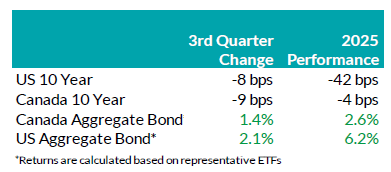
Bond Markets: During Q3, the FTSE Canada Universe Bond Index returned 1.5%. Yields on Canadian bonds with maturities of 10 years or less declined. That reflected increased expectations for interest rate cuts by the Bank of Canada. Yields on bonds with maturities of greater than 10 years increased moderately, as investors continued to demand a higher risk premium for long-term debt.
Overall, corporate bonds saw a positive return for the quarter and outperformed government bonds. This outperformance was due to the higher interest rate on corporate bonds relative to government bonds, with an assist from modestly tighter credit spreads. Corporate issuance was robust during the quarter with strong investor demand, as investors were willing to look past U.S. tariffs and their potential impact to global growth. There were 99 corporate bond issuances during Q3 that combined to raise $45 billion for issuers, a new record. Indeed, the new issuance market is tracking ahead of last year, the previous high-water mark for issuance.
Notwithstanding the continued strong performance from corporate bonds, we have maintained a bias towards shorter corporate bonds where the risk and reward are better balanced. We remain ready to invest in longer corporate bonds as valuations become attractive.
Stock Markets: Equity markets posted strong gains in Q3. The S&P 500 returned 8.1% for the quarter, led by Information Technology and Communication Services. Investors focused on the expansion of AI infrastructure and a more favourable regulatory environment for blockchain technology. These themes supported risk appetite despite valuations remaining high relative to historical averages. The Canadian market returned 12.5% in Q3, outperforming the U.S. by more than 4%. This was driven mainly by strong returns in the Materials sector. Meanwhile, the Europe, Australasia, and Far East Index (EAFE) returned 5.4%, as international investors re-evaluated the “Sell America” trade trend.
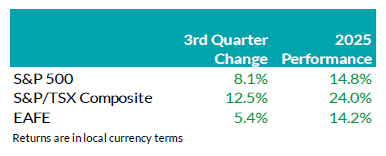
U.S. Equities: In Q3, U.S. equities rose on strong momentum in AI infrastructure investment and growing interest in blockchain innovation. Mega-cap tech stocks led the rally. Major announcements such as NVIDIA’s $100 billion investment in OpenAI and Oracle’s $300 billion multi-year cloud deal highlighted the rapid growth of hyperscale data centers and the deepening commitment to AI development. A more supportive regulatory environment for blockchain technology also boosted investor interest in digital assets. This was reflected in robust IPO activity from crypto-focused companies such as Figure Technology and Gemini. Both stocks saw sharp gains following their public market debuts. That said, the S&P 500 continues to trade at nearly 23 times its forward earnings, roughly 20% above its 10-year average.
Canadian Equities: Canadian equities rose on better-than-expected economic data and sector-driven earnings, outperforming the U.S. by more than 4% in Q3. The Materials sector drove the rally, contributing nearly half of the gain for the TSX in Q3, as the price of gold surged past US$3850/oz (+45% YTD). The Technology sector also posted solid results, highlighted by Shopify’s continued strong performance. Shopify’s AI-driven product expansion and scalable digital commerce growth pushed the stock to trade around 85 times its forward earnings over the next twelve months. Positive sentiment extended to the Financials sector, where better-than-expected provisions for credit losses helped support a revaluation of bank stocks.
Overall, Q3 marked a risk-on environment across North American equities, underpinned by sector-specific earnings strength and structural growth drivers. In the U.S., enthusiasm around AI and digital infrastructure continued to dominate. In Canada, the rally was driven by surging gold prices and better-than-expected bank earnings. These catalysts helped sustain broad-based market strength across both markets.
Bottom line: Overall market sentiment improved in the third quarter following the volatility earlier in the year caused by tariffs. Investors benefited from resilient performance in North American equities and positive performance in fixed income. In the U.S., the Federal Reserve resumed its rate-cutting cycle, while strong consumer demand and continued capex-spending acted as key drivers for the market strength. In Canada, gold prices continued to surge amid persistent safe-haven demand driven by geopolitical risks. Looking ahead, we will continue to closely monitor valuation levels and underlying economic data for signals of inflection as the cycle progresses.
Downloadable Copy
Mark Warywoda, CFA
VP, Public InvestmentsIan Whiteside, CFA, MBA
AVP, Public InvestmentsJohanna Shaw, CFA
Director, Public InvestmentsJin Li
Director, Equity Investments
Wanyi Chen, CFA, FRM
Sr. Quantitative Analyst
Andrew Vermeer, CFA
Senior Analyst, Credit
Elizabeth Ayodele
Analyst, Credit
Edward Ng Cheng Hin
Analyst, Credit
Kate (Huyen) Vinh
Analyst, Equity
Francie Chen
Analyst, Rates
ADVISOR USE ONLY
Any statements contained herein that are not based on historical fact are forward-looking statements. Any forward-looking statements represent the portfolio manager’s best judgment as of the present date as to what may occur in the future. However, forward-looking statements are subject to many risks, uncertainties, and assumptions, and are based on the portfolio manager’s present opinions and views. For this reason, the actual outcome of the events or results predicted may differ materially from what is expressed. Furthermore, the portfolio manager’s views, opinions or assumptions may subsequently change based on previously unknown information, or for other reasons. Equitable® assumes no obligation to update any forward-looking information contained herein. The reader is cautioned to consider these and other factors carefully and not to place undue reliance on forward-looking statements. Investments may increase or decrease in value and are invested at the risk of the investor. Investment values change frequently, and past performance does not guarantee future results. Professional advice should be sought before an investor embarks on any investment strategy. - [pdf] Poster - What does your retirement bucket list include?
-
Responding to Ontario’s biosimilar switch initiative
We are changing coverage for some biologic drugs in Ontario in response to the province’s biosimilar initiative. These changes will help protect your clients’ plans from additional drug costs that may result from this government policy while providing access to equally safe and effective lower-cost biosimilars.
Ontario’s provincial biosimilar initiative
Announced in December 2022, Ontario’s biosimilar switch program ends coverage of eight biologic drugs for Ontario residents covered by the Ontario Drug Benefit (ODB). The transition to biosimilar versions of these drugs began on March 31, 2023. ODB recipients using these drugs will be required to switch to biosimilar versions of these drugs by December 29, 2023, to maintain their provincial coverageEquitable Life’s response
To ensure this provincial change doesn’t result in your clients paying additional and avoidable drug costs, we are changing coverage in Ontario for most biologic drugs included in the provincial initiative.
Beginning October 1, 2023, plan members in Ontario will no longer be eligible for most originator biologic drugs if they have a condition for which Health Canada has approved a lower cost biosimilar version of the drug.** These plan members will be required to switch to a biosimilar version of the drug to maintain coverage under their Equitable Life plan.Communicating this change to plan members
We will inform any affected plan members in early August of the need to switch their medications so that they have ample time to change their prescriptions and avoid any interruptions in treatment or coverage.Will this change impact my clients’ rates?
Any cost savings associated with the change will be factored in at renewal.What is the difference between biologics and biosimilars?
Biologics are drugs that are engineered using living organisms like yeast and bacteria. The first version of a biologic developed is known as the “originator” biologic. Biosimilars are highly similar to the drugs they are based on and Health Canada considers them to be equally safe and effective for approved conditionsQuestions?
** The list of affected drugs is dynamic and will change as Ontario includes more biologic drugs in its biosimilar initiative, as new biosimilars come onto the market, and as we make changes in drug eligibility.
If you have any questions about this change, please contact your Group Account Executive or myFlex Sales Manager. - Choosing the right funds