

Site Search
581 results for enter portal MAKEMUR.com How to get my case dismissed by paying the victim North Carolina
- Congratulations on qualifying as an Elite Advisor
-
February 2020 Advisor eNews
In this issue:
Provincial biosimilar update
Legislative changes for Alberta’s Coverage for Seniors program
Coming soon: enhancements to Equitable EZClaim® Online
Provincial biosimilar update

Alberta Biosimilar Initiative
On December 12, 2019, the Alberta government introduced the launch of the Alberta Biosimilar Initiative. This program will require patients using several originator biologic drugs to switch to a biosimilar, and patients using a non-biologic complex drug (NBCD) to switch to its subsequent entry version before July 1, 2020 in order to maintain coverage.
Biologics are drugs that are engineered using living organisms like yeast and bacteria. The first version of a biologic developed is also known as the “originator” drug. Biosimilars are highly similar to the originator drug they are based on and have been shown to have no clinically meaningful differences in safety or efficacy.
Alberta Health will initially cover both the originator and biosimilar or subsequent entry version of a NBCD drug as patients start the switching process.
The following table outlines the affected originator drugs, their biosimilars or subsequent entry, and the conditions affected by the program.
Biosimilar Drug Originator Biosimilar/Subsequent Entry Indications Affected etanercept Enbrel Brenzys Ankylosing Spondylitis
Rheumatoid ArthritisErelzi Ankylosing Spondylitis
Psoriatic Arthritis
Rheumatoid Arthritisinfliximab Remicade Inflectra
RenflexisAnkylosing Spondylitis
Plaque Psoriasis
Psoriatic Arthritis
Rheumatoid Arthritis
Crohn’s Disease
Ulcerative Colitisinsulin glargine Lantus Basaglar Diabetes (Type 1 and 2) Filgrastim Neupogen Grastofil Neutropenia pegfilgrastim Neulasta Lapelga Neutropenia glatiramer* Copaxone Glatect Multiple Sclerosis *Glatiramer is a non-biologic complex drug where the originator is Copaxone and the subsequent entry is Glatect.
Equitable Life is actively investigating the benefit, risk and appropriate plan changes associated with this new policy on private drug plans and will keep you informed.
For more information about the Alberta Biosimilars Initiative, consult the Alberta government website.
British Columbia
In 2019, BC Pharmacare introduced a Biosimilars Policy that impacted coverage of three biologic drugs – Remicade, Enbrel and Lantus. As of November 25, 2019, these drugs were no longer eligible in BC for most conditions for which lower cost biosimilar versions are available. Patients in the province with these conditions were required to switch to biosimilar versions of these drugs in order to maintain their coverage.
The second phase of the BC Biosimilar Policy takes effect March 6, 2020 when Remicade will be delisted for Crohn’s Disease and Ulcerative Colitis. Patients in the province with these conditions will be required to switch to Inflectra or Renflexis in order to maintain their coverage.
Biosimilar Drug Originator Biosimilar Indications Affected infliximab Remicade Inflectra
RenflexisCrohn’s Disease
Ulcerative ColitisWe have communicated with the affected plan members, informing them of the need to switch medications. If plan members have any questions or concerns, our Customer Care team is here to help and support them through the transition.
If you have any questions about this policy, please contact your Group Account Executive or myFlex Sales Manager.
Ontario
In November 2019 Ontario Minister of Health Christine Elliot indicated that the government was planning to launch consultations to explore solutions in managing biologics.
Equitable Life will continue to monitor these developments and keep you informed of any impact on private drug plans.
Legislative changes for Alberta’s Coverage for Seniors program
The government of Alberta has announced that as of March 1, 2020, seniors’ family members (such as spouses and dependents) who are younger than 65 will no longer be covered by the provincial Coverage for Seniors program. Albertans 65 years of age and older will continue to be covered under the provincial plan.
Equitable Life plan members and their dependents will continue to be covered under the parameters of their group benefits plan.
For more information, please see the Alberta Seniors Health Benefits website.
Coming soon: enhancements to Equitable EZClaim® Online
Faster vision claims processing and payment
Equitable Life will soon provide real-time processing of vision claims submitted via EZClaim Online.
This means plan members will be able to find out the status of their vision claim almost instantaneously. And, for approved claims, they will receive payment even sooner – often in as little as 24 hours.
In order to allow for instantaneous processing and faster payment, plan members will be prompted to enter some additional information including the practitioner’s name, the date of the expense, the type of expense and amount of the expense when submitting their claims for these services.
Equitable Life plan members can submit all vision claims via EZClaim, including coordination of benefits and Health Care Spending Account claims.
This enhancement will be coming to our EZClaim Mobile app in the coming months.
New printable claims extract
As part of our ongoing efforts to improve customer experience for plan members, we will also offer a claims extract in a printable format within the plan member site. Plan members will be able to select a date range and claimant, then generate and download a detailed list of health and dental claims. This is a helpful way to keep track of claims, especially when reviewing them in preparation for income tax filing.
Once these enhancements are live you will be notified in an eNews, and an announcement will be posted on the plan member section of EquitableHealth.ca.
Elimination of Out-of-Country Travellers Program in Ontario
Effective January 1, 2020, the Ontario government eliminated OHIP coverage for emergency services for Ontarians travelling outside of Canada.
Previously, the Out-of-Country Travelers Program provided some reimbursement for services required to treat conditions that are acute, unexpected, arose outside Canada and require immediate treatment. The program covered between $200 and $400 per day for inpatient services and $50 per day for outpatient and doctor services.
For groups who have out-of-country coverage from Allianz, this change will not impact the cost to your plan members, or the process plan members follow in the event of an emergency while travelling.
Plan members should still call Allianz in the event of an out of country emergency. Allianz will deal with their claim as usual and will now pay for the portion of the claim previously paid by OHIP. Plan members will not have any additional out-of-pocket costs.
We will be sharing this information with plan members as a news item on our plan member website, equitablehealth.ca.
-
Homewood Health COVID-19 Resources
As the COVID-19 situation continues to rapidly evolve, you may need information from a trusted source to support your clients, their organizations and their employees.
Through our partnership with Homewood Health, the Canadian leader in mental health and addiction services, all of our clients and their plan members have access to a number of tools and resources designed to provide guidance and support.
Online Cognitive Behavioural Therapy
For plan members dealing with increased anxiety during these uncertain times, Homewood’s Online Cognitive Behavioural Therapy tool, i-Volve, can help. Through self-paced, web-based therapy, i-Volve can help plan members identify, challenge and overcome anxious thoughts, behaviours and emotions.
All Equitable Life clients and their plan members have access to i-Volve. It’s available 24 hours a day, seven days a week, wherever you choose to access it.
Learn more about Online CBT or access i-Volve at Homeweb.ca/Equitable.
COVID-19 Support Resources
Drawing on their expertise in mental health, as well as guidance from trusted sources including Health Canada, the Public Health Agency of Canada and the World Health Organization, Homewood has created a number of resources to help support your clients and their plan members.
- Self-isolation and quarantine: What you need to know
- Quelling COVID-19 Anxiety
- Managing stress and anxiety
- How to speak to children
- How to stay productive and motivated when working from home
- The COVID-19 Pandemic: Managing the Impact
- Support for First Responders, Front Line Workers and Public Facing Employees
- Financial tips for your financial health
- Increases in Domestic Violence
- Those with family members in long-term care facilities
- Parenting during a pandemic
- COVID-19: Employee Fatigue, Isolation and Loneliness
- COVID-19 Back to School - Considerations and tips for parents and caregivers
- COVID-19: Back to School Support for Kids
-
From Insight to Inclusion: Engaging Women Investors with Confidence
Ready to help future‑proof your practice?
Create an experience that truly resonates with women investors.
Join our February Master Class, “From Insight to Inclusion: Engaging Women Investors with Confidence.” Learn how to design strategies that help attract, retain and deepen advisory relationships with women – today and for the long term. We will explore why women are essential to building and sustaining a successful advisory business. We will also share practical steps to help you engage them effectively.
We’ll cover:- Why women remain an underserved client group,
- Why inclusion is critical to your business growth, and
- How to develop strategies that help attract and retain women as value clients.
Why attend?- Turn research into real conversations that can build trust.
- Create a clear plan that speaks to women investors.
- Build a repeatable process for prospecting, onboarding and reviews – one that includes women in a meaningful way.
Join Joseph Trozzo, Vice President, National Investment Sales at Equitable, for an insightful conversation with Susan Silma – lawyer, former regulator, client‑experience strategist and regular columnist for Investment Executive.
Don’t miss this opportunity.
Learn more
Continuing Education Credits
This webcast has been submitted for continuing education (CE) approval for all provinces excluding Quebec via the Insurance Council of Manitoba and Alberta Insurance Council. Upon approval, you will be sent an email notification to come back to the webcast presentation console to download your personalized certificate from the tool bar. To be eligible for CE credits, you must register individually, watch the webcast in full, and complete a short quiz. It is the advisor's responsibility to ensure Continuing Education credits being offered are accepted by their licensing body. Alberta Insurance Council (AIC) credits are valid in Yukon, British Columbia, Alberta, Saskatchewan, Ontario, New Brunswick, Prince Edward Island and Nova Scotia. Insurance Council of Manitoba (ICM) credits are valid in Manitoba only.
This webcast is available in English only.
-
Market Commentary October 2025
Key Takeaways
• Market sentiment improved significantly in Q3 as economic uncertainties eased.
• Both U.S. and Canadian stock markets posted strong gains. The rally was supported by sector-specific earnings strength and structural growth drivers in AI and digital infrastructure. Equity valuations remain elevated, which could become a potential headwind for future performance.
• Canadian bond markets delivered positive returns in Q3. Returns were largely from underlying interest income, supported by modestly lower interest rates and continued strong performance from tighter credit spreads.
• Both the Bank of Canada and the U.S. Federal Reserve restarted easing in Q3. Each central bank cut rates by 25 basis points in September, responding to rising risks to labour markets.
Economic and Market UpdateEconomic Summary: In the U.S., economic activity has remained relatively steady through 2025. However, while business investment remained robust, the pace of hiring slowed. Inflation has increased in recent months, but overall price pressures appear contained. Trade uncertainty eased in the third quarter as the U.S. reached agreements on tariffs with several key trading partners. Countries such as Japan, South Korea, and Indonesia, as well as the European Union, negotiated compromise deals. These deals typically involved U.S. tariffs in the range of 15% to 20% in exchange for market access or investment commitments. However, other nations faced higher tariffs of 30-50% following failed negotiations. Mexico and China are currently in a 90-day pause on tariff hikes, which will expire on October 29 and November 10, respectively. At its September meeting, the U.S. Federal Reserve (the “Fed”) lowered its policy rate by 25 basis points to a range of 4.00%– 4.25%. The Fed also signaled that additional interest rate cuts will likely be required to support the economy. Chair Jerome Powell highlighted increasing risks to the labour market and decreasing risks to inflation. He emphasized that the Fed remains data dependent and that interest rate decisions will be made “meeting-by-meeting”. The October 1 shutdown of the U.S. government added further uncertainty to the economic outlook. Key data releases are expected to be delayed, and the White House has warned of mass layoffs of federal workers.
The Canadian economy experienced a modest rebound in July following weak growth in the second quarter. However, U.S. tariffs and ongoing trade policy uncertainty continue to present risks to the economy. The labour market continues to weaken while inflationary pressures have eased in recent months. On July 31, the U.S. increased tariffs on Canadian imports from 25% to 35% for those products not exempted under USMCA. In addition, the U.S. has expanded its list of sector-specific tariffs. This is expected to place further strain on Canadian exporters. In response to these developments, the Bank of Canada cut its policy rate by 25 basis points to 2.50% during its September meeting. Governor Tiff Macklem indicated that the Bank is prepared to take further action if the balance of risks shifts to weaker growth.
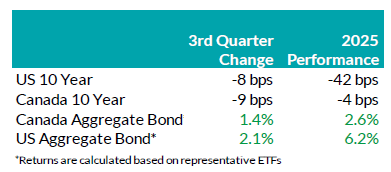
Bond Markets: During Q3, the FTSE Canada Universe Bond Index returned 1.5%. Yields on Canadian bonds with maturities of 10 years or less declined. That reflected increased expectations for interest rate cuts by the Bank of Canada. Yields on bonds with maturities of greater than 10 years increased moderately, as investors continued to demand a higher risk premium for long-term debt.
Overall, corporate bonds saw a positive return for the quarter and outperformed government bonds. This outperformance was due to the higher interest rate on corporate bonds relative to government bonds, with an assist from modestly tighter credit spreads. Corporate issuance was robust during the quarter with strong investor demand, as investors were willing to look past U.S. tariffs and their potential impact to global growth. There were 99 corporate bond issuances during Q3 that combined to raise $45 billion for issuers, a new record. Indeed, the new issuance market is tracking ahead of last year, the previous high-water mark for issuance.
Notwithstanding the continued strong performance from corporate bonds, we have maintained a bias towards shorter corporate bonds where the risk and reward are better balanced. We remain ready to invest in longer corporate bonds as valuations become attractive.
Stock Markets: Equity markets posted strong gains in Q3. The S&P 500 returned 8.1% for the quarter, led by Information Technology and Communication Services. Investors focused on the expansion of AI infrastructure and a more favourable regulatory environment for blockchain technology. These themes supported risk appetite despite valuations remaining high relative to historical averages. The Canadian market returned 12.5% in Q3, outperforming the U.S. by more than 4%. This was driven mainly by strong returns in the Materials sector. Meanwhile, the Europe, Australasia, and Far East Index (EAFE) returned 5.4%, as international investors re-evaluated the “Sell America” trade trend.
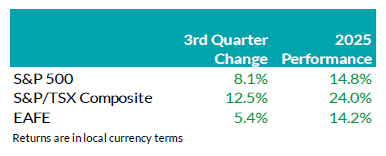
U.S. Equities: In Q3, U.S. equities rose on strong momentum in AI infrastructure investment and growing interest in blockchain innovation. Mega-cap tech stocks led the rally. Major announcements such as NVIDIA’s $100 billion investment in OpenAI and Oracle’s $300 billion multi-year cloud deal highlighted the rapid growth of hyperscale data centers and the deepening commitment to AI development. A more supportive regulatory environment for blockchain technology also boosted investor interest in digital assets. This was reflected in robust IPO activity from crypto-focused companies such as Figure Technology and Gemini. Both stocks saw sharp gains following their public market debuts. That said, the S&P 500 continues to trade at nearly 23 times its forward earnings, roughly 20% above its 10-year average.
Canadian Equities: Canadian equities rose on better-than-expected economic data and sector-driven earnings, outperforming the U.S. by more than 4% in Q3. The Materials sector drove the rally, contributing nearly half of the gain for the TSX in Q3, as the price of gold surged past US$3850/oz (+45% YTD). The Technology sector also posted solid results, highlighted by Shopify’s continued strong performance. Shopify’s AI-driven product expansion and scalable digital commerce growth pushed the stock to trade around 85 times its forward earnings over the next twelve months. Positive sentiment extended to the Financials sector, where better-than-expected provisions for credit losses helped support a revaluation of bank stocks.
Overall, Q3 marked a risk-on environment across North American equities, underpinned by sector-specific earnings strength and structural growth drivers. In the U.S., enthusiasm around AI and digital infrastructure continued to dominate. In Canada, the rally was driven by surging gold prices and better-than-expected bank earnings. These catalysts helped sustain broad-based market strength across both markets.
Bottom line: Overall market sentiment improved in the third quarter following the volatility earlier in the year caused by tariffs. Investors benefited from resilient performance in North American equities and positive performance in fixed income. In the U.S., the Federal Reserve resumed its rate-cutting cycle, while strong consumer demand and continued capex-spending acted as key drivers for the market strength. In Canada, gold prices continued to surge amid persistent safe-haven demand driven by geopolitical risks. Looking ahead, we will continue to closely monitor valuation levels and underlying economic data for signals of inflection as the cycle progresses.
Downloadable Copy
Mark Warywoda, CFA
VP, Public InvestmentsIan Whiteside, CFA, MBA
AVP, Public InvestmentsJohanna Shaw, CFA
Director, Public InvestmentsJin Li
Director, Equity Investments
Wanyi Chen, CFA, FRM
Sr. Quantitative Analyst
Andrew Vermeer, CFA
Senior Analyst, Credit
Elizabeth Ayodele
Analyst, Credit
Edward Ng Cheng Hin
Analyst, Credit
Kate (Huyen) Vinh
Analyst, Equity
Francie Chen
Analyst, Rates
ADVISOR USE ONLY
Any statements contained herein that are not based on historical fact are forward-looking statements. Any forward-looking statements represent the portfolio manager’s best judgment as of the present date as to what may occur in the future. However, forward-looking statements are subject to many risks, uncertainties, and assumptions, and are based on the portfolio manager’s present opinions and views. For this reason, the actual outcome of the events or results predicted may differ materially from what is expressed. Furthermore, the portfolio manager’s views, opinions or assumptions may subsequently change based on previously unknown information, or for other reasons. Equitable® assumes no obligation to update any forward-looking information contained herein. The reader is cautioned to consider these and other factors carefully and not to place undue reliance on forward-looking statements. Investments may increase or decrease in value and are invested at the risk of the investor. Investment values change frequently, and past performance does not guarantee future results. Professional advice should be sought before an investor embarks on any investment strategy. -
Equitable Life Group Benefits Bulletin – March 2022
In this issue:
- CLHIA launches industry anti-fraud initiative*
- Provincial biosimilar update*
- Quebec decreasing insurance premium tax*
- Coming soon: A survey to understand how we can better serve your clients’ needs*
- Remind your clients’ plan members in BC, Manitoba and Saskatchewan to register for Pharmacare *
CLHIA launches industry anti-fraud initiative*
In February, the Canadian Life and Health Insurance Association (CLHIA) announced a new anti-fraud initiative that is using advanced artificial intelligence (AI) to further identify and reduce benefits fraud.
Equitable Life is excited to be a part of this important initiative. It will enhance our own fraud detection analytics by using AI to connect the dots across a huge pool of anonymized claims data. This will lead to more investigations and actions to mitigate the impact of fraud on your clients’ plans.
The initiative is being led by the CLHIA and member insurers and is supported by technology provider Shift Technologies. It will be further rolled-out and expanded over the next three years.
Benefits fraud affects more than just insurers. The costs of fraud are felt by employers and their employees as well. We are looking forward to being able to better identify and reduce benefits fraud.
Provincial biosimilar update*
BC expands its biosimilar initiative
BC Pharmacare recently announced it is adding two rapid-acting insulins to the list of drugs included in its ongoing initiative to switch patients to biosimilar versions of high-cost biologics. Patients taking Humalog or NovoRapid for Type 1 or Type 2 diabetes will be required to switch to a biosimilar version of the drugs by May 29, 2022 to maintain coverage under the public plan.
Biologics are drugs that are engineered using living organisms like yeast and bacteria. The first version of a biologic developed is also known as the “originator” biologic. Biosimilars are also biologics. They are highly similar to the originator biologic drugs they are based on, and Health Canada considers them to be equally safe and effective for approved conditions.
How we are responding to protect our clients
To help prevent this change from resulting in additional costs for our clients’ drug plans while still providing plan members with access to safe and effective medications, we will no longer cover Humalog or NovoRapid for plan members in BC. Effective June 1, 2022, claimants currently taking Humalog or NovoRapid will be required to switch to a biosimilar version of the drugs to maintain coverage under their Equitable Life plan and their BC Pharmacare plan.
We will be communicating this change to plan administrators later this week. And we will be communicating with affected claimants in early April to allow ample time to change their prescription and avoid any interruptions in their treatment or their coverage.
If you have any questions about this change, please contact your Group Account Executive or myFlex Sales Manager.
Nova Scotia and Northwest Territories introduce biosimilar initiatives
The governments of Nova Scotia and the Northwest Territories each recently announced they are launching biosimilar initiatives to switch patients from certain originator biologic drugs to biosimilar versions of the drugs.
Patients in Nova Scotia using affected originator biologic drugs will have until February 2023 to switch to a biosimilar version of their medications in order to maintain coverage under the province’s public drug plans. Patients in the Northwest Territories will have until June 20, 2022, to switch.
Equitable Life® actively monitors and investigates all biosimilar policy changes and the ongoing evolution of biosimilar drugs entering Canada. We will keep you informed of any impact on private drug plans and how we are responding.
Quebec decreasing insurance premium tax*
The Quebec Government has announced that it plans to decrease its Insurance Premium Tax rates effective April 1, 2022. The premium tax rates for group life and accident and sickness insurance are expected to decrease from 3.48% to 3.3%. The new tax rates will be applied to premiums for the billing period beginning on or after April 1, 2022.
Coming soon: A survey to understand how we can better serve your clients’ needs*
We are committed to providing your clients and their plan members with industry-leading service. We’ve introduced several enhancements over the past year to make it easier to do business with us. And we’re continually looking for ways to improve.
In the coming weeks, we will conduct a survey of your clients to help us understand how we can better serve them. On March 28, we will send plan administrators an email with a link to the survey. The survey will remain open until the end of the day on April 11 and will take between five and 10 minutes to complete. Please encourage your clients to participate. Their feedback will be confidential, and their responses will help us improve our service and ensure we’re meeting their expectations. We may also follow up with plan administrators directly to address any concerns they’ve identified.
We know your clients’ time is valuable. So, each plan administrator who completes the survey will be entered into a random draw for a chance to win one of 25 prepaid gift cards for $25.
Remind your clients’ plan members in BC, Manitoba and Saskatchewan to register for Pharmacare*
If your clients have plan members in British Columbia, Manitoba or Saskatchewan, the provincial government offers a Pharmacare program to support prescription drug costs. Plan members in these provinces must register for their provincial Pharmacare program to maintain coverage under their Equitable Life drug plan.
Registration is easy! We will send two registration reminder messages directly to plan members’ pharmacists and post them on their Explanation of Benefits. We’ve also created a step-by-step guide that your clients can share with their plan members.
English version
French version
For more information about the provincial Pharmacare programs, including how plan members can register, please visit:
For British Columbia residents: https://www2.gov.bc.ca/gov/content/health/health-drug-coverage/pharmacare-for-bc-residents
For Manitoba residents: https://www.gov.mb.ca/health/pharmacare/apply.html
For Saskatchewan residents: https://www.saskatchewan.ca/residents/health/prescription-drug-plans-and-health-coverage/extended-benefits-and%20drug-plan/drug-cost-assistance#eligibility
- [pdf] Service is our business
- [pdf] Equitable's Competitive Advantage
-
Equitable Life Group Benefits Bulletin - July 2021
In this issue:
- Fabien Jeudy takes over as President and CEO*
- Reminder: Equitable Life’s Guide to Accessing Virtual Healthcare*
- Mental health resources for plan members*
- Recall of Philips CPAP machines*
Fabien Jeudy takes over as President and CEO*
In March, we announced that Fabien Jeudy was appointed as Equitable Life’s next President and CEO. Jeudy officially took over on July 5th, succeeding Ronald Beettam, who is retiring after 16 years with the company.
Jeudy is a collaborative leader with more than 30 years of experience in the insurance industry, leading actuarial, finance, risk management, distribution, marketing teams and operational teams in the Life & Health Insurance, Wealth Management and Group Benefits markets in Canada, the US, and Asia.
Reminder: Equitable Life’s Guide to Accessing Virtual Healthcare*
The demand for virtual healthcare services has increased as the pandemic is driving more people to access their health care providers from home.
Thankfully, many virtual healthcare services are available for free to Canadians with provincial health care coverage. We have created a Guide to Accessing Virtual Healthcare for plan members to easily access a variety of virtual healthcare services. Our guide includes information and links to both free and paid virtual medical care options, including video appointments, health advice over the phone, emergency dental services, and more.
You can find the guide on our website. It’s also available on our plan member website at EquitableHealth.ca.Mental health resources for plan members*
Many Canadians have been experiencing increased levels of stress, anxiety, and depression since the beginning of the COVID-19 pandemic. Through our partnership with Homewood Health®, all of our clients and their plan members have access to a number of health and wellness resources designed to provide guidance and support.
Homewood’s Online Cognitive Behavioural Therapy tool, i-Volve, can help plan members identify, challenge and overcome anxious thoughts, behaviours and emotions. Learn more about Online CBT or access i-Volve at Homeweb.ca/Equitable.
As well, Homewood has a number of resources available to help support plan members dealing with increased anxiety during these uncertain times:- Quelling COVID-19 Anxiety
- Managing stress and anxiety
- How to speak to children
- How to stay productive and motivated when working from home
- The COVID-19 Pandemic: Managing the Impact
- Support for First Responders, Front Line Workers and Public Facing Employees
- Financial tips for your financial health
- Increases in Domestic Violence
- Those with family members in long-term care facilities
- COVID-19: Employee Fatigue, Isolation and Loneliness
Recall of Philips CPAP machines*
Last month, electronics company, Philips, issued a recall with Health Canada of some of its Continuous Positive Airway Pressure (CPAP), BiLevel Positive Airway Pressure (BiLevel PAP) devices and Mechanical Ventilators. The recall was issued due to a foam abatement within the machines that can become loose and cause potential health risks.
To qualify for repair or replacement of these devices, users must register their machine on the Philips website.
CPAP, BiLevel PAP devices and Mechanical Ventilators are eligible for coverage under an HCSA and under some Extended Health Care plans. Plan administrators may want to inform plan members of this recall if the devices are eligible for coverage under their plan.
-
NEW MARKETING MATERIAL! Flexibility for supplemental income with Equimax
Equitable has created a new piece to help you understand our new Equimax® illustration feature, Paid-Up Additions (PUA) to Cash Dividends, now available!
Did you know Equimax clients can switch from the PUA dividend option to the cash dividend option by simply requesting a dividend option change?1,2
You can illustrate this for paid-up 10 pay and 20 pay Equimax plans! Show clients how they can build in added flexibility and use their policy to create a source of future supplemental income by simply changing the dividend option to cash.3
Illustration Considerations:
● Works with Equimax Estate Builder® or Equimax Wealth Accumulator®.
● Illustrate the Excelerator Deposit Option (EDO) to help build the policy values while the PUA dividend option is in effect. EDO payments can’t be made once the policy is switched to the cash dividend option.
● If a client needs temporary insurance coverage – like mortgage protection - illustrate term riders for how long they are needed to meet the specific goal.3
● If critical illness coverage is needed our competitively priced 20 pay critical illness riders are a great fit to provide paid-up critical illness coverage.3
Clients should apply for the coverage they need. This concept is about flexibility to create a future source of supplemental income.
Want to learn more? Check out our new marketing piece: Flexibility for supplemental income with Equimax (2077).
For more information, reach out to your local wholesaler.
® and TM denote trademarks of The Equitable Life Insurance Company of Canada.
1 Dividends are not guaranteed and are paid at the sole discretion of the Board of Directors. Dividends may be subject to taxation. Dividends will vary based on the actual investment returns in the participating account as well as mortality, expenses, lapse, claims experience, taxes, and other experience of the participating block of policies.
2 To request a change to the dividend option complete and submit form 558 (Request for Withdrawal of Dividends, Change in Option, or Premium Offset). A client can request a change to the cash dividend option from any other dividend option regardless of the premium type or whether premiums continue to be payable, subject to our current administration rules and guidelines. Some dividend option changes are subject to underwriting. Underwriting is not required to change from the PUA to cash dividend option, however, underwriting is required to change from the cash dividend option to the PUA dividend option.
3 This concept is intended to illustrate a one-time switch to cash dividends once premiums are no longer payable for the policy (including premiums for riders). Premiums are paid with after-tax dollars and dividends paid in cash are subject to taxation. If premiums are payable there will be tax savings for the client to use the before-tax cash dividend to reduce the premium instead of taking it entirely as a cash payment. This concept is intended for longer term planning, not to meet short term cash needs by switching back and forth between the PUA and cash options. Clients should consider a policy loan or a cash withdrawal to meet short-term cash needs; policy loans and cash withdrawals may be subject to taxation.