

Site Search
632 results for access link PROBLEMGO.com how much to make customs overlook a violation
-
Your year-end momentum starts today!
Just 79 days left to go in 2025!
As the air turns crisp and the leaves change color, we hope you’re enjoying our beautiful Canadian fall season. But before you get too swept up in the season's fun, remember that the final quarter is also a great time of year to boost your business.
Harvest season for success
Many clients are reviewing their financial goals and plans now. According to LIMRA, nearly 30% of life insurance applications are submitted between October and December1. This means you have a huge sales opportunity.
Why choose Equitable® ?
Clients expect competitive solutions that fit their unique needs well. Equitable offers great products, digital tools, and outstanding service and support. Learn more here.
Act now to finish 2025 on a strong note:
• Review your client list: Identify who needs a check-in before the year ends.
• Spot the opportunities: Year-end financial planning opens doors—don't miss out.
• Leverage our resources: From our e-apps to marketing materials and digital tools, we're here for you.
So, grab your client list (and your pumpkin spiced latte) and make the most of this final quarter. Your Equitable team is here to support you all the way to 2026 — let's finish 2025 strong!
1LIMRA, "Life Insurance Applications by Month," 2025. -
Lin covers her life, her partner, her home, and business with Equitable’s Term Life insurance
Lin has just opened her new business. Her partner Terri has supported her through it all, managing the bills and the mortgage so Lin can focus on getting her store established. Lin knows they’ve both worked so hard to achieve what they have.
She wants to make sure they’re covered in case anything happens to either of them.
With Equitable Life® Term Insurance, Lin can get affordable life insurance, which covers her and Terri’s current needs but is also flexible enough to change as their needs change.
This video can help you start the conversation with clients about Term insurance. It walks them through the different term options and the value of being able to convert term coverage to a permanent life insurance policy later on. It also details the KINDTM benefits that are currently available with Term insurance.
Plus, check out our Term product page, then click on the Marketing Materials tab for the latest Term marketing materials.
Want to learn more? Reach out to your local wholesaler.
Watch our new Term insurance with Equitable Life of Canada video to learn more. See it on Vimeo or YouTube.
® and ™ denote trademarks of The Equitable Life Insurance Company of Canada. - Fidelity Investments Canada
-
EAMG - Macro Tear Sheet – Recent Market Volatility Summary
By separating the noise from the signals, we believe the rotation away from the mega-cap technology names is likely to continue. Recent market volatility, triggered by a multitude of factors that include the unwind of the carry trade, investor reactions to mixed mega-cap earnings, and U.S. economic data, may present more investment opportunities for long-term outperformance. Recall over the past year that the majority of U.S. stock market performance came from a limited number of mega-cap technology companies and, in our view, moving forward it will be prudent to analyze the source of returns as rapid market rotations may punish overly-concentrated portfolios.
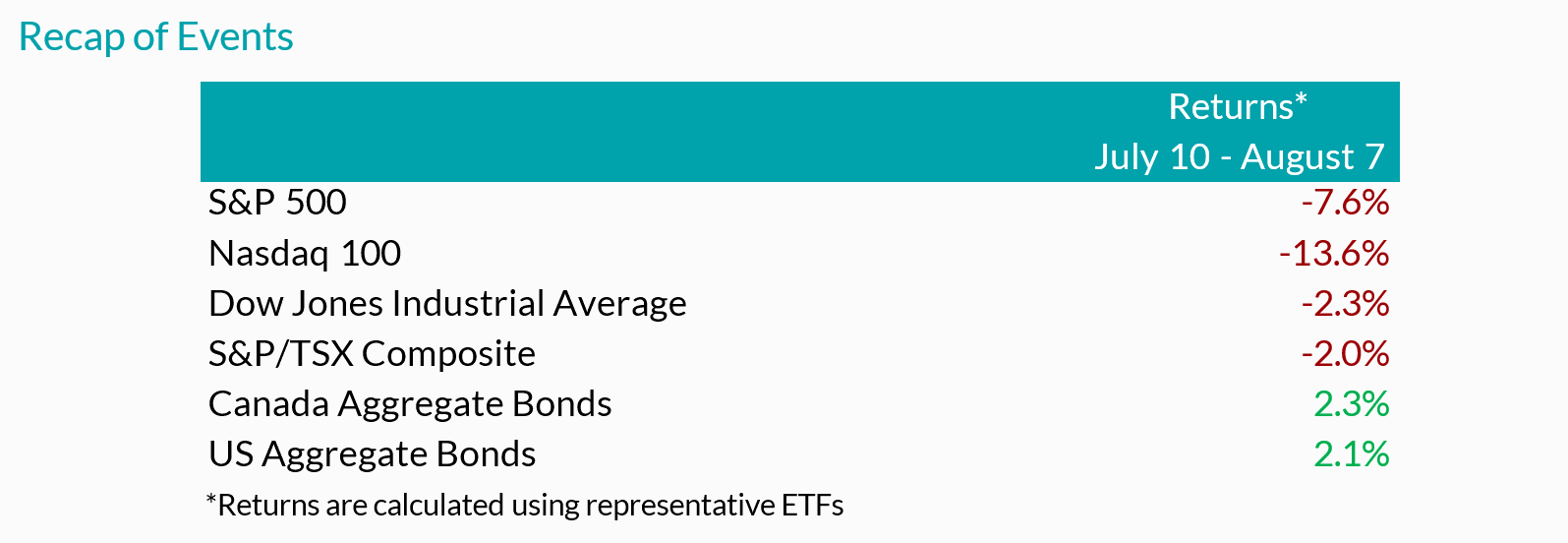
Inflation Slows (July 11) – Headline U.S. inflation readings increased 3.0% year-over-year in June, decelerating from May (3.3%). With prices slowing ahead of forecasts but economic growth remaining strong, investors became more confident regarding the prospects of an economic soft landing.
Outcome: market strength broadened with traders rotating out of highly concentrated areas of the market (“Fabulous 5”) and into more economically sensitive stocks that had been left behind.
• Big Tech Earnings (July 23 – Aug 1) – High profile mega-cap technology companies – including many members of the Magnificent 7 – reported earnings growth that generally surpassed expectations as margins remained healthy. That said, investors were more focused on spending towards AI-initiatives, rewarding businesses with greater success translating their AI investments into higher sales.
Outcome: this trend is evident through the divergence of returns from IBM and Alphabet (Google’s parent company) after releasing their quarterly earnings. The limited number of companies that contributed to the returns of the S&P 500 failed to impress investors, extending the rotation into other areas of the market.
• Caution is Brewing – Following a strong rally of economically sensitive pockets of the market, notably a breakout of returns from U.S. small cap companies, the low volatility factor, which tends to outperform during times of stress, moved in sync with the small caps’ strength.
Outcome: with a lack of fundamental justification supporting small cap performance, markets showed signs of caution.
• Central Bank Decisions (July 31)– The Federal Reserve held interest rates unchanged during its July meeting, in line with market expectations, reiterating committee members’ need for greater confidence that inflation would continue to subside. That said, policymakers signaled a reduction in policy rates could be a possibility in the coming meetings. In contrast, the Bank of Japan (BoJ) increased its key interest rate while also announcing plans to scale back bond purchases – restrictive monetary policy maneuvers aimed at backstopping the depreciating Japanese currency.
Outcome: the bifurcation between the BoJ and most other major central banks sparked a sharp appreciation of the yen and a rapid unwind of the yen carry trade (see below for explanation).
• Growth Scare (August 2)– In early August, a downside surprise in U.S. nonfarm payrolls (114k actual versus 175k expected) and an increase in the unemployment rate to 4.3%, higher than the 4.1% that was expected and up from 3.5% a year ago triggered concerns of a cooling labor market.
Outcome: speculation swelled surrounding the pace of rate cuts with market participants expecting the Federal Reserve to cut rates as much as 125bps over the next 3 policy meetings, up from 50-75bps as of the end of July. Against this backdrop, the ongoing unwind of the yen carry trade accelerated.
Yen Carry Trade Explained
• Simply put, investors have been borrowing Japanese yen – a low yielding currency – to invest in higher-yielding foreign assets. The primary risks in a carry trade can include the uncertainty of foreign exchange rates (if unhedged), as well as changes to expectations of the underlying yields, among other risks. Over the last 2 decades, the BoJ has implemented an ultra-low interest rate monetary policy to combat deflation and stimulate growth. Furthermore, investors were emboldened by the Japanese yen’s ~53% depreciation versus the U.S. dollar over the last 10 years. With the BoJ hiking its key interest rate while also announcing plans to scale back bond purchases, the yen rallied abruptly. Consequently, highly leveraged investors have had to exit their long positions in riskier assets to repay their borrowed yen exposure.
Peak Carry Trade Unwind – Buying Opportunity
• Peak carry trade unwind, which implies heightened panic levels, has historically created an attractive buying environment. That said, we are focused on companies that have demonstrated robust earnings growth and healthy leverage. Given the unprecedented level of market concentration over the last year, we view the unwind of the carry trade as another catalyst for investors to rotate out of the “Fabulous 5”.
Our Findings:
We found that the peak unwind of the carry trade may be a buying opportunity. At present, the current level of the unwind is similar to many notable market bottoms, including the Great Financial Crisis (2008), the European debt crisis (2010), the oil crash (2014), the subsequent emerging market crisis (2015), the Covid-19 crash (2020), and the collapse of Silicon Valley Bank (2023). We assessed the degree of the unwind by looking at the one-month implied volatility between three currency pairs, U.S. Dollar/Yen, Australian Dollar/Yen, and Euro/Yen. Implied volatility is a measure of the expected future volatility of the underlying assets over a given time period. Amid strong earnings growth and steady margins from quality businesses within the U.S. market, the fundamental backdrop suggests that businesses outside the concentrated AI-darlings may drive the next leg of market returns.
Downloadable Copy
Mark Warywoda, CFA
VP, Public Portfolio ManagementIan Whiteside, CFA, MBA
AVP, Public Portfolio ManagementJohanna Shaw, CFA
Director, Portfolio ManagementJin Li
Director, Equity Portfolio Management
Tyler Farrow, CFA
Senior Analyst, Equity
Andrew Vermeer
Senior Analyst, Credit
Elizabeth Ayodele
Analyst, Credit
Francie Chen
Analyst, Rates
ADVISOR USE ONLY
Any statements contained herein that are not based on historical fact are forward-looking statements. Any forward-looking statements represent the portfolio manager’s best judgment as of the present date as to what may occur in the future. However, forward-looking statements are subject to many risks, uncertainties, and assumptions, and are based on the portfolio manager’s present opinions and views. For this reason, the actual outcome of the events or results predicted may differ materially from what is expressed. Furthermore, the portfolio manager’s views, opinions or assumptions may subsequently change based on previously unknown information, or for other reasons. Equitable® assumes no obligation to update any forward-looking information contained herein. The reader is cautioned to consider these and other factors carefully and not to place undue reliance on forward-looking statements. Investments may increase or decrease in value and are invested at the risk of the investor. Investment values change frequently, and past performance does not guarantee future results. Professional advice should be sought before an investor embarks on any investment strategy. -
Market Comments - October 2024
Key Takeaways for Q3· Central banks eased monetary policy by reducing their target interest rates.
· Bond markets performed very well during the quarter as interest rates fell.
· Risk markets experienced some volatility, but stock markets had robust returns.
· Canadian stocks outperformed U.S. stocks in Q3, while the sources of returns in the U.S. market were more balanced and diversified than in the first half of the year.
Views From the Frontline
Bond Markets: During the third quarter, interest rates in both Canada and the U.S. moved significantly lower as markets anticipated that the Bank of Canada would continue – and the Federal Reserve would start – cutting rates. Additionally, the expectation became that the central banks would end up lowering rates more aggressively than previously assumed. That’s because inflation data has softened sufficiently to give the central banks the scope to ease policy, and other economic data, especially from the labour market, indicated the need for them to ease policy in order to prevent economic activity from cooling too much. For instance, in Canada, inflation slowed to the Bank of Canada’s 2% target, while the labour market showed warning signs with the unemployment rate rising to 6.6%. The Bank of Canada cut its target interest rate by 0.25% at each of its July and September meetings. Governor Macklem indicated that if growth does not materialize as expected, “it could be appropriate to move faster on interest rates”. In the U.S., the Federal Reserve kicked off its easing cycle by cutting its target rate by 0.50% in September. The growing signs of a cooling labour market amidst slowing inflation motivated the larger-than-typical move. That said, consumer spending in the U.S. continued to be strong, and GDP is still tracking a healthy growth rate.
While interest rates fell, bonds returns were also boosted by solid behaviour of corporate bonds. Credit spreads (i.e. the risk premium for corporate bonds versus government bonds) continued to grind lower over the quarter. Tightening credit spreads reflected the generally positive risk-on tone to the market, despite some volatility. Lower-rated BBB bonds performed better than higher-quality A-rated bonds. Credit spreads have now generally fallen back to levels that are largely consistent with the tight post-pandemic levels experienced in 2021. The on-going appetite of investors for the extra yield offered by corporate bonds over government bonds is indicated not just by falling credit spreads, but also by investors’ enthusiasm to support the primary issuance market. Corporate bond supply continues to be very robust, with $29B (billion) in new issuance during the quarter, resulting in an impressive $119B issued year-to-date, a new record. Nonetheless, on balance, we do not think the current risk premium adequately compensates for downside risk, particularly in longer-dated corporate bonds, and have a bias towards shorter-dated credit where we view the risk / reward trade-off as being more favourable.
Stock Markets: In the U.S., we continue to caution against heavily concentrated sources of market returns and emphasize a diversified portfolio. Last quarter, diversification proved essential as a multitude of factors heightened market volatility. These factors – which included the unwind of the yen carry trade, investor reactions to mixed mega-cap earnings, and concerns of a slowing labour market – drove investors away from mega-cap technology names and into defensive areas of the market. Following the Federal Reserve’s decision to reduce interest rates by 0.5%, sources of investment returns continued to broaden as investors rotated into economically-sensitive baskets. Underpinned by decelerating inflation and easing monetary policy, we believe the rotation away from the mega-cap tech names is likely to persist and we continue to emphasize portfolio diversification. In Canada, high-quality, high-yielding businesses – composed of the financial sector and non-financial dividend payers – outperformed over the quarter as investors rewarded companies that demonstrated a strong ability to sustain dividends, as well as greater efficiency generating profits. While we continue to favour these businesses, we have taken profit on our financial sector dividend exposure after a sharp reversion in the premium between value creation and current yield. In addition, Chinese officials introduced a wave of stimulus to revitalize growth, bringing life back to the metals and luxury goods sectors. Accordingly, Canadian and European equities have benefitted recently.
Market Update
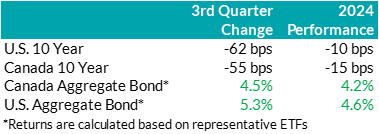 Rates & Credit: In Q3, interest rates in both Canada and the U.S. decreased significantly, with front-end interest rates declining faster than long-end interest rates amid cooling inflation and a weakening labour market. As a result, the FTSE Canada Universe Index posted a positive return of 4.7%. Coincidentally, Canadian corporate bonds and government bonds each also generated returns of 4.7%, totally in-line with the Universe index. On the other hand, despite short-term interest rates falling much more than long-term interest rates, the higher price sensitivity of long-dated bonds had them outperform shorter-dated bonds, with the Long-Term bond index up 5.8% while the Short-Term bond index gained 3.4%. Similarly, within corporate bonds, industries that have longer-dated debt (e.g. energy and infrastructure) outperformed those that tend to have shorter-dated debt (e.g. real estate and financials).
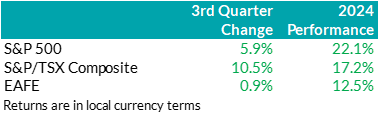 Equity Overview: Underpinned by decelerating inflation data and easing monetary policy – including the outsize 50-basis cut from the Federal Reserve – prospects for an economic soft landing increased over the quarter. That favourable outlook spurred global equity markets to all-time highs, with previously lagging areas of the market narrowing the performance gap compared to the U.S. mega-cap technology names that had led returns in the first half of the year. Canadian equities outperformed their U.S. counterpart last quarter, rising 10.5% as strength in the banking and materials sectors pushed the index higher. Major developed markets from Europe, Australasia, and the Far East (EAFE) were more subdued, gaining 0.9% (in local currency terms) last quarter. That said, grand expectations for further interest rate cuts in the U.S. pushed the greenback to its lowest level in over a year, boosting EAFE returns to over 7% in U.S. dollar terms. Within the U.S., sources of market returns broadened as well, with investors rotating out of concentrated AI companies and into more economically sensitive businesses.
U.S. Fundamentals: Outside of the Magnificent 7, investors are interpreting downside earnings surprises as a normalization of financial performance rather than a deterioration. For example, McDonald’s share price rallied over 17% into quarter-end following its earnings release despite announcing declining sales and contracting earnings per share. Within the AI-ecosystem, investors are beginning to look for opportunities beyond chip manufacturers, such as nuclear energy providers. At an index level, our work shows that members of the Russell 1000 index, excluding the Mag-7, posted a median earnings growth of nearly 9% year-over-year, expanding from the ~6% witnessed in Q2. Furthermore, the number of companies from this group reporting positive earnings growth grew to approximately 67%, up from 60% in the prior quarter. In our view, the ongoing broadening of earnings strength outside of the Mag-7 can provide tailwinds to current market rotations into previously left-behind companies. Within the mega-cap tech space, investors have become more discriminant than in prior quarters, rewarding businesses with greater success monetizing their AI-investments. This trend was evident through the divergence of returns from IBM and Alphabet (Google’s parent company) following their quarterly earnings.
U.S. Quant Factors: Decelerating U.S. inflation data prompted a rotation out of highly concentrated areas of the market (growth) and into more economically-sensitive companies (value). Then, concerns of a slowing U.S. labour market and the unwind of the yen carry trade increased market volatility, leading investors to shelter their positions by reallocating to low volatility. As the quarter progressed, expectations of easing monetary policy and stabilizing employment data helped calm return to the market and the rotation from mega-cap tech sector resumed, albeit at a lesser pace. Notably, this “catch-up” trade also benefitted dividend-paying companies, particularly those with a lengthy and established history of increasing dividends, as investors favoured those more mature operations.
Canadian Fundamentals: Investors returned to the Canadian market after Canadian companies showed signs of recovery last quarter with earnings expanding by more than expected. With inflation showing clearer signs of deceleration and the outlook regarding the path of monetary policy increasingly implying lower interest rates going forward, investors are allocating toward high-quality, dividend-paying companies. From a sector level, surging gold prices provided a tailwind for Canadian miners, helping the materials sector outperform over the quarter. More recently, the materials sector has benefitted from elevated base metal prices following the arrival of Chinese stimulus. In contrast, oil prices declined over 16% last quarter as fears of an oversupplied market swelled following speculation that OPEC+ would look to dial back production cuts. As a result, investors looked past lingering geopolitical risks and the energy sector underperformed.
Canadian Quant Factors: Amid an improving Canadian macroeconomic backdrop and clearer outlook on the trajectory of monetary policy, dividend-yielding businesses became sought after. More specifically, investors continued to emphasize dividend sustainability last quarter, rewarding dividend-paying businesses that demonstrated strong financial performance and the ability to support future payouts. For example, the major Canadian banks sharply outperformed in Q3 after reporting earnings growth that mostly exceeded expectations. In essence, investors have become more constructive on this high-yielding group as their ability to create value relative to financing costs improves.
Downloadable Copy
ADVISOR USE ONLYMark Warywoda, CFA
VP, Public Portfolio ManagementIan Whiteside, CFA, MBA
AVP, Public Portfolio ManagementJohanna Shaw, CFA
Director, Portfolio ManagementJin Li
Director, Equity Portfolio Management
Tyler Farrow, CFA
Senior Analyst, Equity
Andrew Vermeer
Senior Analyst, Credit
Elizabeth Ayodele
Analyst, Credit
Francie Chen
Analyst, Rates
 Any statements contained herein that are not based on historical fact are forward-looking statements. Any forward-looking statements represent the portfolio manager’s best judgment as of the present date as to what may occur in the future. However, forward-looking statements are subject to many risks, uncertainties, and assumptions, and are based on the portfolio manager’s present opinions and views. For this reason, the actual outcome of the events or results predicted may differ materially from what is expressed. Furthermore, the portfolio manager’s views, opinions or assumptions may subsequently change based on previously unknown information, or for other reasons. Equitable® assumes no obligation to update any forward-looking information contained herein. The reader is cautioned to consider these and other factors carefully and not to place undue reliance on forward-looking statements. Investments may increase or decrease in value and are invested at the risk of the investor. Investment values change frequently, and past performance does not guarantee future results. Professional advice should be sought before an investor embarks on any investment strategy.
-
Extending premium relief for Dental and Extended Health Care benefits
We know this continues to be a challenging time for Canadian employers and we remain committed to looking for ways to help your clients manage while still supporting their employees.
Although many health practitioners have re-opened as pandemic restrictions are lifted, plan member use of dental benefits and some health benefits still remains lower than normal in June.
We are pleased to announce that we are extending premium relief for all Traditional and myFlex insured non-refund customers for Health and Dental benefits for the month of June, as follows:
- A 25% reduction on Dental premiums; and
- A 5% reduction on Extended Health Care premiums.
These reductions are effective for June 2020 and will appear as a credit on the July bill, or against the next available billing. We will assess the situation monthly and will continue with monthly refunds for as long as the current crisis period continues. The size of the credit may change over time as dentists and other health practitioners gradually reopen their offices. We will confirm premium credits for July (if any) at a later date. Credits for subsequent months will be communicated on a month-by-month basis.
In order to be eligible for the monthly credit calculation and payout, a policy must be in force on the first of the month and remain in force thereafter. The monthly credit calculation is based on employees in force on the June bill. If employees experienced layoffs during the month, that would not affect eligibility for a premium credit as long as the benefit itself is not terminated.
We expect that claims experience and premiums will return to normal once the current pandemic restrictions are lifted.
In the meantime, plan members will continue to have full access to their benefits coverage throughout the pandemic. In many cases, dental offices have remained open for emergency services, and a variety of healthcare providers are available virtually.
Commissions
We know the pandemic has put financial strain on your business as well, so we will continue to pay full compensation. Although your overall commission will be unaffected by these premium reduction adjustments, you may see a temporary reduction in your commission payments if you are on a pay-as-earned basis.
Communication
We will be communicating this premium relief program to your clients later this week.
Questions?
If you have any questions, please contact your Group Account Executive or myFlex Sales Manager. You can also refer to our online COVID-19 Group Benefits FAQ.
-
Celebrating our most popular Pivotal Select funds
In August 2022, Equitable® launched 12 new segregated funds in Pivotal Select’s Investment Class (75/75). We wanted to bring some new innovative solutions to the product, including six sustainable investment funds. To say the launch of these funds was successful would be an understatement.
The funds are quickly becoming some of the most popular funds in Pivotal Select™, and their performance in 2023 was impressive. Equitable wants to celebrate these funds and encourage clients to consider them for their portfolios.
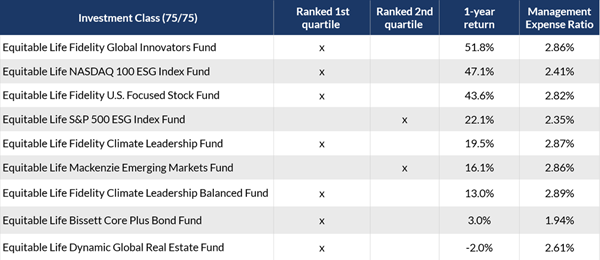
As of February 29, 2024, nine out of the 12 funds received a 1st quartile ranking for their 1-year return and two more were 2nd quartile. The table below shows the new funds that ranked in the top two quartiles for their 1-year returns.
Access additional fund performance information
If you haven’t looked at these funds yet, now is the time. Speak to clients about their investment options and see if these funds fit within their investment portfolio.
Talk to your Director, Investment Sales today for more information.Disclaimer
Any amount that is allocated to a segregated fund is invested at the risk of the contractholder and may increase or decrease in value. Segregated fund values change frequently, and past performance does not guarantee future results. Investors do not purchase an interest in underlying securities or funds, but rather, an individual variable insurance contract issued by The Equitable Life Insurance Company of Canada. There are risks involved with investing in segregated funds. Please read the Contract and Information Folder before investing for a description of risks relevant to each segregated fund and for a complete description of product features and guarantees. Copies of the Contract and Information Folder are available on equitable.ca.
Management Expense Ratios (MERs) are based on figures as of February 29, 2024, and are unaudited. MERs may vary at any time. The MER is the combination of the management fee, insurance fee, operating expenses, HST, and any other applicable non-income tax for the fund and for the underlying fund. For clients with larger contract values, a Management Fee Reduction may be available through the Preferred Pricing Program. For details, please see the Pivotal Select Contract and Information Folder.
® and TM denote trademarks of The Equitable Life Insurance Company of Canada.
Posted April 18, 2024
- Total Cost Reporting: understanding what's coming next
- [pdf] Homewood Health Online
-
Equitable Life Group Benefits Bulletin – October 2020
In this issue:
- Group benefits enrolment just got a lot easier*
- Critical Illness added to myFlex Benefits® selection tool**
- ASO dental available down to 3 lives
- QDIPC updates terms and conditions for 2021*
*Indicates content that will be shared with your clients
**Indicates content that will be shared with myFlex Benefits groups onlyGroup benefits enrolment just got a lot easier*
Our Online Plan Member Enrolment tool now makes it simple to add new employees to the benefits plan.
Enrolling new plan members can be overwhelming – for both you, your clients and their employees. It’s challenging to ensure plan members complete the necessary paperwork before the enrolment deadline, and time consuming to manually load new members.
That’s why we’re updating our plan member enrolment experience. Beginning November 2nd, 2020, all Equitable Life groups will be able to easily enrol new employees in the benefits plan with our Online Plan Member Enrolment Tool.
Benefits of Online Plan Member Enrolment
Our Online Plan Member Enrolment tool offers a more secure and efficient option to traditional paper enrolment. Employees are able to enrol in their benefits plan in just minutes from their computer or mobile device.
The user-friendly interface was built with the plan member in mind. They can easily enter all their enrolment information, including dependent details, banking information for direct deposit of claim payments and details for coordination of benefits. They can even designate their beneficiary electronically.
The online enrolment tool also lessens the effort for plan administrators to onboard new hires. The tool reduces errors and rework that can occur due to spelling mistakes or missing information on paper forms. And the days of chasing plan members for their paper enrolment forms are gone. Once they enter a few employee details, our system will automatically send out an email to each plan member, inviting them to enrol in their benefits program. And there will be no need to send reminders or follow up with employees about their benefits enrolment. It’s all done automatically.
Online plan member enrolment is available to all traditional and myFlex Benefits plan administrators with update access beginning November 2nd, 2020. Plan administrators just choose “New” from the “Certificate” view in EquitableHealth.ca to get started.
This enhancement is for plan administrators who have update access on EquitableHealth.ca. If your clients are not sure if they have update access, they can contact their Equitable Life Client Relationship Specialist or myFlex Benefits Team for support.
Learn More
We’ve created Online Plan Member Enrolment User Guides to support your clients and their plan members with this new tool:
- Online Plan Member Enrolment 1-page flyer
- Plan Member Online Plan Member Enrolment Quick Reference Guide
- myFlex Plan Member Online Plan Member Enrolment Quick Reference Guide
We’re also offering a series of webinars to help your clients learn about Online Plan Member Enrolment. Plan administrators will receive an invitation with links to register for the time that best suits their schedule.
Help your clients spend less time administering group benefits. Contact your Group Account Executive or myFlex Sales Manager to learn more about our enhanced online plan member enrolment.
Critical Illness added to myFlex Benefits selection tool*
For many employers, mandatory Critical Illness (CI) coverage is an important part of their group benefits package. It provides proactive protection against life-altering illness, helping give plan members and their families a sense of security.
While CI is available on myFlex Benefits plans, it was not built into our benefits selection tool since there is no action required by the plan member.
Beginning November 2nd, 2020, we are adding a CI page to the myFlex Benefits selection tool that appears when this coverage is included as part of the plan. There are no options to choose – plan members simply review their CI coverage and carry on with the benefits selection process. It keeps the process smooth, while ensuring plan members fully appreciate their employer’s contributions.
Adding CI to the benefits selection tool also simplifies the budgeting process for employers. Now that CI is included in the selection tool, employers no longer need to break out the amount billed for CI from their contribution per employee when loading flex allocations.
To learn more about our myFlex Benefits selection tool or Critical Illness coverage for myFlex Benefits, contact your myFlex Sales Manager.
ASO dental available down to 3 lives
Beginning November 2nd, 2020, groups with as few as three full-time employees will be able to self-insure their Equitable Life dental benefits with an Administrative Services Only (ASO) funding arrangement.
Currently, dental benefits are only available on an ASO basis for groups with 20 lives or more.
In an ASO arrangement, Equitable Life administers the benefits plan but does not insure it. The plan sponsor pays for all eligible claims, as well as the expenses of administering the plan.
Why ASO?
Choosing an ASO funding arrangement allows plan sponsors to save on premiums. With a traditional insured funding arrangement, a portion of every premium dollar includes a charge for the risk that the insurer is assuming to cover the claims.
With an ASO arrangement, the plan sponsor assumes all risk, so they avoid the risk charge. And since dental claims are usually more predictable than other benefits, there is typically less risk involved in covering those claims.
For more information, contact your Group Account Executive or myFlex Sales Manager.
QDIPC updates terms and conditions for 2021*
Every year, the Quebec Drug Insurance Pooling Corporation (QDIPC) reviews the terms and conditions for the high-cost pooling system in the province. Based on its latest review, QDIPC is revising its pooling levels and fees for 2021 to reflect trends in the volume of claims submitted to the pool, particularly catastrophic claims.
Size of group (# of certificates) Threshold per certificate 2021 Annual factor (without dependents) Annual factor (with dependents) Fewer than 25 $8,000 $251.00 $691.00 25 - 49 $16,500 $165.00 $455.00 50 - 124 $32,500 $94.00 $258.00 125 - 249 $47,500 $68.00 $187.00 250 - 499 $72,000 $49.00 $135.00 500 - 999 $95,000 $40.00 $111.00 1,000 - 3,999 $120,000 $35.00 $95.00 4,000 - 5,999 $300,000 $16.00 $44.00 6,000 and over Free market - Groups not subject to Quebec Industry Pooling Free market - Groups not subject to Quebec Industry Pooling Free market - Groups not subject to Quebec Industry Pooling We will apply the new pooling levels and fees to future renewal calculations that involve Quebec plan members.