

Site Search
766 results for open quick PROBLEMGO.com release from jail early loophole Tor access web begin work immediately
-
EAMG market commentary

March 11, 2022
Since Russia first invaded the Ukraine, there’s been no shortage of headlines and commentaries trying to make sense of the situation. This is a tragedy that from a humanitarian standpoint that can’t be made sense of and our hearts go out to the people of Ukraine and those impacted. From a market standpoint, the common thinking is that geopolitical risks, aka war, historically haven’t been associated with significant corrections in the market. So far, the market reaction has been consistent with the historical experience, with the S&P 500 down only about 1% since the start of the conflict and the S&P/TSX Composite Index up close to 4%, despite the heightened daily volatility.
Given the obvious challenges of predicting how these types of conflicts play out, we look to financial market indicators to give us a better sense of the potential risks in the market. And in this respect, the most obvious indicator is oil. Since the start of the Russian invasion, oil has rallied roughly 18%, which is even more impressive considering it had already rallied 21% from the start of the year to the beginning of the conflict.
While we don’t know what will happen to energy markets over the coming weeks, we do know that oil shocks can result in higher inflation and sometimes lower growth. Inflation was already rising, although strategists generally viewed this as temporary on the expectation that the covid related supply chain disruptions and reopening pressures were the primary causes that would eventually self-correct. But as the Russian-Ukraine conflict intensifies, consensus views are moving towards inflation becoming more structural in nature. There are growing risks this will change consumer behaviour, causing inflation to be longer lasting than initially expected. Much of this has to do with the fact that as the world’s 3rd largest exporter of oil, Russia has taken a material amount of oil production capacity offline, resulting in significantly higher oil and gas prices. This also explains the significant outperformance of energy equities, and the broader S&P/TSX Composite Index vs US counterparts on a YTD basis.
While there are beneficiaries to higher oil prices, the consumer certainly isn’t one of them given gas prices reflect movements in the oil market. So far in 2022 prices paid at the pump have gone up 30%, one of the fastest paces on record. This, in addition to food price increases, will put strain on the consumer as higher bills divert dollars away from discretionary spending and potentially slow economic growth.
The other factor we’re closely watching is the overall health of the European economy, to which Russia supplies about 40% of Europe’s natural gas, 25% of their oil imports and 45% of their coal imports. While the European Commission has indicated plans to cuts their dependence on Russian energy well before 2030, the short-term impacts will be costly as Europe and other global markets see higher energy prices follow. As well, food prices will likely become an issue for the region given the interruption of supply out of the Black Sea which has driven grain and oilseed prices to levels not seen since 2008. Investors to date have priced in significant risk, evidenced by the performance of the Stoxx 50 which is down 17% YTD, one of the worst performing markets across the global universe.
While commodity prices are just one indicator, we are mindful that they could be telling us inflation may be more persistent than previously expected. From a long-term perspective this hasn’t changed our view of the equity market. As a result of potential near term impacts however, we have reduced our exposure to European markets in favour of the Canadian market and as well we have added inflation and risk hedges with sector allocations to energy, consumer staples and utilities, while still maintaining our overall long-term target levels to equities. There is no direct exposure to Russia in any of the three Equitable Life Active Balanced Portfolios which includes Equitable Life Active Balanced Growth Portfolio Select, Equitable Life Active Balanced Portfolio Select and Equitable Life Active Balanced Income Portfolio Select.
Downloadable CopyAny statements contained herein that are not based on historical fact are forward-looking statements. Any forward-looking statements represent the portfolio manager’s best judgment as of the present date as to what may occur in the future. However, forward-looking statements are subject to many risks, uncertainties and assumptions, and are based on the portfolio manager’s present opinions and views. For this reason, the actual outcome of the events or results predicted may differ materially from what is expressed. Furthermore, the portfolio manager’s views, opinions or assumptions may subsequently change based on previously unknown information, or for other reasons. Equitable Life of Canada® assumes no obligation to update any forward-looking information contained herein. The reader is cautioned to consider these and other factors carefully and not to place undue reliance on forward-looking statements. Investments may increase or decrease in value and are invested at the risk of the investor. Investment values change frequently, and past performance does not guarantee future results. Professional advice should be sought before an investor embarks on any investment strategy.
-
Insights from a pandemic: Drug trends during COVID-19
We were expecting drug costs to rise this year due to the increase in “specialty” drugs, the shift to more expensive treatments for common conditions, and the introduction of new, costly medications. The COVID-19 pandemic has caused drug costs to rise even more than expected. While this was partly due to increased claims for certain drug categories, the most significant factor was the increase in dispensing fees as the provinces imposed 30-day refill limits.
Costs and claimants surge, drop, then climb again
Initially, as COVID-19 started to spread, we saw an overall spike in the volume and paid amounts for drug claims in March as plan members rushed to stock up on their medications. On our block, the average amount paid per certificate increased 16% in March, compared with the previous year.
This spike was followed by a drop in April after most provinces put 30-day refill limits in place. This led to a decrease in both average paid amounts and quantity per claim as people were limited to smaller refills. But the dispensing fee portion of drug cost tripled for many plan members who had to refill their prescriptions every month instead of every 90 days.
The April plunge was short-lived. Drug claims started to climb again in May as some provinces removed their 30-day refill limits. We’ve seen a continued increase so far in June as all remaining provinces have lifted their 30-day limits.
Claims for “specialty” drugs increase
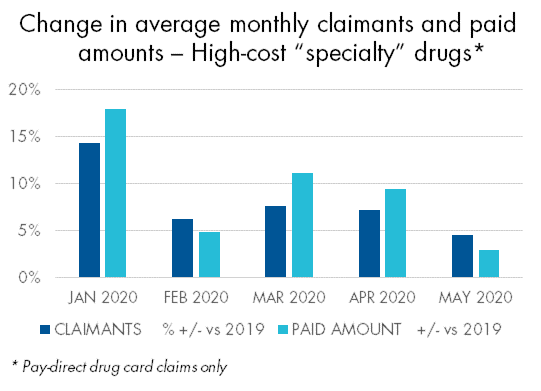 There were some notable exceptions to this trend. For example, both claimants and paid amounts for high-cost “specialty” drugs increased in March, April and May. Thirty-day refills are the norm for these drugs, so they weren’t impacted by the re-fill limits.
Claims for asthma drugs had the largest surge of any common disease category in March but had no subsequent drop in April. Not surprisingly, claims for mental health drugs increased throughout the pandemic, including a 33% increase in the number of claimants in May.
Going forward, we should see the average quantity per prescription stabilize in future months and return to normal, provided pharmacies return most patients to refills of more than 30 days.
The full impact of COVID-19 remains to be determined. We will continue to provide timely updates on any developments that impact our clients and their plan members or their benefits coverage. In the meantime, please contact your Group Account Executive or myFlex Sales Manager if you have questions.
- [pdf] Unique Mortgage Protection
- Re-Allocation of funds
-
Equitable Life Savings & Retirement Webinar Series welcomes Mackenzie Ivy Global Balanced.
In 2021, Equitable Life’s® S&R team will spotlight various aspects of our competitive fund lineup and product offerings. Each webinar in the series will feature a new topic. This series will also give advisors an opportunity to:- learn more about various products and product features,
- hear from industry professionals,
- learn about investment strategies; and so much more.
This month, Equitable Life welcomes Mackenzie Investments.
Join your host Joseph Trozzo, Investment Sales Vice President and Matt Moody, Vice President, Portfolio Manager, Mackenzie Ivy Team and Dagmar-Rose Pagel, Product Manager.
Learn More
-
Important changes are coming to the Equitable Life segregated funds contract.
Fund changes are coming on June 7, 2021 to Equitable Life’s® segregated fund lineup. These fund changes will appear on the June 2021 semi-annual client statement and will be reflected in the 2021 Pivotal Select™ and Pivotal Solutions Fund Facts.
Clients holding these funds received a letter in the mail. To view a copy of these letters, refer to the links below.
- Pivotal Select Special Note
- Pivotal Solutions II Special Note
- Personal Investment Portfolio and Pivotal Solutions Special Note
If you have any questions about these fund changes, please contact your Regional Investment Sales Manager or Advisor Services Team Monday to Friday from 8:30 a.m. to 7:30 p.m. ET at 1.866.884.7427 or email savingsretirement@equitable.ca -
Equitable Life Savings & Retirement Webinar Series featuring Dynamic Funds
In 2022, Equitable Life’s® S&R team will continue to spotlight various aspects of our competitive fund lineup and product offerings. Each webinar in the series features a new topic. This series gives advisors an opportunity to:
-
learn more about products and product features,
-
hear from industry professionals,
-
learn about investment strategies; and so much more.
This month, Equitable Life welcomes David L. Fingold, Vice President and Portfolio Manager, 1832 Asset Management L.P.
Learn More!
-
-
Equitable Life of Canada Webcast Series Featuring Invesco Canada
Equitable Life® continues to spotlight various aspects of our competitive fund lineup and product offerings. This series gives advisors an opportunity to:
- learn more about products and product features,
- hear from industry professionals,
- learn about investment strategies; and so much more.
In this webcast, we welcome

Join us to learn the reasons for the growth in ESG, how the following funds are managed and how they can be positioned in a client’s portfolio.- Equitable Life S&P/TSX Composite ESG Index Fund Select
- Equitable Life S&P 500 ESG Index Fund Select
- Equitable Life NASDAQ 100 ESG Index Fund Select
Learn more
-
Equitable Life Webcast Series featuring Franklin Templeton
Equitable Life® continues to spotlight various aspects of our competitive fund lineup and product offerings. This series gives advisors an opportunity to:
• learn more about products and product features,
• hear from industry professionals,
• learn about investment strategies; and so much more.
In this webcast, we welcome
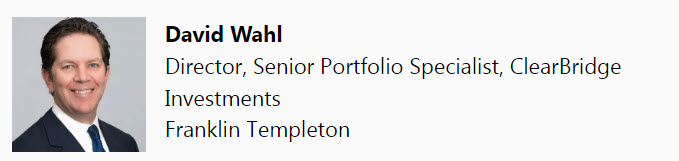.jpg "David-Wahl-(1).jpg")
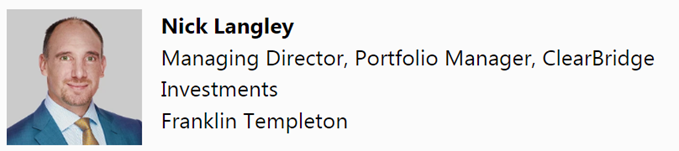
Join us to learn about Equitable Life ClearBridge Sustainable Global Infrastructure Income Fund Select along with the fund’s people, process, philosophy, and performance.Learn more
-
Equitable Life Webcast Series featuring Fidelity Investments
Equitable Life® continues to spotlight various aspects of our competitive fund lineup and product offerings. This series gives advisors an opportunity to:-
learn more about products and product features,
-
hear from industry professionals,
-
learn about investment strategies; and so much more.
In this webcast, we welcome
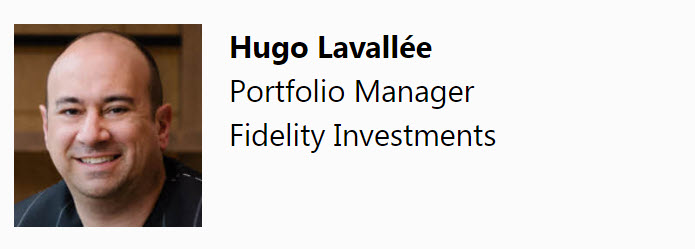.jpg "speaker-(2).jpg")
Join us to learn about the Equitable Life Fidelity® Climate Leadership Balanced Fund Select and Equitable Life Fidelity® Climate Leadership Fund Select now available in Pivotal SelectTM Investment Class (75/75). Learn about the funds’ people, process, philosophy, and performance.
Learn more
You won’t want to miss it! -