
Site Search

985 results for life policy 300109556

  1. Celebrating our most popular Pivotal Select funds

    In August 2022, Equitable® launched 12 new segregated funds in Pivotal Select’s Investment Class (75/75). We wanted to bring some new innovative solutions to the product, including six sustainable investment funds. To say the launch of these funds was successful would be an understatement.

    The funds are quickly becoming some of the most popular funds in Pivotal Select™, and their performance in 2023 was impressive. Equitable wants to celebrate these funds and encourage clients to consider them for their portfolios.

    As of February 29, 2024, nine out of the 12 funds received a 1st quartile ranking for their 1-year return and two more were 2nd quartile. The table below shows the new funds that ranked in the top two quartiles for their 1-year returns.


    TABLE-1-FINAL-EN.png

    Access additional fund performance information

    If you haven’t looked at these funds yet, now is the time. Speak to clients about their investment options and see if these funds fit within their investment portfolio.

    Talk to your Director, Investment Sales today for more information.


    Disclaimer

    Any amount that is allocated to a segregated fund is invested at the risk of the contractholder and may increase or decrease in value. Segregated fund values change frequently, and past performance does not guarantee future results. Investors do not purchase an interest in underlying securities or funds, but rather, an individual variable insurance contract issued by The Equitable Life Insurance Company of Canada. There are risks involved with investing in segregated funds. Please read the Contract and Information Folder before investing for a description of risks relevant to each segregated fund and for a complete description of product features and guarantees. Copies of the Contract and Information Folder are available on equitable.ca.

    Management Expense Ratios (MERs) are based on figures as of February 29, 2024, and are unaudited. MERs may vary at any time. The MER is the combination of the management fee, insurance fee, operating expenses, HST, and any other applicable non-income tax for the fund and for the underlying fund. For clients with larger contract values, a Management Fee Reduction may be available through the Preferred Pricing Program. For details, please see the Pivotal Select Contract and Information Folder.

    ® and TM denote trademarks of The Equitable Life Insurance Company of Canada.


    Posted April 18, 2024 

  2. Advisor Compensation after the DSC/LL ban May 29, 2023 As of May 29, 2023, Pivotal Select segregated fund contracts will not allow new deposits to the Deferred Sales Charge (DSC) and Low Load (LL) sales charge options. This is in response to the ban on deferred sales charges by the Financial Services Regulatory Authority (FSRA). The following sales charge options will continue to be available:
    • No Load (NL)
    • No Load – 3 year chargeback (NL-CB)
    • No Load – 5 year chargeback (NL-CB5)
     
    Advisors may be wondering how compensation compares under various sales charge options.
     
    Here is an example of advisor compensation for a $100,000 segregated fund contract in the Equitable Life Active Balanced Portfolio Select.* 
    Year No Load DSC Low Load No Load CB No Load CB5
    1 $1,008 $5,544 $3,024 $3,500 $5,600
    2 $1,008 $504 $504 $504 $504
    3 $1,008 $504 $504 $504 $504
    4 $1,008 $504 $1,008 $504 $504
    5 $1,008 $504 $1,008 $1,008 $504
    6 $1,008 $504 $1,008 $1,008 $504
    7 $1,008 $504 $1,008 $1,008 $504
    8 $1,008 $504 $1,008 $1,008 $504
    Contract Value Total Compensation Paid
    $100,000 $8,064 $9,072 $9,072 $9,044 $9,128
    *For illustration purposes, this assumes a 0% return over the period shown.
     
     
    Over an 8-year period, total advisor compensation with the CB5 sales charge option is $9,128 versus $9,072 and $8,064 with DSC and NL respectively.
     
    Below is the chargeback schedule for NL-CB and NL-CB5: 
     
    Month (age of units) Commission Chargeback Schedule
    NL-CB
    Commission Chargeback Schedule
    NL-CB5
    1 - 12 100% 100%
    13 - 24 97.2% - 66.4% 98.3% - 82.0%
    25 – 36 63.6% - 32.8% 80.5% - 64.0%
    37 – 48 0% 62.5% - 46.0%
    49 – 60 0% 44.5% - 28%
    61+ 0% 0%
     
    For more information, please contact your Regional Investment Sales Manager.
     
    ™ or ® denote registered trademarks of The Equitable Life Insurance Company of Canada.
     
    Date posted: June 15, 2023 
     
  3. Equitable Life Group Benefits Bulletin – May 2020

    In this issue:

    *Indicates content that will be shared with your clients


    Easy and convenient digital resources for your clients and their plan members

    During this time of physical distancing, people are looking for ways to interact with their providers virtually. We have several convenient digital tools available to make it easier for your clients and their plan members.


    For plan administrators:


    Plan administrator portal (EquitableHealth.ca)

    Our secure portal allows plan administrators to easily manage their plan anytime and anywhere. Instead of printing and mailing forms, they can make real-time updates at their convenience. The site also makes it easy to:

    • View or upload forms and other important documents;
    • Retrieve billing information;
    • Estimate monthly premium costs; and
    • View announcements, tips and reminders.

    Plan administrators can visit www.equitablehealth.ca to activate their account.

    Digital Welcome Kits

    Instead of paper kits that can easily get lost or quickly become outdated, plan members receive personalized welcome kits via an interactive email, including instructions on how to:

    • Activate their online group benefits account;
    • Download their digital benefits card;
    • Submit claims from their computer or mobile device;
    • Review their coverage details; and
    • Explore health and wellness resources.

    Easy automated payments

    Automated payments are a convenient way to avoid missed payments, suspended claims and disruption. Plan administrators simply complete the pre-authorized debit form and send to GroupCollections@equitable.ca. Or contact Group Collections about online banking and electronic funds transfer (EFT).

    We can help

    For assistance, plan administrators can contact their Client Relationship Specialist or our Web Services team at 1.800.265.4556 ext. 283 or groupbenefitsadmin@equitable.ca.


    For plan members:


    Plan member portal (EquitableHealth.ca)

    By logging into EquitableHealth.ca, plan members have secure 24/7 access to their personalized Group Benefits account. They can:

    • View and submit claims;
    • Review their coverage details; and
    • Access health and wellness resources.

    Electronic claims payment and notifications

    Once plan members have activated their Group Benefits account on EquitableHealth.ca, they can easily set up receiving their claim payments via direct deposit, and their claim notifications via email.

    EZClaim Mobile App

    Submitting claims is fast, easy and secure with the Equitable EZClaim® mobile app for iOS and Android devices. Plan members can view and submit health and dental claims and review their coverage details.

    Digital Benefits Cards

    Instead of digging through their wallets, plan members can download a digital version of their benefits card to their mobile device.

    We can help

    We’ve created a video guide to help plan members access and use their digital resources. For further assistance, plan members can contact our Web Services team at 1.800.265.4556 ext. 283 or groupbenefitsadmin@equitable.ca.


    Alberta government delaying biosimilar initiative

    As we announced in the February 2020 issue of eNews, the Alberta Biosimilar Initiative will require patients using several originator biologic drugs to switch to a biosimilar in order to maintain coverage through their Alberta government sponsored drug plan.

    Due to the increased demands the COVID-19 pandemic is placing on healthcare providers, the Alberta government has postponed the switching requirement. Affected patients will now have until January 15, 2021 to switch to the biosimilar version of their drug in order to maintain provincial coverage.

    We continue to investigate appropriate options to help ensure this provincial change does not unreasonably impact Equitable Life groups and patients and will keep you informed.
    For more information about the Alberta Biosimilars Initiative, consult the Alberta government website.


    Yukon increasing Insurance Premium Tax

    The Yukon Government has announced that it plans to increase its Insurance Premium Tax rates effective January 1, 2021. The premium tax rates for group life and accident and sickness insurance are expected to increase from 2% to 4%. The new tax rates will be applied to premiums paid on or after January 1, 2021.


    Manitoba and New Brunswick relaxing drug limits

    In order to protect the drug supply during the COVID-19 crisis, residents of most provinces were temporarily limited to receiving a 30-day supply of drugs when filling a prescription. Normally, doctors prescribe a 90-day supply for most maintenance-type drugs.

    The Government of Manitoba and the Government of New Brunswick are now relaxing this 30-day limit for prescription drugs where shortages do not exist. They will address potential shortages of specific drugs if necessary.

    As the situation continues to evolve, there may continue to be changes to provincial legislation and prescription limits. Plan members should speak to their pharmacist for the most up to date information.


    Free guide to accessing virtual healthcare

    With many health clinics closed and the healthcare system under strain, people are looking to access a doctor and other health providers virtually.

    As we announced previously, we’ve made it easier for plan members to find the information they need using our Guide to Accessing Virtual Healthcare. This online resource provides information about and links to a range of virtual health services they need to take care of their health and the health of their family during these challenging times.

    The Guide also indicates which services are covered by public health plan, so there’s no cost to the patient to access them if they provide their valid provincial health card.
    We will continue to update the Guide as more virtual healthcare providers and services become available.

    The Guide is available on both EquitableHealth.ca and Equitable.ca.


    Homeweb for plan members who are losing coverage

    We know these are difficult times for Canadian employers and their employees. As businesses temporarily suspend operations, some employers have had to make the difficult decision to temporarily lay off employees or put their benefits coverage on hold.

    That’s why we were pleased to announce that Homewood Health® and Equitable Life will extend access to Homeweb, a personalized online mental health and wellness portal, for up to 120 days for plan members who have temporarily lost their benefits coverage due to COVID-19.

    Employees and their family members will continue to have access to the Homeweb website and mobile app, including:

    • iVolve, online self-directed Cognitive Behavioural Therapy;
    • Resources to support themselves and their family members through the COVID-19 pandemic;
    • An interactive online Health Risk Assessment; and
    • An online library of tools, assessments and e-courses.

    This will allow businesses undergoing financial hardship to provide some support to employees who are temporarily without benefits coverage.

  4. EAMG Market Commentary January 2024


    Rates & Credit – Interest rates decreased sharply in Q4 as the market priced in aggressive interest rate cuts by central banks in 2024.  The prospect of lower interest rates also drove a strong risk-on tone to the market, with the risk premium on corporate bonds grinding tighter as prospects for a “soft landing” improved. The rally in interest rates resulted in the best quarter for bonds over the past 15 years, with the FTSE Canada Universe Index returning 8.3%.  Corporate bonds modestly underperformed the Universe Index with a return of 7.3%.  The lower return for corporate bonds was primarily driven by the fact that the corporate bond index is less sensitive to interest rate movements (as compared to the government index), partially offset by the risk-on tone to the market.  Within corporate bonds, lower-rated BBBs outperformed higher-rated A bonds. Industries with higher interest rate exposure such as infrastructure, energy, and communications outperformed those with less exposure (notably financials and securitization), consistent with the overall shift in the yield curve.
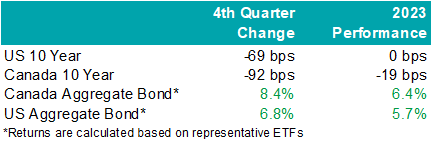
    image1-(1).png
     
    Santa Came to Town – Moving in sync with bonds, global equities jolted higher into the end of the year with cooling inflation data and dovish comments from central bankers. The U.S. market outperformed most regions last quarter with the S&P 500 returning 11.7% in USD terms, bringing the total return in 2023 to 26.3%. The TSX added 8.1% in Q4, boosting the total annual return to 11.8%. Meanwhile, major developed economies from Europe, Australasia, and the Far East (EAFE) gained 5.0% in local currency terms over the quarter, helping the region produce a 16.8% return from the year prior. Prospects of interest rate cuts by the Federal Reserve saw the Loonie rally into year-end and resultantly, investors of Canadian dollar securities witnessed enhanced returns. Strong domestic U.S. economic data helped value pockets of the market outperform. That said, this was not a synchronized trend as China’s economic disappointment weighed on the performance of EAFE.
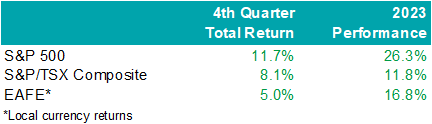
     
    image2.png
     
    U.S. Fundamentals – Our work shows that investors are shifting their focus away from operating margins and towards the ability to sustain debt levels ahead of renewing debt obligations. Corporate earnings beat modest expectations last quarter, contracting by less-than-expected on a year-over-year basis. Resilient operating margins continue to attract investors into equities. After three consecutive quarters of improving forward earnings guidance, we observed that the number of major companies expecting deteriorating financial performance grew to ~35%. We note that this is a sharp contrast relative to the optimistic run-up in equity valuations. In general, corporate pessimism has been underpinned by concerns for the health of the consumer, increasing wage pressures, and inflation.
     
    U.S. Quant Factors – While mega-cap technology stocks gave back some ground in the second half, crowding into the magnificent 7 remains noticeable with the cap weighted S&P 500 outperforming the equal weighted index by 12.5% last year. That said, value areas of the market – which underperformed through the first three quarters of the year – were top performing companies last quarter as the prospects for an economic “soft-landing” improved with U.S. inflation continuing to ease without substantial deteriorations of employment or output data. Quality-growth businesses initially outperformed as the higher-for-longer narrative continued to drive investors toward large cash-rich companies with stable margins. That said, this basket of companies gave back relative returns into quarter-end as weakness in operating margins persisted, making fundamentals appear stretched. Low volatility stocks (i.e. stocks with lower sensitivity to broad market movement and lower price volatility) rallied to start the quarter before dovish comments from central bankers improved risk-sentiment and ultimately pushed this basket lower on a relative basis. Lastly, dividend growth companies, which include businesses with a lengthy and established history of increasing dividends, underperformed the broader index as market participants punished businesses that slowed capital growth projects during the rising interest rate environment. While operating margins have declined, the basket’s strong cash flow and low debt burden may be advantageous if the market’s anticipation of impending interest rate cuts proves to be incorrect or mistimed.
     
    Canadian Fundamentals – Although Canadian companies exceeded bleak forecasts last quarter, earnings continue to contract on a year-over-year basis. Return on equity (ROE) – a gauge of how efficiently a corporation generates profits – continued to decline last quarter while corporate costs of capital remain elevated. In essence, Canadian companies are generating less value relative to their financing cost. Value creation underpins the sustainability of dividend payments, which are a unique and desirable attribute of the Canadian market. Meanwhile, the Bank of Canada held its overnight interest rate unchanged with market participants forecasting a higher probability of interest rate cuts in 2024. On the expectations of easing monetary conditions, dividend yields compressed while earnings forecasts improved with analysts predicting that index aggregate earnings will grow 6% to 8% in 2024. At a sector level, the energy industry’s financial performance normalized – in line with expectations – as weakening oil demand expectations overshadowed geopolitical conflict in the Middle East, ultimately pushing crude prices ~21% lower last quarter. The industrials and financials sectors beat expectations, helping offset softer-than-expected results from the consumer staples and technology sectors.
     
    Canadian Quant Factors – The Canadian banks underperformed for most of the year as they reported increasing provisions for nonperforming loans, reflecting forecasts of worsening economic conditions. That said, expectations of interest rate cuts in 2024 helped tame recession fears and eased concerns of slowing loan growth, propelling banks higher in the fourth quarter as they appeared more stable and therefore favourable than prior estimates. The high-quality basket underperformed last quarter as improving risk sentiment in the market reduced the attractiveness of secure companies with lower earnings variability. Furthermore, high dividend payers with solid growth prospects outperformed in the fourth quarter as market participants rewarded companies that demonstrated a strong ability to support future dividends and punished high yielding businesses with less certain financial capabilities.
     
    Views From the Frontline Rates – Interest rates declined sharply in Q4 as inflation continued to trend lower, fears of excess bond supply declined, and the Federal Open Market Committee signaled that the next change to their overnight policy interest rate would likely be lower. Labour market and consumer spending data remain resilient however businesses have indicated slowing across industries, more price-sensitive consumers, rising delinquencies, and concerns about the high cost of debt.  Central banks remain committed to achieving their 2% inflation target and most acknowledge that interest rates have likely peaked.
     
    Credit – The risk premium for corporate bonds (versus government bonds) tightened materially over the quarter, with a strong risk on tone to the market as investors priced in lower interest rates in 2024 and a “soft-landing” to economic concerns.  Corporate bond supply was well received by the market.  On the balance, we do not think the current risk premium adequately compensates for downside risk, and as such, we remain cautious on   corporate bonds and have a bias towards higher-quality, shorter-dated credit where we view the risk / reward dynamic as being more favourable.
     
    Equity – In the U.S., we allocated exposure to value names which outperformed over the quarter as the macroeconomic outlook improved on the backdrop of rate cut expectations. Looking forward, we expect that margins will continue to normalize as Covid-induced pent up demand fades. While we do not forecast margins to compress at an alarming rate, we believe sticky wage and input costs will continue to pressure businesses while consumers exhibit further exhaustion. As such, we are shifting our focus toward the balance between company reinvestment in capital projects and upcoming debt refinancing requirements. In line with this view, we favour businesses with stable cash flows and decreased debt loads as we believe they present an attractive contrarian opportunity if soft-landing projections prove to be overstated. Within Canada, we remain attentive to the inverse movements of ROE relative to financing costs over 2023. With the excess between ROE and financing costs compressing, businesses’ ability to create value appears more stretched than earlier in 2023. Therefore, we continue to favour high quality companies in Canada, which is typically defined by high ROE, stable earnings variability, and low financial leverage. Geographically, the U.S. economy appears to be in healthier condition with inflation easing while employment and output data remain stable and hence, our focus will be on capital expenditures. EAFE – which is generally more economically linked to China than North America – contains a large bucket of stable, high-quality businesses that may benefit from any upside economic surprises out of China. Lastly, through the lens of a Canadian investor, the Loonie’s relative value versus other major currencies presents another resource in our investment mandate to derive excess return.


    Downloadable Copy


    Mark Warywoda, CFA
    VP, Public Portfolio Management
    Ian Whiteside, CFA, MBA
    AVP, Public Portfolio Management
    Johanna Shaw, CFA
    Director, Portfolio Management
    Jin Li
    Director, Equity Portfolio Management
     
    Tyler Farrow, CFA
    Senior Analyst, Equity
     
    Andrew Vermeer
    Senior Analyst, Credit
     
    Elizabeth Ayodele
    Analyst, Credit


    ADVISOR USE ONLY

    Any statements contained herein that are not based on historical fact are forward-looking statements. Any forward-looking statements represent the portfolio manager’s best judgment as of the present date as to what may occur in the future. However, forward-looking statements are subject to many risks, uncertainties, and assumptions, and are based on the portfolio manager’s present opinions and views. For this reason, the actual outcome of the events or results predicted may differ materially from what is expressed. Furthermore, the portfolio manager’s views, opinions or assumptions may subsequently change based on previously unknown information, or for other reasons. Equitable® assumes no obligation to update any forward-looking information contained herein. The reader is cautioned to consider these and other factors carefully and not to place undue reliance on forward-looking statements. Investments may increase or decrease in value and are invested at the risk of the investor. Investment values change frequently, and past performance does not guarantee future results. Professional advice should be sought before an investor embarks on any investment strategy.
     
  5. [pdf] DSC/Transfer Fee Recovery Program – FAQ
  6. [pdf] Market Commentary October 2025
  7. [pdf] Life Quick Reference Guide
  8. [pdf] Gradual Inheritance Strategy
  9. Advisor Guide
  10. [pdf] Alternative Identification Requirements