

Site Search
575 results for visit site now MAKEMUR.com pay to destroy evidence in my criminal case
-
How to talk to clients about CI when they don’t want to
Does this sound familiar?
You’re having a chat with your client about Critical Illness insurance. They suddenly interject: “Critical illness insurance isn’t for me.”
“Why is that?” you ask.
“Because….
- Critical Illness insurance is expensive!
- I don’t understand what it covers exactly.
- I have money to cover me if I get sick, so I don’t need this.
- I’m healthy enough.
- It’s not life insurance, so I don’t need it right now.
- I already have disability coverage through my work.”
If you’ve heard any of these responses, and didn’t know how to respond, we can help.
Our Path to Success program covers all these objections and more with simple-to-follow PDFs and videos. You’ll learn conversation strategies and tips on how to navigate the sale. Most importantly, you’ll know exactly what to say the next time a client objects to Critical Illness insurance.
Want to learn more? Check out our CI Path to Success modules here!
Need CE credits? Take our Path to Success program here. - Brandes
-
NEW MARKETING MATERIAL! Flexibility for supplemental income with Equimax
Equitable has created a new piece to help you understand our new Equimax® illustration feature, Paid-Up Additions (PUA) to Cash Dividends, now available!
Did you know Equimax clients can switch from the PUA dividend option to the cash dividend option by simply requesting a dividend option change?1,2
You can illustrate this for paid-up 10 pay and 20 pay Equimax plans! Show clients how they can build in added flexibility and use their policy to create a source of future supplemental income by simply changing the dividend option to cash.3
Illustration Considerations:
● Works with Equimax Estate Builder® or Equimax Wealth Accumulator®.
● Illustrate the Excelerator Deposit Option (EDO) to help build the policy values while the PUA dividend option is in effect. EDO payments can’t be made once the policy is switched to the cash dividend option.
● If a client needs temporary insurance coverage – like mortgage protection - illustrate term riders for how long they are needed to meet the specific goal.3
● If critical illness coverage is needed our competitively priced 20 pay critical illness riders are a great fit to provide paid-up critical illness coverage.3
Clients should apply for the coverage they need. This concept is about flexibility to create a future source of supplemental income.
Want to learn more? Check out our new marketing piece: Flexibility for supplemental income with Equimax (2077).
For more information, reach out to your local wholesaler.
® and TM denote trademarks of The Equitable Life Insurance Company of Canada.
1 Dividends are not guaranteed and are paid at the sole discretion of the Board of Directors. Dividends may be subject to taxation. Dividends will vary based on the actual investment returns in the participating account as well as mortality, expenses, lapse, claims experience, taxes, and other experience of the participating block of policies.
2 To request a change to the dividend option complete and submit form 558 (Request for Withdrawal of Dividends, Change in Option, or Premium Offset). A client can request a change to the cash dividend option from any other dividend option regardless of the premium type or whether premiums continue to be payable, subject to our current administration rules and guidelines. Some dividend option changes are subject to underwriting. Underwriting is not required to change from the PUA to cash dividend option, however, underwriting is required to change from the cash dividend option to the PUA dividend option.
3 This concept is intended to illustrate a one-time switch to cash dividends once premiums are no longer payable for the policy (including premiums for riders). Premiums are paid with after-tax dollars and dividends paid in cash are subject to taxation. If premiums are payable there will be tax savings for the client to use the before-tax cash dividend to reduce the premium instead of taking it entirely as a cash payment. This concept is intended for longer term planning, not to meet short term cash needs by switching back and forth between the PUA and cash options. Clients should consider a policy loan or a cash withdrawal to meet short-term cash needs; policy loans and cash withdrawals may be subject to taxation.
- Chinese Markets
-
Equitable Life Group Benefits Bulletin - September 2020
In this issue:
Enhancements to Equitable EZClaim Mobile
New reports available on EquitableHealth.ca* Indicates content that will be shared with your clients.
Enhancements to Equitable EZClaim® Mobile*
We’ve updated our Equitable EZClaim mobile app to process vision claims faster, to provide a new option for submitting documents and to increase password security.
Faster vision claims processing and payment
Equitable Life now provides faster processing of vision claims submitted via EZClaim Mobile.
This means plan members can find out the status of their vision claim almost instantaneously. And, for approved claims, they will receive payment even sooner – often in as little as 24 hours.
In order to allow for instant processing and faster payment, plan members will be prompted to enter some additional information, including their practitioner’s name, the date of the expense, the type of expense and amount of the expense when submitting their claims for these services.
Equitable Life plan members can submit all vision claims via Equitable EZClaim, including coordination of benefits and Health Care Spending Account claims.
Submit documents from a mobile device
We have added our Document Submission tool to EZClaim Mobile so plan members can conveniently submit documents directly from their mobile device. Applications, change forms, statement of health forms and more can all be easily uploaded whenever and wherever they are.
Improved security with stronger passwords
To help you, your clients and plan members better protect personal information, we have increased the maximum length of passwords for both EZClaim Online and EZClaim Mobile from 12 to 32 characters. This longer character limit makes it easier to create stronger and more secure passwords.
There is no change for plan members, plan administrators or advisors. All existing passwords will continue to function. However, if you choose to update your password you will now be able to choose longer passwords or passphrases.
Why should I change my password?
Changing your password frequently helps keep your information safe. The longer and more random the password, the more secure it is. To improve security even more, a passphrase is recommended.
A passphrase is a series of words or other text used like a password. Because it is much longer, a passphrase is more secure. Although the words in the phrase may be meaningful to you and easy to remember, they can be random enough that the full phrase is difficult for someone else to guess. It’s even better if you use numbers or other characters in your passphrase.
Your passphrase should be:
- Long enough to be hard to guess;
- Not a famous quotation;
- Easy to remember and type; and
- Not used in multiple places.
To change your password:
- Log in to EquitableHealth.ca
- Click on My Information > User Profile
- Click Edit
- Confirm your information and enter your new password
- Click Save
We will be announcing this enhancement to plan members on EquitableHealth.ca.
New reports available on EquitableHealth.ca*
Plan administrators and advisors with reporting access can now download three additional reports any time via the plan administrator and advisor websites on EquitableHealth.ca:
- Premium and Tax – This report provides a breakdown of premiums and taxes paid per plan member for any specific time period for all applicable benefits.
- Occupation and Earnings – This report provides current plan member earnings and occupation information and gives plan administrators an efficient way to report updates to us.
- Employee listing – This report lists all plan members’ information, including name, certificate number, date of birth, province, occupation and salary, as well as benefit coverage currently in place and HCSA allocations.
These reports can be downloaded in Excel format for easy updating, filtering or sorting.
For more information, please contact your Client Relationship Specialist.
*Indicates content that will be shared with your clients
-
February 2020 Advisor eNews
In this issue:
Provincial biosimilar update
Legislative changes for Alberta’s Coverage for Seniors program
Coming soon: enhancements to Equitable EZClaim® Online
Provincial biosimilar update

Alberta Biosimilar Initiative
On December 12, 2019, the Alberta government introduced the launch of the Alberta Biosimilar Initiative. This program will require patients using several originator biologic drugs to switch to a biosimilar, and patients using a non-biologic complex drug (NBCD) to switch to its subsequent entry version before July 1, 2020 in order to maintain coverage.
Biologics are drugs that are engineered using living organisms like yeast and bacteria. The first version of a biologic developed is also known as the “originator” drug. Biosimilars are highly similar to the originator drug they are based on and have been shown to have no clinically meaningful differences in safety or efficacy.
Alberta Health will initially cover both the originator and biosimilar or subsequent entry version of a NBCD drug as patients start the switching process.
The following table outlines the affected originator drugs, their biosimilars or subsequent entry, and the conditions affected by the program.
Biosimilar Drug Originator Biosimilar/Subsequent Entry Indications Affected etanercept Enbrel Brenzys Ankylosing Spondylitis
Rheumatoid ArthritisErelzi Ankylosing Spondylitis
Psoriatic Arthritis
Rheumatoid Arthritisinfliximab Remicade Inflectra
RenflexisAnkylosing Spondylitis
Plaque Psoriasis
Psoriatic Arthritis
Rheumatoid Arthritis
Crohn’s Disease
Ulcerative Colitisinsulin glargine Lantus Basaglar Diabetes (Type 1 and 2) Filgrastim Neupogen Grastofil Neutropenia pegfilgrastim Neulasta Lapelga Neutropenia glatiramer* Copaxone Glatect Multiple Sclerosis *Glatiramer is a non-biologic complex drug where the originator is Copaxone and the subsequent entry is Glatect.
Equitable Life is actively investigating the benefit, risk and appropriate plan changes associated with this new policy on private drug plans and will keep you informed.
For more information about the Alberta Biosimilars Initiative, consult the Alberta government website.
British Columbia
In 2019, BC Pharmacare introduced a Biosimilars Policy that impacted coverage of three biologic drugs – Remicade, Enbrel and Lantus. As of November 25, 2019, these drugs were no longer eligible in BC for most conditions for which lower cost biosimilar versions are available. Patients in the province with these conditions were required to switch to biosimilar versions of these drugs in order to maintain their coverage.
The second phase of the BC Biosimilar Policy takes effect March 6, 2020 when Remicade will be delisted for Crohn’s Disease and Ulcerative Colitis. Patients in the province with these conditions will be required to switch to Inflectra or Renflexis in order to maintain their coverage.
Biosimilar Drug Originator Biosimilar Indications Affected infliximab Remicade Inflectra
RenflexisCrohn’s Disease
Ulcerative ColitisWe have communicated with the affected plan members, informing them of the need to switch medications. If plan members have any questions or concerns, our Customer Care team is here to help and support them through the transition.
If you have any questions about this policy, please contact your Group Account Executive or myFlex Sales Manager.
Ontario
In November 2019 Ontario Minister of Health Christine Elliot indicated that the government was planning to launch consultations to explore solutions in managing biologics.
Equitable Life will continue to monitor these developments and keep you informed of any impact on private drug plans.
Legislative changes for Alberta’s Coverage for Seniors program
The government of Alberta has announced that as of March 1, 2020, seniors’ family members (such as spouses and dependents) who are younger than 65 will no longer be covered by the provincial Coverage for Seniors program. Albertans 65 years of age and older will continue to be covered under the provincial plan.
Equitable Life plan members and their dependents will continue to be covered under the parameters of their group benefits plan.
For more information, please see the Alberta Seniors Health Benefits website.
Coming soon: enhancements to Equitable EZClaim® Online
Faster vision claims processing and payment
Equitable Life will soon provide real-time processing of vision claims submitted via EZClaim Online.
This means plan members will be able to find out the status of their vision claim almost instantaneously. And, for approved claims, they will receive payment even sooner – often in as little as 24 hours.
In order to allow for instantaneous processing and faster payment, plan members will be prompted to enter some additional information including the practitioner’s name, the date of the expense, the type of expense and amount of the expense when submitting their claims for these services.
Equitable Life plan members can submit all vision claims via EZClaim, including coordination of benefits and Health Care Spending Account claims.
This enhancement will be coming to our EZClaim Mobile app in the coming months.
New printable claims extract
As part of our ongoing efforts to improve customer experience for plan members, we will also offer a claims extract in a printable format within the plan member site. Plan members will be able to select a date range and claimant, then generate and download a detailed list of health and dental claims. This is a helpful way to keep track of claims, especially when reviewing them in preparation for income tax filing.
Once these enhancements are live you will be notified in an eNews, and an announcement will be posted on the plan member section of EquitableHealth.ca.
Elimination of Out-of-Country Travellers Program in Ontario
Effective January 1, 2020, the Ontario government eliminated OHIP coverage for emergency services for Ontarians travelling outside of Canada.
Previously, the Out-of-Country Travelers Program provided some reimbursement for services required to treat conditions that are acute, unexpected, arose outside Canada and require immediate treatment. The program covered between $200 and $400 per day for inpatient services and $50 per day for outpatient and doctor services.
For groups who have out-of-country coverage from Allianz, this change will not impact the cost to your plan members, or the process plan members follow in the event of an emergency while travelling.
Plan members should still call Allianz in the event of an out of country emergency. Allianz will deal with their claim as usual and will now pay for the portion of the claim previously paid by OHIP. Plan members will not have any additional out-of-pocket costs.
We will be sharing this information with plan members as a news item on our plan member website, equitablehealth.ca.
-
Market Commentary January 2025
Key Takeaways
Full year 2024:
-
Despite reductions of policy-setting interest rates by central banks, yields on longer-term bonds finished the year higher than they started the year.
-
Positive risk appetite helped corporate bonds perform well, led by lower-quality issuers.
-
Global equity markets posted robust returns, with U.S. equities outperforming other developed markets, driven by heavy concentration into the ‘Magnificent 7’ stocks.
Fourth Quarter:
-
Central banks continued to ease monetary policy in Q4, with the Bank of Canada cutting its policy interest rate more aggressively than did the U.S. Federal Reserve.
-
The Republican victory across both the executive and legislative branches in the U.S. ignited expectations of economic growth, pushing bond yields and stock prices higher.
-
Risk sentiment helped corporate bonds continue to outperform government bonds.
-
Markets remained volatile: while North American stock markets continued to outperform most international indices, Canadian stocks managed to outperform U.S. stocks in Q4, as sources of returns in the U.S. narrowed into year-end.
Economic and Market Update
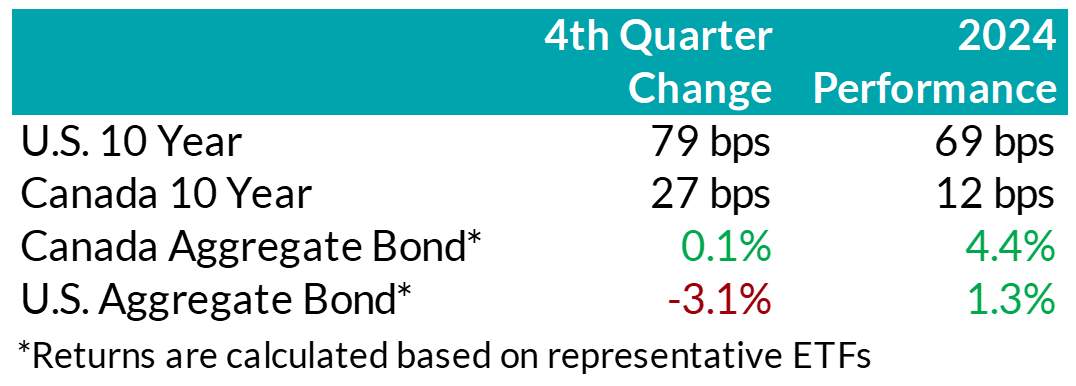
Economic Summary: In the U.S., economic activity continued to expand at a solid pace in Q4. The rate of inflation continued to slow but remained above the central bank’s 2% objective. The labour market in the U.S. remained resilient, as the unemployment rate has remained low compared to historical norms. A decisive victory for Donald Trump and the Republican Party further boosted expectations for continued growth. The return of the President-elect’s old tactics of threatening tariffs to influence trade, security, and drug control re-introduced some economic uncertainty, particularly regarding the potential return of inflationary pressures. Those concerns prompted the Federal Reserve to slow the pace of its policy easing, as it lowered rates by just 0.25% at each of its two meetings in Q4, following the 0.50% cut in September. Throughout 2024, the Fed reduced rates by a total of 100 basis points, from 5.50% to 4.50%. Nonetheless, bond yields were significantly higher for most maturity terms during the fourth quarter as the market priced in not just a stronger economy than had been the expectation during Q3, implying less interest rate cuts by the Fed, but also growing concerns about the government deficit.
In Canada, growth remained positive during 2024 and improved a bit to close the year, but continued to fall short of the Bank of Canada’s expectations. Similarly, inflation came in lower than expected and below the Bank’s 2% target. The labour market continued to soften for much of the year, with employment growth falling short of labour force growth. The weakness in the labour market and economy, along with tamed inflation, prompted the Central Bank to cut rates at the pace of 50 basis points at each of its two meetings in Q4. For the full year, the Bank of Canada ended up lowering its policy rate by a total of 175 basis points, from 5% to 3.25%. The market has been expecting the Bank of Canada to need to continue cutting rates due to slower economic growth in Canada, but the fear of a possible trade war with the U.S. has made the economic outlook somewhat murkier.
.png "Chart1-(1).png")
Bond Markets: During the quarter, yields on mid- to long-term bonds in Canada rose in sympathy with rising bond yields in the U.S. However, bond yields in Canada rose to a lesser extent, and yields on shorter-term bonds were actually little changed over the quarter. The FTSE Canada Universe Bond Index was basically flat during Q4 and posted a return of 4.2% for the full year. Although interest rates rose, credit spreads (i.e. the extra yield on corporate bonds versus government bonds to compensate for their extra risk) continued to grind lower, helping corporate bonds post positive overall returns in the quarter. Tightening credit spreads reflected the generally positive risk-on tone to the market, despite some volatility. Lower-rated BBB bonds generally performed better than higher-quality A-rated bonds. Credit spreads have now generally fallen back to levels similar to those experienced in 2021, when markets did quite well after the pandemic. The on-going appetite of investors for the extra yield offered by corporate bonds over government bonds is indicated not just by falling credit spreads, but also by investors’ enthusiasm to support the primary issuance market. Corporate bond supply continued to be very robust in the quarter, with $30 billion in new issuance, resulting in a record-breaking year with $141 billion of new issuance in 2024. Nonetheless, on balance, we do not think the current risk premium adequately compensates for downside risk, particularly in longer-dated corporate bonds, and have a bias towards shorter-dated credit where we view the risk / reward trade-off as being more favourable.
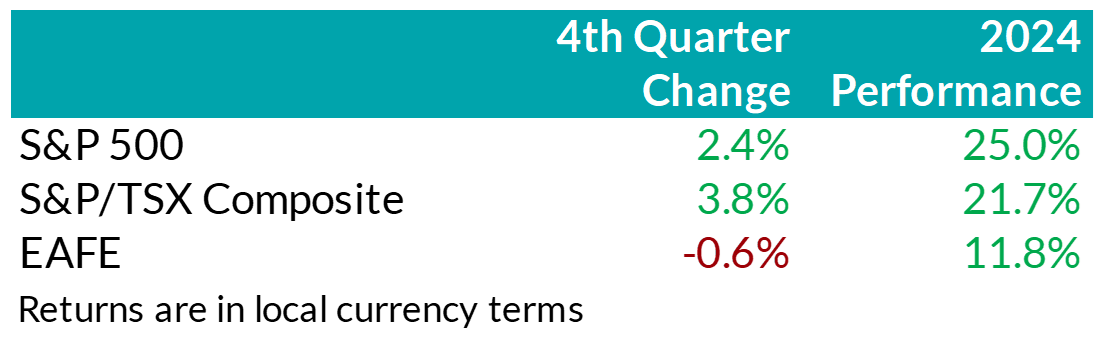.png "Chart2-(1).png") Stock Markets – Overview: Trump’s presidential victory and the Republican party’s ‘red sweep’ in the Senate and House of Representatives sparked optimism surrounding economic growth and a new era of U.S. exceptionalism. As a result, North American equity markets extended their rally in Q4, capping off a year of robust returns. The S&P 500 returned 2.4%, bringing its year-to-date return to 25%. Within the U.S., the broadening of returns paused during the quarter as the chase for growth intensified, with mega-cap growth names like Tesla driving performance. Canadian equities surprisingly outperformed the U.S. market over the quarter, returning 3.8% in Q4, despite threats of widespread tariff negotiations looming on the horizon that could negatively impact Canadian corporate fundamentals. At a sector level, strength in the technology, financials, and energy sectors more than offset weakness in telecommunication companies as well as in the materials sector. Elsewhere, major developed markets from Europe and Asia (EAFE) underperformed last quarter as deteriorating Chinese growth prospects and weak economic growth in the Eurozone weighed on equities. Notably, foreign investors of U.S. denominated securities benefitted from a rebounding U.S. dollar with the dollar index adding over 7.6% in Q4.
Stock Markets – Overview: Trump’s presidential victory and the Republican party’s ‘red sweep’ in the Senate and House of Representatives sparked optimism surrounding economic growth and a new era of U.S. exceptionalism. As a result, North American equity markets extended their rally in Q4, capping off a year of robust returns. The S&P 500 returned 2.4%, bringing its year-to-date return to 25%. Within the U.S., the broadening of returns paused during the quarter as the chase for growth intensified, with mega-cap growth names like Tesla driving performance. Canadian equities surprisingly outperformed the U.S. market over the quarter, returning 3.8% in Q4, despite threats of widespread tariff negotiations looming on the horizon that could negatively impact Canadian corporate fundamentals. At a sector level, strength in the technology, financials, and energy sectors more than offset weakness in telecommunication companies as well as in the materials sector. Elsewhere, major developed markets from Europe and Asia (EAFE) underperformed last quarter as deteriorating Chinese growth prospects and weak economic growth in the Eurozone weighed on equities. Notably, foreign investors of U.S. denominated securities benefitted from a rebounding U.S. dollar with the dollar index adding over 7.6% in Q4.
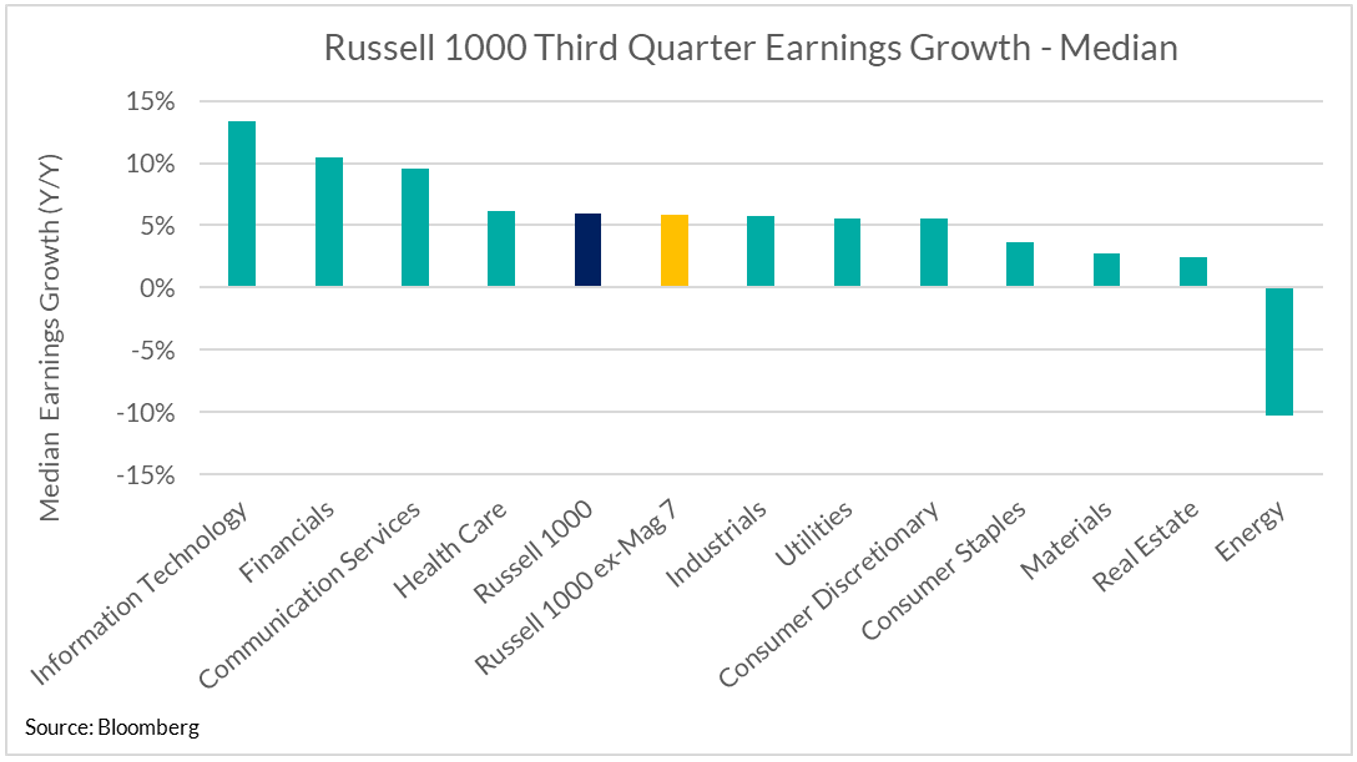.png "Chart3-(1).png") U.S. Equities: U.S. equities remain supported by resilient margins and strong corporate earnings growth with over 70% of businesses surpassing bottom-line expectations last quarter. We remain attentive to the broadening of earnings performance and note that this trend has continued, albeit at a normalized pace versus prior quarters. More specifically, our work shows that members of the Russell 1000, excluding the Magnificent 7, posted median earnings growth of 6% last quarter, down from nearly 9% in Q3 but comparable to Q2 (6%). Looking forward to 2025, analysts continue to forecast U.S. exceptionalism, with forecasts of ~12% earnings growth.
U.S. Equities: U.S. equities remain supported by resilient margins and strong corporate earnings growth with over 70% of businesses surpassing bottom-line expectations last quarter. We remain attentive to the broadening of earnings performance and note that this trend has continued, albeit at a normalized pace versus prior quarters. More specifically, our work shows that members of the Russell 1000, excluding the Magnificent 7, posted median earnings growth of 6% last quarter, down from nearly 9% in Q3 but comparable to Q2 (6%). Looking forward to 2025, analysts continue to forecast U.S. exceptionalism, with forecasts of ~12% earnings growth.
Following Trump’s presidential victory, stocks with greater sensitivity to the U.S. economy, such as small cap businesses, benefitted from expectations of domestically focused growth initiatives. However, stubborn inflation and expectations of fewer interest rate cuts by the Federal Reserve saw the trend of broadening sources of returns pause into the end of the year. Instead, market concentration reaccelerated with investors rushing back towards mega-cap growth stocks. In fact, Tesla – which is approximately 2% of the S&P 500 Index by market cap – contributed approximately one-third of the total index return in Q4, while the Mag 7 as a group contributed over 100% of total returns. In other words, U.S. large cap companies excluding the Magnificent 7 declined in aggregate last quarter.
Canadian Equities: Against the backdrop of cooling inflation and below-trend growth, the Bank of Canada continued to loosen monetary policy. As a result, Canadian companies
showed signs of improving efficiency with return on equity – a gauge of corporate profitability – improving versus prior quarters. Under these conditions, investors remained focused on higher quality, high-dividend paying companies – particularly within the financial sector. Relative to prior quarters, this group witnessed greater contribution out of non-bank financials (such as asset managers and insurance companies), as the premium investors were willing to pay for Canadian banks remained elevated. Across other sectors, the energy sector had a positive quarter as the price of oil stabilized, but falling prices for raw industrials pushed the materials sector lower.
Bottom line: U.S. political developments and subsequent growth expectations dominated market sentiment last quarter. As a result, investors dialed back rate cut expectations and bond yields moved higher. In equity markets, the potential for an era of higher-for-longer rates prompted a resumption of investors crowding into growth stocks. Going forward, we remain cautious of elevated valuations and continue to prioritize diversified sources of returns with a long-term outlook. Nonetheless, despite rich valuations, our base case remains that investors’ enthusiasm for equities will persist in the near-term and stocks should continue to outperform bonds.
Downloadable Copy
ADVISOR USE ONLYMark Warywoda, CFA
VP, Public Portfolio ManagementIan Whiteside, CFA, MBA
AVP, Public Portfolio ManagementJohanna Shaw, CFA
Director, Portfolio ManagementJin Li
Director, Equity Portfolio Management
Tyler Farrow, CFA
Senior Analyst, Equity
Andrew Vermeer
Senior Analyst, Credit
Elizabeth Ayodele
Analyst, Credit
Francie Chen
Analyst, Rates
 Any statements contained herein that are not based on historical fact are forward-looking statements. Any forward-looking statements represent the portfolio manager’s best judgment as of the present date as to what may occur in the future. However, forward-looking statements are subject to many risks, uncertainties, and assumptions, and are based on the portfolio manager’s present opinions and views. For this reason, the actual outcome of the events or results predicted may differ materially from what is expressed. Furthermore, the portfolio manager’s views, opinions or assumptions may subsequently change based on previously unknown information, or for other reasons. Equitable® assumes no obligation to update any forward-looking information contained herein. The reader is cautioned to consider these and other factors carefully and not to place undue reliance on forward-looking statements. Investments may increase or decrease in value and are invested at the risk of the investor. Investment values change frequently, and past performance does not guarantee future results. Professional advice should be sought before an investor embarks on any investment strategy.
-
-
More time to complete and view applications on EZcomplete
You asked for more time, we listened!
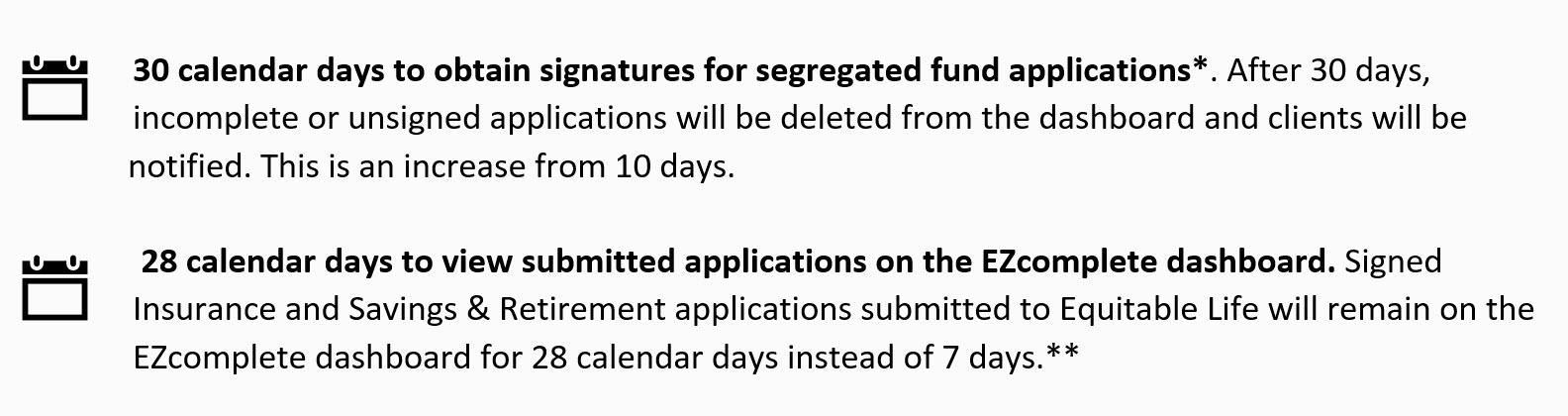
Effective January 14, 2023, you will have more time to complete and view in-flight and completed applications on the EZcomplete® dashboard.
You will now have,
.jpg?width=900&height=238 "image-(1).jpg")
There are no changes to EZcomplete’s Sandbox. Applications in the Practice Site will continue to be deleted after 10 calendar days.Take me to the Sandbox
Take me to EZcomplete
Play around in the Sandbox with a demo client account.
Submit your applications today.
If you have any questions, contact your Regional Investment Sales Manager or Advisor Services Team Monday to Friday, 8:30 a.m. – 7:30 p.m. ET at 1.866.884.7427, or email savingsretirement@equitable.ca.
*Insurance applications currently offer 30 calendar days
** In-flight applications created prior to January 14, 2023, will maintain the existing 10-day submission timeline.
® denote a trademark of The Equitable Life Insurance Company of Canada.
Posted: January 14, 2023 -
Give clients guaranteed retirement income with Payout Annuities
With increased market volatility and interest rates higher than we have seen for much of the past decade, now is a great time to consider payout annuities. Payout annuities can provide regular guaranteed income regardless of how markets perform.
Clients using only a Systematic Withdrawal Plan (SWP) for retirement income are potentially vulnerable during times of market volatility due to the sequence-of-returns risk.1 When markets are down, more units are redeemed to cover income needs. When markets later rise, clients are not able to participate fully in the recovery because more units were redeemed to provide income. That is why having a guaranteed income component, like a payout annuity, as part of an overall retirement strategy is so important.
Three great reasons to consider Equitable Life® for your payout annuity business:
1. Choose from a variety of payout annuity options including:
A. Life Annuity – guaranteed income for one life
B. Joint Life Annuity – guaranteed income for two lives
C. Term Certain – guaranteed income for a specific period of time (5 to 30 years)
D. Term Certain to Age 90 – guaranteed income until age 90
2. Attractive rates, particularly in Registered and Term Certain Annuities
3. Step Up Your Wealth Sales program - 25% of payout annuity net sales qualify for the 0.75% bonus commission earned on net deposits for 20222
.png "button-(1).png")
For more information, please contact your Equitable Life Regional Investment Sales Manager.
1Sequence-of-returns risk, or sequence risk, is the risk that an investor will experience negative portfolio returns very late in their working life and/or early in retirement.
2All eligible deposits, sales, and redemptions occurring between January 1 and December 31, 2022, will be used to calculate an advisor’s 2022 net deposits.
® denotes a registered trademark of The Equitable Life Insurance Company of Canada. -
Update: Improved Employee Assistance from Homewood Health
As we announced in June, we are expanding our relationship with Homewood Health to help you meet the mental health and wellness needs of your employees and their families. Beginning Oct. 1, 2019, Homewood will be the new provider of both our Employee and Family Assistance Program (EFAP) and our online health and wellness services.
Following the transition to Homewood, plan members will benefit from added features:
- Signing in to Homewood Health online allows the platform to customize content unique to your interests.
- All plan members will have access to a Health Risk Assessment to help identify health and wellness barriers.
- i-Volve, Homewood's online cognitive behavioural therapy program is available for all plan members to help them manage anxiety and depression.
Learn more about Homewood Health and how they will be providing your plan members with exceptional EFAP and online health and wellness resources.
What does the transition to Homewood mean for you and your plan members?
We will be working with you in the coming months to facilitate the transition and support your employees. Most importantly, there will be no disruption of service delivery to employees who are currently in short-term counselling with our current EFAP provider.
The transition timeline
Groups without an EFAP
Online health and wellness resources will be available through EquitableHealth.ca just as they are now. Here's what you can expect in the coming months.
September
- We will send plan administrators an email with more details about the resources available to assist in the transition, including:
- How to register for Homewood Health online
- A video orientation for plan members
October
- October 1st – plan members can access the Homewood online resources! They simply need to visit homeweb.ca/Equitable to sign up and create their unique login.
The transition timeline
Groups with an EFAP
We’ve created a helpful infographic that outlines the steps involved in the transition to the Homewood Health EFAP over the coming months. Please save or print it for easy reference. Below are some of the highlights.
August
- We will send plan administrators an email with official notice that the enrolment certificate for our current EAP provider, LifeWorks, will terminate on Sept. 30, 2019, and that Homewood Health Inc. will be our new Employee Assistance Program provider as of Oct. 1.
September
- Homewood will send you a welcome email, including how to access the EFAP, who to contact for support and where to find resources to help share the news with plan members.
- Homewood will follow up directly to answer any questions you may have.
- Homewood will begin offering orientation and training sessions for both plan administrators and plan members. These will be running throughout the fall so you can attend at your convenience.
October
- October 1st – plan members can access the Homewood EFAP and online resources! They simply need to visit homeweb.ca/Equitable to sign up and create their unique login.
- Orientation and training sessions will continue to be available for both plan administrators and plan members throughout October.
Learn More
The resources listed below answer common questions about Homewood and our EFAP transition:
If you have a question that is not addressed here, please contact your Group Account Executive or myFlex Sales Manager.